
BIOL-208 · Lesson 12 of 12 · 28 min
Capstone: global change ecology
The previous eleven lessons built a toolkit: climate and biomes, physiological tolerance, population growth and life histories, metapopulations, competition, predation and disease, community structure, succession and disturbance, and ecosystem energy and nutrients. This capstone applies the toolkit to the global changes now reshaping North American ecosystems: a warming climate, changing fire regimes, invasive species and fragmented landscapes. For each, the question is the same one ecologists always ask: what determines where organisms live and how many there are, and how are those determinants changing? The lesson ends with an integrated analysis of an invented dataset and a discussion of how Indigenous knowledge and Western science work together in practice.
Climate change as an ecological force
Global mean surface temperature has risen by more than 1 °C since the late nineteenth century, and northern regions are warming two to four times faster than the global average, a pattern called Arctic amplification. Canada as a whole has warmed at roughly twice the global rate, and Alaska and northern Canada faster still. Precipitation is changing too, with more intense rainfalls in many regions and longer droughts in others. Each lesson of this course predicts consequences. Lesson 3's thermal performance curves predict that ectotherms already living near their optimum will suffer; lesson 2's biome diagram predicts that climate zones will shift northward and upslope; lesson 4's stochastic models predict that more variable conditions will raise extinction risk for small populations.
Phenology and mismatch
Phenology is the timing of seasonal events, such as leaf-out, flowering, insect emergence, migration and breeding. Many plants and insects time these events by temperature, while many migratory birds time their departure by day length on wintering grounds far away. As springs warm, leaf-out and insect emergence advance, but birds that rely on day length may not keep pace, arriving after the peak of the caterpillars they need to feed their nestlings. This phenological mismatch has been documented in European pied flycatchers and great tits and is being studied in North American songbirds. Caribou calving in West Greenland, studied by Eric Post, appeared to fall behind the earlier green-up of forage plants, with lower calf survival in mismatched years.
Range shifts
Many species are moving their ranges poleward and upslope. Analyses of breeding bird surveys show the centers of many North American bird ranges shifting northward over recent decades. Ecologists estimate the velocity of climate change, the speed at which a given temperature moves across the landscape, as the rate of warming divided by the spatial temperature gradient. In flat terrain, where temperature changes slowly with distance, climate moves fast; in mountains, where a short climb changes temperature a lot, it moves slowly. Species must track climate at this speed or adapt, and for long-lived trees with limited seed dispersal this may be impossible without help, which has led to debate over assisted migration of tree species, now being tested in British Columbia's forest planting rules and in US research plantations.
# Velocity of climate change = warming rate / spatial temperature gradient (illustrative numbers)
warming = 0.03            # degrees C per year
for place, gradient in [("flat prairie or boreal plain", 0.004), ("rolling hills", 0.02),
                        ("mountain slope", 0.6)]:      # degrees C per km
    v = warming / gradient
    print(f"{place:28s} gradient {gradient:5.3f} C/km  ->  climate moves {v:7.2f} km per year")

seed_dispersal = 0.2      # km per year, typical of many trees (illustrative)
print("a tree spreading at", seed_dispersal, "km/yr would lag far behind on flat ground")flat prairie or boreal plain gradient 0.004 C/km -> climate moves 7.50 km per year rolling hills gradient 0.020 C/km -> climate moves 1.50 km per year mountain slope gradient 0.600 C/km -> climate moves 0.05 km per year a tree spreading at 0.2 km/yr would lag far behind on flat ground
Arctic and permafrost
In the Arctic, warming is lengthening growing seasons, and satellite records show widespread greening as shrubs such as willow, alder and dwarf birch expand into tundra. Taller shrubs trap snow, which insulates the ground and warms the permafrost beneath, a positive feedback. Permafrost soils hold enormous amounts of carbon accumulated over thousands of years (lesson 11). As they thaw, microbes decompose this organic matter, releasing carbon dioxide where soils drain and methane where they stay waterlogged. Thaw also causes the ground to collapse into thermokarst lakes and slumps, damaging roads and buildings in northern communities. How fast this carbon will be released remains one of the major uncertainties in climate projections.
Wildfire in a warming world
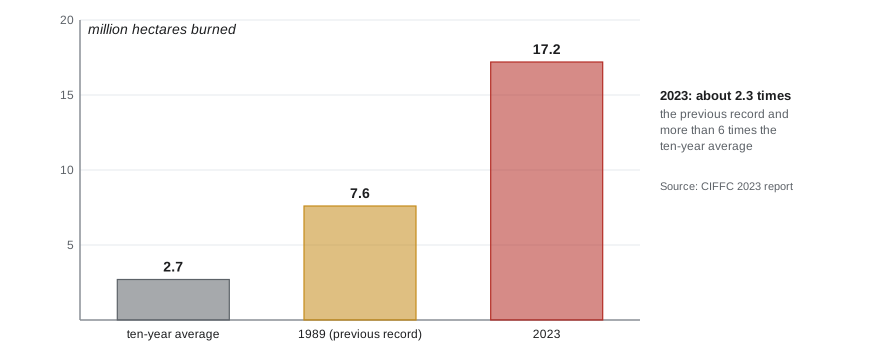
Lesson 10 described fire as a natural part of boreal and many western ecosystems. Warming is changing fire regimes by lengthening fire seasons, drying fuels and increasing lightning in some regions. The 2023 fire season in Canada was the most extreme on record. According to the Canadian Interagency Forest Fire Center's final report, 7,131 fires burned about 17.2 million hectares, more than twice the previous record of about 7.6 million hectares set in 1989 and roughly six times the ten-year average of about 2.7 million hectares. Smoke spread across much of North America, and hundreds of thousands of people were evacuated, including the entire city of Yellowknife.
In the United States, wildfire is managed by federal, state, tribal and local agencies coordinated through the National Interagency Fire Center in Boise, Idaho, with the US Forest Service managing most federal forest land. Western states have seen larger and more severe fires since the 1980s, linked to warming, drought, fuel accumulation after decades of suppression and expanding development in fire-prone areas. Tribal nations are increasingly leading cultural burning programs in partnership with agencies.
More frequent fire can change the course of succession. If boreal stands burn again before young trees are old enough to produce seed, black spruce may fail to regenerate and be replaced by aspen, jack pine or shrubland. Studies in Alaska and the Northwest Territories have documented such shifts after repeated burns. Because aspen and other broadleaf trees burn less readily than spruce, this could eventually slow fire spread, an example of how ecosystem changes can feed back on disturbance regimes.
Invasive species
An invasive species is a non-native species that spreads widely and causes ecological or economic harm. Invasion proceeds through stages: transport to a new region, introduction and establishment of a population, and spread. Most introduced species fail to establish, and most of those that establish do not become invasive, but the few that do can transform ecosystems. Lesson 4's exponential growth, lesson 6's dispersal kernels and lesson 8's consumer–resource interactions all help explain invasions.
The emerald ash borer, a beetle from northeastern Asia, was identified near Detroit and Windsor in 2002, probably having arrived in wooden packing material. Its larvae tunnel under ash bark and kill nearly all ash trees they attack. It has since spread through much of eastern North America, killing hundreds of millions of ash trees and costing municipalities billions of dollars to remove and replace street trees. Black ash, used by many Indigenous peoples for basketry, is especially affected. Spread has been greatly accelerated by people moving firewood, which carries larvae far beyond the beetle's own flight range, a vivid example of long-distance dispersal.
In the United States, the Department of Agriculture's Animal and Plant Health Inspection Service led a federal quarantine on ash materials for years before ending it in 2021 to focus on biological control, releasing parasitoid wasps from the beetle's native range; states still regulate firewood movement. Cities have injected high-value trees with insecticide and planted replacements.
Zebra mussels and quagga mussels, small freshwater bivalves from the Black and Caspian Sea region, arrived in ballast water from ships and were discovered in Lake St. Clair in 1988. They spread through the Great Lakes and the Mississippi River system within a few years. Filtering huge volumes of water, they have made lakes clearer, shifting production from open water to the bottom, starving native mussels and plankton-feeding fish, and contributing to blooms of bottom algae and the toxic cyanobacteria discussed in lesson 11. They clog water intakes and cost industries and utilities large sums. Ballast water regulations now require ships to exchange or treat ballast before entering the Great Lakes, and boat inspection stations in western Canada and the western United States aim to keep the mussels out of uninfested lakes.
Fragmentation and land use
Lesson 6 showed how fragmentation shrinks and isolates populations. Land conversion for agriculture, cities, roads and resource extraction is still the largest single cause of biodiversity loss globally. In North America, the tallgrass prairie has been reduced to a few percent of its original extent, and the boreal caribou's habitat is fragmented by roads, seismic lines and cutblocks that let wolves travel and hunt more efficiently, while young forests in cutblocks support moose and deer that sustain more wolves, an example of apparent competition (lesson 7). Restoring linear disturbances such as seismic lines is now a major focus of caribou recovery.
Indigenous knowledge and two-eyed seeing in practice
Lesson 1 introduced two-eyed seeing (Etuaptmumk). In practice, this means Indigenous knowledge holders and scientists working together from the start: setting research questions, gathering observations and interpreting results. Indigenous Guardians programs across Canada and tribal natural resource departments in the United States monitor wildlife, water and land, often combining traditional observation with modern tools such as cameras and GPS collars. Cultural burning, practiced for millennia to renew berry patches, maintain meadows and reduce fuel, is being revived, and fire scientists now recognize it as an important part of managing fire-adapted ecosystems. Co-management boards in the North bring Inuit, Dene and other Indigenous representatives together with government biologists to set harvests of caribou and other wildlife. These partnerships recognize Indigenous rights as well as the value of long-term, place-based knowledge, and they work best when communities control how their knowledge is used.
Capstone analysis: an invented regional dataset
The final exercise brings the course together with an invented dataset for an imaginary region of mixed boreal forest. It contains 30 years of first-flowering dates of a spring wildflower, annual area burned, and the radius of an expanding invasive insect population. The tasks are to estimate trends, check whether they are statistically meaningful, and interpret them with the concepts of the course.
import numpy as np
from scipy import stats

rng = np.random.default_rng(208)
years = np.arange(1995, 2025)
n = years.size

# 1. Phenology: first flowering day of year (invented), advancing about 0.3 days per year
flower = 140 - 0.3 * (years - 1995) + rng.normal(0, 4, n)
ph = stats.linregress(years, flower)
print(f"flowering trend: {ph.slope:.2f} days per year (p = {ph.pvalue:.4f}), "
      f"about {ph.slope * 30:.0f} days over 30 years")

# 2. Fire: area burned (thousand ha), lognormal with rising mean (invented)
burned = np.exp(3.0 + 0.04 * (years - 1995) + rng.normal(0, 0.8, n))
fr = stats.linregress(years, np.log(burned))
print(f"area burned grows about {100 * (np.exp(fr.slope) - 1):.1f}% per year on average (p = {fr.pvalue:.4f}); "
      f"largest year {years[burned.argmax()]} with {burned.max():.0f} thousand ha")

# 3. Invasion: area occupied (km2) -> equivalent radius; spread rate is the slope of radius on time
area = np.pi * (2 + 4.5 * (years - 1995)) ** 2 * rng.normal(1, 0.05, n)
radius = np.sqrt(area / np.pi)
inv = stats.linregress(years, radius)
print(f"invasion front advances about {inv.slope:.1f} km per year (r^2 = {inv.rvalue**2:.3f})")flowering trend: -0.20 days per year (p = 0.0585), about -6 days over 30 years area burned grows about 5.7% per year on average (p = 0.0019); largest year 2023 with 381 thousand ha invasion front advances about 4.6 km per year (r^2 = 0.998)
Interpreting the results draws on the whole course. Flowering has advanced by about six days over 30 years, consistent with warming springs (lessons 2 and 3), but with a p-value of about 0.06 the trend falls just short of conventional statistical significance: year-to-year variation is large relative to the change. Before concluding anything, an ecologist would add more years, more sites or a temperature covariate, and only then ask whether the wildflower's pollinators have kept pace or a mismatch is developing (lesson 9). Area burned has grown by about 6 percent a year on average, and here the trend is clear statistically, but fire years are extremely variable, so the estimated rate is uncertain; longer records from fire scars and lake sediments would help (lesson 10). The invasion front advances at a nearly constant speed, the pattern predicted when a population grows and disperses at constant rates; a constant radial speed means the occupied area grows with the square of time. Faster, irregular jumps would point to long-distance dispersal by people moving infested material (lesson 6). Each conclusion is provisional and testable, which is how ecology works.
Worked problem
Is the fire record unusual?
Using the CIFFC figures, by what factors did area burned in 2023 exceed the 1989 record and the ten-year average?
Show solution
- 2023: about 17.2 million hectares. 1989: about 7.6 million hectares. Ten-year average: about 2.7 million hectares.
- Ratio to 1989: 17.2 / 7.6 ≈ 2.3.
- Ratio to the ten-year average: 17.2 / 2.7 ≈ 6.4.
Answer: The 2023 season burned about 2.3 times the previous record and more than six times the ten-year average. One extreme year does not prove a trend by itself, but it fits the projected increase in fire activity with warming.
Where to go next
This course has covered the principles of ecology at every level from individual to biosphere. Students who want to go further can take BIOL-430 for field methods and experimental design, BIOL-440 for boreal and northern ecology, BIOL-460 for aquatic ecology, BIOL-367 for conservation biology and population viability analysis, and BIOL-322 for population genetics, which links ecology to evolution. Ecology is an empirical science that depends on long-term observation, careful experiments and honest models, and it is more urgently needed now than at any time in its history.
Common mistakes
MistakeAll species will simply move north as the climate warms.
InsteadMany species cannot disperse fast enough, are blocked by fragmented landscapes, or depend on partners that respond differently.
MistakeArctic greening means the Arctic will store more carbon.
InsteadShrub growth adds some carbon, but warming soils and thawing permafrost can release far more.
MistakeA single record fire season proves a trend.
InsteadTrends need long records; one year is consistent with, but does not prove, a change.
MistakeMost introduced species become invasive.
InsteadMost introductions fail or stay harmless; a small fraction become invasive and cause major harm.
MistakeIndigenous knowledge is just a source of data for scientists.
InsteadTwo-eyed seeing treats Indigenous knowledge as a knowledge system in its own right, with communities controlling its use.
Summary and key terms
- Warming is fastest in the North; climate change shifts phenology, ranges and biome boundaries.
- Phenological mismatch can occur when partners use different cues, such as temperature and day length.
- The velocity of climate change is the warming rate divided by the spatial temperature gradient; it is fastest on flat terrain.
- Arctic greening and permafrost thaw can feed back on climate by releasing stored carbon.
- The 2023 Canadian fire season burned about 17.2 million hectares, about 2.3 times the previous record; repeated fire can shift succession.
- Invasive species such as the emerald ash borer and zebra mussels spread fastest with human help and transform ecosystems.
- Two-eyed seeing brings Indigenous knowledge and science together in guardians programs, cultural burning and co-management.
- Arctic amplification
- Faster warming in the Arctic than in the rest of the world.
- phenology
- The timing of seasonal biological events.
- phenological mismatch
- A loss of synchrony between interacting species as their seasonal timing shifts differently.
- velocity of climate change
- The speed at which a given temperature moves across the landscape.
- assisted migration
- Moving species or populations to areas expected to suit them under future climate.
- thermokarst
- Ground collapse caused by thawing of ice-rich permafrost.
- invasive species
- A non-native species that spreads widely and causes harm.
- ballast water
- Water carried in ships for stability, a major pathway for aquatic invasions.
- cultural burning
- Deliberate, low-intensity burning by Indigenous peoples to manage land.
- co-management
- Shared management of resources by governments and Indigenous or local communities.
Practice problems
Work each problem on paper first, then reveal the answer to check.
Why might a migratory songbird suffer from earlier springs?
Show answer
If it times migration by day length, it may arrive after the peak of insect food, a phenological mismatch.
Warming is 0.04 °C per year and the temperature gradient is 0.01 °C per km. What is the velocity of climate change?
Show answer
4 km per year.
Why does climate move more slowly up a mountain than across a plain?
Show answer
The temperature gradient is much steeper with elevation, so a short distance covers a large temperature change.
Describe one positive feedback between Arctic shrubs and permafrost.
Show answer
Shrubs trap snow, which insulates and warms the soil, thawing permafrost and releasing carbon.
By how much did 2023 area burned in Canada exceed the ten-year average?
Show answer
About six times (17.2 vs about 2.7 million hectares).
How can repeated fires change boreal succession?
Show answer
Stands burning before spruce produce seed can shift to aspen, jack pine or shrubland.
Why has the emerald ash borer spread faster than it can fly?
Show answer
People move infested firewood and wood products, giving long-distance dispersal.
Give two ecological effects of zebra mussels.
Show answer
Clearer water with production shifted to the bottom; decline of native mussels and plankton feeders (also cyanobacteria blooms).
Why do roads and seismic lines harm boreal caribou?
Show answer
They let wolves travel and hunt efficiently, and young forests support moose and deer that sustain more wolves.
What makes two-eyed seeing different from simply collecting traditional knowledge?
Show answer
It is a partnership from the start, respecting Indigenous knowledge as a system with community control.
Lesson quiz · 5 questions
Score 60% or more to complete this lesson.
Create a free account to save your progress, take quizzes and earn a certificate.