
BIOL-201 · Lesson 9 of 12 · 24 min
Chromosomal mutations: changes in structure and number
Mutations come in all sizes. Lesson 10 deals with changes to single genes, often a single base. This lesson deals with changes large enough to see under a microscope: whole chromosomes gained or lost, and segments deleted, duplicated, inverted or moved to another chromosome. Such changes are a major cause of miscarriage, birth differences and intellectual disability in humans, a driving force in cancer, and, over evolutionary time, a source of new genes and new species. They also produce characteristic genetic behavior, such as unexpected ratios and reduced fertility, that geneticists use to detect them.
Changes in chromosome number
Changes in number are of two kinds. Euploidy refers to changes in the number of whole chromosome sets: a diploid becomes triploid (3n), tetraploid (4n) or more generally polyploid. Aneuploidy refers to the gain or loss of individual chromosomes, so that the cell has one or a few chromosomes too many or too few.
| Term | Chromosome complement | Human notation example |
|---|---|---|
| Monosomy | One chromosome of a pair missing (2n − 1) | 45,X (Turner syndrome) |
| Trisomy | One extra chromosome (2n + 1) | 47,XX,+21 (Down syndrome) |
| Nullisomy | Both members of a pair missing (2n − 2) | Not viable in humans |
| Triploidy | Three complete sets (3n) | 69,XXY; almost always lethal before birth |
| Tetraploidy | Four complete sets (4n) | 92,XXXX; lethal in humans, common in plants |
Nondisjunction
Most aneuploidy arises from nondisjunction, the failure of chromosomes to separate properly during meiosis. If homologues fail to separate in meiosis I, all four products are abnormal: two carry both homologues (n + 1) and two carry neither (n − 1). If sister chromatids fail to separate in meiosis II, only the two products of that division are abnormal; the other two are normal. When an n + 1 gamete is fertilized by a normal gamete, the zygote is trisomic; an n − 1 gamete gives a monosomic zygote.
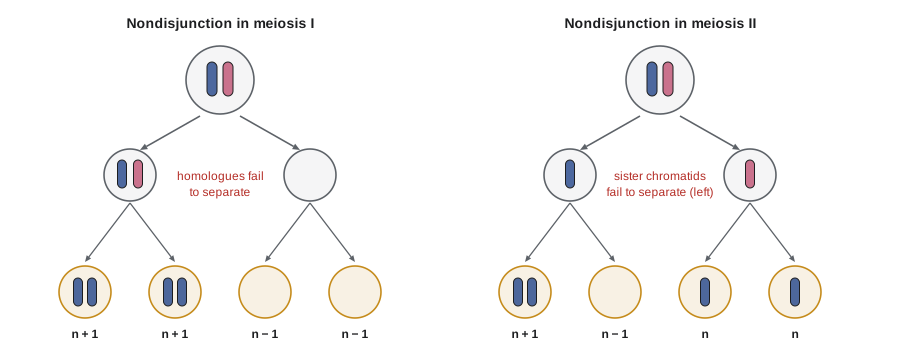
In humans, about 10 to 25 percent of fertilized eggs may be aneuploid, the large majority because of errors in the egg, and most of these pregnancies end in miscarriage, often before the pregnancy is recognized. Only a few aneuploidies are compatible with live birth: trisomies of the small, gene-poor chromosomes 13, 18 and 21, and changes in sex chromosome number. Monosomy of any autosome is lethal early in development, showing how sensitive development is to the dosage of many genes at once.
| Condition | Karyotype | Approximate frequency at birth | Main features |
|---|---|---|---|
| Down syndrome | Trisomy 21 | About 1 in 700 to 800 (varies with maternal age and screening practices) | Intellectual disability of varying degree, characteristic facial features, heart defects in about half; life expectancy now about 60 years in high-income countries |
| Edwards syndrome | Trisomy 18 | About 1 in 5,000 | Severe developmental problems; most affected infants die within the first year |
| Patau syndrome | Trisomy 13 | About 1 in 10,000 to 16,000 | Severe malformations; most affected infants die within the first year |
| Turner syndrome | 45,X | About 1 in 2,500 girls | Short stature, ovarian insufficiency; typical intelligence |
| Klinefelter syndrome | 47,XXY | About 1 in 600 boys | Tall stature, small testes, reduced fertility; often undiagnosed |
| Triple X | 47,XXX | About 1 in 1,000 girls | Often no obvious features; may be taller than average |
| XYY | 47,XYY | About 1 in 1,000 boys | Often no obvious features; may be taller than average |
Sex chromosome aneuploidies are much milder than autosomal ones because of X inactivation (lesson 7): all X chromosomes beyond the first are inactivated, and the Y carries few genes. Many people with an extra X or Y never learn of it. The mildness of Turner syndrome is more surprising, and reflects the fact that a few genes escape X inactivation, so a single X is not quite enough.
Maternal age and Down syndrome
The risk of trisomy 21 rises steeply with maternal age, from roughly 1 in 1,500 at age 20 to about 1 in 350 at 35 and about 1 in 30 at 45. About 90 percent of cases arise from nondisjunction in the egg, most often in meiosis I. The likely cause is the long pause in prophase I described in lesson 6: the protein complexes (cohesins) that hold homologues and sister chromatids together are laid down before birth and are not replaced, and they gradually deteriorate. Paternal age has a much smaller effect on aneuploidy, though it matters more for new point mutations (lesson 10).
About 3 to 4 percent of Down syndrome cases are caused not by nondisjunction but by a Robertsonian translocation, in which the long arm of chromosome 21 is fused to another acrocentric chromosome, usually 14. A person carrying a balanced translocation has 45 chromosomes but a normal amount of genetic material and is healthy, yet has a substantial chance of producing gametes with an extra copy of the 21q arm. Unlike most cases, translocation Down syndrome can recur in a family regardless of the mother's age, which is why a karyotype is recommended for every child diagnosed.
from itertools import combinations
# Gametes from a balanced Robertsonian carrier of a 14;21 fusion.
# The carrier has: normal 14, normal 21, and the fused chromosome t(14;21).
chroms = {"14": {"14": 1}, "21": {"21": 1}, "t(14;21)": {"14": 1, "21": 1}}
# Segregation sends one or two of the three chromosomes to each gamete (simplified: all
# six ways of splitting the trivalent into two poles treated as equally likely).
outcomes = []
items = list(chroms)
for k in (1, 2):
    for gam in combinations(items, k):
        dose = {"14": 0, "21": 0}
        for c in gam:
            for arm, n in chroms[c].items():
                dose[arm] += n
        partner = {"14": 1, "21": 1}          # normal gamete from the other parent
        zyg = {a: dose[a] + partner[a] for a in dose}
        if zyg == {"14": 2, "21": 2}:
            result = "balanced carrier" if "t(14;21)" in gam else "normal"
        elif zyg["21"] == 3: result = "translocation trisomy 21"
        elif zyg["21"] == 1: result = "monosomy 21 (lethal)"
        elif zyg["14"] == 3: result = "trisomy 14 (lethal)"
        else: result = "monosomy 14 (lethal)"
        outcomes.append((" + ".join(gam), result))
for gam, res in outcomes:
print(f"gamete {gam:16s} -> zygote: {res}")gamete 14 -> zygote: monosomy 21 (lethal) gamete 21 -> zygote: monosomy 14 (lethal) gamete t(14;21) -> zygote: balanced carrier gamete 14 + 21 -> zygote: normal gamete 14 + t(14;21) -> zygote: trisomy 14 (lethal) gamete 21 + t(14;21) -> zygote: translocation trisomy 21
In reality the segregations are not equally likely: the alternate pattern that gives normal and balanced gametes is favored, and many unbalanced embryos are lost early. Observed risks of a liveborn child with Down syndrome are about 10 to 15 percent when the mother carries the translocation and about 1 percent when the father does.
Prenatal screening and diagnosis
Screening tests estimate the chance that a pregnancy has a chromosome change; diagnostic tests give a definite answer. Non-invasive prenatal testing (NIPT), introduced around 2011, sequences fragments of DNA from the placenta circulating in the pregnant person's blood and detects trisomy 21 with very high sensitivity, but a positive result must be confirmed by a diagnostic test such as chorionic villus sampling or amniocentesis, which carry a small risk of miscarriage.
In the United States, the American College of Obstetricians and Gynecologists recommends that all pregnant patients be offered both screening and diagnostic testing for chromosome conditions, regardless of age. Coverage of NIPT depends on the patient's insurance and state Medicaid rules, and many insurers now cover it for all pregnancies. The choice to test or not rests with the patient.
Screening raises ethical questions that genetics students should take seriously, including how information about conditions such as Down syndrome is presented, and the concern of many disability advocates that screening programs can imply that some lives are less valuable. Good practice emphasizes informed, voluntary choice and accurate, balanced information about what life with the condition can be like.
Polyploidy
Polyploidy is rare in animals but very common in plants: many crops are polyploid, including wheat (bread wheat is hexaploid, 6n = 42, combining three ancestral genomes), potato (tetraploid), strawberry (octoploid) and canola (an allotetraploid formed from two Brassica species). Polyploids often have larger cells and organs, which breeders value. Autopolyploids have extra sets from the same species; allopolyploids combine sets from two different species, as in canola and wheat. As BIOL-108 explained, polyploidy can create a new species in a single generation.
Triploids are usually sterile, because three homologues cannot pair and separate evenly in meiosis, so most gametes are unbalanced. Breeders exploit this: seedless watermelons are triploids made by crossing a tetraploid with a diploid, and commercial bananas are sterile triploids propagated from cuttings. Autotetraploids, with four copies of each chromosome, produce unusual segregation ratios. A tetraploid of genotype AAaa, if chromosomes pair at random, makes gametes AA, Aa and aa in the ratio 1 : 4 : 1, so selfing gives only 1/36 aaaa offspring instead of the 1/4 of a diploid cross.
from itertools import combinations, product
from collections import Counter
from fractions import Fraction

def tetraploid_gametes(genotype):
    """Each diploid gamete gets 2 of the 4 chromosomes, chosen at random (chromosome segregation)."""
    return Counter("".join(sorted(pair)) for pair in combinations(genotype, 2))

g = tetraploid_gametes("AAaa")
total = sum(g.values())
print("gametes of AAaa:", {k: f"{v}/{total}" for k, v in g.items()})
self_cross = Counter()
for (g1, n1), (g2, n2) in product(g.items(), g.items()):
    self_cross["".join(sorted(g1 + g2))] += n1 * n2
denom = total * total
for geno in sorted(self_cross, key=lambda s: -s.count("A")):
    print(f"  {geno}: {Fraction(self_cross[geno], denom)}")
rec = Fraction(self_cross["aaaa"], denom)
print(f"recessive phenotype in AAaa self: {rec}; dominant : recessive = {1 - rec} : {rec}")gametes of AAaa: {'AA': '1/6', 'Aa': '4/6', 'aa': '1/6'}
AAAA: 1/36
AAAa: 2/9
AAaa: 1/2
Aaaa: 2/9
aaaa: 1/36
recessive phenotype in AAaa self: 1/36; dominant : recessive = 35/36 : 1/36Changes in chromosome structure
Structural changes arise when chromosomes break and the broken ends rejoin incorrectly, or when crossing over occurs between similar repeated sequences in the wrong places. There are four main types.
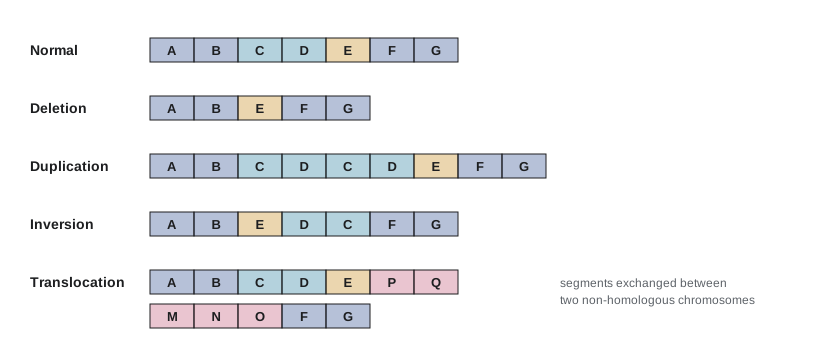
| Rearrangement | What happens | Typical consequence | Example |
|---|---|---|---|
| Deletion | A segment is lost | Loss of genes; often harmful, especially if large | Cri-du-chat syndrome, del(5p); 22q11.2 deletion syndrome |
| Duplication | A segment is repeated | Extra gene dosage; raw material for new genes in evolution | Charcot–Marie–Tooth disease type 1A (PMP22 duplication) |
| Inversion | A segment is flipped end to end | Usually no effect on carrier; reduced fertility from unbalanced gametes | Inversions in Drosophila populations; a common inversion on human chromosome 9 |
| Reciprocal translocation | Segments are exchanged between non-homologous chromosomes | Balanced carriers healthy but may have unbalanced offspring; can activate cancer genes | Philadelphia chromosome t(9;22) in chronic myeloid leukemia |
| Robertsonian translocation | Two acrocentric chromosomes fuse at their centromeres | Balanced carrier has 45 chromosomes; risk of unbalanced offspring | Translocation Down syndrome |
Inversions have a striking genetic effect: they suppress recombination. In an inversion heterozygote, homologues can pair only by forming a loop. A crossover within the loop produces chromatids that are missing some genes and duplicating others, and the resulting gametes usually fail. As a result, alleles inside an inversion are inherited as a block. Geneticists exploit this by using balancer chromosomes, which carry multiple inversions and a visible marker, to keep mutant alleles together in Drosophila stocks. In nature, inversions can keep together combinations of alleles that work well together, and they are often involved in local adaptation.
Translocations can cause cancer by placing a gene under the control of the wrong regulatory sequences or by fusing two genes. In chronic myeloid leukemia, the Philadelphia chromosome, discovered in 1960 by Peter Nowell and David Hungerford in Philadelphia, results from a translocation between chromosomes 9 and 22 that fuses the BCR and ABL1 genes, producing an overactive enzyme that drives cell division. The drug imatinib, approved in 2001, blocks that enzyme and transformed the disease from a usually fatal one to a manageable chronic condition, one of the first triumphs of targeted cancer therapy. BIOL-450 explores cancer genetics further.
Common mistakes
MistakeNondisjunction in meiosis II makes all four gametes abnormal.
InsteadOnly the two products of the affected division are abnormal; nondisjunction in meiosis I affects all four.
MistakeMost Down syndrome is inherited from a parent with Down syndrome.
InsteadMost cases arise from new nondisjunction in the egg; only a few percent involve an inherited translocation.
MistakePolyploidy is always harmful.
InsteadPolyploidy is lethal in humans but common and useful in plants such as wheat, potato and canola.
MistakeA balanced translocation carrier is missing genetic material.
InsteadA balanced carrier has a normal amount of DNA and is usually healthy; problems arise in their gametes.
MistakeNIPT is a diagnostic test.
InsteadNIPT is a highly sensitive screening test; positive results must be confirmed by diagnostic testing.
Summary and key terms
- Euploid changes involve whole chromosome sets; aneuploidy is the gain or loss of individual chromosomes.
- Nondisjunction in meiosis I affects all four products; in meiosis II only two.
- Only trisomies 13, 18 and 21 and sex chromosome aneuploidies are seen regularly at birth; sex chromosome changes are milder because of X inactivation.
- Down syndrome risk rises with maternal age; a few percent of cases involve a Robertsonian translocation that can recur in families.
- Polyploidy is common in plants; triploids are usually sterile and autotetraploids give unusual ratios such as 35 : 1.
- Deletions, duplications, inversions and translocations change chromosome structure; inversions suppress recombination.
- Translocations such as the Philadelphia chromosome can drive cancer and be targeted by drugs such as imatinib.
- aneuploidy
- Having one or a few chromosomes more or fewer than normal.
- euploidy
- Having complete chromosome sets, whether diploid or polyploid.
- nondisjunction
- Failure of homologues or sister chromatids to separate during cell division.
- trisomy
- Having three copies of a chromosome instead of two.
- monosomy
- Having one copy of a chromosome instead of two.
- polyploidy
- Having more than two complete sets of chromosomes.
- allopolyploid
- A polyploid combining chromosome sets from two different species.
- inversion
- A chromosome segment reversed in orientation.
- reciprocal translocation
- An exchange of segments between two non-homologous chromosomes.
- Robertsonian translocation
- Fusion of two acrocentric chromosomes at or near their centromeres.
Practice problems
Work each problem on paper first, then reveal the answer to check.
A person has 47 chromosomes including three copies of chromosome 13. Write the karyotype for a male.
Show answer
47,XY,+13.
Nondisjunction of the sex chromosomes in meiosis I in a father produces which sperm types?
Show answer
Sperm carrying both X and Y, and sperm carrying no sex chromosome.
Which zygote results when an XY sperm fertilizes a normal egg?
Show answer
47,XXY (Klinefelter syndrome).
Why are monosomies of autosomes not seen at birth?
Show answer
Losing one copy of many genes at once disrupts development and is lethal early.
Why should every child with Down syndrome have a karyotype?
Show answer
To detect translocation cases, which carry a recurrence risk for the family.
Why are triploid plants usually sterile?
Show answer
Three homologues cannot pair and divide evenly, so most gametes are unbalanced.
What fraction of offspring from selfing a duplex autotetraploid (AAaa) shows the recessive phenotype?
Show answer
1/36.
How does an inversion suppress recombination?
Show answer
Crossovers within the inversion loop produce unbalanced chromatids whose gametes usually fail, so recombinants are not recovered.
What genes are fused by the Philadelphia chromosome?
Show answer
BCR on chromosome 22 and ABL1 on chromosome 9.
Distinguish screening from diagnostic prenatal tests.
Show answer
Screening estimates the chance of a condition; diagnostic tests (CVS, amniocentesis) give a definite answer.
Lesson quiz · 5 questions
Score 60% or more to complete this lesson.
Create a free account to save your progress, take quizzes and earn a certificate.