
BIOL-201 · Lesson 4 of 12 · 28 min
Extensions of Mendel: dominance, multiple alleles, lethal alleles and penetrance
Mendel's seven pea traits were unusually tidy: each was controlled by one gene with two alleles, one completely dominant, and the phenotypes were easy to classify. Most genes are messier. Heterozygotes may be intermediate or show both parental phenotypes; a gene may have dozens of alleles; some allele combinations kill the organism; and individuals with the same genotype may show a trait to different degrees, or not at all. None of these complications overturns Mendel's laws. Alleles still segregate and unlinked genes still assort independently. What changes is the relationship between genotype and phenotype, and therefore the ratios we observe.
Why dominance happens
Dominance is a property of the relationship between alleles at one gene, not of the alleles themselves, and it is easiest to understand at the level of the protein each allele encodes. Many recessive alleles are loss-of-function alleles: they produce a protein that does not work, or no protein at all. If one working copy produces enough protein for a normal phenotype, the heterozygote looks normal and the loss-of-function allele is recessive. This is the case for most enzymes, because cells usually make more enzyme than they need; a gene for which one copy is enough is called haplosufficient.
When one copy is not enough, a loss-of-function allele can be dominant; such genes are haploinsufficient. Other dominant alleles gain a new or excessive activity, or produce a faulty protein that interferes with the normal one. These dominant-negative alleles are common in proteins that work as parts of larger assemblies, such as collagen: a single defective chain can spoil a whole triple helix, which is why some forms of osteogenesis imperfecta (brittle bone disease) are dominant.
| Type of allele | Effect on protein | Usual dominance | Example |
|---|---|---|---|
| Loss of function, haplosufficient gene | No or reduced activity; one normal copy enough | Recessive | Phenylketonuria (PAH enzyme) |
| Loss of function, haploinsufficient gene | Half the normal amount is not enough | Dominant | Some forms of familial hypercholesterolemia |
| Dominant negative | Faulty protein disrupts the normal one | Dominant | Collagen mutations in osteogenesis imperfecta |
| Gain of function | New or excessive activity | Dominant | Achondroplasia (an overactive FGFR3 receptor) |
Incomplete dominance
In incomplete dominance the heterozygote has a phenotype intermediate between the two homozygotes. The classic example is flower color in snapdragons and four-o'clocks: crossing red-flowered (C^R C^R) with white-flowered (C^W C^W) plants gives pink F1 plants. In the F2 the red, pink and white phenotypes appear in a 1 : 2 : 1 ratio, the same as the genotypic ratio, because every genotype has its own phenotype. Pink is not blending: the red and white alleles reappear unchanged in the F2. The pink color arises because one copy of the functional allele makes about half the red pigment of two copies.
In humans, familial hypercholesterolemia behaves in a similar way. Heterozygotes, about 1 person in 250 in many populations, have blood cholesterol roughly twice normal and an increased risk of early heart disease; homozygotes, who are rare, have cholesterol four or more times normal and may have heart attacks in childhood without treatment.
Codominance and the ABO blood groups
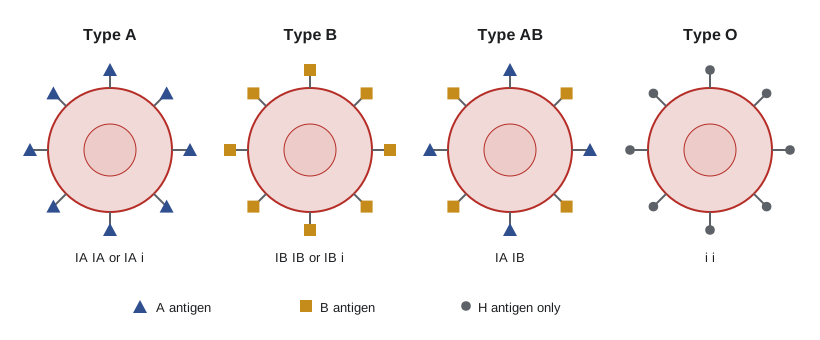
In codominance the heterozygote shows the phenotypes of both alleles at once, rather than an intermediate. The human ABO blood group gene provides the best-known example and also illustrates multiple alleles. The gene encodes an enzyme that adds a sugar to a molecule on the surface of red blood cells. The I^A allele adds N-acetylgalactosamine, producing the A antigen; the I^B allele adds galactose, producing the B antigen; the i allele encodes an inactive enzyme and adds nothing, leaving the unmodified H antigen (type O).
| Genotype | Antigens on red cells | Blood type | Antibodies in plasma |
|---|---|---|---|
| I^A I^A or I^A i | A | A | Anti-B |
| I^B I^B or I^B i | B | B | Anti-A |
| I^A I^B | A and B | AB | Neither |
| i i | Neither (H only) | O | Anti-A and anti-B |
I^A and I^B are codominant with each other, because an I^A I^B person makes both antigens, and both are completely dominant to i. One gene with three alleles thus gives six genotypes and four phenotypes. With k alleles, the number of possible genotypes is k(k + 1)/2: k homozygotes plus k(k − 1)/2 heterozygotes.
Worked problem
A paternity-style question
A mother is type A and her child is type O. Which blood types are impossible for the biological father?
Show solution
- A type O child is ii and received i from each parent.
- The mother is therefore I^A i.
- The father must carry i: he can be I^A i (A), I^B i (B) or ii (O).
- An AB father (I^A I^B) carries no i and cannot have an O child.
Answer: Type AB is impossible. Blood groups can exclude a man as the father but can never prove he is the father; modern parentage testing uses DNA markers.
Whether a relationship looks dominant, incompletely dominant or codominant can depend on the level at which we look. Sickle-cell disease is a good illustration. At the level of the whole person, the sickle allele (HbS) is recessive: heterozygotes, said to have sickle-cell trait, are usually healthy. At the level of red blood cells under low oxygen, a small fraction of heterozygote cells sickle, so the allele is incompletely dominant. At the level of the hemoglobin protein, heterozygotes make both normal and sickle hemoglobin, so the alleles are codominant. Dominance is a description of a phenotype, and phenotypes can be measured at many levels.
Multiple alleles and allelic series
A population can carry many alleles of a gene even though each diploid individual carries at most two. The human leukocyte antigen (HLA) genes, which help the immune system recognize foreign cells, are the most variable genes known; thousands of alleles have been cataloged at some HLA loci, which is why finding a well-matched unrelated bone marrow donor can be so difficult and why registries such as Canadian Blood Services' Stem Cell Registry and the US National Marrow Donor Program list millions of potential donors.
Alleles can also form a dominance series. In rabbits, the C gene, which controls pigment production, has four common alleles: full color (C), chinchilla (c^ch), Himalayan (c^h) and albino (c), with the dominance order C > c^ch > c^h > c. The Himalayan allele encodes a temperature-sensitive enzyme that works only in the cooler extremities, giving dark ears, nose, feet and tail, the same pattern seen in Siamese cats. This is a striking example of the environment shaping the phenotype a genotype produces.
Lethal alleles
Some alleles are so damaging that individuals homozygous for them die, often before birth. Lethal alleles change the ratios of surviving offspring in characteristic ways. The first lethal allele was found in mice in 1905 by Lucien Cuénot. Yellow mice crossed with each other always produced yellow and non-yellow (agouti) offspring in a ratio of 2 : 1, never true-breeding yellow mice. The explanation is that the yellow allele A^Y is dominant for coat color but recessive for lethality: A^Y A^Y embryos die early in development.
Worked problem
A 2 : 1 ratio from a lethal allele
Two yellow mice (A^Y A) are crossed and produce 48 surviving pups. How many yellow and how many agouti pups do you expect?
Show solution
- Expected genotypes at conception: 1/4 A^Y A^Y, 1/2 A^Y A, 1/4 AA.
- A^Y A^Y embryos die, leaving A^Y A and AA in the ratio 2 : 1 among survivors.
- Yellow (A^Y A): 2/3 × 48 = 32; agouti (AA): 1/3 × 48 = 16.
- Litters are also about one-quarter smaller than litters from agouti × agouti crosses.
Answer: About 32 yellow and 16 agouti; the 2 : 1 ratio and smaller litters are the signature of a recessive lethal.
The same pattern appears in Manx cats, where the tailless allele is lethal when homozygous, and in many crop and livestock breeding programs. In humans, homozygosity for the achondroplasia allele is usually lethal in infancy, so a couple who both have achondroplasia face a 1/4 risk of a lethal homozygous pregnancy, a 1/2 chance of a child with achondroplasia and a 1/4 chance of a child of average stature. Lethal alleles that act late in life, such as the Huntington disease allele, do not distort ratios at birth because they act after reproduction may already have occurred.
Penetrance and expressivity
Even a clear single-gene trait may not appear in everyone who has the relevant genotype. Penetrance is the percentage of individuals with a given genotype who show the expected phenotype at all. Expressivity is the degree to which the phenotype is expressed in those who show it. A dominant allele with 80 percent penetrance produces the trait in 80 percent of carriers; the other 20 percent are said to be non-penetrant, and they can still pass the allele on, which can make a dominant trait appear to skip a generation.
| Concept | Question it answers | Example |
|---|---|---|
| Penetrance | Does the genotype produce the phenotype at all? | BRCA1 pathogenic variants: lifetime breast cancer risk roughly 55–72 percent, so penetrance is incomplete |
| Variable expressivity | How strongly is the phenotype expressed? | Neurofibromatosis type 1: from a few skin spots to many tumors, even within one family |
| Age-dependent penetrance | When does the phenotype appear? | Huntington disease: penetrance rises with age, with most carriers affected by their 60s |
Incomplete penetrance and variable expressivity arise because genes do not act alone. Other genes (modifier genes), the environment and chance events during development all influence the outcome. For genetic counseling, penetrance changes risk calculations: the chance that a child of a carrier of a dominant allele with penetrance P will be affected is 1/2 × P.
from fractions import Fraction

def risk_affected_child(penetrance):
    """Child of a heterozygote for a dominant allele with given penetrance."""
    return Fraction(1, 2) * penetrance

def carrier_given_unaffected(penetrance):
    """Bayes: a child of a heterozygous parent who is unaffected (fully adult).
    prior carrier 1/2; P(unaffected | carrier) = 1 - penetrance."""
    prior = Fraction(1, 2)
    joint_carrier = prior * (1 - penetrance)
    joint_non = (1 - prior) * 1
    return joint_carrier / (joint_carrier + joint_non)

for pen in (Fraction(1), Fraction(9, 10), Fraction(7, 10), Fraction(1, 2)):
    print(f"penetrance {float(pen):.0%}: child affected {float(risk_affected_child(pen)):.3f}; "
f"unaffected adult child is still a carrier with P = {float(carrier_given_unaffected(pen)):.3f}")penetrance 100%: child affected 0.500; unaffected adult child is still a carrier with P = 0.000 penetrance 90%: child affected 0.450; unaffected adult child is still a carrier with P = 0.091 penetrance 70%: child affected 0.350; unaffected adult child is still a carrier with P = 0.231 penetrance 50%: child affected 0.250; unaffected adult child is still a carrier with P = 0.333
The second column shows a useful consequence. With full penetrance, an unaffected adult child of an affected parent cannot carry the allele. With 70 percent penetrance, that person still has about a 13 percent chance of carrying it and passing it on.
Pleiotropy and the environment
A single gene often affects several apparently unrelated traits, a phenomenon called pleiotropy. The sickle allele, for example, causes anemia, pain crises, organ damage and increased susceptibility to infection, all traceable to one change in hemoglobin. Marfan syndrome, caused by mutations in the fibrillin-1 gene, affects the skeleton (long limbs), the eyes (dislocated lenses) and the aorta (risk of dangerous dilation), because fibrillin is part of connective tissue throughout the body. Pleiotropy explains why a single gene can be under selection for several reasons at once.
Finally, phenotype is always the outcome of genotype and environment together. People with phenylketonuria have a recessive defect in the enzyme that breaks down the amino acid phenylalanine. On a normal diet, phenylalanine builds up and causes severe intellectual disability. Detected by newborn screening and treated with a low-phenylalanine diet, people with PKU develop normally. The genotype has not changed; the environment has. The range of phenotypes a genotype can produce across environments is called its norm of reaction.
Common mistakes
MistakeThe pink flowers from red × white snapdragons show that parental traits blend.
InsteadRed and white alleles reappear unchanged in the F2; pink results from half the amount of pigment, an example of incomplete dominance.
MistakeCodominance and incomplete dominance are the same thing.
InsteadIn codominance both parental phenotypes appear (A and B antigens); in incomplete dominance the heterozygote is intermediate.
MistakeA type AB man could be the father of a type O child.
InsteadAn AB man carries no i allele, so he cannot have an ii child.
MistakeA 2 : 1 ratio in a cross means the experiment went wrong.
InsteadA 2 : 1 ratio among survivors is the expected signature of a recessive lethal allele.
MistakeIf a dominant allele has incomplete penetrance, unaffected people cannot pass it on.
InsteadNon-penetrant carriers still transmit the allele, so the trait can appear to skip a generation.
Summary and key terms
- Dominance reflects protein function: loss-of-function alleles in haplosufficient genes are recessive; haploinsufficiency, dominant-negative and gain-of-function alleles are often dominant.
- Incomplete dominance gives intermediate heterozygotes and a 1 : 2 : 1 phenotypic ratio.
- Codominance shows both phenotypes in heterozygotes, as with the I^A and I^B blood group alleles.
- A gene can have many alleles in a population; k alleles give k(k + 1)/2 genotypes.
- Recessive lethal alleles produce 2 : 1 ratios among survivors of crosses between heterozygotes.
- Penetrance is whether a genotype produces its phenotype; expressivity is how strongly.
- Pleiotropy and the environment mean one genotype can have many effects and different outcomes, as PKU treatment shows.
- incomplete dominance
- A heterozygote has a phenotype intermediate between the two homozygotes.
- codominance
- A heterozygote expresses the phenotypes of both alleles.
- multiple alleles
- More than two alleles of a gene present in a population.
- haploinsufficiency
- A single functional copy of a gene is not enough for a normal phenotype.
- dominant negative
- A mutant protein that interferes with the function of the normal protein.
- lethal allele
- An allele that causes death, usually when homozygous.
- penetrance
- The percentage of individuals with a genotype who show the associated phenotype.
- expressivity
- The degree to which a phenotype is expressed in individuals who show it.
- pleiotropy
- One gene affecting several distinct traits.
- norm of reaction
- The range of phenotypes one genotype produces across different environments.
Practice problems
Work each problem on paper first, then reveal the answer to check.
Red (C^R C^R) × pink (C^R C^W) snapdragons: what offspring are expected?
Show answer
1/2 red and 1/2 pink.
A type A woman and a type B man have a type O child. What are the parents’ genotypes?
Show answer
I^A i and I^B i.
What blood types could the children of I^A i × I^B i parents have, and in what proportions?
Show answer
AB, A, B and O, each 1/4.
How many genotypes are possible with five alleles of a gene?
Show answer
5 × 6 / 2 = 15.
Crossing two heterozygotes for a recessive lethal gives 90 surviving offspring. How many show the dominant phenotype for the visible trait if heterozygotes are distinguishable?
Show answer
About 60 heterozygotes and 30 homozygous normal (2 : 1).
A dominant condition has 60 percent penetrance. What is the risk that a child of a heterozygote is affected?
Show answer
1/2 × 0.6 = 0.3.
Explain why a loss-of-function allele of an enzyme gene is usually recessive.
Show answer
One working copy usually makes enough enzyme for a normal phenotype (haplosufficiency).
Distinguish penetrance from expressivity using neurofibromatosis as an example.
Show answer
Penetrance is nearly complete (almost all carriers show signs); expressivity is variable (from mild skin spots to many tumors).
Give an example of pleiotropy.
Show answer
Marfan syndrome: fibrillin-1 mutations affect bones, eyes and the aorta.
Why is PKU an example of a norm of reaction?
Show answer
The same genotype causes severe disability on a normal diet but normal development on a low-phenylalanine diet.
Lesson quiz · 5 questions
Score 60% or more to complete this lesson.
Create a free account to save your progress, take quizzes and earn a certificate.