
BIOL-201 · Lesson 6 of 12 · 23 min
Chromosomes, meiosis and the chromosome theory of inheritance
Mendel described what happens to hereditary factors; chromosomes explain why. This lesson connects the two. We look at how chromosomes are organized, how they are counted and described in a karyotype, and how their behavior during meiosis produces segregation, independent assortment and the enormous genetic variety of offspring. BIOL-107 introduced the stages of mitosis and meiosis; here we focus on what those stages mean for the inheritance of genes, and on how geneticists study meiosis directly in organisms such as yeast.
The structure of chromosomes
A eukaryotic chromosome is a single, very long DNA molecule packaged with proteins into chromatin. Human chromosome 1, the largest, contains about 248 million base pairs, which would stretch over 8 cm if pulled straight; it fits into a nucleus a few thousandths of a millimeter across thanks to several levels of coiling around histone proteins. Each chromosome has a centromere, the constriction where spindle fibers attach during cell division, and telomeres, repetitive sequences that protect its ends. The position of the centromere divides the chromosome into a short arm (p, from the French petit) and a long arm (q).
| Centromere position | Name | Appearance | Human example |
|---|---|---|---|
| Near the middle | Metacentric | Arms of roughly equal length | Chromosome 1 |
| Off-center | Submetacentric | One arm clearly shorter | Chromosome 4 |
| Near one end | Acrocentric | Very short p arm, often with satellite DNA | Chromosomes 13, 14, 15, 21 and 22 |
| At the very end | Telocentric | Only one arm | None in humans; common in mice |
After DNA replication in S phase, each chromosome consists of two identical sister chromatids joined at the centromere. Chromatids remain together until anaphase of mitosis or anaphase II of meiosis. It is important not to confuse sister chromatids, which are identical copies, with homologous chromosomes, which are the two different copies of a chromosome inherited from the two parents. Homologues carry the same genes in the same order but may carry different alleles of those genes.
Ploidy and the karyotype
The number of complete chromosome sets in a cell is its ploidy. Human body cells are diploid (2n = 46), with 23 pairs: 22 pairs of autosomes, numbered roughly from largest to smallest, and one pair of sex chromosomes (XX or XY). Eggs and sperm are haploid (n = 23). Chromosome numbers vary enormously among species and have little to do with complexity: a fruit fly has 2n = 8, a dog 2n = 78, a potato 2n = 48 (it is tetraploid), and the adder's-tongue fern more than 1,200.
A karyotype is an organized picture of a cell's chromosomes, arranged in pairs by size, centromere position and banding pattern. Karyotypes are usually prepared from white blood cells grown briefly in culture and arrested at metaphase, when chromosomes are most condensed. Staining with Giemsa dye produces a pattern of light and dark G-bands unique to each chromosome, allowing small changes to be seen. Clinical karyotypes are written in a standard notation, the International System for Human Cytogenomic Nomenclature (ISCN).
| Notation | Meaning |
|---|---|
| 46,XX | Normal female karyotype |
| 46,XY | Normal male karyotype |
| 47,XY,+21 | Male with an extra chromosome 21 (Down syndrome) |
| 45,X | Female with one X chromosome (Turner syndrome) |
| 47,XXY | Male with an extra X (Klinefelter syndrome) |
| 46,XX,del(5)(p15) | Female with a deletion in band 15 of the short arm of chromosome 5 |
| 46,XY,t(9;22)(q34;q11) | Male with a reciprocal translocation between chromosomes 9 and 22, as in the Philadelphia chromosome of chronic myeloid leukemia |
The first number is the total chromosome count, followed by the sex chromosomes and then any abnormalities. Lesson 9 returns to these abnormalities and how they arise. Today, conventional karyotyping is increasingly supplemented by chromosomal microarrays and sequencing, which detect much smaller gains and losses, but the karyotype remains the quickest way to see whole chromosomes and large rearrangements.
How meiosis produces Mendel's laws
Meiosis consists of one round of DNA replication followed by two divisions. In prophase I homologous chromosomes pair along their length (synapsis) and exchange segments by crossing over. In metaphase I the paired homologues line up on the equator, and in anaphase I they separate, one homologue to each pole. Meiosis II then separates the sister chromatids, as in mitosis. The result is four haploid cells, each with one copy of each chromosome.
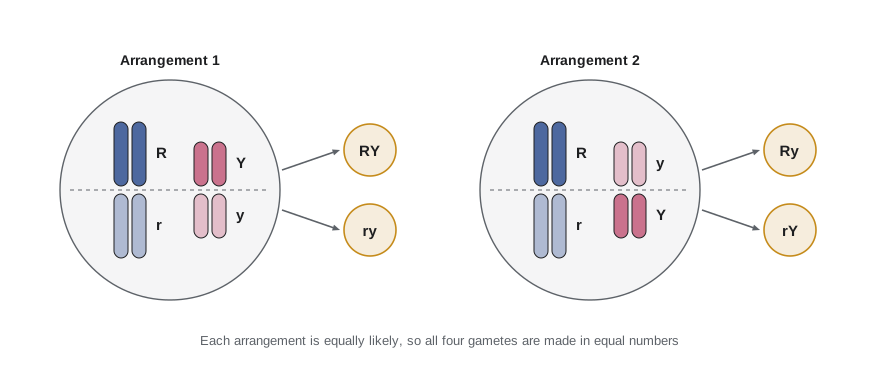
Segregation follows from anaphase I. Suppose a pea plant is heterozygous Rr. The R allele sits on one homologue and r on the other. When the homologues separate, each daughter cell receives one of them, so half the gametes carry R and half carry r. Independent assortment follows from metaphase I. How one homologous pair is oriented on the spindle (maternal chromosome facing up or down) has no influence on how any other pair is oriented, so the alleles of genes on different chromosomes are distributed independently.
Genetic variety from meiosis
Independent assortment alone generates great variety. A cell with n chromosome pairs can produce 2ⁿ different combinations of maternal and paternal chromosomes. For humans, with 23 pairs, that is 2²³, about 8.4 million combinations per parent, so two parents could produce about 70 trillion different chromosome combinations in their children, before counting crossing over, which reshuffles alleles within each chromosome and makes the true number effectively unlimited. This is why siblings, apart from identical twins, are never genetically identical.
import random
random.seed(201)
pairs = 23
combos = 2 ** pairs
print(f"chromosome combinations per parent: {combos:,}")
print(f"combinations for a child from two parents: {combos ** 2:,}")
print(f"chance a gamete has only grandmaternal chromosomes: 1 in {combos:,}")

# Simulate 100,000 gametes: how many of the 23 chromosomes come from the grandmother?
counts = [sum(random.random() < 0.5 for _ in range(pairs)) for _ in range(100_000)]
mean = sum(counts) / len(counts)
print(f"average grandmaternal chromosomes per gamete: {mean:.2f} of {pairs}")
print("fewest and most observed:", min(counts), max(counts))chromosome combinations per parent: 8,388,608 combinations for a child from two parents: 70,368,744,177,664 chance a gamete has only grandmaternal chromosomes: 1 in 8,388,608 average grandmaternal chromosomes per gamete: 11.51 of 23 fewest and most observed: 1 20
The simulation shows that a typical gamete carries close to half its chromosomes from each grandparent, but individual gametes vary widely. On average you share about a quarter of your DNA with each grandparent, but the actual share varies from person to person because of this random assortment.
Crossing over and chiasmata
During prophase I, the paired homologues are held together by a protein structure called the synaptonemal complex, and enzymes cut and rejoin non-sister chromatids, exchanging segments. The points of exchange are visible later as X-shaped chiasmata (singular chiasma). Most human chromosome pairs have one to three crossovers per meiosis. At least one crossover per pair is usually needed: chiasmata hold homologues together until anaphase I and help them separate correctly. When no crossover forms, the risk of nondisjunction rises (lesson 9).
Crossing over produces chromosomes that carry new combinations of alleles from the two parents. For genes on different chromosomes it has no effect on the ratios we observe, because independent assortment already mixes them. For genes on the same chromosome, crossing over is the only way new combinations can arise, and the frequency with which it separates two genes is the basis of genetic mapping (lesson 8).
Meiosis in females and males
In human males, meiosis begins at puberty and continues throughout life, each primary spermatocyte producing four sperm. In females, meiosis begins before birth: oocytes enter prophase I in the fetal ovary and then pause, sometimes for 40 years or more, until the months before ovulation. Meiosis I is completed just before ovulation and meiosis II only if a sperm fertilizes the egg. Each oocyte produces one egg and small polar bodies that degenerate. The long pause in prophase I is thought to contribute to the steep rise with maternal age in the frequency of eggs with the wrong number of chromosomes.
Recombination also differs between the sexes. Across the human genome, female meiosis produces roughly 1.6 times as many crossovers as male meiosis, so genetic maps measured in female meioses are longer. Mutations, in contrast, are more often of paternal origin, because sperm precursor cells keep dividing throughout a man's life and each division carries a small chance of a copying error.
Seeing meiosis directly: tetrad analysis
In most organisms the four products of a single meiosis are scattered among many gametes. In some fungi, including baker's yeast and the bread mold Neurospora, the four haploid products stay together in a sac called an ascus, forming a tetrad. Geneticists can dissect a tetrad and test each spore, seeing the outcome of an individual meiosis. Tetrad analysis gave the first direct proof that segregation and independent assortment happen in meiosis.
For two genes, each tetrad is one of three types. A parental ditype (PD) contains only the two parental combinations; a non-parental ditype (NPD) contains only the two recombinant combinations; and a tetratype (T) contains all four. If the genes are on different chromosomes and assort independently, PD and NPD tetrads are equally frequent, because the two alignments at metaphase I are equally likely. If the genes are linked, PD greatly outnumbers NPD.
import random
from collections import Counter
random.seed(201)

def tetrad(linked=False, p_cross=0.0, p_cross_unlinked=0.5):
    """Return the tetrad type for genes A and B in a cross AB x ab (yeast)."""
    if not linked:
        # independent orientation of two chromosome pairs, plus crossovers to centromeres
        # (crossovers between a gene and its centromere make tetratypes possible)
        orient_same = random.random() < 0.5
        cross_a = random.random() < 0.3
        cross_b = random.random() < 0.3
        if cross_a or cross_b:
            return "T"
        return "PD" if orient_same else "NPD"
    # linked genes: at most one crossover in the interval (no double crossovers)
    return "T" if random.random() < p_cross else "PD"

for label, kw in [("unlinked genes", {}), ("linked genes", {"linked": True, "p_cross": 0.2})]:
    c = Counter(tetrad(**kw) for _ in range(10_000))
print(f"{label:15s} PD {c['PD']:5d} NPD {c['NPD']:5d} T {c['T']:5d}")unlinked genes PD 2414 NPD 2379 T 5207 linked genes PD 7969 NPD 0 T 2031
The simulation is deliberately simplified (it ignores double crossovers between linked genes, which create the occasional NPD), but it shows the key diagnostic: PD ≈ NPD means unlinked genes; PD much greater than NPD means linkage.
The chromosome theory proven
Correlations between chromosome behavior and Mendel's laws were suggestive, but proof required a gene that could be followed together with a visibly distinctive chromosome. That came from sex chromosomes. Morgan's discovery that the white-eye mutation in Drosophila is inherited along with the X chromosome, and the later work of his student Calvin Bridges, who showed that flies with unusual inheritance of X-linked traits had unusual numbers of X chromosomes, tied specific genes to specific chromosomes beyond reasonable doubt. Lesson 7 takes up sex determination and sex-linked inheritance.
Common mistakes
MistakeSister chromatids carry different alleles from the two parents.
InsteadSister chromatids are identical copies; homologous chromosomes come from different parents and may differ.
MistakeIndependent assortment happens in anaphase II.
InsteadIt results from the random orientation of homologous pairs at metaphase I and their separation in anaphase I.
MistakeMore chromosomes means a more complex organism.
InsteadChromosome number varies widely and is not related to complexity; dogs have 78 and some ferns more than 1,200.
MistakeA human egg completes meiosis before ovulation.
InsteadMeiosis I completes just before ovulation; meiosis II completes only after fertilization.
MistakeCrossing over changes the ratios seen for genes on different chromosomes.
InsteadIndependent assortment already mixes unlinked genes; crossing over matters for genes on the same chromosome.
Summary and key terms
- Chromosomes are long DNA molecules with a centromere and telomeres, described by arm (p and q) and centromere position.
- Sister chromatids are identical copies; homologous chromosomes are different copies from the two parents.
- Karyotypes display chromosomes in pairs, and ISCN notation (for example 47,XY,+21) records abnormalities.
- Segregation arises from separation of homologues in anaphase I; independent assortment from random orientation at metaphase I.
- Humans can make 2²³ (about 8.4 million) chromosome combinations per parent, before crossing over adds more variety.
- Crossovers form chiasmata, help homologues separate correctly and create new allele combinations on one chromosome.
- Tetrad analysis in fungi shows meiosis directly; equal PD and NPD tetrads indicate unlinked genes.
- centromere
- The chromosome region where sister chromatids are joined and spindle fibers attach.
- telomere
- A protective repetitive DNA sequence at the end of a chromosome.
- homologous chromosomes
- A pair of chromosomes, one from each parent, carrying the same genes in the same order.
- sister chromatids
- The two identical copies of a replicated chromosome.
- karyotype
- An organized display of an individual’s chromosomes.
- autosome
- Any chromosome other than a sex chromosome.
- synapsis
- The close pairing of homologous chromosomes in prophase I.
- chiasma
- A visible point of crossing over between non-sister chromatids.
- tetrad analysis
- Study of the four products of a single meiosis kept together in an ascus.
- ploidy
- The number of complete chromosome sets in a cell.
Practice problems
Work each problem on paper first, then reveal the answer to check.
A chromosome has its centromere very close to one end with a tiny short arm. What type is it?
Show answer
Acrocentric.
What does the karyotype 47,XX,+18 indicate?
Show answer
A female with an extra chromosome 18 (trisomy 18).
How many chromosome combinations can a cell with 2n = 8 produce by independent assortment?
Show answer
2⁴ = 16.
In which stage of meiosis do homologous chromosomes separate?
Show answer
Anaphase I.
Why are siblings genetically different?
Show answer
Independent assortment and crossing over give each gamete a different combination of alleles.
A diploid cell has 2n = 20. How many chromosomes and chromatids are in each cell at the end of meiosis I?
Show answer
10 chromosomes, each still with two chromatids (20 chromatids).
In a yeast cross, tetrads are 45 PD, 44 NPD and 111 T. Are the genes linked?
Show answer
No; PD ≈ NPD indicates independent assortment.
Tetrads are 160 PD, 2 NPD and 38 T. What do you conclude?
Show answer
The genes are linked; PD greatly exceeds NPD.
Why might the frequency of chromosomally abnormal eggs rise with maternal age?
Show answer
Oocytes pause in prophase I for decades, and the cohesion holding homologues together may weaken.
What is the role of chiasmata in meiosis I?
Show answer
They hold homologues together until anaphase I, helping them separate correctly.
Lesson quiz · 5 questions
Score 60% or more to complete this lesson.
Create a free account to save your progress, take quizzes and earn a certificate.