
BIOL-201 · Lesson 12 of 12 · 30 min
Extranuclear inheritance, epigenetics and capstone: genetics in medicine and society
The final lesson covers forms of inheritance that do not follow Mendel's rules, because the genes involved are outside the nucleus or because their expression depends on which parent they came from, and then brings the whole course together in a capstone: applying transmission genetics, probability and an understanding of testing and law to a realistic family case. By the end you should be able to analyze a family history, estimate risks, and discuss the ethical and legal context in which genetic information is used.
Mitochondrial inheritance
Mitochondria contain their own small circular genome. In humans, mitochondrial DNA (mtDNA) is about 16,569 base pairs long and carries 37 genes, 13 of them encoding proteins of the energy-producing respiratory chain. Each cell contains hundreds to thousands of copies. Because the egg contributes essentially all of the zygote's mitochondria and sperm mitochondria are destroyed after fertilization, mtDNA is inherited almost exclusively from the mother. A mother passes her mtDNA to all of her children; a father passes his to none.
Mutations in mtDNA cause a range of diseases, mostly affecting tissues with high energy demands, such as brain, muscle, eye and heart. Leber hereditary optic neuropathy causes sudden loss of central vision, usually in young men; MELAS (mitochondrial encephalomyopathy with lactic acidosis and stroke-like episodes) affects the brain and muscles. Mitochondrial disorders as a whole affect roughly 1 in 5,000 people, though many are caused by nuclear genes that encode mitochondrial proteins and follow Mendelian patterns.
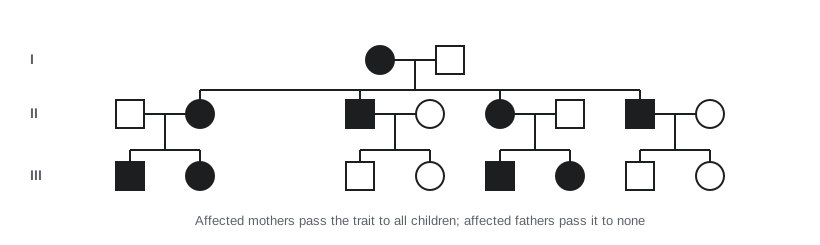
A complication is heteroplasmy: a cell can contain a mixture of normal and mutant mtDNA, and disease appears only when the mutant fraction exceeds a threshold, often 60 to 90 percent depending on the tissue. During egg formation, only a small number of mtDNA molecules pass through a genetic bottleneck, so the mutant fraction can shift dramatically between a mother and her children. A mother with 30 percent mutant mtDNA may have one child with almost none and another with a high, disease-causing level, which makes risk prediction difficult.
import numpy as np
rng = np.random.default_rng(201)
# mtDNA bottleneck: each egg's founder population is a random sample of the mother's mtDNA
mother_fraction = 0.30
bottleneck = 8             # effective number of mtDNA molecules that found each egg's population (illustrative)
threshold = 0.60           # mutant fraction above which disease is likely (illustrative)
eggs = rng.binomial(bottleneck, mother_fraction, size=10_000) / bottleneck
print(f"mother's mutant fraction: {mother_fraction:.0%}")
print(f"children: mean {eggs.mean():.0%}, middle 90% range {np.percentile(eggs, 5):.0%}-{np.percentile(eggs, 95):.0%}")
print(f"share of children above the {threshold:.0%} threshold: {np.mean(eggs > threshold):.2%}")
print(f"share of children below 10%: {np.mean(eggs < 0.10):.1%}")mother's mutant fraction: 30% children: mean 30%, middle 90% range 0%-62% share of children above the 60% threshold: 5.66% share of children below 10%: 6.0%
Mitochondrial replacement techniques aim to prevent transmission of mtDNA disease by transferring the nuclear chromosomes from an affected woman's egg or embryo into a donor egg with healthy mitochondria. The resulting child has nuclear DNA from both parents and mtDNA from the donor. The United Kingdom legalized the techniques in 2015 under strict licensing, and in 2025 researchers in Newcastle reported the births of eight children conceived this way; Australia legalized them in 2022.
In the United States, a rider attached to federal appropriations bills every year since 2016 bars the Food and Drug Administration from reviewing applications for research in which a human embryo is intentionally modified to include a heritable genetic change, which effectively prevents mitochondrial replacement and heritable editing from being used clinically; the rider was carried again in the fiscal 2027 appropriations bill in 2026.
Chloroplasts also have their own DNA and, in most flowering plants, are inherited through the egg. Variegated plants, with patches of green and white tissue, can result from a mixture of normal and mutant chloroplasts, a plant version of heteroplasmy first studied by Carl Correns in 1909, one of the rediscoverers of Mendel.
Maternal effect
Maternal effect genes are nuclear genes whose products, deposited by the mother into the egg, determine the offspring's phenotype; the offspring's own genotype does not matter. In the water snail Lymnaea, the direction in which the shell coils is set by the mother's genotype: a snail with the dextral (right-coiling) allele in its mother coils to the right even if it is itself homozygous for the sinistral allele. Maternal effect genes are essential in early development; in Drosophila, the bicoid gene, expressed by the mother, sets up the head-to-tail axis of the embryo. Maternal effect inheritance is easy to confuse with mitochondrial inheritance, but it is nuclear, Mendelian and simply delayed by one generation.
Genomic imprinting
For most genes, the copy from the mother and the copy from the father are expressed equally. For a few hundred genes in mammals, only one parental copy is expressed; the other is silenced by chemical marks, especially DNA methylation, that are set during egg or sperm formation. This is genomic imprinting. The marks are erased and reset in each generation's germ line according to the sex of the parent.
Imprinting explains a remarkable pair of conditions. Deletions in the same region of chromosome 15 (15q11–q13) cause Prader–Willi syndrome when the deletion is on the chromosome inherited from the father, and Angelman syndrome when it is on the chromosome inherited from the mother. Different genes in the region are expressed from different parental copies: Prader–Willi results from loss of paternally expressed genes, and Angelman from loss of the maternally expressed gene UBE3A. Both can also arise from uniparental disomy, in which a child inherits both copies of chromosome 15 from one parent.
| Cause | Prader–Willi syndrome | Angelman syndrome |
|---|---|---|
| Deletion of 15q11–q13 | On the paternal chromosome (about 70 percent of cases) | On the maternal chromosome (about 70 percent of cases) |
| Uniparental disomy | Both chromosome 15s from the mother | Both chromosome 15s from the father (rare) |
| Imprinting defect | Paternal copy carries a maternal-type imprint | Maternal copy carries a paternal-type imprint |
| Main features | Low muscle tone in infancy, then insatiable appetite and obesity, mild to moderate intellectual disability | Severe intellectual disability, little speech, seizures, frequent happy demeanour |
Epigenetics
Imprinting is one example of epigenetic inheritance: heritable changes in gene expression that do not involve changes to the DNA sequence. Epigenetic marks include methylation of cytosine bases and chemical modifications of histone proteins that affect how tightly DNA is packaged. X inactivation (lesson 7) is another example; once one X is silenced in an early embryonic cell, it stays silenced in all of that cell's descendants. Epigenetic marks allow cells with identical genomes to become different cell types, and they are frequently disrupted in cancer.
Whether environmental experiences can leave epigenetic marks that are passed to later generations is an active and contested research area. Studies of people conceived during the Dutch Hunger Winter famine of 1944–1945 found differences in methylation of some genes six decades later, and some animal studies suggest that parental diet or stress can affect offspring through epigenetic routes. In mammals, however, most epigenetic marks are erased in the germ line and early embryo, and evidence for transmission across several generations in humans is limited. This is not a return to the inheritance of acquired characteristics in the sense Lamarck meant.
Genetic testing
Genetic tests are now part of routine health care. They differ in purpose, and each purpose raises different questions.
| Type of test | Purpose | Example |
|---|---|---|
| Diagnostic | Confirm or rule out a suspected genetic condition | Sequencing CFTR in a child with symptoms of cystic fibrosis |
| Carrier | Identify healthy people who carry a recessive allele | Screening prospective parents for cystic fibrosis, spinal muscular atrophy or hemoglobin disorders |
| Predictive (presymptomatic) | Determine whether a healthy person will develop a late-onset condition | Testing an adult at risk of Huntington disease |
| Susceptibility | Estimate increased risk, not certainty | BRCA1 and BRCA2 testing for hereditary breast and ovarian cancer |
| Prenatal | Test a pregnancy | NIPT and diagnostic testing for chromosome conditions (lesson 9) |
| Newborn screening | Detect treatable conditions early | PKU, congenital hypothyroidism, sickle-cell disease, spinal muscular atrophy |
| Pharmacogenetic | Predict drug response | Testing before prescribing certain drugs whose dosage depends on genotype |
| Direct-to-consumer | Ancestry or health information sold to the public | Saliva tests for ancestry and selected health variants |
Newborn screening in the United States is run by each state, guided by the federal Recommended Uniform Screening Panel (RUSP), which as of 2026 lists 40 core conditions and 26 secondary conditions. In August 2026 the Health Resources and Services Administration launched a new framework to speed up evidence reviews for adding conditions. States decide which conditions to include, and most screen for nearly all core conditions.
Genetic counseling helps people understand genetic information and make decisions consistent with their own values. Counselors take family histories, draw pedigrees, explain inheritance and risks, discuss the benefits and limits of testing, and support people through the results. Good counseling is non-directive: the counselor informs but does not tell the client what to do. Predictive testing for untreatable conditions such as Huntington disease is offered only after careful counseling, and many people at risk choose not to be tested.
Genetic discrimination and the law
A long-standing fear is that people will be treated unfairly by insurers or employers because of genetic test results, and that this fear will deter people from being tested or joining research. Canada and the United States have taken different approaches.
The US Genetic Information Nondiscrimination Act (GINA, 2008) prohibits health insurers and employers with 15 or more employees from using genetic information to make decisions about coverage, premiums, hiring, firing or promotion. GINA does not cover life insurance, disability insurance or long-term care insurance, and some states, such as Florida in 2020, have passed laws restricting the use of genetic information in some of these areas. The Affordable Care Act separately bars health insurers from denying coverage for pre-existing conditions.
| Feature | Canada: Genetic Non-Discrimination Act (2017) | United States: GINA (2008) |
|---|---|---|
| Legal approach | Criminal law; also amended the Canadian Human Rights Act | Civil law covering health insurance and employment |
| Health insurance | Covered | Covered |
| Employment | Covered (federal law plus provincial human rights codes) | Covered for employers with 15 or more employees |
| Life and disability insurance | Covered: insurers cannot require testing or disclosure | Not covered by GINA; some state laws |
| Court challenge | Upheld by the Supreme Court of Canada in 2020 | Not successfully challenged |
Gene editing and the germ line
CRISPR–Cas9 and newer editing tools allow precise changes to DNA. Editing somatic cells to treat disease is now a clinical reality, as with the sickle-cell therapy described in lesson 5, and its effects are confined to the patient. Editing the germ line or early embryos is different, because the changes would be inherited by future generations who cannot consent, and off-target effects or mosaicism could cause harm that is difficult to detect.
In 2018 the Chinese scientist He Jiankui announced the birth of twin girls whose embryos he had edited to disable the CCR5 gene, in an attempt to confer resistance to HIV. The work was widely condemned as medically unjustified, unsafe and conducted without adequate consent or oversight, and he was sentenced to three years in prison in China. International summits on human genome editing have since concluded that heritable editing is not acceptable at this time. As described above for mitochondrial replacement, Canada prohibits heritable genome modification under the Assisted Human Reproduction Act, and in the United States the appropriations rider prevents the FDA from considering such applications.
Capstone: a family case
The following case is invented, but it brings together the methods of the whole course. Work through it before reading the solution.
Worked problem
Capstone: the Okafor–Lindqvist family
Maya Lindqvist, aged 29, is planning a pregnancy with her partner Daniel Okafor. Maya’s brother died in childhood of Duchenne muscular dystrophy (X-linked recessive); her mother has never been tested, and Maya has no children yet. Daniel’s sister has cystic fibrosis (autosomal recessive); both of Daniel’s parents are healthy. Maya has no family history of cystic fibrosis, and the carrier frequency in her population is about 1 in 25. Estimate (a) Maya’s probability of being a Duchenne carrier, (b) the risk that a son of Maya’s would have Duchenne, (c) the risk that a child of Maya and Daniel would have cystic fibrosis, and (d) recommend next steps.
Show solution
- (a) About two-thirds of Duchenne cases with no prior family history arise from a carrier mother and one-third from a new mutation in the egg. As a working estimate, take Maya’s mother as a carrier with probability 2/3; Maya then has a 1/2 × 2/3 = 1/3 prior probability of being a carrier (germ-line mosaicism in the mother would adjust this slightly).
- (b) If Maya is a carrier, each son has a 1/2 chance of Duchenne: 1/3 × 1/2 = 1/6 per son, or 1/12 per child of either sex.
- (c) Daniel is the unaffected sibling of an affected person, so his carrier probability is 2/3. Maya’s is 1/25. If both are carriers, each child has a 1/4 chance: 2/3 × 1/25 × 1/4 = 1/150.
- (d) Both risks can be refined dramatically by testing. Testing for the specific DMD mutation found in Maya’s brother (if a sample or record exists), or a full DMD analysis in Maya, can confirm or exclude carrier status. Carrier testing for CFTR in Daniel and Maya can replace the 1/150 estimate with a definite answer for most couples.
Answer: Before testing: about a 1 in 3 chance that Maya is a Duchenne carrier (1 in 6 risk for each son) and about a 1 in 150 risk of cystic fibrosis for each child. Genetic counseling and targeted testing would resolve most of this uncertainty, and if both partners prove to be carriers they can discuss options including prenatal diagnosis or preimplantation genetic testing with IVF. Every decision is theirs to make.
from fractions import Fraction as F

# Capstone risk calculation (working estimates before testing)
p_mother_carrier = F(2, 3)                 # isolated DMD case: ~2/3 of mothers are carriers
p_maya_dmd = F(1, 2) * p_mother_carrier
p_son_dmd = p_maya_dmd * F(1, 2)

p_daniel_cf = F(2, 3)                      # unaffected sibling of an affected person
p_maya_cf = F(1, 25)                       # population carrier frequency
p_child_cf = p_daniel_cf * p_maya_cf * F(1, 4)

print(f"Maya DMD carrier probability:   {p_maya_dmd} ({float(p_maya_dmd):.3f})")
print(f"risk of DMD for each son:       {p_son_dmd} ({float(p_son_dmd):.3f})")
print(f"risk of CF for each child:      {p_child_cf} ({float(p_child_cf):.4f})")

# How much would a negative CFTR carrier test in Maya help? (test detects ~90% of carriers, illustrative)
detect = F(9, 10)
p_maya_cf_after = (p_maya_cf * (1 - detect)) / (p_maya_cf * (1 - detect) + (1 - p_maya_cf))
print(f"Maya CF carrier probability after a negative test: about 1 in {round(1 / p_maya_cf_after)}")
print(f"risk of CF for each child after her negative test: about 1 in "
f"{round(1 / (p_daniel_cf * p_maya_cf_after * F(1, 4)))}")Maya DMD carrier probability: 1/3 (0.333) risk of DMD for each son: 1/6 (0.167) risk of CF for each child: 1/150 (0.0067) Maya CF carrier probability after a negative test: about 1 in 241 risk of CF for each child after her negative test: about 1 in 1446
The capstone shows how the threads of the course come together: X-linked and autosomal recessive inheritance (lessons 2 and 7), conditional and Bayesian probability (lessons 3 and 7), the biology of mutation (lesson 10), and the practical, ethical and legal context of testing (this lesson). It also shows the limits of calculation. Real counseling takes account of laboratory results, the family's values, the reproductive options available and the emotional weight of the decisions. Genetics provides the numbers; people decide what to do with them.
Common mistakes
MistakeMitochondrial diseases are passed from fathers to all their children.
InsteadmtDNA is inherited from the mother; affected fathers do not transmit mtDNA disease.
MistakeMaternal effect and mitochondrial inheritance are the same.
InsteadMaternal effect genes are nuclear and Mendelian; the mother’s genotype determines the offspring’s phenotype one generation later.
MistakePrader–Willi and Angelman syndromes are caused by different chromosomes.
InsteadBoth involve 15q11–q13; the parent of origin of the deletion determines which syndrome results.
MistakeGINA protects Americans from genetic discrimination in life insurance.
InsteadGINA covers health insurance and employment only; life, disability and long-term care insurance are not covered.
MistakeHeritable embryo editing is legal and routine in Canada and the United States.
InsteadCanada prohibits heritable genome modification by law, and a US appropriations rider prevents the FDA from approving it.
Summary and key terms
- Mitochondrial DNA is inherited from the mother; heteroplasmy and the mtDNA bottleneck make disease levels vary among siblings.
- Mitochondrial replacement is legal in the UK and Australia but effectively prohibited in Canada and the United States.
- Maternal effect genes act through products the mother places in the egg; they are nuclear and Mendelian.
- Genomic imprinting silences one parental copy of some genes; deletions of 15q11–q13 cause Prader–Willi or Angelman syndrome depending on parent of origin.
- Epigenetic marks such as DNA methylation change gene expression without changing sequence; most are reset between generations.
- Genetic tests serve diagnostic, carrier, predictive, prenatal, newborn and pharmacogenetic purposes, supported by non-directive genetic counseling.
- Canada’s Genetic Non-Discrimination Act and the US GINA protect against genetic discrimination with different scope; heritable genome editing remains prohibited or blocked.
- mitochondrial DNA
- The small circular genome of mitochondria, inherited maternally in humans.
- heteroplasmy
- The presence of more than one type of mitochondrial DNA in a cell or individual.
- maternal effect
- Determination of an offspring’s phenotype by the mother’s nuclear genotype.
- genomic imprinting
- Expression of a gene from only one parental copy, depending on parent of origin.
- uniparental disomy
- Inheriting both copies of a chromosome from one parent.
- epigenetic
- Describing heritable changes in gene expression without changes in DNA sequence.
- DNA methylation
- Addition of methyl groups to DNA, usually to cytosine, often silencing genes.
- predictive testing
- Genetic testing of healthy people for conditions that may develop later.
- non-directive counseling
- Genetic counseling that informs without telling clients what to decide.
- germ-line editing
- Changing the DNA of eggs, sperm or embryos so that changes are inherited.
Practice problems
Work each problem on paper first, then reveal the answer to check.
An affected father has a mitochondrial disease. What is the risk to his children?
Show answer
Essentially none, because he does not transmit mtDNA.
Why can a mother with 20 percent mutant mtDNA have a severely affected child?
Show answer
The mtDNA bottleneck in egg formation can greatly increase the mutant fraction in some eggs.
A snail homozygous for the sinistral allele coils to the right. Explain.
Show answer
Coiling is a maternal effect trait; its mother carried a dextral allele.
A child has a deletion of 15q11–q13 on the maternal chromosome. Which syndrome is expected?
Show answer
Angelman syndrome.
Give one example of epigenetic inheritance within an individual.
Show answer
X inactivation or genomic imprinting maintained through cell divisions.
Distinguish a carrier test from a predictive test.
Show answer
A carrier test finds healthy carriers of recessive alleles; a predictive test determines whether a healthy person will develop a late-onset condition.
What does non-directive genetic counseling mean?
Show answer
The counselor provides information and support but does not tell the client what to decide.
Which kinds of insurance does Canada’s Genetic Non-Discrimination Act cover that GINA does not?
Show answer
Life, disability and other insurance contracts.
Why is heritable genome editing considered unacceptable at present?
Show answer
Safety concerns (off-target effects, mosaicism), lack of consent from future generations and lack of compelling medical need.
In the capstone, why is Daniel’s carrier probability 2/3 rather than 1/2?
Show answer
He is known to be unaffected, which removes the affected genotype from the possibilities.
Lesson quiz · 5 questions
Score 60% or more to complete this lesson.
Create a free account to save your progress, take quizzes and earn a certificate.