
BIOL-201 · Lesson 2 of 12 · 28 min
Mendelian inheritance: segregation and independent assortment
Gregor Mendel's experiments with garden peas are the foundation of transmission genetics. In this lesson we follow his reasoning step by step: the monohybrid cross that revealed dominance and segregation, the testcross that confirmed it, and the dihybrid cross that revealed independent assortment. Along the way we learn the vocabulary and the tools, Punnett squares and the branch-diagram method, that the rest of the course uses constantly.
Why peas?
The garden pea, Pisum sativum, was a well-chosen subject. Peas are easy to grow, produce many seeds, and complete a generation in a single season. Their flowers normally self-pollinate before they open, so a gardener can keep lines pure; but the flowers can also be opened, the anthers removed and pollen from another plant applied with a brush, giving complete control over which plants mate. Seed merchants already sold many varieties that differed in clear-cut ways. Mendel chose seven traits, each with two contrasting forms, and spent two years confirming that his starting lines were true-breeding: when self-pollinated they produced only offspring like themselves.
| Trait | Dominant form | Recessive form | F2 counts (dominant : recessive) | Ratio |
|---|---|---|---|---|
| Seed shape | Round | Wrinkled | 5,474 : 1,850 | 2.96 : 1 |
| Seed color | Yellow | Green | 6,022 : 2,001 | 3.01 : 1 |
| Flower color | Purple | White | 705 : 224 | 3.15 : 1 |
| Pod shape | Inflated | Constricted | 882 : 299 | 2.95 : 1 |
| Pod color | Green | Yellow | 428 : 152 | 2.82 : 1 |
| Flower position | Axial | Terminal | 651 : 207 | 3.14 : 1 |
| Stem length | Tall | Short | 787 : 277 | 2.84 : 1 |
The monohybrid cross
Mendel crossed true-breeding plants that differed in a single trait, for example round-seeded with wrinkled-seeded plants. This parental generation is called P. All of the first filial generation, F1, had round seeds; the wrinkled form had vanished. He then let the F1 plants self-pollinate. In the second filial generation, F2, wrinkled seeds reappeared, unchanged, in about one-quarter of the offspring. Across the seven traits the F2 ratio was always close to 3 : 1.
Mendel explained these results with a few bold propositions, which in modern language are:
| Proposition | Modern wording |
|---|---|
| Hereditary determinants are particles | Traits are controlled by genes that keep their identity from generation to generation |
| Each plant has two determinants per trait | Diploid organisms carry two alleles of each gene, one from each parent |
| One determinant can mask the other | A dominant allele determines the phenotype of a heterozygote; the masked allele is recessive |
| The two determinants separate when gametes form | Law of segregation: each gamete receives one allele, chosen at random |
| Gametes combine at random | Fertilization unites gametes without regard to the alleles they carry |
With symbols, using R for the round allele and r for wrinkled, the P generation is RR × rr. The RR parent makes only R gametes and the rr parent only r gametes, so every F1 plant is Rr and, because R is dominant, round. Each F1 plant makes R and r gametes in equal numbers. Combining them at random gives the F2 genotypes RR, Rr and rr in the proportions 1 : 2 : 1, which collapse into the phenotypes round and wrinkled in the ratio 3 : 1.
Vocabulary of transmission genetics
A few terms come up constantly. The genotype is the set of alleles an individual carries; the phenotype is its observable characteristics. An individual with two identical alleles is homozygous (RR or rr); one with two different alleles is heterozygous (Rr). By convention, a dominant allele is often written with a capital letter and the recessive allele with the same letter in lower case, but many fields use other systems, such as the wild-type allele written with a plus sign in Drosophila.
The Punnett square, introduced by Reginald Punnett around 1905, is a grid that lists one parent's gametes along the top and the other's down the side; each cell is a possible zygote. Because every gamete type is equally likely, every cell has the same probability.
from itertools import product
from collections import Counter

def gametes(genotype):
    """A single-gene genotype such as 'Rr' gives gametes 'R' and 'r'."""
    return list(genotype)

def monohybrid(p1, p2):
    cells = ["".join(sorted(e + s)) for e, s in product(gametes(p1), gametes(p2))]
    return Counter(cells)

for cross in [("RR", "rr"), ("Rr", "Rr"), ("Rr", "rr")]:
    counts = monohybrid(*cross)
    total = sum(counts.values())
    geno = ", ".join(f"{g}: {n}/{total}" for g, n in sorted(counts.items()))
    round_ = sum(n for g, n in counts.items() if "R" in g)
print(f"{cross[0]} x {cross[1]} -> {geno}; round {round_}/{total}")RR x rr -> Rr: 4/4; round 4/4 Rr x Rr -> RR: 1/4, Rr: 2/4, rr: 1/4; round 3/4 Rr x rr -> Rr: 2/4, rr: 2/4; round 2/4
Upper-case letters sort before lower-case ones in Python strings, which is why sorting each pair of alleles gives the conventional order Rr rather than rR.
The testcross
A plant with the dominant phenotype could be homozygous or heterozygous. How can we tell which? Mendel's answer was the testcross: cross the individual of unknown genotype to a homozygous recessive. If the unknown is RR, every offspring receives an R and is round. If it is Rr, half the offspring receive r from both parents and are wrinkled, giving a 1 : 1 ratio. The testcross works because the recessive parent contributes only recessive alleles, so the offspring phenotypes directly reveal the gametes made by the unknown parent. Testcrosses remain a standard tool in plant and animal breeding and, as lesson 8 shows, in gene mapping.
Worked problem
Reading a testcross
A breeder testcrosses a purple-flowered pea plant to a white-flowered plant. The offspring are 41 purple and 37 white. What was the purple parent’s genotype, and what would she have expected if it were homozygous?
Show solution
- White is recessive (p), so the tester is pp and contributes only p.
- White offspring must have received p from the purple parent as well, so that parent carries p.
- The purple parent is therefore Pp; a 1 : 1 ratio is expected, and 41 : 37 is close to it.
- If the purple parent were PP, every offspring would be Pp and purple; even one white offspring rules this out.
Answer: The purple parent was heterozygous, Pp. A homozygous parent would have given only purple offspring.
The dihybrid cross and independent assortment
Next Mendel asked whether genes for different traits are inherited together or separately. He crossed true-breeding plants with round, yellow seeds (RRYY) to plants with wrinkled, green seeds (rryy). The F1 were all round and yellow (RrYy), as expected from dominance. When the F1 self-pollinated, the F2 contained four phenotypes: 315 round yellow, 108 round green, 101 wrinkled yellow and 32 wrinkled green, very close to a 9 : 3 : 3 : 1 ratio.
This is precisely what is expected if the two genes are inherited independently. Each F1 plant makes four kinds of gametes, RY, Ry, rY and ry, in equal frequency, because which allele of the seed-shape gene a gamete receives has no effect on which allele of the color gene it receives. This is Mendel's second law, the law of independent assortment. A 4 × 4 Punnett square of these gametes gives 16 equally likely cells.
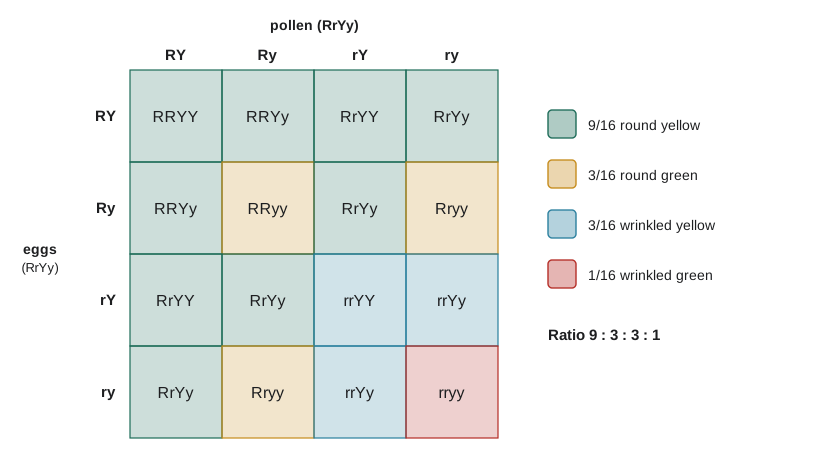
Note that each gene on its own still shows a 3 : 1 ratio: 315 + 108 = 423 round to 101 + 32 = 133 wrinkled, and 315 + 101 = 416 yellow to 108 + 32 = 140 green. The 9 : 3 : 3 : 1 ratio is simply the product of two independent 3 : 1 ratios: (3 : 1) × (3 : 1). This observation leads to a far faster method than drawing large squares.
The branch-diagram and product methods
Because independently assorting genes behave like separate coin tosses, we can treat each gene separately and multiply. For RrYy × RrYy, the probability of round is 3/4 and of yellow is 3/4, so the probability of round yellow is 3/4 × 3/4 = 9/16; round green is 3/4 × 1/4 = 3/16; and so on. For three or more genes, Punnett squares become unmanageable (a trihybrid square has 64 cells), but multiplication remains easy.
Worked problem
A trihybrid cross by multiplication
In the cross AaBbCc × AaBbCc, with all three genes assorting independently and showing complete dominance, what fraction of offspring is aaB_C_ (recessive for A, dominant for B and C)? What fraction is heterozygous for all three genes?
Show solution
- P(aa) = 1/4; P(B_) = 3/4; P(C_) = 3/4.
- P(aaB_C_) = 1/4 × 3/4 × 3/4 = 9/64.
- For each gene, P(heterozygous) from Aa × Aa = 1/2.
- P(AaBbCc) = 1/2 × 1/2 × 1/2 = 1/8.
Answer: 9/64 of offspring are aaB_C_ and 1/8 are triple heterozygotes.
The number of possible gametes, genotypes and phenotypes grows rapidly with the number of heterozygous genes. With n independently assorting heterozygous genes and complete dominance there are 2ⁿ kinds of gametes, 3ⁿ genotypes and 2ⁿ phenotypes, and the probability of a fully homozygous recessive offspring is (1/4)ⁿ.
from itertools import product
from collections import Counter
from fractions import Fraction

def gametes(genes):
    """genes: list of two-letter genotypes, e.g. ['Rr', 'Yy'] -> all gamete combinations."""
    return ["".join(g) for g in product(*genes)]

def phenotype(zygote_pairs):
    # dominant if an upper-case allele is present at a gene
    return "".join(p[0].upper() if any(a.isupper() for a in p) else p[0].lower()
                   for p in zygote_pairs)

parent = ["Rr", "Yy"]
g = gametes(parent)
print("gametes:", g)
counts = Counter()
for e, s in product(g, g):
    pairs = [e[i] + s[i] for i in range(len(parent))]
    counts[phenotype(pairs)] += 1
labels = {"RY": "round yellow", "Ry": "round green", "rY": "wrinkled yellow", "ry": "wrinkled green"}
for k in ["RY", "Ry", "rY", "ry"]:
    print(f"{labels[k]:16s} {counts[k]:2d}/16 = {Fraction(counts[k], 16)}")
for n in range(1, 6):
print(f"{n} genes: {2**n:3d} gametes, {3**n:4d} genotypes, P(all recessive) = 1/{4**n}")gametes: ['RY', 'Ry', 'rY', 'ry'] round yellow 9/16 = 9/16 round green 3/16 = 3/16 wrinkled yellow 3/16 = 3/16 wrinkled green 1/16 = 1/16 1 genes: 2 gametes, 3 genotypes, P(all recessive) = 1/4 2 genes: 4 gametes, 9 genotypes, P(all recessive) = 1/16 3 genes: 8 gametes, 27 genotypes, P(all recessive) = 1/64 4 genes: 16 gametes, 81 genotypes, P(all recessive) = 1/256 5 genes: 32 gametes, 243 genotypes, P(all recessive) = 1/1024
Segregation and assortment in meiosis
Mendel knew nothing of chromosomes, but his laws follow directly from meiosis, which BIOL-107 introduced. The two alleles of a gene sit at the same position (locus) on the two members of a homologous chromosome pair. In anaphase I the homologues separate to opposite poles, so each gamete gets one allele: segregation. Different chromosome pairs line up on the metaphase plate independently of each other, so which maternal or paternal chromosome of pair 1 goes to a pole has no bearing on pair 2: independent assortment. Lesson 6 develops this connection, and lesson 8 shows the important exception: genes close together on the same chromosome do not assort independently.
Mendelian traits in humans
Humans cannot be crossed experimentally, but many human traits and diseases follow Mendel's rules. Online Mendelian Inheritance in Man, a catalog maintained at Johns Hopkins University, lists thousands of single-gene conditions. Most common traits, such as height, skin color and eye color, are influenced by many genes and the environment (lesson 11), and popular claims that a trait such as tongue rolling or attached earlobes is a simple Mendelian trait are not well supported. Clear single-gene examples include cystic fibrosis and sickle-cell disease (recessive), Huntington disease and achondroplasia (dominant), and hemophilia A (X-linked recessive, lesson 7).
| Condition | Gene | Pattern | What a carrier or heterozygote shows |
|---|---|---|---|
| Cystic fibrosis | CFTR | Autosomal recessive | No symptoms |
| Sickle-cell disease | HBB | Autosomal recessive (codominant at the protein level) | Usually healthy; some resistance to severe malaria |
| Phenylketonuria (PKU) | PAH | Autosomal recessive | No symptoms; detected by newborn screening |
| Huntington disease | HTT | Autosomal dominant | Affected, usually from mid-adulthood |
| Achondroplasia | FGFR3 | Autosomal dominant | Affected (short stature) |
| Familial hypercholesterolemia | LDLR and others | Autosomal dominant (incompletely dominant) | High cholesterol; homozygotes are more severely affected |
These patterns are the subject of pedigree analysis in lesson 7. For now the key point is that the same rules Mendel found in peas, segregation, dominance and independent assortment, apply to genes in people, because they arise from meiosis, which is shared by all sexually reproducing eukaryotes.
Common mistakes
MistakeDominant alleles are more common in populations than recessive alleles.
InsteadDominance describes the phenotype of heterozygotes, not allele frequency; many dominant disease alleles are rare.
MistakeThe F2 ratio of 1 : 2 : 1 refers to phenotypes in a cross with complete dominance.
Instead1 : 2 : 1 is the genotypic ratio; with complete dominance the phenotypic ratio is 3 : 1.
MistakeA testcross is any cross involving a recessive individual.
InsteadA testcross specifically crosses an individual of unknown genotype to a homozygous recessive tester.
MistakeThe 9 : 3 : 3 : 1 ratio applies to any two genes.
InsteadIt applies only when both genes are heterozygous, show complete dominance and assort independently (are unlinked).
MistakeDrawing a Punnett square is the only reliable way to solve multi-gene crosses.
InsteadFor independent genes, multiplying single-gene probabilities is faster and less error-prone.
Summary and key terms
- Mendel used true-breeding lines, controlled pollination, two-form traits and large counts to reveal the rules of inheritance.
- The monohybrid cross gives a 1 : 2 : 1 genotypic and 3 : 1 phenotypic ratio when one allele is completely dominant.
- The law of segregation: the two alleles of a gene separate into different gametes with equal probability.
- A testcross to a homozygous recessive reveals the genotype of a dominant-phenotype individual.
- The law of independent assortment: alleles of different (unlinked) genes sort into gametes independently, giving 9 : 3 : 3 : 1 in a dihybrid cross.
- For independent genes, multiply single-gene probabilities; n heterozygous genes give 2ⁿ gamete types and 3ⁿ genotypes.
- Mendel’s laws follow from the behavior of homologous chromosomes in meiosis.
- genotype
- The alleles an individual carries for one or more genes.
- phenotype
- The observable characteristics of an individual.
- homozygous
- Having two identical alleles of a gene.
- heterozygous
- Having two different alleles of a gene.
- dominant allele
- An allele that determines the phenotype in a heterozygote.
- recessive allele
- An allele whose effect is masked in a heterozygote.
- true-breeding
- Producing offspring identical to the parent for a trait when self-fertilized; homozygous.
- testcross
- A cross of an individual of unknown genotype to a homozygous recessive.
- law of segregation
- The two alleles of a gene separate into different gametes.
- law of independent assortment
- Alleles of different unlinked genes segregate into gametes independently.
Practice problems
Work each problem on paper first, then reveal the answer to check.
In peas, tall (T) is dominant to short (t). What are the offspring of Tt × tt?
Show answer
1/2 Tt (tall) and 1/2 tt (short).
Two tall pea plants produce 3/4 tall and 1/4 short offspring. What are the parents’ genotypes?
Show answer
Both Tt.
How would you determine whether a yellow-seeded plant is YY or Yy?
Show answer
Testcross it to yy; any green offspring show it is Yy.
In the dihybrid cross RrYy × RrYy, what fraction of offspring is RRYY?
Show answer
1/4 × 1/4 = 1/16.
In RrYy × rryy, what phenotypes appear and in what ratio?
Show answer
Round yellow, round green, wrinkled yellow and wrinkled green in a 1 : 1 : 1 : 1 ratio.
How many kinds of gametes can AaBbCcDd make if all four genes assort independently?
Show answer
2⁴ = 16.
In AaBbCc × AaBbCc, what is the probability of an aabbcc offspring?
Show answer
(1/4)³ = 1/64.
Why did the wrinkled form disappear in Mendel’s F1 and reappear in the F2?
Show answer
The F1 were heterozygous and the round allele was dominant; in the F2 one-quarter received two wrinkled alleles.
In the cross AaBb × Aabb, what fraction of offspring shows both dominant traits?
Show answer
3/4 × 1/2 = 3/8.
What feature of meiosis explains independent assortment?
Show answer
Homologous pairs line up and separate independently of other pairs at metaphase and anaphase I.
Lesson quiz · 5 questions
Score 60% or more to complete this lesson.
Create a free account to save your progress, take quizzes and earn a certificate.