
BIOL-201 · Lesson 8 of 12 · 28 min
Linkage, recombination and gene mapping
Mendel's law of independent assortment holds for genes on different chromosomes. But every chromosome carries hundreds or thousands of genes, and genes on the same chromosome tend to be inherited together. Such genes are linked. Linkage is only partial, because crossing over in meiosis can separate linked alleles, and the further apart two genes are, the more often a crossover falls between them. This simple idea, worked out by Alfred Sturtevant in 1913 when he was still an undergraduate, lets geneticists build maps of chromosomes from breeding data alone. Genetic maps guided the search for disease genes for most of the twentieth century and remain essential in plant and animal breeding today.
Discovering linkage
Bateson and Punnett noticed in 1905 that two sweet pea traits, flower color and pollen shape, did not show a 9 : 3 : 3 : 1 ratio; the parental combinations were far too common. They called it coupling, but could not explain it. Morgan explained it in 1911 using Drosophila. He crossed flies and found that certain traits tended to stay together in the combinations they had in the parents, and proposed that the genes lay on the same chromosome. The occasional new combinations, he suggested, arose from crossing over, which the cytologist Frans Janssens had recently proposed as an explanation for the chiasmata seen in meiosis.
Parental and recombinant gametes
Consider a fly heterozygous for two linked genes, with the dominant alleles A and B on one homologue and the recessive alleles a and b on the other. This arrangement, with dominant alleles together, is called coupling (or cis); the opposite arrangement, A b on one homologue and a B on the other, is repulsion (or trans). If no crossover occurs between the genes, the fly makes only parental gametes, AB and ab. A crossover between the genes produces recombinant gametes, Ab and aB.
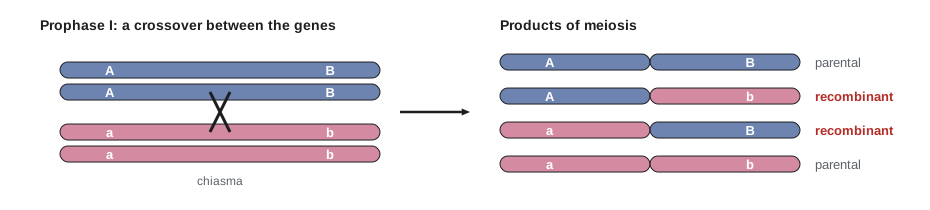
A single crossover involves only two of the four chromatids, so even when a crossover happens between two genes in every meiosis, at most half the gametes are recombinant. This is why the recombination frequency between two genes can never exceed 50 percent. Genes very far apart on the same chromosome recombine so often that they behave as if they were unlinked, giving 50 percent recombinants, just like genes on different chromosomes.
Measuring recombination frequency
The easiest way to count recombinant gametes is a testcross: cross the double heterozygote to a double homozygous recessive (ab/ab). The tester contributes only ab gametes, so the phenotype of each offspring reveals the gamete it received from the heterozygous parent. The recombination frequency (RF) is the proportion of offspring that are recombinant:
Sturtevant's insight was that RF can serve as a measure of distance. He defined one map unit, now called a centimorgan (cM) in Morgan's honor, as the distance giving 1 percent recombinant offspring.
Worked problem
A two-point testcross
In Drosophila, a female heterozygous for black body (b) and vestigial wings (vg), in coupling (b+ vg+ / b vg), is testcrossed to a black, vestigial male. The offspring are 965 wild type, 944 black vestigial, 206 black with normal wings and 185 gray with vestigial wings. How far apart are the genes?
Show solution
- Parental classes (most frequent): wild type 965 and black vestigial 944.
- Recombinant classes (least frequent): black normal 206 and gray vestigial 185.
- Total = 965 + 944 + 206 + 185 = 2,300.
- RF = (206 + 185)/2,300 = 391/2,300 = 0.170.
Answer: About 17 percent recombinants, so the genes are about 17 cM apart on the same chromosome.
The three-point testcross
Two-point crosses give distances but can miss double crossovers, which restore the parental combination for the outer genes and so make distant genes look closer than they are. A three-point testcross, following three linked genes at once, solves this and also reveals the gene order. The procedure is the same every time, and it is worth learning as a recipe.
| Step | What to do |
|---|---|
| 1 | Group the eight offspring classes into four reciprocal pairs |
| 2 | The most frequent pair is parental; the least frequent pair is the double crossovers |
| 3 | Find the gene order: the gene that differs between the parental and double-crossover classes is in the middle |
| 4 | Calculate each interval’s RF, counting single crossovers in that interval plus the double crossovers |
| 5 | Add the two intervals to get the distance between the outer genes |
| 6 | Compare observed with expected double crossovers to calculate interference |
Worked problem
A three-point cross in corn
A corn plant heterozygous for three recessive mutations, v (virescent seedlings), lg (liguleless leaves) and gl (glossy leaves), is testcrossed. The offspring (1,000 total) are: v lg gl 270; + + + 235; v + gl 62; + lg + 40; + + gl 4; v lg + 7; v + + 165; + lg gl 217. Find the gene order and map distances.
Show solution
- Parental classes (largest pair): v lg gl (270) and + + + (235).
- Double crossovers (smallest pair): + + gl (4) and v lg + (7).
- Compare v lg gl with v lg +: only gl has changed, so gl is the middle gene. Order: v – gl – lg.
- Crossovers between v and gl: classes where v and gl have separated from their parental partners: v + + (165) and + lg gl (217), plus the double crossovers (11): RF = (165 + 217 + 11)/1,000 = 0.393.
- Crossovers between gl and lg: v + gl (62) and + lg + (40), plus the double crossovers (11): RF = (62 + 40 + 11)/1,000 = 0.113.
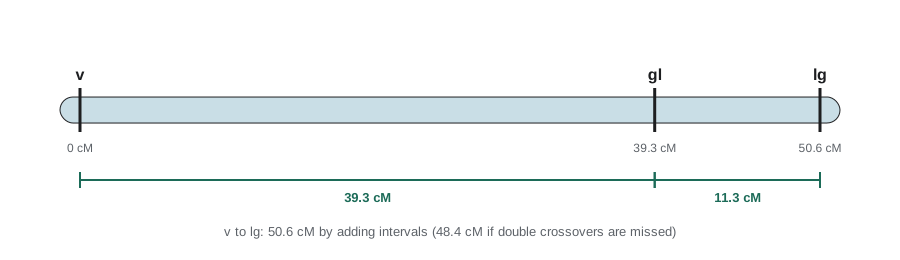
- v to lg distance = 39.3 + 11.3 = 50.6 cM.
Answer: Order v – gl – lg, with v–gl about 39.3 cM and gl–lg about 11.3 cM, so the outer genes are about 50.6 cM apart. A two-point cross of v and lg alone would underestimate this distance by missing the double crossovers.
Interference
If crossovers in two neighboring intervals happened independently, the expected frequency of double crossovers would be the product of the two RFs. In practice there are usually fewer double crossovers than this, because a crossover tends to inhibit another nearby. The coefficient of coincidence (c) and interference (I) measure this:
In the corn example, the expected number of double crossovers is 0.393 × 0.113 × 1,000 ≈ 44, but only 11 were seen, so c = 11/44 ≈ 0.25 and I ≈ 0.75. Three-quarters of the expected double crossovers were suppressed. Interference is usually strong over short distances, often near 1 in intervals of a few centimorgans.
from itertools import combinations

# Three-point testcross data (corn): genotype of the gamete from the heterozygote -> count
data = {("v", "lg", "gl"): 270, ("+", "+", "+"): 235, ("v", "+", "gl"): 62, ("+", "lg", "+"): 40,
        ("+", "+", "gl"): 4, ("v", "lg", "+"): 7, ("v", "+", "+"): 165, ("+", "lg", "gl"): 217}
genes = ["v", "lg", "gl"]
total = sum(data.values())
ranked = sorted(data.items(), key=lambda kv: -kv[1])
parental = ranked[0][0]
double = ranked[-1][0]
# middle gene: the double crossover differs from one of the two parental classes at exactly one gene
parentals = [ranked[0][0], ranked[1][0]]
for par in parentals:
    diff = [g for i, g in enumerate(genes) if par[i] != double[i]]
    if len(diff) == 1:
        middle = diff
print("parental:", parental, "double crossover:", double, "middle gene:", middle[0])

def rf(i, j):
    """Recombinant fraction between genes i and j: alleles separated relative to parental."""
    rec = 0
    for cls, n in data.items():
        same_i = (cls[i] == parental[i]); same_j = (cls[j] == parental[j])
        if same_i != same_j:
            rec += n
    return rec / total

dist = {}
for i, j in combinations(range(3), 2):
    dist[(genes[i], genes[j])] = rf(i, j)
    print(f"{genes[i]}-{genes[j]}: RF = {rf(i, j):.3f}")
m = genes.index(middle[0])
outer = [k for k in range(3) if k != m]
r1, r2 = rf(outer[0], m), rf(m, outer[1])
dco_obs = ranked[-1][1] + ranked[-2][1]
expected = r1 * r2 * total
print(f"map: {genes[outer[0]]} --{100*r1:.1f} cM-- {middle[0]} --{100*r2:.1f} cM-- {genes[outer[1]]}")
print(f"double crossovers observed {dco_obs}, expected {expected:.1f}; "
f"coincidence = {dco_obs/expected:.2f}, interference = {1 - dco_obs/expected:.2f}")parental: ('v', 'lg', 'gl') double crossover: ('+', '+', 'gl') middle gene: gl
v-lg: RF = 0.484
v-gl: RF = 0.393
lg-gl: RF = 0.113
map: v --39.3 cM-- gl --11.3 cM-- lg
double crossovers observed 11, expected 44.4; coincidence = 0.25, interference = 0.75The direct two-point estimate for the outer genes, v and lg, ignores the double crossovers and comes out shorter than the sum of the intervals. This is the main reason for building maps from short intervals.
Map distance and physical distance
Genetic maps measure recombination, not physical length. Crossovers are not evenly distributed: they are rare near centromeres, often concentrated in hotspots a few thousand base pairs long, and more frequent in female than in male meiosis in humans (lesson 6). Across the human genome as a whole, 1 cM corresponds on average to roughly a million base pairs, but the local ratio can vary tenfold or more. The total human genetic map is about 3,500 cM averaged over the sexes, longer in females than in males.
Because double and multiple crossovers go undetected, RF underestimates map distance for genes far apart. Mapping functions correct for this. The simplest, Haldane's mapping function, assumes crossovers occur at random with no interference and converts an observed RF (r) into map distance (d, in morgans):
For small r, \(d \approx r\), so the correction matters only for larger distances. An observed RF of 0.30 corresponds to a Haldane distance of about 0.46 morgans, or 46 cM.
Linkage in human families and LOD scores
In humans, geneticists cannot design testcrosses, so they test for linkage by following a disease and a genetic marker through families. Because family sizes are small, evidence from many families must be combined. The standard measure is the LOD score (logarithm of the odds), introduced by Newton Morton in 1955. It compares the probability of the observed family data if the disease gene and the marker are linked at a given recombination fraction θ with the probability if they are unlinked (θ = 0.5):
By convention, a LOD score of 3 or more (odds of 1,000 to 1 in favor of linkage) is accepted as evidence of linkage, and a score of −2 or less as evidence against. LOD scores from different families can simply be added, which is why they suited the gradual collection of family data.
import math

def lod(recombinants, nonrecombinants, theta):
    """LOD score for phase-known meioses: R recombinants and N non-recombinants."""
    n = recombinants + nonrecombinants
    linked = (theta ** recombinants) * ((1 - theta) ** nonrecombinants)
    unlinked = 0.5 ** n
    return math.log10(linked / unlinked)

# Combined data from several families: 2 recombinants among 20 informative meioses (invented)
R, N = 2, 18
best = max((lod(R, N, t / 100), t / 100) for t in range(1, 50))
for theta in (0.01, 0.05, 0.10, 0.20, 0.30, 0.40):
    print(f"theta = {theta:.2f}: LOD = {lod(R, N, theta):5.2f}")
print(f"maximum LOD = {best[0]:.2f} at theta = {best[1]:.2f}")theta = 0.01: LOD = 1.94 theta = 0.05: LOD = 3.02 theta = 0.10: LOD = 3.20 theta = 0.20: LOD = 2.88 theta = 0.30: LOD = 2.19 theta = 0.40: LOD = 1.23 maximum LOD = 3.20 at theta = 0.10
Linkage analysis with LOD scores mapped the genes for Huntington disease (to chromosome 4 in 1983), cystic fibrosis (chromosome 7, 1985) and many others before they were identified. The cystic fibrosis gene was then found in 1989 by a team at the Hospital for Sick Children in Toronto and the University of Michigan, one of the first human disease genes found purely from its map position. Today most new disease genes are found by sequencing, but linkage still helps narrow the search in large families.
Uses of genetic maps
Genetic maps are not just of historical interest. Plant and animal breeders use maps of molecular markers to follow valuable genes through crosses, a technique called marker-assisted selection: a seedling can be tested for markers linked to a disease-resistance gene long before the plant is old enough to show resistance. Maps also underpin the study of quantitative traits (lesson 11), the forensic and ancestry use of DNA markers, and the assembly of genome sequences, which must be anchored to chromosomes.
Common mistakes
MistakeRecombination frequency can be as high as 100 percent for distant genes.
InsteadA crossover involves only two of four chromatids, so RF cannot exceed 50 percent.
MistakeThe most frequent classes in a testcross are the recombinants.
InsteadFor linked genes the parental classes are the most frequent.
MistakeIn a three-point cross, the middle gene is the one listed in the middle of the data.
InsteadThe middle gene is the one whose allele differs between the parental and double-crossover classes.
MistakeOne centimorgan always equals one million base pairs.
InsteadThat is only a genome-wide average; the ratio varies greatly with recombination hotspots, centromeres and sex.
MistakeA LOD score of 1 shows linkage.
InsteadA LOD of 1 is only 10 : 1 odds; the threshold for accepting linkage is 3.
Summary and key terms
- Genes on the same chromosome are linked and tend to be inherited together; crossing over produces recombinants.
- Coupling (AB/ab) and repulsion (Ab/aB) describe how linked alleles are arranged on homologues.
- Recombination frequency from a testcross measures map distance: 1 percent = 1 centimorgan; RF cannot exceed 50 percent.
- Three-point crosses reveal gene order (the middle gene changes in double crossovers) and detect double crossovers.
- Interference reduces double crossovers; I = 1 − observed/expected double crossovers.
- Map distances differ from physical distances; mapping functions such as Haldane’s correct for multiple crossovers.
- LOD scores of 3 or more indicate linkage in human families; maps guide disease-gene discovery and breeding.
- linkage
- The tendency of genes close together on a chromosome to be inherited together.
- recombinant
- A gamete or offspring with a combination of alleles not present in either parental chromosome.
- coupling
- Arrangement of linked genes with both dominant alleles on one homologue (cis).
- repulsion
- Arrangement of linked genes with one dominant allele on each homologue (trans).
- recombination frequency
- The proportion of recombinant offspring, used to estimate map distance.
- centimorgan
- The map distance giving 1 percent recombination.
- three-point testcross
- A testcross following three linked genes to find gene order and distances.
- interference
- The reduction in double crossovers below the number expected if crossovers were independent.
- mapping function
- A formula converting recombination frequency into map distance, correcting for multiple crossovers.
- LOD score
- The base-10 logarithm of the odds favoring linkage at a given recombination fraction.
Practice problems
Work each problem on paper first, then reveal the answer to check.
A testcross gives 430 AB, 418 ab, 76 Ab and 76 aB offspring. What is the RF?
Show answer
152/1,000 = 15.2 percent (15.2 cM).
Why can RF never exceed 50 percent?
Show answer
Each crossover involves only two of the four chromatids; even with crossovers in every meiosis at most half the products are recombinant.
Genes A and B are 10 cM apart, B and C are 20 cM apart, and A and C are 30 cM apart. What is the gene order?
Show answer
A – B – C.
In a three-point cross the parental classes are a b c and + + +, and the double crossovers are a + c and + b +. Which gene is in the middle?
Show answer
b.
If two intervals have RFs of 0.10 and 0.20 among 2,000 offspring, how many double crossovers are expected without interference?
Show answer
0.10 × 0.20 × 2,000 = 40.
If only 10 double crossovers are seen instead of 40, what is the interference?
Show answer
c = 10/40 = 0.25, so I = 0.75.
Use Haldane’s function to convert an RF of 0.20 to map distance.
Show answer
d = −0.5 ln(0.6) ≈ 0.255 morgans (25.5 cM).
What LOD score is conventionally accepted as evidence of linkage?
Show answer
3 or more.
A double heterozygote is in repulsion (Ab/aB). Which testcross classes are parental?
Show answer
Ab and aB.
Give one use of genetic maps in agriculture.
Show answer
Marker-assisted selection for disease resistance or other valuable traits.
Lesson quiz · 5 questions
Score 60% or more to complete this lesson.
Create a free account to save your progress, take quizzes and earn a certificate.