
BIOL-201 · Lesson 7 of 12 · 27 min
Sex determination, sex linkage and pedigree analysis
Genes on the sex chromosomes are inherited differently from genes on autosomes, because males and females carry different numbers of X chromosomes. This lesson explains how sex is determined in different organisms, how X-linked and Y-linked genes are transmitted, why X-linked recessive conditions such as hemophilia and red–green color blindness are far more common in males, and how geneticists read family trees, or pedigrees, to work out how a trait is inherited and to estimate risks for relatives.
How sex is determined
Organisms determine sex in strikingly different ways, which shows that sex determination has evolved many times.
| System | Females | Males | Examples |
|---|---|---|---|
| XX–XY (Y-dominant) | XX | XY; the Y carries a male-determining gene | Most mammals, including humans |
| XX–XY (X-counting) | XX | XY; sex depends on the number of X chromosomes | Drosophila |
| XX–XO | XX | X only (no second sex chromosome) | Grasshoppers, C. elegans (males; XX are hermaphrodites) |
| ZW–ZZ | ZW | ZZ | Birds, butterflies, some reptiles |
| Haplodiploidy | Diploid (fertilized eggs) | Haploid (unfertilized eggs) | Bees, wasps, ants |
| Temperature-dependent | Set by incubation temperature | Set by incubation temperature | Many turtles, all crocodilians |
In humans and other mammals, the key is a gene on the Y chromosome called SRY (sex-determining region Y). In an XY embryo, SRY switches on a cascade of genes that turns the undifferentiated gonads into testes, which then produce hormones that direct male development. Rare XX individuals who carry a copy of SRY translocated to an X chromosome develop as males, and rare XY individuals with a non-functional SRY develop as females, confirming its role. Sex development involves many other genes as well, and differences in sex development, in which chromosomes, gonads and anatomy do not align in the typical way, occur in perhaps 1 in several thousand births, depending on how they are defined.
In Drosophila, by contrast, the Y chromosome is not male-determining: XO flies are male (though sterile) and XXY flies are female. Sex depends on the ratio of X chromosomes to sets of autosomes. Calvin Bridges discovered this in the 1920s while studying flies with abnormal chromosome numbers, work that also provided the final proof of the chromosome theory.
Dosage compensation
Females have two X chromosomes and males one, yet X-linked genes are expressed at similar levels in both sexes. Organisms solve this dosage problem differently. In mammals, one X chromosome in each female cell is inactivated early in embryonic development and condensed into a dark-staining Barr body, named after Murray Barr of the University of Western Ontario, who with Ewart Bertram discovered it in 1949. Mary Lyon proposed in 1961 that the inactivated X is chosen at random in each cell and stays inactive in all of that cell's descendants. Female mammals are therefore mosaics of cells expressing one X or the other.
The tortoiseshell or calico cat is the classic visible example. The orange and black coat color alleles are on the X chromosome, so a female heterozygous for them has patches of orange fur (where the X with the black allele is inactive) and black fur (where the X with the orange allele is inactive). Calico cats are therefore almost always female; the rare male calicos are usually XXY. In Drosophila, dosage compensation works the other way: the single male X is transcribed at about twice the rate.
X-linked inheritance
Genes on the X chromosome show a distinctive pattern because males are hemizygous: they have only one copy of each X-linked gene, so a single recessive allele on their X is expressed. A male receives his X from his mother and his Y from his father, so a father cannot pass an X-linked allele to his son, but passes it to all of his daughters.
Morgan's experiments showed this in 1910. He crossed his white-eyed male with red-eyed females; all the F1 had red eyes. In the F2, red-eyed and white-eyed flies appeared in a 3 : 1 ratio, but all the white-eyed flies were male. The reciprocal cross, white-eyed females with red-eyed males, gave red-eyed daughters and white-eyed sons. The results made sense only if the eye-color gene was on the X chromosome. The convention is to write X-linked alleles as superscripts on the X: X^w for white and X^+ for the wild-type red allele.
from itertools import product
from collections import Counter

def offspring(mother, father):
    """mother: two X alleles, e.g. ('X+', 'Xw'); father: X allele and 'Y'."""
    out = Counter()
    for egg, sperm in product(mother, father):
        sex = "son" if sperm == "Y" else "daughter"
        geno = egg + "/" + sperm
        recessive = (sex == "son" and egg == "Xw") or (sex == "daughter" and egg == sperm == "Xw")
        out[(sex, geno, "white" if recessive else "red")] += 1
    return out

for label, mom, dad in [("red female x white male", ("X+", "X+"), ("Xw", "Y")),
                        ("F1 x F1", ("X+", "Xw"), ("X+", "Y")),
                        ("white female x red male", ("Xw", "Xw"), ("X+", "Y"))]:
    print(label)
    for (sex, geno, phen), n in sorted(offspring(mom, dad).items()):
print(f" {sex:8s} {geno:6s} {phen:5s} {n}/4")red female x white male daughter X+/Xw red 2/4 son X+/Y red 2/4 F1 x F1 daughter X+/X+ red 1/4 daughter Xw/X+ red 1/4 son X+/Y red 1/4 son Xw/Y white 1/4 white female x red male daughter Xw/X+ red 2/4 son Xw/Y white 2/4
X-linked conditions in humans
Several well-known human conditions are X-linked recessive. Because a male needs only one copy of the allele to be affected while a female usually needs two, these conditions are much more common in males. If the frequency of a recessive X-linked allele is q, the frequency of affected males is q while the frequency of affected females is q². For red–green color vision deficiency, about 8 percent of males of northern European ancestry are affected, so q ≈ 0.08 and only about 0.6 percent of females.
| Condition | Gene | Approximate frequency in males | Notes |
|---|---|---|---|
| Red–green color vision deficiency | OPN1LW and OPN1MW | About 8 percent (northern European ancestry); lower in many other populations | Usually mild; daughters of affected men are carriers |
| Hemophilia A | F8 (clotting factor VIII) | About 1 in 5,000 | Bleeding disorder; about one-third of cases arise from new mutations |
| Hemophilia B | F9 (clotting factor IX) | About 1 in 25,000 | The “royal disease” of Queen Victoria’s descendants |
| Duchenne muscular dystrophy | DMD (dystrophin) | About 1 in 3,500 to 5,000 | Progressive muscle weakness from early childhood |
| G6PD deficiency | G6PD | Common where malaria is or was endemic | Hemolysis triggered by certain foods and drugs; some malaria protection |
X-linked dominant conditions are rarer. In them, affected fathers pass the trait to all daughters and no sons, and affected heterozygous mothers pass it to half their children of either sex. Examples include X-linked hypophosphatemic rickets and Rett syndrome, which is seen almost entirely in girls because most affected male embryos do not survive.
Y-linked inheritance
The human Y chromosome is small and carries only a few dozen protein-coding genes, many involved in male fertility. Y-linked traits pass from father to son in every generation and never to daughters. Because the Y does not recombine with the X along most of its length, it passes almost unchanged down the male line, which makes it useful for tracing paternal ancestry and in forensic work; the mitochondrial genome plays the same role for the maternal line (lesson 12).
Reading pedigrees
Humans cannot be crossed experimentally, so human geneticists rely on pedigrees: diagrams of family relationships showing who has a trait. Squares represent males and circles females; filled symbols are affected individuals, and half-filled or dotted symbols may show known carriers. A horizontal line joins mates, a vertical line leads to their children, and generations are numbered with Roman numerals. The person who brought the family to medical attention is the proband, marked with an arrow.
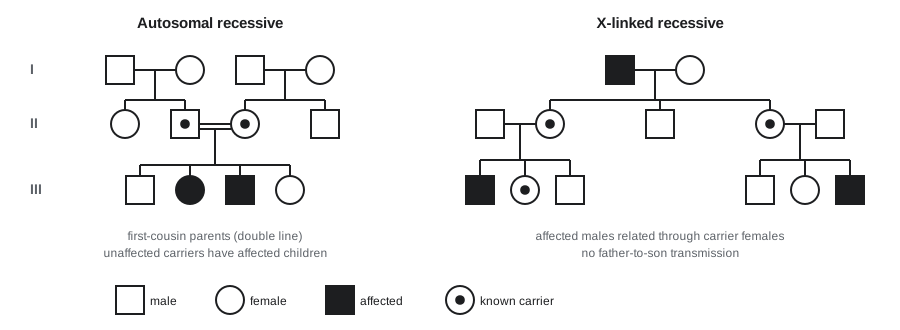
Each mode of inheritance leaves a characteristic signature in a pedigree. Working through these clues, and ruling out patterns that are impossible, is the core skill of pedigree analysis.
| Mode | Key clues in a pedigree |
|---|---|
| Autosomal recessive | Affected children of unaffected parents; both sexes equally affected; often appears in only one sibship; more likely with consanguinity |
| Autosomal dominant | Every affected person has an affected parent (unless a new mutation or incomplete penetrance); both sexes affected; male-to-male transmission occurs; about half the children of an affected parent are affected |
| X-linked recessive | Mostly males affected; affected males are related through unaffected carrier females; no male-to-male transmission; all daughters of affected males are carriers |
| X-linked dominant | Affected fathers have all daughters and no sons affected; more females than males affected |
| Y-linked | Only males affected; every son of an affected father affected |
| Mitochondrial | Passed by affected mothers to all children; never through fathers (lesson 12) |
Two observations are especially decisive. Male-to-male transmission rules out X-linked inheritance, because a father gives his son a Y, not an X. Two affected parents with an unaffected child rule out recessive inheritance, because two homozygous recessive parents can have only homozygous recessive children (barring new mutations or incomplete penetrance).
Worked problem
Analyzing a pedigree
In a family, an affected man and an unaffected woman have two affected sons and one unaffected daughter. One of the affected sons has an affected son of his own. What modes can be ruled out?
Show solution
- Male-to-male transmission (father to son, and son to grandson) rules out X-linked inheritance.
- Only males are affected, so Y-linked inheritance is possible, but an unaffected daughter is also consistent with autosomal patterns.
- Autosomal recessive would require the unaffected mother to be a carrier, possible but less likely if the trait is rare.
- Autosomal dominant fits well: each affected child has an affected parent.
Answer: X-linked inheritance is ruled out. Autosomal dominant is most likely; Y-linked and autosomal recessive remain possible and more families would be needed to distinguish them.
Calculating risks for X-linked conditions
Risk calculations for X-linked recessive conditions often use the conditional probability approach of lesson 3, extended into Bayesian analysis. Consider a woman whose brother has Duchenne muscular dystrophy and whose mother is a known carrier. Her prior probability of being a carrier is 1/2. If she has already had healthy sons, each one makes it a little less likely that she is a carrier, because a carrier would have a 1/2 chance with each son of having an affected one. Bayes' theorem combines the prior with this evidence.
from fractions import Fraction

def posterior_carrier(prior, unaffected_sons):
    """Bayesian risk that a woman is a carrier of an X-linked recessive allele."""
    like_carrier = Fraction(1, 2) ** unaffected_sons   # each son unaffected with P 1/2
    like_noncarrier = Fraction(1)
    num = prior * like_carrier
    return num / (num + (1 - prior) * like_noncarrier)

prior = Fraction(1, 2)            # her mother is a known carrier
for sons in range(0, 5):
    post = posterior_carrier(prior, sons)
    risk_next_son = post * Fraction(1, 2)
    print(f"{sons} unaffected sons: carrier probability {str(post):>5s} = {float(post):.3f}; "
f"risk for next son {float(risk_next_son):.3f}")0 unaffected sons: carrier probability 1/2 = 0.500; risk for next son 0.250 1 unaffected sons: carrier probability 1/3 = 0.333; risk for next son 0.167 2 unaffected sons: carrier probability 1/5 = 0.200; risk for next son 0.100 3 unaffected sons: carrier probability 1/9 = 0.111; risk for next son 0.056 4 unaffected sons: carrier probability 1/17 = 0.059; risk for next son 0.029
Three unaffected sons lower her carrier risk from 1/2 to 1/9. In real counseling, these calculations are combined with laboratory evidence, such as measuring creatine kinase in blood or, today, testing directly for the family's specific mutation, which usually gives a definitive answer.
Sex-influenced and sex-limited traits
Not every trait that differs between the sexes is sex-linked. Sex-influenced traits are controlled by autosomal genes whose expression depends on the sex of the individual, usually because of hormones. Male-pattern baldness is an example: an allele that is dominant in males behaves more like a recessive in females. Sex-limited traits are expressed in only one sex, although both sexes carry the genes. Milk production in dairy cattle and beard growth in humans are sex-limited; a bull carries genes affecting milk yield and passes them to his daughters, which is why dairy breeders evaluate bulls by the milk production of their daughters.
Common mistakes
MistakeA father can pass an X-linked recessive allele to his son.
InsteadA father gives his son a Y chromosome, so X-linked alleles pass from fathers only to daughters.
MistakeX-linked recessive conditions never affect females.
InsteadFemales can be affected if they are homozygous, or occasionally through skewed X inactivation, but this is much rarer.
MistakeIn birds, as in mammals, females are XX.
InsteadBirds use the ZW system: females are ZW and males ZZ.
MistakeTwo affected parents can have an unaffected child if the trait is autosomal recessive.
InsteadTwo affected recessive parents can only have affected children; an unaffected child points to dominant inheritance.
MistakeMale-pattern baldness is X-linked because it is more common in men.
InsteadIt is largely sex-influenced, controlled by genes whose expression depends on hormones; many genes, including autosomal ones, contribute.
Summary and key terms
- Sex is determined by chromosomes (XY, ZW, XO), ploidy (haplodiploidy) or temperature, depending on the species.
- In mammals the Y-linked SRY gene triggers testis development.
- Mammals equalize X-linked gene dosage by random X inactivation, making females mosaics, as calico cats show.
- Males are hemizygous for X-linked genes, so X-linked recessive traits are more common in males and pass from carrier mothers to sons.
- Fathers pass X-linked alleles to all daughters and no sons; Y-linked traits pass father to son.
- Pedigree analysis identifies inheritance patterns; male-to-male transmission excludes X-linkage.
- Bayesian calculations update carrier risks using information such as the number of unaffected sons.
- sex chromosomes
- Chromosomes that differ between the sexes, such as X and Y or Z and W.
- SRY
- The Y-chromosome gene that initiates male development in mammals.
- hemizygous
- Having only one copy of a gene, as males have for X-linked genes.
- X inactivation
- Silencing of one X chromosome in each cell of female mammals.
- Barr body
- The condensed, inactive X chromosome visible in female mammalian cells.
- X-linked
- Describes a gene located on the X chromosome.
- pedigree
- A diagram of family relationships showing the inheritance of a trait.
- proband
- The person through whom a family first comes to medical attention.
- sex-influenced trait
- An autosomal trait expressed differently in males and females.
- sex-limited trait
- A trait expressed in only one sex though both carry the genes.
Practice problems
Work each problem on paper first, then reveal the answer to check.
A color-blind man and a woman homozygous for normal vision have children. What are the expected phenotypes?
Show answer
All sons have normal vision; all daughters are carriers with normal vision.
A carrier woman and a normal man have children. What fraction of their sons is affected by an X-linked recessive condition?
Show answer
1/2.
Why are calico cats almost always female?
Show answer
The orange and black alleles are X-linked; patches arise from random X inactivation in heterozygous females.
In birds, which sex is hemizygous for Z-linked genes?
Show answer
Females (ZW).
What pedigree observation rules out X-linked inheritance?
Show answer
Father-to-son transmission.
If 6 percent of males have an X-linked recessive trait, what fraction of females is expected to have it?
Show answer
q = 0.06, so q² = 0.0036 (0.36 percent).
A woman whose mother is a carrier of hemophilia has one unaffected son. What is her carrier probability?
Show answer
(1/2 × 1/2) / (1/2 × 1/2 + 1/2) = 1/3.
What role does SRY play?
Show answer
It triggers testis development, leading to male development.
Give an example of a sex-limited trait.
Show answer
Milk production in cattle, or beard growth in humans.
Why can Y-chromosome markers trace paternal ancestry?
Show answer
The Y passes from father to son and mostly does not recombine, so it changes little over generations.
Lesson quiz · 5 questions
Score 60% or more to complete this lesson.
Create a free account to save your progress, take quizzes and earn a certificate.