
BIOL-107 · Lesson 9 of 12 · 26 min
Cellular respiration
Every cell needs a steady supply of ATP (lesson 8), and most cells make it by breaking down food molecules in a controlled series of steps called cellular respiration. Burning a gram of sugar in a flame releases its energy all at once as heat and light. A cell releases the same energy in dozens of small steps, capturing a large share of it in ATP. This lesson follows a glucose molecule through glycolysis, pyruvate oxidation, the citric acid cycle and oxidative phosphorylation, then shows what happens when oxygen runs out. BIOC-330 and BIOC-331 revisit each pathway in chemical detail.
The overall equation and the idea of redox
Aerobic respiration of glucose can be summarized as:
The equation hides the key chemistry: respiration is a series of redox reactions, transfers of electrons. Oxidation is the loss of electrons (in biology, often the loss of hydrogen atoms, each with its electron); reduction is the gain of electrons. A useful memory aid is OIL RIG: oxidation is loss, reduction is gain. Glucose is oxidized to carbon dioxide, and oxygen is reduced to water. Electrons move from glucose, which holds them loosely and at high energy, to oxygen, which pulls them strongly, and the energy released along the way is used to make ATP.
Cells do not hand electrons straight to oxygen, which would release energy explosively. Instead, enzymes strip electrons, with hydrogen, from food molecules and pass them to carrier molecules, chiefly NAD+ (nicotinamide adenine dinucleotide), which becomes NADH, and FAD, which becomes FADH2. These reduced carriers then deliver electrons to a chain of proteins in the inner mitochondrial membrane, where the energy is released in small steps. Think of NADH as a charged battery carrying electrons to the mitochondria.
Stage 1: glycolysis
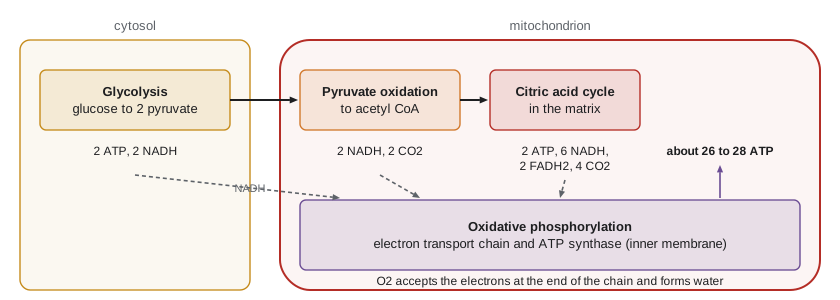
Glycolysis (sugar splitting) happens in the cytosol and needs no oxygen. In ten enzyme-catalyzed steps, one six-carbon glucose molecule is split into two three-carbon molecules of pyruvate. The pathway has two phases. In the investment phase, the cell spends 2 ATP to phosphorylate glucose, trapping it in the cell and destabilizing it. In the payoff phase, it produces 4 ATP by substrate-level phosphorylation (transferring phosphate groups directly from a substrate to ADP) and reduces 2 NAD+ to 2 NADH.
| Glycolysis per glucose | Amount |
|---|---|
| ATP used (investment phase) | 2 |
| ATP produced (payoff phase) | 4 |
| Net ATP | 2 |
| NADH produced | 2 |
| Products | 2 pyruvate (3 carbons each) |
| Location | Cytosol |
| Oxygen required? | No |
Glycolysis is found in nearly all living things, a sign that it evolved very early, before Earth's atmosphere contained much oxygen. It is a central hub: other sugars, and the glycerol from fats, feed into it, and its intermediates are used to build amino acids and lipids. One of its enzymes, phosphofructokinase, is a major control point; it is allosterically inhibited by ATP and citrate, so glycolysis slows when the cell already has plenty of energy (feedback regulation, lesson 8).
Stage 2: pyruvate oxidation
If oxygen is available, pyruvate is transported into the mitochondrial matrix. There, a large enzyme complex, pyruvate dehydrogenase, removes one carbon as carbon dioxide, oxidizes the remaining two-carbon fragment and attaches it to coenzyme A (made from the vitamin pantothenic acid), forming acetyl CoA. Each pyruvate also reduces one NAD+ to NADH. Since each glucose gives two pyruvates, this stage yields 2 CO2, 2 NADH and 2 acetyl CoA per glucose.
Stage 3: the citric acid cycle
Acetyl CoA enters the citric acid cycle, also called the Krebs cycle after Hans Krebs, who worked it out in 1937. In the matrix, the two-carbon acetyl group joins a four-carbon molecule, oxaloacetate, to form six-carbon citrate. Over eight steps, citrate is oxidized back to oxaloacetate, releasing two carbon dioxide molecules, so the cycle can turn again. Each turn produces 3 NADH, 1 FADH2 and 1 ATP (or the similar molecule GTP). Two turns are needed per glucose.
| Citric acid cycle | Per acetyl CoA (one turn) | Per glucose (two turns) |
|---|---|---|
| CO2 released | 2 | 4 |
| NADH | 3 | 6 |
| FADH2 | 1 | 2 |
| ATP (or GTP) | 1 | 2 |
By the end of the citric acid cycle, all six carbons of glucose have left as carbon dioxide: two during pyruvate oxidation and four in the cycle. The carbon dioxide you exhale comes from these steps. But so far the cell has made only 4 ATP per glucose. Most of glucose's energy is now held by the electrons in 10 NADH and 2 FADH2.
Stage 4: oxidative phosphorylation
The final stage converts the energy of those electrons into ATP, and it is where most ATP is made. It has two linked parts.
First, the electron transport chain: a series of protein complexes (I to IV) and mobile carriers embedded in the inner mitochondrial membrane. NADH hands its electrons to complex I; FADH2 hands its electrons to complex II, a step later, which is why it yields less ATP. Electrons pass from carrier to carrier, each with a stronger pull than the last, until complex IV gives them to oxygen, which combines with hydrogen ions to form water. Oxygen is the final electron acceptor; without it the chain backs up and stops. As electrons flow, complexes I, III and IV use the released energy to pump hydrogen ions (protons) from the matrix into the intermembrane space, building a steep proton gradient.
Second, chemiosmosis. The inner membrane is impermeable to protons, so the only way back into the matrix is through ATP synthase, a remarkable molecular machine. As protons flow through it down their gradient, part of the enzyme physically rotates, about 100 to 150 times a second, and the rotation drives the joining of ADP and phosphate into ATP. Peter Mitchell proposed this chemiosmotic theory in 1961 against strong skepticism; he received the 1978 Nobel Prize in Chemistry, and Paul Boyer and John Walker shared the 1997 prize for working out how ATP synthase works.
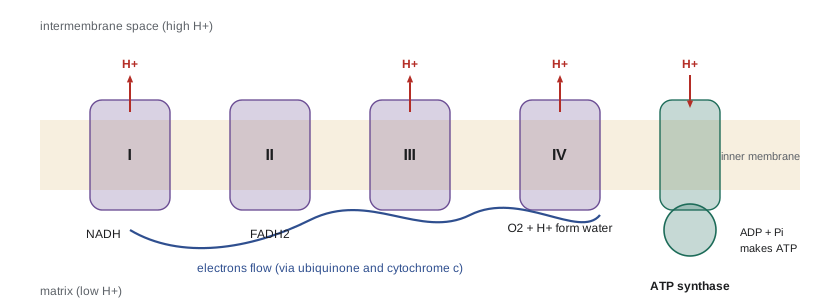
The gradient is a form of stored energy, called the proton-motive force, like water held behind a dam with ATP synthase as the turbine. The same principle, using an electron transport chain to pump protons and a membrane ATP synthase to make ATP, operates in chloroplasts (lesson 10) and in the plasma membranes of bacteria. It is one of the most universal features of life.
Counting the ATP
How much ATP does one glucose yield? Textbooks used to say 36 or 38, but measurements show that about 10 protons must flow back for each ATP made and exported, giving roughly 2.5 ATP per NADH and 1.5 per FADH2. The modern estimate is about 30 to 32 ATP per glucose. The exact number varies because the proton gradient is also used for other jobs and because the NADH made in the cytosol by glycolysis must be shuttled into the mitochondrion, sometimes at a cost.
# ATP yield per glucose using modern P/O ratios
ATP_PER_NADH, ATP_PER_FADH2 = 2.5, 1.5
stages = {                                  # (substrate-level ATP, NADH, FADH2)
    "glycolysis":         (2, 2, 0),
    "pyruvate oxidation": (0, 2, 0),
    "citric acid cycle":  (2, 6, 2),
}
total = 0
for name, (atp, nadh, fadh2) in stages.items():
    made = atp + nadh * ATP_PER_NADH + fadh2 * ATP_PER_FADH2
    total += made
    print(f"{name:<19} ATP {atp}, NADH {nadh}, FADH2 {fadh2}  ->  {made:4.1f} ATP")
print(f"Total with malate-aspartate shuttle: {total:.0f} ATP")
# glycerol phosphate shuttle: cytosolic NADH enters as FADH2 (1.5 instead of 2.5 each)
print(f"Total with glycerol phosphate shuttle: {total - 2 * (ATP_PER_NADH - ATP_PER_FADH2):.0f} ATP")glycolysis ATP 2, NADH 2, FADH2 0 -> 7.0 ATP pyruvate oxidation ATP 0, NADH 2, FADH2 0 -> 5.0 ATP citric acid cycle ATP 2, NADH 6, FADH2 2 -> 20.0 ATP Total with malate-aspartate shuttle: 32 ATP Total with glycerol phosphate shuttle: 30 ATP
Worked problem
How efficient is respiration?
Complete oxidation of glucose releases about 2,870 kJ/mol under standard conditions. If a cell makes 30 ATP per glucose and each ATP stores about 50 kJ/mol under cell conditions, what fraction of the energy is captured?
Show solution
- Energy captured = 30 × 50 = 1,500 kJ per mole of glucose.
- Efficiency = 1,500 / 2,870 ≈ 0.52.
- Using the standard value of 30.5 kJ per ATP instead gives 30 × 30.5 / 2,870 ≈ 0.32.
Answer: Roughly a third to a half of glucose’s energy is captured in ATP, depending on how the ATP energy is counted. The rest is released as heat, which helps keep mammals and birds warm. A car engine converts only about 25 to 30 percent of its fuel’s energy into motion.
Poisons, heat and disease
Because oxidative phosphorylation is so central, interfering with it is deadly. Cyanide and carbon monoxide block complex IV, stopping electron flow, so cells cannot use oxygen even when it is plentiful. Some substances called uncouplers make the inner membrane leaky to protons, so the gradient collapses without making ATP and the energy is released as heat. Brown fat, found in newborns and in some adults, does this deliberately: a protein called thermogenin (UCP1) lets protons leak back to generate heat. A drug called 2,4-dinitrophenol was sold as a weight-loss pill in the 1930s because it uncouples mitochondria; it caused deaths from overheating and is banned for human use.
Mitochondrial diseases, caused by mutations in mitochondrial or nuclear genes for respiratory proteins, mainly affect energy-hungry tissues: brain, muscle, heart and eyes. Because mitochondria are inherited through the egg, mutations in mitochondrial DNA pass from mothers to all their children. The United Kingdom (from 2015) and Australia (from 2022) have legalized mitochondrial donation techniques to prevent transmission in some families; other countries, including Canada and the United States, do not currently permit clinical use.
When oxygen runs out: fermentation
Without oxygen, the electron transport chain stops, NADH cannot unload its electrons, and the cell soon runs out of NAD+. Since glycolysis needs NAD+, it would stop too, cutting off even its small supply of ATP. Fermentation solves this by using the electrons from NADH to reduce pyruvate, regenerating NAD+ so glycolysis can continue. Fermentation itself makes no extra ATP; it keeps glycolysis running, at 2 ATP per glucose.
| Pathway | End products | Where it happens | ATP per glucose |
|---|---|---|---|
| Aerobic respiration | CO2 and water | Most cells with oxygen | About 30 to 32 |
| Lactic acid fermentation | Lactate | Muscle cells short of oxygen; red blood cells (which lack mitochondria); bacteria in yogurt | 2 |
| Alcoholic fermentation | Ethanol and CO2 | Yeast in bread, beer and wine; some bacteria | 2 |
| Anaerobic respiration | Varies (for example, sulfide or nitrite) | Some bacteria and archaea using sulfate or nitrate instead of oxygen | Intermediate |
During intense exercise, muscles make ATP faster than oxygen can be delivered, so some pyruvate becomes lactate. Lactate is carried in the blood to the liver and heart, where it is converted back to pyruvate and used. (The old idea that lactic acid causes next-day muscle soreness is not supported; soreness comes mainly from small injuries to muscle fibers.) Yeast's alcoholic fermentation gives bread its rise (carbon dioxide) and beer and wine their alcohol (ethanol).
Respiration of fats and proteins
Cells respire more than glucose. Fats are broken into glycerol, which enters glycolysis, and fatty acids, which are cut two carbons at a time into acetyl CoA by beta-oxidation in the mitochondria, generating large amounts of NADH and FADH2. A 16-carbon fatty acid, palmitate, yields about 106 ATP, which is why fat stores so much energy. Proteins are broken into amino acids, which lose their amino groups (excreted as urea in mammals) and enter the pathway at several points. The citric acid cycle is therefore a crossroads for the breakdown of all major food molecules, and its intermediates are also drawn off to build new molecules.
Common mistakes
MistakeRespiration means breathing.
InsteadBreathing (ventilation) brings in oxygen; cellular respiration is the chemical breakdown of food in cells to make ATP.
MistakeMost ATP is made in glycolysis.
InsteadGlycolysis makes only 2 net ATP per glucose; about 26 to 28 come from oxidative phosphorylation in mitochondria.
MistakeOxygen is needed to make carbon dioxide.
InsteadCarbon dioxide is released in pyruvate oxidation and the citric acid cycle; oxygen’s role is to accept electrons at the end of the chain, forming water.
MistakeFermentation produces extra ATP from pyruvate.
InsteadFermentation makes no extra ATP; it regenerates NAD+ so glycolysis can continue making 2 ATP per glucose.
MistakePlants photosynthesize instead of respiring.
InsteadPlants respire in their mitochondria at all times, using sugars made by photosynthesis.
Summary and key terms
- Respiration oxidizes glucose to CO2 and reduces O2 to water, capturing energy in ATP through a series of redox steps.
- NAD+ and FAD carry electrons from food to the electron transport chain as NADH and FADH2.
- Glycolysis in the cytosol splits glucose into 2 pyruvate, netting 2 ATP and 2 NADH without oxygen.
- Pyruvate oxidation and the citric acid cycle in the matrix release all six carbons as CO2 and produce NADH, FADH2 and 2 ATP.
- The electron transport chain pumps protons; ATP synthase uses the proton gradient (chemiosmosis) to make most of the ATP. Oxygen is the final electron acceptor.
- The modern yield is about 30 to 32 ATP per glucose (2.5 per NADH, 1.5 per FADH2), capturing roughly a third to a half of the energy.
- Without oxygen, fermentation regenerates NAD+ so glycolysis can continue, producing lactate or ethanol and CO2.
- cellular respiration
- The breakdown of food molecules in cells to release energy and make ATP.
- oxidation
- Loss of electrons (often with hydrogen) from a molecule.
- reduction
- Gain of electrons by a molecule.
- NAD+
- An electron carrier that accepts electrons and hydrogen to become NADH.
- glycolysis
- The splitting of glucose into two pyruvate in the cytosol, netting 2 ATP and 2 NADH.
- citric acid cycle
- A cycle in the mitochondrial matrix that oxidizes acetyl CoA to CO2, producing NADH, FADH2 and ATP.
- electron transport chain
- Protein complexes in the inner mitochondrial membrane that pass electrons to oxygen and pump protons.
- chemiosmosis
- Use of a proton gradient across a membrane to drive ATP synthesis.
- ATP synthase
- A rotary enzyme that makes ATP as protons flow through it.
- fermentation
- Anaerobic regeneration of NAD+ by reducing pyruvate to lactate or ethanol.
Practice problems
Work each problem on paper first, then reveal the answer to check.
Write the overall equation for aerobic respiration of glucose.
Show answer
C6H12O6 + 6 O2 → 6 CO2 + 6 H2O, releasing about 2,870 kJ/mol.
In respiration, which molecule is oxidized and which is reduced?
Show answer
Glucose is oxidized to CO2; oxygen is reduced to water.
What are the net products of glycolysis per glucose?
Show answer
2 pyruvate, 2 ATP (net) and 2 NADH.
Where in the cell does each stage of respiration occur?
Show answer
Glycolysis in the cytosol; pyruvate oxidation and the citric acid cycle in the matrix; oxidative phosphorylation in the inner mitochondrial membrane.
Why does FADH2 yield less ATP than NADH?
Show answer
It enters the electron transport chain at complex II, after complex I, so its electrons drive fewer protons across the membrane.
Explain why cyanide is lethal even when a person is breathing oxygen.
Show answer
It blocks complex IV, so electrons cannot pass to oxygen; the chain stops, the proton gradient collapses and ATP production fails.
Using 2.5 ATP per NADH and 1.5 per FADH2, how much ATP comes from the 6 NADH and 2 FADH2 of the citric acid cycle per glucose?
Show answer
6 × 2.5 + 2 × 1.5 = 18 ATP.
What is the purpose of fermentation?
Show answer
To regenerate NAD+ from NADH so glycolysis can continue producing ATP without oxygen.
How does brown fat produce heat?
Show answer
Thermogenin (UCP1) lets protons leak back across the inner membrane without passing through ATP synthase, so the energy is released as heat.
How do fats enter respiration?
Show answer
Glycerol enters glycolysis; fatty acids are broken into acetyl CoA by beta-oxidation, which enters the citric acid cycle.
Lesson quiz · 5 questions
Score 60% or more to complete this lesson.
Create a free account to save your progress, take quizzes and earn a certificate.