
BIOL-107 · Lesson 8 of 12 · 30 min
Energy, enzymes and metabolism
Staying alive costs energy. A cell must build proteins and membranes, pump ions against their gradients, move cargo along its cytoskeleton and divide, and every one of those jobs needs a supply of usable energy. Metabolism is the sum of all the chemical reactions in a cell, and it is organized into pathways: sequences of steps, each speeded up by a specific enzyme. This lesson covers the rules of energy that every pathway must obey, the molecule that cells use as energy currency, and the enzymes that make reactions happen fast enough to support life. Lessons 9 and 10 apply these ideas to respiration and photosynthesis; BIOC-330 and BIOC-331 go deeper into metabolism.
Energy and the laws of thermodynamics
Energy is the capacity to do work. Cells deal with kinetic energy (the energy of motion, including heat and the movement of molecules) and potential energy (stored energy, such as the chemical energy in the bonds of glucose or the energy stored in an ion gradient across a membrane).
Two laws of thermodynamics govern every energy transformation. The first law says energy cannot be created or destroyed, only converted from one form to another. A cell does not make energy; it converts the chemical energy of food, or in plants the energy of light, into forms it can use. The second law says every energy conversion increases the disorder (entropy) of the universe, and some energy is always lost as heat. No conversion is 100 percent efficient. Cells maintain their own high degree of order only by taking in energy and releasing heat and disorder to their surroundings, which is why you are warm.
Free energy: which reactions can happen?
To predict whether a reaction can occur on its own, biologists use the change in Gibbs free energy, ΔG, the energy available to do work. A reaction with a negative ΔG releases free energy and is called exergonic; it can proceed spontaneously, although spontaneous does not mean fast. A reaction with a positive ΔG requires an input of free energy and is called endergonic; it will not proceed on its own. Building a protein from amino acids is endergonic; breaking glucose down to carbon dioxide and water is strongly exergonic.
ΔG depends on conditions, especially the concentrations of reactants and products. Biochemists use a standard value, ΔG°′, measured at 1 M concentrations and pH 7, and correct it for real cell conditions:
Here \(R\) is the gas constant (8.314 J per mol per kelvin), \(T\) the temperature in kelvin, and \(Q\) the ratio of product concentrations to reactant concentrations. If products are scarce, \(Q\) is small, \(\ln Q\) is negative, and ΔG becomes more negative than ΔG°′. Cells exploit this: by constantly using up the product of one reaction in the next step of a pathway, they keep \(Q\) low and push reactions forward.
Worked problem
How much energy does ATP really release?
The standard free energy of ATP hydrolysis (ATP + water → ADP + phosphate) is about −30.5 kJ/mol. In a typical cell at 37 °C (310 K), [ATP] = 5 mM, [ADP] = 0.5 mM and [phosphate] = 5 mM. Calculate the actual ΔG.
Show solution
- Q = [ADP][Pi]/[ATP] = (0.0005 × 0.005) / 0.005 = 0.0005 (concentrations in M; water is not included).
- RT = 8.314 × 310 = 2,577 J/mol = 2.577 kJ/mol.
- ln Q = ln(0.0005) ≈ −7.60.
- ΔG = −30.5 + 2.577 × (−7.60) ≈ −30.5 − 19.6 = −50.1 kJ/mol.
Answer: About −50 kJ/mol. Because cells keep ATP far more concentrated than its products, each ATP hydrolyzed releases much more free energy than the standard value suggests.
import math
# Actual free energy of ATP hydrolysis at cell concentrations
R, T = 8.314, 310.0           # J/(mol K), K
dG0 = -30.5                   # kJ/mol
def dG(atp_mM, adp_mM, pi_mM):
    Q = (adp_mM / 1000) * (pi_mM / 1000) / (atp_mM / 1000)
    return dG0 + R * T * math.log(Q) / 1000

print("Typical cell (5, 0.5, 5 mM):  ", round(dG(5, 0.5, 5), 1), "kJ/mol")
print("Exhausted muscle (2, 2, 20 mM):", round(dG(2, 2, 20), 1), "kJ/mol")
print("Standard conditions (1 M each):", round(dG(1000, 1000, 1000), 1), "kJ/mol")Typical cell (5, 0.5, 5 mM): -50.1 kJ/mol Exhausted muscle (2, 2, 20 mM): -40.6 kJ/mol Standard conditions (1 M each): -30.5 kJ/mol
ATP: the energy currency
Adenosine triphosphate (ATP) is a nucleotide (lesson 3) with a chain of three phosphate groups. The phosphates are negatively charged and repel each other, and the products of hydrolysis are more stable, so removing the end phosphate releases a lot of free energy. Cells use that release to drive endergonic processes through energy coupling: the exergonic hydrolysis of ATP is linked to an endergonic reaction so that the combined ΔG is negative.
Coupling usually works by transferring the phosphate group to another molecule, a process called phosphorylation. The phosphorylated molecule is more reactive or changes shape. The sodium–potassium pump (lesson 7) is phosphorylated by ATP, changes shape and moves ions. Motor proteins change shape each time they split an ATP, producing movement. In biosynthesis, ATP activates building blocks so they can be joined.
ATP is a currency, not a store. A cell holds only enough ATP for a few seconds to a minute of activity and regenerates it constantly. An active human turns over roughly their own body weight in ATP each day, recycling each ADP molecule hundreds of times a day. Long-term energy is stored as glycogen, starch or fat.
# How much ATP does a person turn over in a day? (rough estimate)
energy_kj_per_day = 8400        # about 2,000 kcal
fraction_captured = 0.45        # fraction of food energy captured as ATP (rough)
kj_per_mol_atp = 50             # actual free energy per ATP in cells
molar_mass_atp = 507            # g/mol
mol_atp = energy_kj_per_day * fraction_captured / kj_per_mol_atp
print(f"Moles of ATP made per day: {mol_atp:.0f}")
print(f"Mass of ATP turned over: {mol_atp * molar_mass_atp / 1000:.0f} kg")
print("Body content of ATP is only about 0.25 kg, so each molecule is recycled",
round(mol_atp * molar_mass_atp / 250), "times a day")Moles of ATP made per day: 76 Mass of ATP turned over: 38 kg Body content of ATP is only about 0.25 kg, so each molecule is recycled 153 times a day
Enzymes: biological catalysts
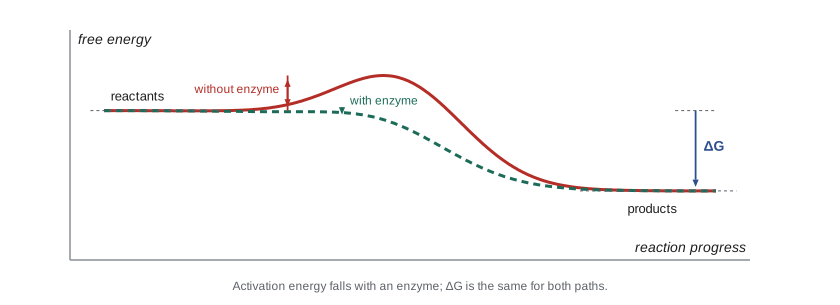
Many exergonic reactions are extremely slow at body temperature. A sugar cube can sit in air for years without reacting with oxygen, although burning it releases a lot of energy. The barrier is the activation energy, the energy needed to start a reaction by straining or breaking existing bonds. Catalysts lower the activation energy, speeding reactions without being used up. Enzymes are biological catalysts, almost all of them proteins; a few RNA molecules, called ribozymes, also act as catalysts, including the joining of amino acids in the ribosome.
Enzymes do not change ΔG. They cannot make an endergonic reaction happen on its own or shift where the equilibrium lies; they only make the reaction reach equilibrium faster. But the speed-up is enormous: many enzymes accelerate reactions by factors of a million to more than a trillion. Without them, the chemistry of life would be far too slow to sustain it.
Each enzyme acts on a specific substrate, which binds in a pocket called the active site. The active site's shape and chemistry complement the substrate. The older lock-and-key picture has been replaced by the induced-fit model: the enzyme changes shape slightly as the substrate binds, gripping it more tightly and straining the bonds that need to break. Enzymes lower activation energy by orienting substrates correctly, straining bonds, providing a favorable chemical environment (for example, acidic or basic side chains) and sometimes briefly forming covalent bonds with the substrate.
Many enzymes need helpers. Cofactors are inorganic ions such as zinc, iron, magnesium or copper. Coenzymes are small organic molecules, often made from vitamins, such as NAD+ (from niacin) and FAD (from riboflavin), which carry electrons in respiration. That is why vitamin deficiencies cause disease: without the coenzyme, the enzyme cannot work.
Factors that affect enzyme activity
Because enzymes are proteins with precise shapes, their activity depends on conditions:
| Factor | Effect | Explanation |
|---|---|---|
| Temperature | Activity rises with temperature up to an optimum, then falls sharply | Molecules collide more often when warmer, but too much heat denatures the enzyme |
| pH | Each enzyme has an optimum pH | pH changes the charges on side chains, altering the active site; pepsin works best near pH 2, most cytoplasmic enzymes near 7 |
| Substrate concentration | Rate rises, then levels off at a maximum | Once all active sites are occupied, the enzyme is saturated |
| Enzyme concentration | More enzyme gives a proportionally faster rate when substrate is plentiful | More active sites are available |
| Inhibitors | Reduce activity | Competitive inhibitors block the active site; non-competitive inhibitors bind elsewhere and change the enzyme’s shape |
Human enzymes typically work best near 37 °C. Enzymes from organisms living in hot springs, such as Taq DNA polymerase from the bacterium Thermus aquaticus, work best above 70 °C and survive near boiling; Taq is used in the polymerase chain reaction (PCR), which repeatedly heats DNA to 95 °C.
Measuring enzyme speed: Michaelis–Menten kinetics
If you measure the initial rate of an enzyme reaction (v) at different substrate concentrations ([S]), the results usually follow a curve that rises steeply and then levels off at a maximum rate, Vmax, when the enzyme is saturated. Leonor Michaelis and Maud Menten described this in 1913 with a simple equation:
\(K_m\), the Michaelis constant, is the substrate concentration at which the rate is half of \(V_{\max}\). A low \(K_m\) means the enzyme reaches half its maximum speed at a low substrate concentration, which roughly indicates high affinity for the substrate. \(V_{\max}\) depends on how much enzyme is present; dividing it by the enzyme concentration gives the turnover number, \(k_{cat}\), the number of substrate molecules each active site converts per second. Values range from below 1 per second to about a million per second for carbonic anhydrase, which converts carbon dioxide and water to bicarbonate in red blood cells.
import numpy as np
from scipy.optimize import curve_fit

def mm(S, Vmax, Km):
    return Vmax * S / (Km + S)

rng = np.random.default_rng(107)
S = np.array([0.5, 1, 2, 4, 8, 16, 32])           # substrate, mM
true_v = mm(S, 100, 3.0)                          # true Vmax 100 umol/min, Km 3 mM
v = true_v * (1 + rng.normal(0, 0.04, S.size))     # 4% measurement noise

(Vmax, Km), cov = curve_fit(mm, S, v, p0=[80, 2])
print("Measured rates:", np.round(v, 1))
print(f"Fitted Vmax = {Vmax:.1f} umol/min, Km = {Km:.2f} mM")
print(f"Rate at [S] = Km: {mm(Km, Vmax, Km):.1f} (half of Vmax)")Measured rates: [14.5 23.1 39.9 61.2 68.4 86.2 89.3] Fitted Vmax = 98.6 umol/min, Km = 2.91 mM Rate at [S] = Km: 49.3 (half of Vmax)
Before computers, biochemists turned the curve into a straight line by plotting 1/v against 1/[S] (the Lineweaver–Burk or double-reciprocal plot), whose intercepts give 1/Vmax and −1/Km. It is still useful for visualizing inhibitors, but it distorts measurement errors badly, magnifying the noisiest points at low substrate concentration. Fitting the curve directly by non-linear regression, as in the program above, gives more reliable estimates.
Worked problem
Reading kinetics
An enzyme has Vmax = 120 µmol/min and Km = 4 mM. What is the reaction rate at substrate concentrations of 4 mM, 12 mM and 1 mM?
Show solution
- At [S] = Km = 4 mM, v = Vmax/2 = 60 µmol/min.
- At 12 mM: v = 120 × 12 / (4 + 12) = 1440/16 = 90 µmol/min.
- At 1 mM: v = 120 × 1 / (4 + 1) = 24 µmol/min.
Answer: 60, 90 and 24 µmol/min. Tripling [S] from Km only raises the rate from 50 to 75 percent of Vmax; the enzyme approaches saturation.
Regulating metabolism
Cells cannot run every pathway at full speed all the time; they must respond to need. Several mechanisms adjust enzyme activity. Competitive inhibitors resemble the substrate and compete for the active site; they raise the apparent Km but not Vmax, because enough substrate can outcompete them. Many drugs work this way: statins lower cholesterol by competitively inhibiting HMG-CoA reductase, an enzyme in cholesterol synthesis. Non-competitive inhibitors bind elsewhere and reduce Vmax. Some poisons are irreversible inhibitors: nerve agents and some insecticides permanently block acetylcholinesterase, an enzyme at nerve–muscle junctions.
Allosteric regulation is especially important. Many enzymes have regulatory sites separate from the active site; molecules binding there switch the enzyme between more and less active shapes. In feedback inhibition, the end product of a pathway allosterically inhibits an enzyme near the start, so the pathway slows down when its product builds up and speeds up when the product is scarce, just as a thermostat controls a furnace. Cells also switch enzymes on and off by adding or removing phosphate groups (lesson 11), control how much of each enzyme is made, and confine pathways to particular compartments.
Metabolism as a whole is divided into catabolism, pathways that break molecules down and release energy (such as respiration), and anabolism, pathways that build molecules and consume energy (such as protein synthesis and photosynthesis). ATP and electron carriers such as NADH and NADPH link the two, carrying energy and electrons from catabolic to anabolic reactions.
Common mistakes
MistakeEnzymes make reactions more favorable by changing ΔG.
InsteadEnzymes lower activation energy and speed reactions but do not change ΔG or the equilibrium position.
MistakeEnergy is released by breaking the bonds of ATP.
InsteadBreaking any bond requires energy; free energy is released because the products of ATP hydrolysis are much more stable than ATP.
MistakeSpontaneous reactions happen quickly.
InsteadSpontaneous (negative ΔG) means the reaction can proceed without energy input; its speed depends on the activation energy and catalysts.
MistakeA low Km means a slow enzyme.
InsteadKm measures the substrate concentration for half-maximal rate; a low Km usually indicates high affinity, while speed is measured by Vmax or kcat.
MistakeRaising temperature always speeds enzyme reactions.
InsteadAbove the optimum temperature enzymes denature and activity falls rapidly.
Summary and key terms
- The first law: energy is conserved but converted; the second law: every conversion increases entropy and loses some energy as heat.
- Reactions with negative ΔG are exergonic and can proceed spontaneously; positive ΔG reactions need energy input. ΔG = ΔG°′ + RT ln Q.
- ATP hydrolysis releases about −30.5 kJ/mol under standard conditions and about −50 kJ/mol in cells; it drives work through energy coupling and phosphorylation.
- Enzymes lower activation energy, bind substrates at active sites by induced fit, and often need cofactors or coenzymes.
- Enzyme activity depends on temperature, pH, substrate and enzyme concentrations, and inhibitors.
- Michaelis–Menten kinetics: v = Vmax[S]/(Km + [S]); Km is the substrate concentration giving half of Vmax.
- Cells regulate pathways by inhibitors, allosteric control, feedback inhibition, phosphorylation and changes in enzyme amounts.
- metabolism
- All the chemical reactions in a cell or organism.
- free energy (G)
- The portion of a system’s energy available to do work; ΔG predicts whether a reaction can proceed.
- exergonic
- Describes a reaction that releases free energy (negative ΔG).
- endergonic
- Describes a reaction that requires free energy (positive ΔG).
- ATP
- Adenosine triphosphate, the main energy currency of cells.
- activation energy
- The energy needed to start a reaction.
- active site
- The region of an enzyme where the substrate binds and the reaction occurs.
- Michaelis constant (Km)
- The substrate concentration at which an enzyme works at half its maximum rate.
- allosteric regulation
- Control of an enzyme by a molecule binding at a site other than the active site.
- feedback inhibition
- Inhibition of an early enzyme in a pathway by the pathway’s end product.
Practice problems
Work each problem on paper first, then reveal the answer to check.
State the first and second laws of thermodynamics in biological terms.
Show answer
Energy cannot be created or destroyed, only converted; every conversion increases disorder and releases some energy as heat.
Is protein synthesis exergonic or endergonic, and how do cells make it happen?
Show answer
Endergonic; it is coupled to the hydrolysis of ATP and GTP.
Calculate ΔG for a reaction with ΔG°′ = +5 kJ/mol at 310 K when Q = 0.01.
Show answer
ΔG = 5 + 2.577 × ln(0.01) = 5 − 11.9 ≈ −6.9 kJ/mol, so it can proceed.
Why is ATP called an energy currency rather than an energy store?
Show answer
Cells hold only seconds to a minute of ATP and regenerate it constantly; long-term energy is stored as glycogen, starch or fat.
How do enzymes speed up reactions?
Show answer
They lower the activation energy by orienting and straining substrates and providing a favorable chemical environment.
Why does an enzyme stop working at very high temperature?
Show answer
Heat disrupts the weak interactions holding its shape, denaturing it and destroying the active site.
An enzyme has Km = 2 mM and Vmax = 50 µmol/min. What is v at [S] = 6 mM?
Show answer
v = 50 × 6 / (2 + 6) = 37.5 µmol/min.
How does a competitive inhibitor affect Km and Vmax?
Show answer
It increases the apparent Km but leaves Vmax unchanged, because high substrate concentrations can outcompete it.
Explain feedback inhibition using an analogy.
Show answer
Like a thermostat turning off a furnace when the room is warm, a pathway’s end product inhibits an early enzyme when enough product has been made.
Why is the Lineweaver–Burk plot less reliable than direct curve fitting?
Show answer
Taking reciprocals magnifies errors in the measurements at low substrate concentrations, distorting the fitted values.
Lesson quiz · 5 questions
Score 60% or more to complete this lesson.
Create a free account to save your progress, take quizzes and earn a certificate.