
BIOL-107 · Lesson 2 of 12 · 29 min
The chemistry of life I: water, bonds and pH
Cells are chemical systems. Everything a cell does, from copying DNA to contracting a muscle, is a set of chemical reactions between molecules. Before we can understand membranes, enzymes or energy, we need a small toolkit of chemistry: which elements life uses, how atoms bond, why water is so unusual, and what pH measures. This lesson builds that toolkit; lesson 3 uses it to explain the large molecules of life.
The elements of life
About 25 chemical elements are essential to life, but four of them, carbon, hydrogen, oxygen and nitrogen, make up about 96 percent of the mass of a typical organism. Phosphorus and sulfur add most of the rest. A memory aid is CHNOPS. Smaller amounts of calcium, potassium, sodium, chlorine and magnesium play vital roles, and trace elements such as iron, zinc, copper and iodine are needed in tiny quantities, often as parts of enzymes.
| Element | Symbol | Approximate share of human body mass | Example roles |
|---|---|---|---|
| Oxygen | O | About 65 percent | Water, all major organic molecules, final electron acceptor in respiration |
| Carbon | C | About 18 percent | Backbone of every organic molecule |
| Hydrogen | H | About 10 percent | Water, organic molecules, proton gradients |
| Nitrogen | N | About 3 percent | Amino acids, nucleotide bases |
| Calcium | Ca | About 1.5 percent | Bones, muscle contraction, cell signaling |
| Phosphorus | P | About 1 percent | DNA and RNA backbone, ATP, phospholipids |
| Potassium, sulfur, sodium, chlorine, magnesium | K, S, Na, Cl, Mg | Each under 0.5 percent | Nerve impulses, protein structure, enzyme cofactors |
| Trace elements | Fe, Zn, Cu, I and others | Under 0.01 percent each | Hemoglobin, enzyme active sites, thyroid hormone |
Oxygen tops the list mainly because about 60 percent of a human body is water. Carbon is special because each carbon atom can form four stable covalent bonds, so carbon atoms can link into chains, branches and rings of almost unlimited variety. Molecules built around carbon are called organic molecules, a name left over from the time when people thought only living things could make them.
How atoms bond
An atom has a nucleus of protons and neutrons surrounded by electrons. Chemical behavior depends on the outer electrons. Atoms are most stable when their outer shell is full, and they reach that state by sharing or transferring electrons. The result is a chemical bond. Cells use several kinds of bonds and attractions, which differ hugely in strength, and the difference matters: strong bonds hold molecules together, while weak ones let molecules recognize, fold and release each other.
| Interaction | What happens | Typical strength (kJ/mol) | Role in cells |
|---|---|---|---|
| Covalent bond | Atoms share a pair of electrons | About 200 to 900 | Holds the atoms of a molecule together |
| Ionic bond | One atom transfers electrons to another; opposite charges attract | Strong in a dry crystal, much weaker in water | Salt bridges in proteins; ions in solution |
| Hydrogen bond | A hydrogen on an electronegative atom is attracted to another electronegative atom | About 4 to 20 | Water structure, DNA base pairing, protein folding |
| Van der Waals attraction | Brief, weak attractions between fluctuating charges | About 0.4 to 4 | Close packing of molecules, enzyme and substrate fit |
| Hydrophobic effect | Non-polar groups cluster together to avoid water | Not a bond; driven by water | Membrane formation, protein cores |
Whether electrons are shared equally depends on electronegativity, an atom's pull on electrons. Oxygen and nitrogen are strongly electronegative; carbon and hydrogen are similar to each other. In a C–H bond the electrons are shared about equally, so the bond is non-polar. In an O–H bond the oxygen pulls the electrons closer, giving it a partial negative charge and leaving the hydrogen partially positive. The bond is polar. These partial charges are behind most of what makes water, and life, work.
Water: the solvent of life
A water molecule is bent, with the oxygen at the apex and the two hydrogens at an angle of about 104.5 degrees. Because the oxygen is partially negative and the hydrogens partially positive, each molecule is a small dipole. The positive hydrogen of one molecule is attracted to the negative oxygen of a neighbor, forming a hydrogen bond. In liquid water each molecule makes up to four hydrogen bonds at any instant; they break and re-form trillions of times per second.
Hydrogen bonding gives water a set of properties that cells depend on:
| Property | Cause | Why it matters for life |
|---|---|---|
| Excellent solvent for polar and charged substances | Water molecules surround ions and polar molecules (hydration shells) | Most cellular chemistry happens in water; sugars, salts and amino acids dissolve readily |
| Cohesion and surface tension | Hydrogen bonds hold water molecules together | Water columns rise in plant xylem; small insects walk on ponds |
| High specific heat | Energy is needed to break hydrogen bonds before molecules move faster | Water buffers temperature changes in cells, bodies and oceans |
| High heat of vaporization | Escaping molecules must break hydrogen bonds | Sweating and transpiration cool organisms effectively |
| Ice is less dense than liquid water | Hydrogen bonds lock molecules into an open lattice | Lakes freeze from the top, insulating the water beneath |
| Drives the hydrophobic effect | Non-polar molecules disrupt water’s hydrogen bonding | Lipids form membranes; proteins fold with non-polar cores |
Substances that dissolve in water, such as salt and sugar, are hydrophilic (water-loving). Substances that do not, such as oils and fats, are hydrophobic (water-fearing). Some molecules are both: one end is polar and the other non-polar. These amphipathic molecules, including the phospholipids of membranes (lesson 6) and soaps, arrange themselves with their polar parts facing water and their non-polar parts hidden.
Concentrations: moles and molarity
Cell biologists constantly prepare and dilute solutions, so it is worth getting the units right at the start. A mole is a fixed number of particles, Avogadro's number, \(6.022 \times 10^{23}\). The mass of one mole of a substance in grams equals its molecular mass in daltons: one mole of glucose (C6H12O6) weighs about 180 g. Molarity (M) is moles of solute per liter of solution. A 1 M glucose solution has 180 g of glucose per liter; 1 mM (millimolar) is a thousandth of that.
To dilute a stock solution, use the fact that the amount of solute does not change: \(C_1 V_1 = C_2 V_2\), where \(C_1\) and \(V_1\) are the concentration and volume of the stock, and \(C_2\) and \(V_2\) those of the diluted solution.
Worked problem
Making a working solution
You have a 1.0 M stock of sodium chloride and need 250 mL of 150 mM NaCl for a cell experiment. How much stock and how much water do you use?
Show solution
- Write the dilution equation: C1 × V1 = C2 × V2.
- Put the concentrations in the same units: C1 = 1.0 M = 1000 mM, C2 = 150 mM, V2 = 250 mL.
- Solve for V1: V1 = (150 mM × 250 mL) / 1000 mM = 37.5 mL.
- Add water to make the total volume 250 mL, which is about 212.5 mL of water.
Answer: Measure 37.5 mL of the 1.0 M stock and bring it to 250 mL with water.
# Grams needed for a solution, and a dilution using C1 V1 = C2 V2
def grams_needed(molar_mass_g_per_mol, molarity_M, volume_L):
    return molar_mass_g_per_mol * molarity_M * volume_L

print("Glucose, 5 mM, 0.5 L:", round(grams_needed(180.16, 0.005, 0.5), 3), "g")
print("NaCl, 150 mM, 1 L:  ", round(grams_needed(58.44, 0.150, 1.0), 2), "g")

def stock_volume(c_stock, c_final, v_final):
    return c_final * v_final / c_stock

v1 = stock_volume(1000, 150, 250)    # mM, mM, mL
print("Stock needed:", v1, "mL; water:", 250 - v1, "mL")Glucose, 5 mM, 0.5 L: 0.45 g NaCl, 150 mM, 1 L: 8.77 g Stock needed: 37.5 mL; water: 212.5 mL
Acids, bases and pH
Water molecules occasionally split into a hydrogen ion (H+, in reality attached to another water molecule as H3O+) and a hydroxide ion (OH−). In pure water at 25 °C the concentration of each is \(10^{-7}\) M. Acids are substances that release hydrogen ions and raise their concentration; bases remove hydrogen ions or release hydroxide.
Because hydrogen ion concentrations span many powers of ten, biologists use a logarithmic scale: \(\text{pH} = -\log_{10}[\text{H}^+]\). Pure water has pH 7. Each unit lower means ten times more hydrogen ions: a solution at pH 4 is a thousand times more acidic than one at pH 7.
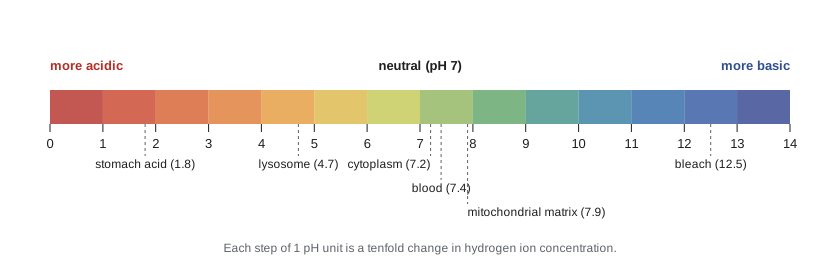
Most of the inside of a cell is kept near pH 7.2, and human blood between 7.35 and 7.45. Some compartments are deliberately different: lysosomes, the cell's digestive organelles, are kept near pH 4.5 to 5 so that their enzymes work, and the stomach is near pH 2. Small changes matter, because the charges on proteins depend on pH, and a protein's shape depends on its charges. Blood pH below about 7.35 is called acidosis and is a medical emergency when severe.
import math
# Hydrogen ion concentration and pH
for label, h in [("pure water", 1e-7), ("cytoplasm", 6.3e-8), ("lysosome", 3.2e-5), ("stomach", 1e-2)]:
    print(f"{label:<11} [H+] = {h:.1e} M  ->  pH {-math.log10(h):.1f}")

ratio = 10 ** (7.2 - 4.7)
print(f"A lysosome at pH 4.7 has {ratio:.0f} times the [H+] of cytoplasm at pH 7.2")pure water [H+] = 1.0e-07 M -> pH 7.0 cytoplasm [H+] = 6.3e-08 M -> pH 7.2 lysosome [H+] = 3.2e-05 M -> pH 4.5 stomach [H+] = 1.0e-02 M -> pH 2.0 A lysosome at pH 4.7 has 316 times the [H+] of cytoplasm at pH 7.2
Buffers keep pH steady
Cells and body fluids resist pH changes using buffers: mixtures of a weak acid and its conjugate base that can absorb added H+ or OH−. When acid is added, the base form picks up the extra hydrogen ions; when base is added, the acid form releases hydrogen ions to neutralize it. The main buffer in blood is the carbonic acid and bicarbonate pair; inside cells, phosphate ions and the side chains of proteins do much of the work.
The Henderson–Hasselbalch equation relates pH to the ratio of base to acid: \(\text{pH} = \text{p}K_a + \log_{10}\frac{[\text{A}^-]}{[\text{HA}]}\). The \(\text{p}K_a\) is the pH at which the acid is half dissociated. A buffer works best within about one pH unit of its \(\text{p}K_a\), where both forms are present in useful amounts.
Worked problem
The bicarbonate buffer in blood
For the carbonic acid and bicarbonate system in blood, the effective pKa is about 6.1. If the ratio of bicarbonate to carbonic acid is 20 to 1, what is the blood pH?
Show solution
- Use pH = pKa + log10([base]/[acid]).
- Substitute: pH = 6.1 + log10(20).
- log10(20) is about 1.30.
- pH = 6.1 + 1.3 = 7.4.
Answer: About pH 7.4, the normal value for arterial blood. Lungs adjust carbon dioxide (and so carbonic acid) and kidneys adjust bicarbonate to keep the ratio near 20.
import math
# Henderson-Hasselbalch: pH of a phosphate buffer (pKa about 6.86 at 25 C)
pKa = 6.86
for base, acid in [(1, 9), (1, 1), (2, 1), (9, 1)]:
    pH = pKa + math.log10(base / acid)
    print(f"[HPO4 2-]:[H2PO4 -] = {base}:{acid}  ->  pH {pH:.2f}")

# Ratio needed for pH 7.2
target = 7.2
print("Ratio needed for pH 7.2:", round(10 ** (target - pKa), 2), "to 1")[HPO4 2-]:[H2PO4 -] = 1:9 -> pH 5.91 [HPO4 2-]:[H2PO4 -] = 1:1 -> pH 6.86 [HPO4 2-]:[H2PO4 -] = 2:1 -> pH 7.16 [HPO4 2-]:[H2PO4 -] = 9:1 -> pH 7.81 Ratio needed for pH 7.2: 2.19 to 1
Laboratory buffers such as phosphate-buffered saline (PBS) and HEPES are chosen for the same reason: they hold pH near 7.2 to 7.4 so that cells and proteins behave as they would in the body. Lesson 4 and the capstone in lesson 12 use them.
Functional groups: chemistry's building blocks
Organic molecules are carbon skeletons decorated with small clusters of atoms called functional groups. Each group behaves in a characteristic way, so knowing a handful of them lets you predict how a molecule will behave: whether it dissolves in water, carries a charge at cell pH, or reacts with other molecules.
| Group | Structure | Properties at cell pH | Found in |
|---|---|---|---|
| Hydroxyl | –OH | Polar; forms hydrogen bonds | Sugars, alcohols |
| Carbonyl | C=O | Polar | Sugars (aldehydes and ketones) |
| Carboxyl | –COOH | Acidic; usually ionized to –COO− at pH 7 | Amino acids, fatty acids |
| Amino | –NH2 | Basic; usually ionized to –NH3+ at pH 7 | Amino acids |
| Phosphate | –OPO3 2− | Negatively charged; links molecules and stores energy | DNA, RNA, ATP, phospholipids |
| Sulfhydryl | –SH | Two can join as a disulfide bridge (–S–S–) | The amino acid cysteine; stabilizes proteins |
| Methyl | –CH3 | Non-polar | Fats; methylated DNA (gene regulation) |
Note that an amino acid has both a carboxyl group and an amino group. At pH 7 the carboxyl loses a hydrogen ion and the amino group gains one, so a single amino acid carries both a negative and a positive charge. That dual behavior, and the side chains attached to it, is the starting point for protein structure in lesson 3.
Common mistakes
MistakeA pH of 6 is only slightly more acidic than a pH of 7.
InsteadpH is logarithmic: pH 6 has ten times the hydrogen ion concentration of pH 7, and pH 5 has a hundred times.
MistakeHydrogen bonds are bonds within a water molecule.
InsteadThe O–H bonds within water are covalent; hydrogen bonds are weaker attractions between molecules (or between parts of large molecules).
MistakeA buffer keeps pH absolutely constant.
InsteadA buffer resists change within its capacity and works best within about one pH unit of its pKa; enough added acid or base will overwhelm it.
MistakeIn C1V1 = C2V2 you can mix units, such as M and mM.
InsteadBoth concentrations must be in the same unit, and both volumes in the same unit, or the answer will be off by powers of ten.
MistakeOrganic means natural or pesticide-free in chemistry.
InsteadIn chemistry, organic means a carbon-based compound, whether made by a cell or in a laboratory.
Summary and key terms
- Carbon, hydrogen, oxygen and nitrogen make up about 96 percent of living mass; phosphorus and sulfur are also major elements.
- Covalent bonds hold molecules together; weaker hydrogen bonds, ionic attractions, van der Waals forces and the hydrophobic effect shape and connect them.
- Water is polar and forms hydrogen bonds, making it an excellent solvent with high specific heat, cohesion and less dense ice.
- Molarity is moles per liter; dilutions follow C1V1 = C2V2 with consistent units.
- pH = −log10[H+]; each unit is a tenfold change; cytoplasm is near pH 7.2 and blood near 7.4.
- Buffers resist pH change; the Henderson–Hasselbalch equation relates pH to pKa and the base-to-acid ratio.
- Functional groups such as hydroxyl, carboxyl, amino and phosphate determine how organic molecules behave.
- covalent bond
- A strong chemical bond in which two atoms share a pair of electrons.
- electronegativity
- An atom’s tendency to attract the electrons in a bond toward itself.
- polar molecule
- A molecule with an uneven distribution of charge, such as water.
- hydrogen bond
- A weak attraction between a partially positive hydrogen and a partially negative atom such as oxygen or nitrogen.
- hydrophobic
- Not dissolving in or attracting water; non-polar.
- amphipathic
- Having both a hydrophilic part and a hydrophobic part.
- molarity
- Concentration expressed as moles of solute per liter of solution.
- pH
- The negative base-10 logarithm of the hydrogen ion concentration.
- buffer
- A solution that resists changes in pH, usually a weak acid and its conjugate base.
- functional group
- A cluster of atoms with characteristic chemical behavior attached to a carbon skeleton.
Practice problems
Work each problem on paper first, then reveal the answer to check.
Which four elements make up about 96 percent of living matter?
Show answer
Carbon, hydrogen, oxygen and nitrogen.
Why is an O–H bond polar but a C–H bond nearly non-polar?
Show answer
Oxygen is much more electronegative than hydrogen and pulls the shared electrons toward itself; carbon and hydrogen have similar electronegativity.
Explain how hydrogen bonding makes water a good temperature buffer.
Show answer
Heat must first break hydrogen bonds before water molecules move faster, so water absorbs a lot of energy for a small temperature rise.
How many grams of glucose (180 g/mol) are needed for 2 L of a 10 mM solution?
Show answer
180 × 0.010 × 2 = 3.6 g.
How would you make 50 mL of 20 mM Tris from a 1 M stock?
Show answer
V1 = 20 × 50 / 1000 = 1 mL of stock, made up to 50 mL with water.
What is the pH of a solution with [H+] = 1 × 10^−5 M?
Show answer
pH = 5.
How many times more hydrogen ions are in stomach acid at pH 2 than in blood at pH 7.4?
Show answer
10^(7.4 − 2) = 10^5.4, about 250,000 times.
A buffer has pKa 7.0. What base-to-acid ratio gives pH 8.0?
Show answer
10 to 1, from pH − pKa = log10(ratio) = 1.
Why do phospholipids form membranes in water?
Show answer
They are amphipathic: their polar heads face water and their non-polar tails cluster away from it, driven by the hydrophobic effect.
At pH 7, what charges do the carboxyl and amino groups of an amino acid carry?
Show answer
The carboxyl is negative (COO−) and the amino group is positive (NH3+).
Lesson quiz · 5 questions
Score 60% or more to complete this lesson.
Create a free account to save your progress, take quizzes and earn a certificate.