
BIOL-107 · Lesson 1 of 12 · 28 min
What life is: cells and the cell theory
Every living thing you have ever seen, from the moss on a rock to the person sitting next to you, is built from cells. A bacterium is a single cell. A human body is roughly 30 trillion of them, plus a comparable number of bacterial cells living on and inside it. Introduction to Cell Biology is about those units: what they are made of, how they are organized, how they capture and spend energy, how they talk to each other, and how they make more of themselves. It is the first course in the Biology and Biochemistry programs, and the ideas here return in genetics (BIOL-201), molecular biology (BIOL-207), cell biology in depth (BIOL-214), microbiology (BIOL-330) and metabolism (BIOC-330 and BIOC-331).
The course assumes no previous biology beyond high school, and only basic chemistry. Where we need a chemical idea, such as a hydrogen bond or a pH value, lesson 2 or 3 introduces it. Where we need arithmetic, the worked examples show each step, and short Python programs let you check the numbers and try your own. You do not need to be a programmer; the code is there to make calculations visible and repeatable, the way a lab notebook makes an experiment repeatable.
What counts as alive?
Biologists have never agreed on a one-line definition of life, but they agree on a list of properties that living things share. No single property is enough on its own: fire grows and consumes energy, crystals reproduce their structure, and a computer virus copies itself. It is the combination that marks life.
| Property | What it means | Cell-level example |
|---|---|---|
| Organization | Living things are built from one or more cells, with ordered internal structure | A bacterium has a membrane, ribosomes and a DNA region; a neuron has a nucleus, axon and synapses |
| Metabolism | They take in energy and matter and transform them through chemical reactions | Yeast converts glucose to carbon dioxide and ethanol, capturing energy as ATP |
| Homeostasis | They keep their internal conditions within limits despite outside change | Cells pump ions to keep internal sodium low and potassium high |
| Growth and reproduction | They grow and produce new individuals or new cells | One E. coli cell can divide into two in about 20 minutes in rich medium |
| Heredity | They pass information to offspring, mainly as DNA | Daughter cells inherit copies of the parent cell’s chromosomes |
| Response to stimuli | They sense and react to their surroundings | Bacteria swim toward sugar; white blood cells crawl toward signals of infection |
| Evolution | Populations change over generations through natural selection | Bacteria become resistant to an antibiotic after repeated exposure |
Viruses are the classic borderline case. A virus particle has genetic material and a protein coat, and it evolves, but it has no metabolism of its own and can only reproduce inside a host cell, using the host's machinery. Most biologists therefore treat viruses as non-living, or as on the edge of life, and they do not count as cells. You will meet them again in microbiology (BIOL-330) and immunology (BIOL-380).
The cell theory and how it was built
The idea that all living things are made of cells is so familiar that it is easy to forget it had to be discovered, and that the discovery depended on technology. Cells are mostly between 1 and 100 micrometers across, below what the eye can see (about 100 micrometers at best). Until lenses improved, nobody could see them.
In 1665 the English scientist Robert Hooke looked at a thin slice of cork through an early compound microscope and saw a honeycomb of small empty boxes. He called them cells, after the small rooms monks lived in. What he saw were the walls of dead plant cells. A few years later the Dutch draper Antonie van Leeuwenhoek, grinding his own small, powerful single lenses, saw living, moving single-celled organisms in pond water and scrapings from his teeth, which he called animalcules.
It took another 170 years for the observations to become a general theory. In 1838 the botanist Matthias Schleiden concluded that all plants are made of cells, and in 1839 the zoologist Theodor Schwann extended the claim to animals. In 1855 the physician Rudolf Virchow popularized the third part, often quoted in Latin as omnis cellula e cellula: every cell arises from a pre-existing cell. (Virchow drew on the work of Robert Remak, who had shown cell division in embryos but received less credit at the time.)
The modern cell theory has three classic statements, plus refinements added in the twentieth century:
| Statement | What it rules out or adds |
|---|---|
| All living organisms are composed of one or more cells | Life does not exist in a non-cellular form |
| The cell is the basic unit of structure and function in living things | Life’s activities happen in and between cells |
| All cells arise from pre-existing cells | Cells do not arise spontaneously from non-living matter today |
| Cells contain hereditary information (DNA) passed on when they divide | Added after DNA was identified as the genetic material in the 1940s and 1950s |
| All cells have basically the same chemical composition and use similar metabolic pathways | Points to a common origin for all life |
The third statement settled an old debate. For centuries people believed in spontaneous generation: that maggots arose from rotting meat or microbes from broth. Experiments by Francesco Redi (1668) and, decisively, Louis Pasteur (1859–1862) showed that when broth is boiled and protected from airborne particles, nothing grows. Life comes from life. (How the very first cells arose, about 3.5 to 4 billion years ago, is a separate scientific question about chemistry on the early Earth; the cell theory describes life since then.)
Why are cells so small? Surface area and volume
Cells are small for a physical reason. A cell exchanges nutrients, oxygen and wastes through its surface, but it consumes them throughout its volume. As a cell gets bigger, its volume grows faster than its surface area, so each unit of volume is served by less membrane.
For a cube of side \(s\), the surface area is \(6s^2\) and the volume is \(s^3\), so the ratio of surface area to volume is \(6/s\). For a sphere of radius \(r\), the area is \(4\pi r^2\) and the volume is \(\frac{4}{3}\pi r^3\), giving a ratio of \(3/r\). Either way, doubling the size halves the ratio.
import math
# Surface area to volume ratio of spherical cells of different diameters
for d_um in [1, 2, 10, 20, 100]:
    r = d_um / 2
    area = 4 * math.pi * r**2            # um^2
    vol = (4/3) * math.pi * r**3          # um^3
print(f"diameter {d_um:>3} um: area {area:9.1f} um^2, volume {vol:11.1f} um^3, SA:V {area/vol:5.2f} per um")diameter 1 um: area 3.1 um^2, volume 0.5 um^3, SA:V 6.00 per um diameter 2 um: area 12.6 um^2, volume 4.2 um^3, SA:V 3.00 per um diameter 10 um: area 314.2 um^2, volume 523.6 um^3, SA:V 0.60 per um diameter 20 um: area 1256.6 um^2, volume 4188.8 um^3, SA:V 0.30 per um diameter 100 um: area 31415.9 um^2, volume 523598.8 um^3, SA:V 0.06 per um
A bacterium 1 micrometer across has six units of membrane for every unit of volume; a 100-micrometer cell has only 0.06. Large cells cope in several ways: they become long and thin (nerve cells, muscle fibers), fold their membranes into microvilli (cells lining the intestine), divide their interior into compartments with their own membranes (eukaryotic organelles, lesson 5), or keep a huge central vacuole so that the active cytoplasm is a thin layer near the surface (many plant cells).
Worked problem
Will this cell keep up?
A spherical cell 10 micrometers across needs oxygen in proportion to its volume and absorbs it in proportion to its surface area. If its diameter doubled to 20 micrometers with no change in shape, by what factor would its surface area, volume and SA:V ratio change?
Show solution
- Area scales with the square of the linear size: doubling the diameter multiplies area by 2 squared, which is 4.
- Volume scales with the cube: it is multiplied by 2 cubed, which is 8.
- The ratio therefore changes by 4/8 = 0.5; it halves, from 0.6 to 0.3 per micrometer.
- Each cubic micrometer of cytoplasm is now served by half as much membrane, so uptake per unit of demand halves.
Answer: Area ×4, volume ×8, SA:V ×0.5. The larger cell has half the membrane per unit of volume, which is why cells divide or change shape rather than simply growing.
Diffusion inside the cell adds a second limit. Molecules spread by random motion, and the time it takes them to travel a distance grows with the square of that distance (lesson 7 works through the numbers). A small molecule crosses a 1-micrometer bacterium in about a millisecond but would need minutes to cross a millimeter. Cells that are big, like the egg of a frog or the long axon of a nerve, rely on active transport along internal tracks (lesson 11) rather than diffusion alone.
Two kinds of cells: prokaryotes and eukaryotes
When electron microscopes revealed the inside of cells in the mid-twentieth century, biologists saw a sharp division. Some cells have their DNA in a membrane-bound nucleus and are full of internal membrane-bound compartments called organelles. These are eukaryotic cells (from Greek for true kernel). Others have no nucleus and few or no internal membranes. These are prokaryotic cells (before the kernel).
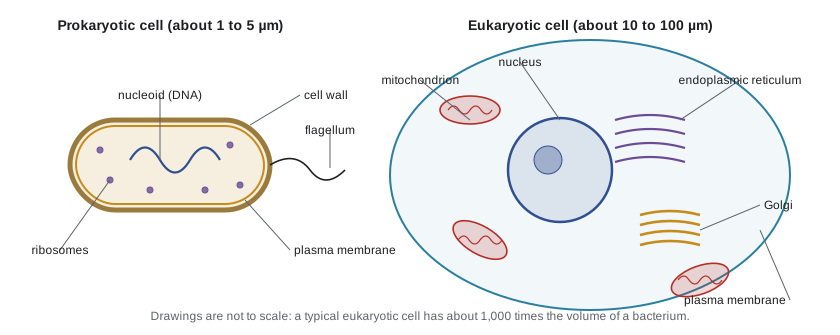
| Feature | Prokaryotic cells | Eukaryotic cells |
|---|---|---|
| Organisms | Bacteria and archaea | Animals, plants, fungi and protists |
| Typical size | About 1 to 5 micrometers | About 10 to 100 micrometers |
| Nucleus | None; DNA sits in a region called the nucleoid | DNA enclosed in a nucleus with a double membrane |
| DNA | Usually one circular chromosome, often with small plasmids | Several linear chromosomes wrapped around histone proteins |
| Membrane-bound organelles | Absent | Present: endoplasmic reticulum, Golgi, mitochondria, and in plants chloroplasts |
| Ribosomes | Smaller (70S) | Larger (80S) in the cytoplasm; 70S inside mitochondria and chloroplasts |
| Cell wall | Usually present (peptidoglycan in bacteria) | Present in plants (cellulose) and fungi (chitin); absent in animals |
| Division | Binary fission | Mitosis and meiosis |
The terms describe cell organization, not family relationships. Comparing genes in the 1970s, Carl Woese found that prokaryotes fall into two very different groups, Bacteria and Archaea, which are as different from each other as either is from eukaryotes. Life is therefore usually divided into three domains: Bacteria, Archaea and Eukarya. Archaea look like bacteria under the microscope, but many of their genes and membrane lipids are distinctive, and some live in extreme habitats such as hot springs, salt flats and the guts of cattle (where they make methane).
Where did eukaryotic cells come from? Endosymbiosis
Mitochondria (which release energy from food, lesson 9) and chloroplasts (which capture light energy, lesson 10) have a curious set of features. Each has its own small circular DNA molecule, its own 70S ribosomes like a bacterium's, and two membranes. Each divides by a process that resembles bacterial binary fission. A cell cannot make a new mitochondrion from scratch; it can only grow and divide existing ones.
The endosymbiotic theory, developed and championed by Lynn Margulis from 1967, explains these features: mitochondria descend from bacteria that were engulfed by an ancestral host cell and lived inside it as partners, and chloroplasts descend from engulfed photosynthetic bacteria (cyanobacteria) in a later event in the ancestors of algae and plants. Over time most of the bacteria's genes moved to the host's nucleus. The evidence is now overwhelming: mitochondrial genes are most closely related to those of a group of bacteria called alphaproteobacteria, and chloroplast genes to cyanobacteria. The host itself appears to have been related to archaea, which is why eukaryotes share some features with each domain.
How to study this course
Cell biology has a large vocabulary, and new terms arrive quickly. The terms list at the end of each lesson is a good place to start, but memorizing words is not the goal. Try to connect each structure to a job (what problem does the Golgi apparatus solve?), each process to energy (where does the energy come from, and where does it go?), and each claim to evidence (how do we know?). The worked examples and Python programs are there to make quantities concrete: a cell that is 10 micrometers across, a membrane 7 nanometers thick, an enzyme that turns over a thousand molecules a second.
The practice questions mix recall with reasoning. If you can explain an answer to someone else in plain language, you understand it. If you can only recognize the right option, revisit the lesson.
Common mistakes
MistakeCells are tiny bags of liquid with a few floating parts.
InsteadThe cytoplasm is crowded with proteins, membranes and filaments; about 20 to 30 percent of a cell's volume is large molecules, and much of it is highly organized.
MistakeProkaryotes are primitive, simple cells that have not evolved.
InsteadBacteria and archaea have evolved for as long as eukaryotes and are biochemically very diverse; prokaryotic describes their organization, not their sophistication.
MistakeRobert Hooke discovered living cells.
InsteadHooke saw and named the empty walls of dead cork cells; Leeuwenhoek was the first to see living cells.
MistakeViruses are the smallest cells.
InsteadViruses are not cells: they lack metabolism and ribosomes and can reproduce only inside a host cell.
MistakeA bigger cell is simply a more capable cell.
InsteadAs size increases, the surface area to volume ratio falls, limiting exchange; large cells need special shapes or internal transport to function.
Summary and key terms
- Living things share organization, metabolism, homeostasis, growth and reproduction, heredity, response to stimuli and evolution; no single property defines life.
- The cell theory states that all organisms are made of cells, the cell is the basic unit of life, and all cells come from pre-existing cells.
- The theory was built by Hooke, Leeuwenhoek, Schleiden, Schwann, Remak and Virchow, with Pasteur disproving spontaneous generation.
- Surface area to volume ratio falls as cells grow (3/r for a sphere), which limits cell size.
- Prokaryotic cells (bacteria and archaea) lack a nucleus and membrane-bound organelles; eukaryotic cells have both and are usually 10 times larger.
- Life is divided into three domains: Bacteria, Archaea and Eukarya.
- Mitochondria and chloroplasts descend from engulfed bacteria, as shown by their own DNA, 70S ribosomes, double membranes and division.
- cell theory
- The principle that all living things are made of cells, that cells are the basic units of life, and that all cells come from pre-existing cells.
- spontaneous generation
- The disproved idea that living things arise from non-living matter under ordinary conditions.
- prokaryote
- An organism whose cells lack a nucleus and membrane-bound organelles; bacteria and archaea.
- eukaryote
- An organism whose cells have a nucleus and membrane-bound organelles; animals, plants, fungi and protists.
- nucleoid
- The region of a prokaryotic cell where the chromosome is located, without a surrounding membrane.
- organelle
- A specialized structure inside a cell, often enclosed by membranes, such as the nucleus or a mitochondrion.
- domain
- The highest level of classification of life: Bacteria, Archaea or Eukarya.
- endosymbiotic theory
- The theory that mitochondria and chloroplasts originated as bacteria living inside an ancestral host cell.
- surface area to volume ratio
- The amount of surface per unit of volume; it falls as an object gets larger and limits cell size.
- homeostasis
- The maintenance of relatively stable internal conditions despite changes outside.
Practice problems
Work each problem on paper first, then reveal the answer to check.
Name four properties of living things and give a cell-level example of each.
Show answer
For example: metabolism (yeast fermenting glucose), homeostasis (ion pumps keeping potassium high inside), reproduction (bacterial binary fission), response to stimuli (bacteria swimming toward food).
Why are viruses usually not considered alive?
Show answer
They have no metabolism and no ribosomes of their own, and they can reproduce only inside a host cell using its machinery.
State the three classic parts of the cell theory.
Show answer
All organisms are made of one or more cells; the cell is the basic unit of structure and function; all cells come from pre-existing cells.
What did Pasteur’s experiments show, and which part of the cell theory did they support?
Show answer
Sterilized broth protected from airborne particles stayed free of microbes, disproving spontaneous generation and supporting the idea that cells come only from cells.
Calculate the surface area to volume ratio of a spherical cell with a diameter of 4 micrometers.
Show answer
For a sphere the ratio is 3/r; r = 2 micrometers, so SA:V = 1.5 per micrometer.
A cube-shaped cell has a side of 3 micrometers. If the side triples, what happens to its SA:V ratio?
Show answer
For a cube SA:V = 6/s, so it falls from 2 to 2/3 per micrometer: one third of the original.
Give two ways large cells overcome the limits of a low surface area to volume ratio.
Show answer
Long thin shapes, folded membranes such as microvilli, internal compartments, or a large central vacuole keeping cytoplasm near the surface.
List three differences between prokaryotic and eukaryotic cells.
Show answer
Eukaryotes have a nucleus, membrane-bound organelles and larger 80S cytoplasmic ribosomes; they are usually about ten times larger and divide by mitosis.
Give three pieces of evidence for the endosymbiotic origin of mitochondria.
Show answer
They have their own circular DNA, 70S ribosomes, two membranes, divide like bacteria, and their genes resemble those of alphaproteobacteria.
Why are archaea placed in a separate domain from bacteria even though both are prokaryotes?
Show answer
Gene comparisons, beginning with Woese’s ribosomal RNA studies, show archaea differ from bacteria as much as from eukaryotes, including in membrane lipids and many enzymes.
Lesson quiz · 5 questions
Score 60% or more to complete this lesson.
Create a free account to save your progress, take quizzes and earn a certificate.