
BAR-236 · Lesson 9 of 12 · 21 min
Ohio family law, property and probate
▶ Video coming soon A video version of this lesson is on the way.
Family law and probate were the areas Wesley knew least. 'My files involve injured people,' he said. 'The only time I see a probate court is when a claimant dies and an estate has to be opened before we can settle.' Hollis reminded him that general practice lawyers in Ohio spend much of their time in exactly those courts, and that the removal of Family Law and Trusts and Estates from the MEE in July 2026 meant he would not see them on the exam essays. 'That is a reason to learn Ohio's rules here, not a reason to skip them,' she said. 'And it is why Ohio's NextGen committee wants wills and trusts on the future Ohio component.'
This lesson covers the main Ohio rules of divorce and dissolution, property division, spousal support, the allocation of parental rights and child support, and then Ohio's rules on wills, intestate succession, a surviving spouse's rights and probate procedure. Domestic relations cases are heard in the domestic relations division of the court of common pleas, and estates in the probate division.
Ending a marriage: divorce, dissolution and legal separation
Ohio offers three ways to change a marriage's legal status. A divorce is a contested or uncontested action begun by a complaint. A dissolution is an agreed termination: the spouses file a joint petition together with a separation agreement that resolves all issues, including property, support and, if there are children, a parenting plan. Under R.C. 3105.64, the court holds a hearing not less than 30 nor more than 90 days after the petition is filed, at which both spouses must appear and acknowledge that they are satisfied with the agreement. A legal separation under R.C. 3105.17 resolves the same issues without ending the marriage.
To file for divorce, the plaintiff must have been a resident of Ohio for at least six months immediately before filing, under R.C. 3105.03. The grounds for divorce are listed in R.C. 3105.01. Most are fault grounds that reflect the nineteenth-century origins of the statute: a spouse living at the time of the marriage, willful absence for one year, adultery, extreme cruelty, fraudulent contract, gross neglect of duty, habitual drunkenness, imprisonment at the time of filing, and procurement of a divorce outside Ohio. Two are no-fault grounds: living separate and apart without cohabitation for one year, and incompatibility, unless denied by either party. Because incompatibility can be defeated by the other spouse's denial, a spouse seeking a no-fault divorce over objection usually relies on a year of living apart, or on a fault ground.
Ohio does not recognize common-law marriages entered into in Ohio after October 10, 1991, under R.C. 3105.12. Common-law marriages formed in Ohio before that date, and those validly formed in other states that permit them, are recognized. Same-sex marriages have been valid in Ohio since Obergefell v. Hodges (2015), a United States Supreme Court case that began in Ohio when James Obergefell of Cincinnati sought to be listed as the surviving spouse on his husband's death certificate.
Dividing property
Property division is governed by R.C. 3105.171. The court first classifies each asset as marital or separate property. Marital property generally includes property acquired by either spouse during the marriage, and the appreciation of separate property that results from either spouse's labor, money or in-kind contribution during the marriage. Separate property includes property acquired before the marriage, inheritances, gifts made to one spouse during the marriage and proved by clear and convincing evidence, passive income and appreciation on separate property, and compensation for personal injury except for loss of marital earnings and expenses paid from marital assets.
Commingling does not automatically convert separate property into marital property. Separate property keeps its character as long as it remains traceable. A spouse who deposited a 30,000 dollar inheritance into a joint account and then withdrew 30,000 dollars from the same account a month later to buy a car in her own name may be able to trace the car to the inheritance; a spouse whose inheritance was spent on household expenses for years will usually find it untraceable.
Marital property is divided equally unless an equal division would be inequitable, in which case the court divides it equitably after considering the factors the statute lists, such as the duration of the marriage, the assets and liabilities of the spouses, the desirability of awarding the family home to the residential parent, the liquidity of the property, the tax consequences, and any other factor the court finds relevant. The marriage is generally measured from the date of marriage to the date of the final hearing, but the court may use a different, de facto termination date if that would be more equitable, for example when the spouses separated long before the hearing. A court may also make a distributive award from separate property and may compensate a spouse for the other's financial misconduct, such as hiding or dissipating marital assets.
Spousal support
Ohio uses the term spousal support. Under R.C. 3105.18, the court decides whether support is appropriate and reasonable, and its nature, amount, terms and duration, after considering a list of factors that include the income of the parties, their relative earning abilities, their ages and health, retirement benefits, the duration of the marriage, the standard of living during the marriage, education, assets and liabilities, contributions to the other's education or earning ability, the time and expense needed for the requesting spouse to obtain education or training, tax consequences, and lost income production capacity from marital responsibilities. Ohio does not have a statutory formula, and practice varies by county.
One Ohio rule catches new lawyers. A court can modify a spousal support award after the decree only if the decree itself expressly reserved jurisdiction to modify it. A separation agreement that is silent on modification produces an unmodifiable award. Drafting the reservation, or deliberately omitting it, is one of the most consequential decisions in an Ohio divorce.
Children: parental rights and child support
Ohio's statute speaks of the allocation of parental rights and responsibilities rather than custody. Under R.C. 3109.04, the court either designates one parent as residential parent and legal custodian, with the other parent receiving parenting time, or approves a shared parenting plan under which both parents share rights and responsibilities in the way the plan describes. The court's guiding standard is the best interest of the child, and R.C. 3109.04(F) lists factors the court must consider, including the parents' wishes, the child's wishes and concerns as expressed to the court in an interview, the child's relationships with parents, siblings and others, the child's adjustment to home, school and community, the mental and physical health of everyone involved, which parent is more likely to honor court-approved parenting time, and any history of abuse, neglect or domestic violence.
Child support is calculated under the guidelines in R.C. Chapter 3119 using an income shares model: the parents' combined income determines a basic support obligation from a statutory schedule, which is then divided between the parents in proportion to their incomes, with adjustments for health insurance, child care, parenting time and other factors. Ohio updated its schedule and calculation rules through legislation that took effect in 2019. The court may deviate from the guideline amount if it finds the amount unjust or inappropriate and not in the child's best interest, and it must explain the deviation in its findings. Support generally continues until the child turns 18, or later if the child is still attending high school, subject to the limits in the statute.
| Issue | Ohio rule | Source |
|---|---|---|
| Residency for divorce | Six months in Ohio before filing | R.C. 3105.03 |
| Dissolution hearing | Not less than 30 nor more than 90 days after filing | R.C. 3105.64 |
| Property | Marital property divided equally unless inequitable; separate property traced | R.C. 3105.171 |
| Spousal support | Factors; modifiable only if the decree reserves jurisdiction | R.C. 3105.18 |
| Parenting | Residential parent or shared parenting; best interest factors | R.C. 3109.04 |
| Child support | Income shares guidelines and schedule | R.C. Chapter 3119 |
| Common-law marriage | Not recognized if formed in Ohio after October 10, 1991 | R.C. 3105.12 |
Making a will in Ohio
Ohio's formal requirements for a will are in R.C. 2107.03. A will must be in writing, signed at the end by the testator, or by another person in the testator's conscious presence and at her express direction, and attested and subscribed in the testator's conscious presence by two or more competent witnesses who saw the testator sign or heard the testator acknowledge the signature. Ohio has no general exception for handwritten, unwitnessed wills: a holographic will that is not witnessed is not valid in Ohio. Ohio also allows a testator to deposit her will with the probate court for safekeeping.
A gift to a witness is a classic Ohio trap. If a will cannot be proved without the testimony of a witness who is also a beneficiary, the gift to that witness is void except to the extent of the share the witness would have taken if there were no will. Careful drafters use two disinterested witnesses, and many use three.
Intestate succession
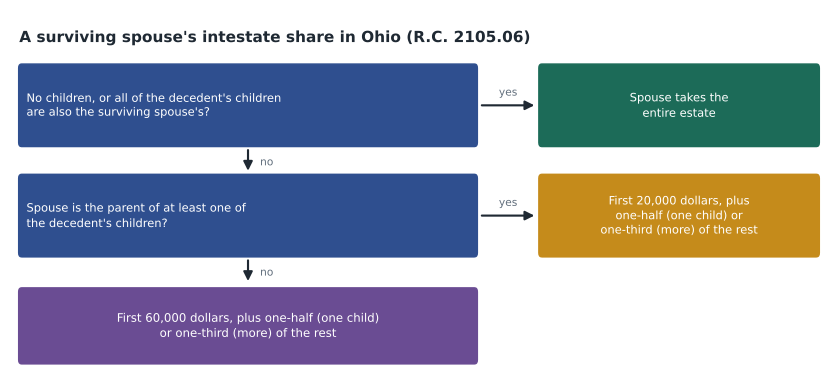
When an Ohio resident dies without a valid will, her probate estate passes under the statute of descent and distribution, R.C. 2105.06. The rules for a surviving spouse are distinctive. If all of the decedent's children or their lineal descendants are also children or descendants of the surviving spouse, the spouse takes the entire estate. If the decedent left children who are not the surviving spouse's, the spouse takes a fixed amount first, 20,000 dollars if the spouse is the parent of one of the decedent's children and 60,000 dollars if the spouse is the parent of none of them, plus one-half of the balance if there is one child and one-third of the balance if there is more than one, with the rest passing to the children equally or by representation. With no surviving spouse, the estate passes to children and their descendants; with no descendants, to parents; and then to siblings and more distant relatives in the order the statute sets.
Ohio requires survival by 120 hours. Under Ohio's version of the Uniform Simultaneous Death Act, a person who fails to survive the decedent by 120 hours is generally treated as having predeceased her for purposes of inheritance, unless the governing instrument provides otherwise.
Worked problem
An Ohio intestate estate
Jolyon Quaile, a hypothetical Ohio resident, dies without a will. His probate estate is worth 260,000 dollars. He is survived by his wife, Roswitha, and two children: Oriel, his child with Roswitha, and Gareth, his child from an earlier marriage. How is the estate distributed?
Show solution
- Not all of Jolyon's children are Roswitha's children, so she does not take the whole estate.
- Roswitha is the parent of one of his children, Oriel, so her fixed amount is 20,000 dollars.
- The balance is 240,000 dollars. There is more than one child, so Roswitha takes one-third of the balance, 80,000 dollars.
- The remaining 160,000 dollars passes to Oriel and Gareth equally, 80,000 dollars each.
Answer: Roswitha takes 100,000 dollars (20,000 plus 80,000), and Oriel and Gareth each take 80,000 dollars. Roswitha may also claim a surviving spouse's allowance for support, which is paid before distribution.
A surviving spouse's other rights
Ohio gives a surviving spouse several rights that apply whether or not there is a will. Under R.C. Chapter 2106, the spouse may elect to take against the will, taking the share the statute provides in place of the gifts under the will, within the time the statute allows after the will is admitted to probate. The spouse is entitled to an allowance for support, generally 40,000 dollars, paid from the estate before distribution, and has the right to remain in the family home, which the statute calls the mansion house, for a period after the death. A probate lawyer opening an estate with a surviving spouse reviews each of these rights early.
Probate procedure and avoiding it
Estates are administered in the probate division of the court of common pleas in the county where the decedent lived. A full administration involves appointing an executor or administrator, giving notice, inventorying assets, paying debts and taxes and distributing what remains. Ohio offers a simpler procedure, release from administration, for small estates: under R.C. 2113.03, an estate whose probate assets do not exceed 35,000 dollars, or 100,000 dollars if the surviving spouse is entitled to everything, may be released from full administration. Ohio repealed its estate tax for deaths on or after January 1, 2013.
Much property in Ohio passes outside probate. Real estate can be transferred at death by a transfer on death designation affidavit recorded during the owner's life under R.C. 5302.22, or held with a survivorship deed. Bank accounts can be payable on death, investment accounts can have transfer on death beneficiaries, and life insurance and retirement accounts pass by beneficiary designation. Trusts are governed by the Ohio Trust Code, in R.C. Chapters 5801 through 5811, which is based on the Uniform Trust Code and took effect in 2007. Ohio also allows certain self-settled asset protection trusts under the Ohio Legacy Trust Act. For Wesley's claims files, the practical lesson was simpler: when a claimant dies with a pending injury claim, someone must be appointed by the probate court before the claim can be settled, and wrongful death proceeds are distributed under the probate court's supervision.
Common mistakes
MistakeIncompatibility always allows a no-fault divorce in Ohio.
InsteadIncompatibility fails if either party denies it; a year of living apart is the reliable no-fault ground.
MistakeA court can always modify Ohio spousal support later.
InsteadOnly if the decree expressly reserved jurisdiction to modify it.
MistakeAn unwitnessed handwritten will is valid in Ohio.
InsteadOhio requires two competent witnesses; there is no general holographic exception.
MistakeAn Ohio surviving spouse always takes the whole intestate estate.
InsteadOnly if all of the decedent's children are also the spouse's, or there are none.
Practice problems
Work each problem on paper first, then reveal the answer to check.
How long must an Ohio divorce plaintiff have lived in Ohio before filing?
Show answer
Six months.
When is a dissolution hearing held?
Show answer
Not less than 30 nor more than 90 days after the joint petition is filed.
What are the formal requirements of an Ohio will?
Show answer
A writing signed at the end by the testator and attested by two competent witnesses who saw her sign or heard her acknowledge the signature.
What is the small-estate threshold for release from administration?
Show answer
35,000 dollars, or 100,000 dollars if the surviving spouse takes everything.
Summary and key terms
- Ohio offers divorce (fault grounds plus one year apart or incompatibility unless denied), dissolution by agreement, and legal separation; divorce requires six months' residency.
- Marital property is divided equally unless inequitable; separate property keeps its character if traceable.
- Spousal support follows statutory factors and is modifiable only if the decree reserves jurisdiction.
- Parenting is allocated to a residential parent or shared under a plan, by best interest factors; child support uses income shares guidelines.
- Ohio wills need a signature at the end and two competent witnesses; gifts to necessary witnesses are limited.
- Intestacy favors the spouse fully only when all children are the spouse's; spouses also have election, support allowance and mansion house rights.
- dissolution
- An agreed termination of an Ohio marriage on a joint petition with a full separation agreement.
- marital property
- Property acquired during the marriage and active appreciation of separate property, divided under R.C. 3105.171.
- shared parenting plan
- An Ohio plan under which both parents share parental rights and responsibilities.
- release from administration
- A simplified Ohio probate procedure for small estates under R.C. 2113.03.
- transfer on death designation affidavit
- A recorded Ohio instrument that passes real estate at death outside probate.
Lesson quiz · 5 questions
Score 60% or more to complete this lesson.
Create a free account to save your progress, take quizzes and earn a certificate.