
BAR-236 · Lesson 10 of 12 · 20 min
The Ohio Rules of Professional Conduct, client trust accounts and lawyer discipline
▶ Video coming soon A video version of this lesson is on the way.
Wesley had already passed the MPRE with room to spare, so Hollis started the professional conduct session with a challenge. 'You know the Model Rules,' she said. 'The MPRE tests them. But the day you are sworn in, the Model Rules stop governing you. The Ohio Rules of Professional Conduct do. Most of the text is the same. The differences are the ones that end up in disciplinary decisions, because lawyers assume Ohio follows the Model Rule and it does not.' She gave him five Ohio rules to learn before anything else: the malpractice insurance notice, the contingent fee closing statement, the fee division rule, the nonrefundable fee rule and the trust account rules.
This lesson covers those Ohio rules, the client trust account system, Ohio's reporting duty and catch-all misconduct rule, and the disciplinary system that enforces them.
The Ohio Rules and their structure
The Supreme Court of Ohio adopted the Ohio Rules of Professional Conduct effective February 1, 2007, replacing the older Code of Professional Responsibility. The Ohio Rules follow the numbering and much of the text of the ABA Model Rules, and they are cited as Prof.Cond.R. followed by the rule number, such as Prof.Cond.R. 1.5. The official Ohio version includes comments, and many rules are followed by notes comparing the Ohio rule with the former Ohio Code and with the Model Rule. Those comparison notes are the fastest way to find an Ohio difference: when an Ohio lawyer wants to know whether a Model Rule principle applies, she reads the comparison note first.
Telling clients about malpractice insurance
Ohio does not require lawyers to carry malpractice insurance, but it requires them to tell clients when they do not. Under Prof.Cond.R. 1.4(c), a lawyer who does not maintain professional liability insurance in at least the amounts of 100,000 dollars per occurrence and 300,000 dollars in the aggregate must inform the client of that fact in writing at the time of the engagement, using a notice that the client signs, and must keep a copy of the signed notice for a period after the representation ends. The rule does not apply to lawyers who represent only a government entity or their employer, such as in-house counsel. The requirement continues for the life of the engagement: if the insurance lapses mid-representation, the lawyer must notify the client then.
Hollis said new Ohio lawyers who open solo practices most often trip over this rule. 'The engagement letter template you downloaded from another state will not have the notice. If you do not have the coverage, you need the signed form, at the start. Disciplinary decisions in Ohio regularly list a missing 1.4(c) notice alongside the main violation.'
Fees: the Ohio differences
Prof.Cond.R. 1.5 begins like the Model Rule: a lawyer may not charge a clearly excessive fee, and the scope of the representation and the basis of the fee should be communicated to the client, preferably in writing, before or within a reasonable time after the representation begins. The Ohio differences come next.
Contingent fees. Every contingent fee agreement must be in a writing signed by the client and the lawyer, stating the method of calculating the fee, the percentages that apply at different stages, the expenses to be deducted and whether they are deducted before or after the fee is calculated. At the conclusion of the matter, if the lawyer will disburse the funds, Ohio requires a closing statement that shows the remittance to the client and the method of its determination, and the closing statement must be signed by both the client and the lawyer. The Model Rule requires only a written statement to the client; Ohio requires both signatures.
Prohibited contingent fees. Like the Model Rule, Ohio prohibits a fee in a domestic relations matter that is contingent on securing a divorce or on the amount of support or property settlement, and a contingent fee for representing a defendant in a criminal case.
Earned upon receipt and nonrefundable fees. Under Prof.Cond.R. 1.5(d)(3), a lawyer may not charge a fee denominated as earned upon receipt, nonrefundable or in any similar terms unless the client is simultaneously advised in writing that, if the lawyer does not complete the representation, the client may be entitled to a refund of all or part of the fee. A flat fee for a criminal case or a divorce, labeled nonrefundable without that advisory, violates the rule.
Fee division. Under Prof.Cond.R. 1.5(e), lawyers who are not in the same firm may divide a fee only if the division is in proportion to the services each performs or each lawyer assumes joint responsibility for the representation; the client gives written consent after full disclosure of the identity of each lawyer, the fact that the fee will be divided and the share each will receive; the total fee is reasonable; and, in a contingent fee case, the closing statement is signed by the client and each lawyer who shares the fee. A referral fee for nothing more than sending a client to another lawyer is not permitted unless the referring lawyer accepts joint responsibility.
Disputes between lawyers. Prof.Cond.R. 1.5(f) requires lawyers in different firms who disagree about a division of fees to submit the dispute to mediation or arbitration by a local bar association, or, if none is available, by the Ohio State Bar Association, before turning to the courts.
Worked problem
A referral and a settlement
Sunniva Hollins, a hypothetical Ohio lawyer, refers an injury client to Bastian Gildersleeve, a trial lawyer at another firm, under a 33 percent contingent fee. Sunniva expects one-third of the fee and will do no work on the case. The case settles for 150,000 dollars. What must happen for Sunniva to receive part of the fee?
Show solution
- A division between lawyers in different firms requires either proportional work or joint responsibility. Sunniva will do no work, so she must assume joint responsibility for the representation.
- The client must consent in writing after being told that both lawyers are involved, that the fee will be divided, and what share each will receive.
- The contingent fee agreement must be in a writing signed by the client and the lawyer, and the total fee must be reasonable.
- At the end of the case, the closing statement must be signed by the client and by each lawyer who shares the fee, unless a court approves the division.
Answer: Sunniva may share the fee only if she assumes joint responsibility, the client consents in writing to the division and the shares, the total fee is reasonable, and the closing statement is signed by the client, Bastian and Sunniva. Without joint responsibility, a pure referral fee is not permitted.
Client trust accounts
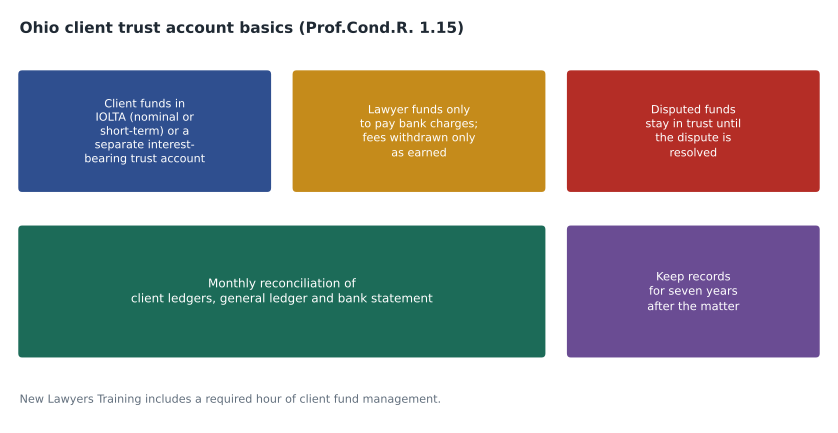
Client money is where most serious Ohio discipline begins. Prof.Cond.R. 1.15 requires a lawyer to hold client and third-party property separate from the lawyer's own, in a trust account maintained in the state where the lawyer's office is situated or elsewhere with the client's consent. A lawyer may deposit her own funds in the trust account only to pay or obtain a waiver of bank service charges. Advance fees and expenses go into the trust account and are withdrawn only as they are earned or incurred. When the lawyer and the client both claim an interest in funds, the disputed portion stays in the trust account until the dispute is resolved.
Ohio's record-keeping requirements are detailed. A lawyer must keep a record for each client on whose behalf funds are held, a general ledger for the account, bank statements and monthly reconciliations of the three, and must keep the records for seven years after the representation ends. New Ohio lawyers admitted by examination must complete an hour of client fund management as part of New Lawyers Training, discussed in Lesson 11, because the Court has seen how often trust account problems begin with simple ignorance of the rules.
Nominal and short-term client funds, those that cannot earn net income for the client, must be held in an interest on lawyers' trust account, known as IOLTA, under R.C. 4705.09. The interest goes to fund civil legal aid in Ohio. Larger or longer-held funds that can earn net interest for the client go into a separate interest-bearing trust account for that client's benefit.
Reporting misconduct and the catch-all rule
Prof.Cond.R. 8.3 requires an Ohio lawyer who possesses unprivileged knowledge of another lawyer's violation of the Ohio Rules that raises a question as to that lawyer's honesty, trustworthiness or fitness as a lawyer to inform a disciplinary authority. The rule also covers judges' violations of the Code of Judicial Conduct. Information a lawyer learns while participating in an approved lawyers assistance program, such as the Ohio Lawyers Assistance Program, is protected from the reporting requirement, so that lawyers can seek help for colleagues without triggering a report.
Prof.Cond.R. 8.4 lists the familiar forms of misconduct, such as committing an illegal act that reflects adversely on honesty or fitness, engaging in conduct involving dishonesty, fraud, deceit or misrepresentation, and engaging in conduct prejudicial to the administration of justice. Ohio adds two provisions worth knowing. Prof.Cond.R. 8.4(g) prohibits engaging, in a professional capacity, in conduct involving discrimination prohibited by law. And Prof.Cond.R. 8.4(h) is a catch-all: a lawyer may not engage in any other conduct that adversely reflects on the lawyer's fitness to practice law. The Supreme Court of Ohio has said that 8.4(h) should be used for conduct not covered by another rule but still serious enough to warrant discipline.
Advertising and solicitation
Ohio's advertising rules in Prof.Cond.R. 7.1 through 7.3 follow the Model Rules' core principle that communications about a lawyer's services may not be false or misleading. Ohio adds specific requirements for written, recorded and electronic solicitations of prospective clients known to need legal services in a particular matter, including labeling requirements and, for solicitations directed at accident or disaster victims and their families, a waiting period after the event. A new lawyer who plans direct mail or targeted online advertising should read the current Ohio text of Prof.Cond.R. 7.3 before sending anything.
The disciplinary system
Discipline is governed by Gov.Bar.R. V. Grievances against Ohio lawyers are investigated by the Office of Disciplinary Counsel, a statewide office of the Supreme Court, or by one of the certified grievance committees operated by local bar associations and the Ohio State Bar Association. If the investigator finds substantial, credible evidence of misconduct, it files a formal complaint with the Board of Professional Conduct, known before 2015 as the Board of Commissioners on Grievances and Discipline.
A three-member hearing panel of the Board hears the case, takes evidence and makes findings and a recommended sanction. The Board reviews the panel's report and files its own recommendation with the Supreme Court of Ohio, which decides the case. Respondents may file objections to the Board's report. The available sanctions are disbarment, indefinite suspension, suspension for a definite term, which the Court frequently stays in whole or part on conditions such as monitoring or restitution, and public reprimand. The Court can also impose interim remedial suspensions in urgent cases. Supreme Court of Ohio disciplinary decisions are published with the same public domain citations as other opinions, and they are the best guide to how the Court weighs aggravating and mitigating factors.
The Board of Professional Conduct has a second role: it issues advisory opinions interpreting the Ohio Rules of Professional Conduct and the Code of Judicial Conduct. A lawyer facing an unfamiliar ethics question can check the Board's advisory opinions, and ethics counsel at the Board and at the Ohio State Bar Association offer informal guidance.
Clients who lose money through a lawyer's dishonest conduct may apply to the Lawyers' Fund for Client Protection, funded through a portion of attorney registration fees, which reimburses eligible losses up to a cap.
| Ohio rule | What it requires |
|---|---|
| Prof.Cond.R. 1.4(c) | Signed written notice to the client if the lawyer lacks malpractice insurance of 100,000 / 300,000 |
| Prof.Cond.R. 1.5(c) | Contingent fee agreement and closing statement each signed by client and lawyer |
| Prof.Cond.R. 1.5(d)(3) | Earned-upon-receipt or nonrefundable fees only with written advice that a refund may be due |
| Prof.Cond.R. 1.5(e) | Fee division by proportion or joint responsibility, with written client consent and disclosed shares |
| Prof.Cond.R. 1.15 | Separate trust account, IOLTA for nominal funds, monthly reconciliation, records for seven years |
| Prof.Cond.R. 8.4(h) | No other conduct that adversely reflects on fitness to practice law |
Common mistakes
MistakeOhio lawyers must carry malpractice insurance.
InsteadOhio does not require coverage, but Prof.Cond.R. 1.4(c) requires a signed notice to clients if the lawyer lacks it.
MistakeA closing statement only needs to be sent to the client.
InsteadIn Ohio the contingent fee closing statement must be signed by the client and the lawyer.
MistakeA flat fee can simply be labeled nonrefundable.
InsteadOnly with written advice that the client may be entitled to a refund if the representation is not completed.
MistakeThe Ohio State Bar Association disciplines lawyers.
InsteadDiscipline is decided by the Supreme Court of Ohio after proceedings before the Board of Professional Conduct.
Practice problems
Work each problem on paper first, then reveal the answer to check.
What insurance amounts trigger Ohio's malpractice notice requirement?
Show answer
Coverage below 100,000 dollars per occurrence and 300,000 dollars in the aggregate.
Who must sign an Ohio contingent fee closing statement?
Show answer
The client and the lawyer, and in a divided fee case each lawyer sharing the fee.
How long must Ohio trust account records be kept?
Show answer
Seven years after the representation ends.
What body hears formal disciplinary complaints in Ohio?
Show answer
The Board of Professional Conduct, through three-member hearing panels; the Supreme Court decides.
Summary and key terms
- The Ohio Rules of Professional Conduct took effect February 1, 2007; comparison notes flag differences from the Model Rules.
- Prof.Cond.R. 1.4(c) requires a signed notice to clients if the lawyer lacks 100,000 / 300,000 malpractice coverage.
- Ohio contingent fee agreements and closing statements must be signed by client and lawyer; nonrefundable fees need a written refund advisory; fee divisions need proportion or joint responsibility and written consent.
- Prof.Cond.R. 1.15 requires separate trust accounts, IOLTA for nominal funds, monthly reconciliation and seven years of records.
- Prof.Cond.R. 8.3 requires reporting; 8.4(g) bars unlawful discrimination and 8.4(h) is a catch-all.
- Disciplinary Counsel or certified grievance committees investigate; the Board of Professional Conduct hears; the Supreme Court of Ohio decides.
- closing statement
- The written accounting at the end of an Ohio contingent fee matter, signed by client and lawyer.
- IOLTA
- An interest on lawyers' trust account for nominal or short-term client funds, with interest funding legal aid.
- joint responsibility
- Financial and ethical responsibility for a representation, allowing a referring lawyer to share a fee.
- Board of Professional Conduct
- The Ohio board that hears disciplinary cases and issues advisory opinions.
- certified grievance committee
- A bar association committee authorized to investigate and prosecute grievances in Ohio.
Lesson quiz · 5 questions
Score 60% or more to complete this lesson.
Create a free account to save your progress, take quizzes and earn a certificate.