
BAR-236 · Lesson 1 of 12 · 22 min
Becoming a lawyer in Ohio
▶ Video coming soon A video version of this lesson is on the way.
Wesley Barczak grew up in Parma, a suburb south of Cleveland, and has spent the last six years settling other people's injury claims. He started as a trainee adjuster at a property and casualty insurer in Columbus after college, moved up to handling bodily injury files, and in the fall of 2022 began the part-time evening program at an Ohio law school while keeping his day job. He finishes his last courses in December 2026, and he plans to sit the Ohio bar examination in February 2027. He joined Hollis Marchetti's Tuesday evening study group in the fall of 2026, and because Hollis also lives in Ohio, she offered him a set of extra sessions on the parts of the process that are particular to Ohio.
'I know a lot about Ohio law from the claims side,' Wesley told her at their first session. 'Comparative fault, the damages caps, what happens when a city truck hits somebody. What I don't know is the admission process. I registered as a candidate years ago, filed my application in October, and sat through an interview with two lawyers from a local bar committee. I did each step because the law school told me to. I couldn't explain to you how the pieces fit together.'
Hollis said that was the most common position for an Ohio candidate to be in, and the easiest to fix. 'Ohio's process has more moving parts than most,' she said. 'There is an early registration in law school, a separate application for each exam, a character review that runs through a local bar association, a state-specific online test, and then the swearing-in and registration. Once you can see the whole map, each step makes sense.' This course follows their sessions.
The first six lessons cover admission: who admits Ohio lawyers, registering as a candidate and the filing deadlines, character and fitness and the MPRE, the Uniform Bar Examination and its 270 passing score, Ohio's planned move to the NextGen exam in July 2028, and the Ohio Law Component. Lessons 7 through 10 cover Ohio law a new lawyer meets early: the courts and civil procedure, tort law and government immunity, family law and probate, and the Ohio Rules of Professional Conduct. Lesson 11 covers score transfer, admission without examination and the first years of practice, and Lesson 12 is a capstone with original practice questions and an exam-day plan.
The Supreme Court of Ohio admits lawyers
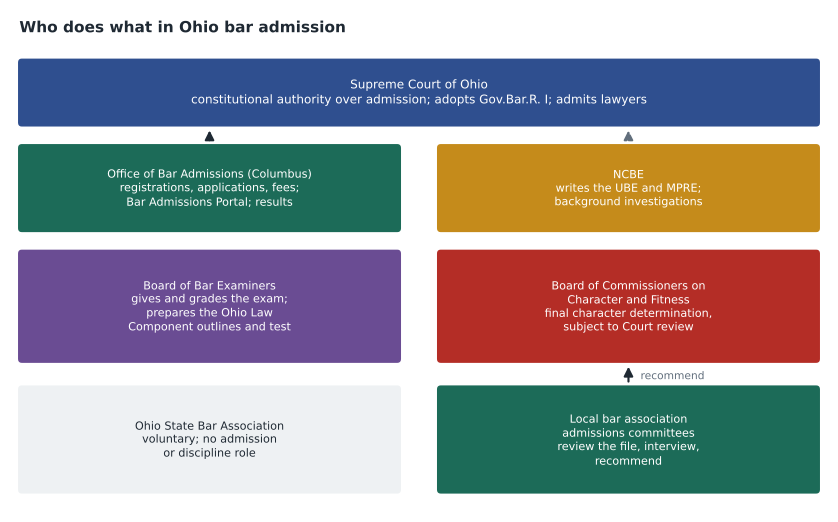
In Ohio, as in every state, the power to admit lawyers belongs to the state's highest court. The Ohio Constitution gives the Supreme Court of Ohio original jurisdiction over the admission to the practice of law, the discipline of lawyers and all other matters relating to the practice of law. The Court sits in Columbus and has seven members: a chief justice and six justices, each elected statewide to a six-year term. The Court exercises its authority over the profession through a set of rules called the Supreme Court Rules for the Government of the Bar of Ohio, usually cited as Gov.Bar.R. followed by a Roman numeral.
Rule I of those rules governs admission to the practice of law. It is divided into sections, and a candidate who learns the main ones will find the Court's materials much easier to read. The early sections set the general requirements and the preliminary registration that every bar exam candidate files during law school. Later sections cover the application to take the bar examination, the examination itself, character and fitness, and the alternative routes into the Ohio bar, including admission without examination under Section 10 and admission by transferred Uniform Bar Examination score under Section 11. Wesley had read Section 2 of Rule I, the registration rule, while still a second-year evening student, and had never opened the rest.
The Court's other rules for the bar matter just as much on the day of admission. Gov.Bar.R. V governs lawyer discipline. Gov.Bar.R. VI governs attorney registration, which every Ohio lawyer must complete after taking the oath and then renew every two years. Gov.Bar.R. X governs continuing legal education, including the New Lawyers Training requirement for those admitted by examination. And the Ohio Rules of Professional Conduct, adopted by the Court and in force since February 1, 2007, govern how lawyers practice. Lessons 10 and 11 return to these rules.
The Office of Bar Admissions and the two boards
The Court does not run the admission process day to day. That work belongs to the Office of Bar Admissions, part of the Court's Attorney Services Division, located at 65 South Front Street in Columbus. The Office receives registrations and applications through an online Bar Admissions Portal, checks that applicants meet the education and filing requirements, collects fees, schedules applicants for the exam and posts results. When Wesley filed his exam application in October 2026, he did it through that portal, and the portal is where he will learn his result.
Two boards appointed by the Court make the important decisions. The Board of Bar Examiners prepares, administers and grades the Ohio bar examination. Because Ohio gives the Uniform Bar Examination, the Board does not write the national components; NCBE writes them, and the Board oversees grading of the written portion in Ohio. The Board of Bar Examiners also prepares the outlines and questions for the Ohio Law Component, the state-specific test covered in Lesson 6. The Board of Commissioners on Character and Fitness decides whether each applicant has the character, fitness and moral qualifications to practice law in Ohio. It receives recommendations from local bar association admissions committees and makes the final character determination, subject to review by the Court.
Local bar associations and NCBE
Ohio is unusual in how much of the character review happens close to home. Every applicant for admission by examination is interviewed by members of a local bar association admissions committee, typically in the county where the applicant lives or attends law school. The committee reviews the applicant's file, conducts a personal interview, and recommends to the Board of Commissioners on Character and Fitness that the applicant be approved, disapproved or approved with further review. Wesley's interview took place in late October 2026 with two volunteer lawyers from a committee in central Ohio, at a conference room in one of their offices. Lesson 3 covers what they were looking for.
The National Conference of Bar Examiners plays two roles in Ohio. First, it writes the components of the Uniform Bar Examination, the Multistate Bar Examination, the Multistate Essay Examination and the Multistate Performance Test, and it scales and reports scores. It also writes the MPRE, the separate ethics exam Ohio requires. Second, NCBE conducts the background investigation for Ohio applicants: the character questionnaire an applicant completes is NCBE's, and NCBE gathers records and reports its findings to Ohio. An applicant therefore pays one set of fees to the Supreme Court of Ohio and another set directly to NCBE.
The Ohio State Bar Association is not the regulator
Candidates moving from states with an integrated bar are sometimes confused by Ohio's structure. In an integrated or unified bar state, every lawyer must join the state bar, and the bar itself often runs admissions or discipline. Ohio's bar is not integrated. The Ohio State Bar Association is a voluntary professional association that offers continuing education, practice resources and sections for different areas of law, and many Ohio lawyers belong to it, but membership is not required to practice. The regulatory functions, registration, discipline and CLE compliance, sit with the Supreme Court of Ohio and its offices and boards.
Local bar associations in Ohio are also voluntary, but they play official roles assigned by Court rule. Their admissions committees interview applicants, and some of them operate certified grievance committees that investigate complaints against lawyers alongside the Court's Office of Disciplinary Counsel. Wesley found it helpful to think of the local bar associations as volunteers the Court has deputized for particular tasks.
Three main ways in
Ohio admits lawyers in three main ways. The first, and the one this course centers on, is admission by examination: registering as a candidate, applying for and passing the Ohio bar examination, passing the Ohio Law Component and the MPRE, receiving final character approval, and taking the oath. Most new law graduates use this path.
The second is admission by transferred Uniform Bar Examination score under Section 11 of Rule I. An applicant who earned a UBE score of 270 or higher in another UBE jurisdiction within five years before applying in Ohio can transfer that score instead of sitting again, provided she also passes the Ohio Law Component, meets the MPRE requirement and receives character approval. Ohio began accepting NextGen scores of 620 or higher in November 2026.
The third is admission without examination under Section 10, for lawyers who have practiced in another United States jurisdiction for at least five of the last seven years. Ohio does not require reciprocity: a lawyer from any state can qualify if she meets the practice and other requirements. Ohio also offers narrower forms of permission, including temporary certification for certain lawyers and legal intern certificates for law students working under supervision. Lesson 11 covers the alternative routes in detail.
The order of the steps
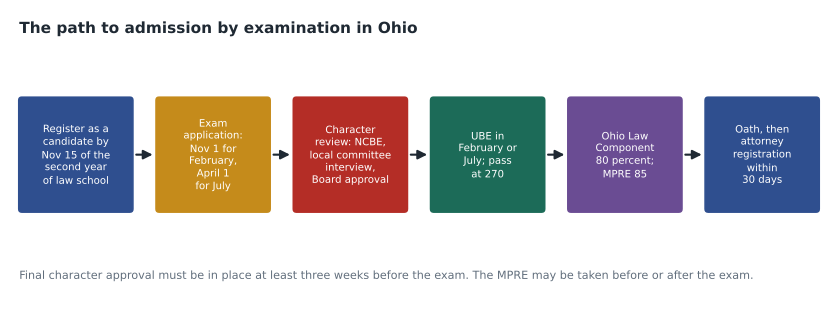
Hollis asked Wesley to list his steps in order. He wrote them on the shared screen. In November 2023, during his second year, he filed the Application to Register as a Candidate for Admission, with the NCBE character questionnaire, a copy of his photo identification, his college transcript and the fees. That registration started the NCBE investigation. In August 2026 he took the MPRE. In October 2026 he filed the Application to Take the Bar Examination for the February 2027 exam, ahead of the November deadline. In late October he had his local admissions committee interview. Still to come were his law school's certification of his degree and his ethics and substance abuse instruction, final approval by the Board of Commissioners on Character and Fitness, the exam itself, the Ohio Law Component, and, if all went well, admission.
'The thing people miss,' Hollis said, 'is that Ohio's character review is tied to the exam calendar. You cannot sit the exam unless the Board has given you final character approval at least three weeks before it. That is why the registration comes so early and why the interview happened in October. If your file had a problem in it, you would want to know in October, not in February.'
She also pointed out what Ohio does not require. There is no requirement to pass the MPRE before sitting the bar exam, and no time limit on when the MPRE score was earned. There is no limit on the number of times an applicant can sit the exam, though an applicant who fails and does not retake within the next four exams has her application deemed withdrawn. And there is no separate in-person Ohio essay test: Ohio's state-specific requirement is the online Ohio Law Component.
How Ohio law fits in
The Uniform Bar Examination tests general principles of law, not Ohio law. An Ohio candidate answering an MEE question on negligence applies the general rules the question is built on, not Ohio's statutes. That is the bargain of the UBE: a portable score in exchange for testing general law. Ohio covers its own law through the Ohio Law Component, an open-book online test based on outlines prepared by the Board of Bar Examiners.
Ohio law still matters for an Ohio candidate in two ways. First, it matters on the Ohio Law Component itself. Second, and more important for a career, it matters on the first day of practice. A new lawyer in Ohio files a complaint under the Ohio Rules of Civil Procedure, calculates fault under Ohio's comparative fault statute, sues a city under Ohio's political subdivision immunity statute, and handles trust money under the Ohio Rules of Professional Conduct. Lessons 7 through 10 cover those areas because they are where general bar exam rules and Ohio practice part ways.
Wesley said his claims work had already taught him one difference. 'On the exam, a plaintiff who is more at fault than the defendant might still recover something, depending on the comparative fault system the question uses. In Ohio, a plaintiff whose fault is greater than the combined fault of the defendants recovers nothing. I've closed files on that rule.' Hollis told him to keep a running list of differences like that, one line each, and to bring it to every session.
Worked problem
Mapping the authority
A classmate tells Wesley that the Ohio State Bar Association decided his character application and will also decide whether he passes the Ohio Law Component. Using what this lesson covers, identify which body actually makes each decision and under what authority.
Show solution
- The power to admit lawyers belongs to the Supreme Court of Ohio, which exercises it through Gov.Bar.R. I.
- Character and fitness is decided by the Board of Commissioners on Character and Fitness, on the recommendation of a local bar association admissions committee, subject to review by the Court.
- The Ohio Law Component is prepared by the Board of Bar Examiners, which writes the outlines and questions; a score of 80 percent or higher is required before admission.
- The Ohio State Bar Association is a voluntary professional association with no role in either decision.
Answer: Neither decision belongs to the Ohio State Bar Association. The Board of Commissioners on Character and Fitness decides character after a local committee recommendation, and the Board of Bar Examiners prepares and sets the pass mark for the Ohio Law Component, all under the authority of the Supreme Court of Ohio.
Common mistakes
MistakeThe Ohio State Bar Association admits and disciplines Ohio lawyers.
InsteadThe Supreme Court of Ohio admits and disciplines lawyers; the Ohio State Bar Association is a voluntary association.
MistakeAn Ohio candidate must pass the MPRE before sitting the bar exam.
InsteadOhio requires an MPRE score of 85 for admission, with no rule that it come first and no time limit on the score.
MistakeThe Ohio bar exam includes Ohio essay questions.
InsteadOhio gives the Uniform Bar Examination, which tests general law; Ohio law is covered by the online Ohio Law Component.
MistakeCharacter review starts after the exam.
InsteadCharacter review starts with the registration in law school, and final approval must come at least three weeks before the exam.
Practice problems
Work each problem on paper first, then reveal the answer to check.
What body of rules governs admission to the bar in Ohio?
Show answer
Rule I of the Supreme Court Rules for the Government of the Bar of Ohio (Gov.Bar.R. I).
Which board prepares and grades the Ohio bar examination?
Show answer
The Board of Bar Examiners, appointed by the Supreme Court of Ohio; NCBE writes the UBE components.
Who interviews Ohio bar applicants about character and fitness?
Show answer
Members of a local bar association admissions committee, who make a recommendation to the Board of Commissioners on Character and Fitness.
Must an Ohio lawyer join the Ohio State Bar Association?
Show answer
No. Ohio does not have an integrated bar; lawyers must register with the Supreme Court under Gov.Bar.R. VI.
Summary and key terms
- The Supreme Court of Ohio holds constitutional authority over admission and acts through Gov.Bar.R. I.
- The Office of Bar Admissions in Columbus runs the process through the Bar Admissions Portal.
- The Board of Bar Examiners handles the exam and the Ohio Law Component; the Board of Commissioners on Character and Fitness decides character.
- Local bar association admissions committees interview applicants; NCBE writes the UBE and MPRE and conducts background investigations.
- Ohio's bar is not integrated; the Ohio State Bar Association is voluntary.
- Three main paths: examination, transferred UBE score under Section 11, and admission without examination under Section 10.
- Gov.Bar.R.
- The Supreme Court Rules for the Government of the Bar of Ohio, cited by Roman numeral; Rule I governs admission.
- Office of Bar Admissions
- The Supreme Court of Ohio office that receives registrations and applications and runs the admission process.
- Board of Commissioners on Character and Fitness
- The board appointed by the Supreme Court of Ohio that makes final character and fitness determinations.
- admissions committee
- A local bar association committee that interviews Ohio applicants and recommends on their character and fitness.
- integrated bar
- A state bar that every lawyer must join; Ohio does not have one.
Lesson quiz · 5 questions
Score 60% or more to complete this lesson.
Create a free account to save your progress, take quizzes and earn a certificate.