
BAR-236 · Lesson 7 of 12 · 21 min
Ohio courts, the Court of Claims and civil procedure
▶ Video coming soon A video version of this lesson is on the way.
Wesley knows Ohio's courts from the outside. His bodily injury files end up in the courts of common pleas when they do not settle, occasionally in a municipal court when the claim is small, and once, memorably, in the Court of Claims of Ohio, after a state highway department truck backed into his insured's parked van. 'The claimant's lawyer filed in common pleas first,' he told Hollis, 'and the case got dismissed because suits against the state for money go to the Court of Claims. By then the two years had almost run.' Hollis said that was exactly the sort of Ohio-specific trap this lesson is about.
This lesson covers the structure of the Ohio courts, the Court of Claims, the Ohio Rules of Civil Procedure and the Ohio limitations rules a new lawyer uses most. The UBE tests federal civil procedure and general principles; Ohio practice runs on Ohio's rules, which follow the federal model in many places and depart from it in important ones.
The Supreme Court of Ohio
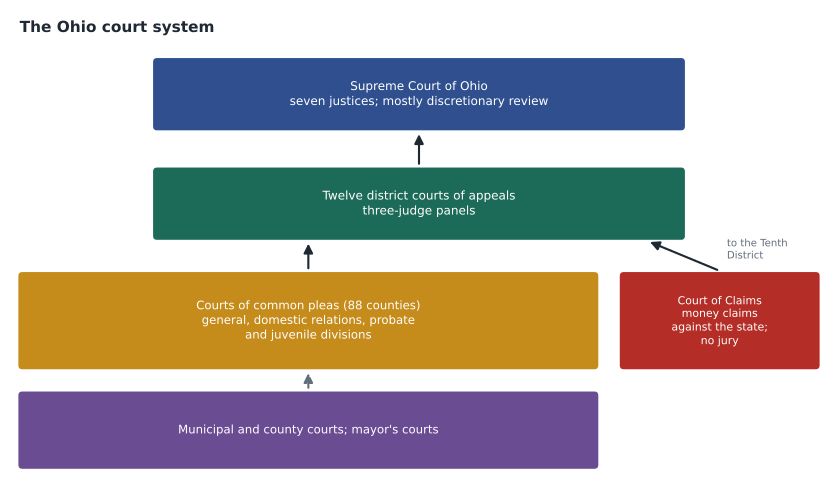
At the top of the system is the Supreme Court of Ohio, with a chief justice and six justices elected statewide to six-year terms. Since a 2021 statute, Senate Bill 80, candidates for the Supreme Court and the courts of appeals appear on the general election ballot with their party affiliation; candidates for the trial courts do not. When a vacancy arises between elections, the governor appoints a replacement, who then must stand for election.
The Supreme Court's appellate jurisdiction is mostly discretionary. A party seeking review files a memorandum in support of jurisdiction arguing that the case involves a question of public or great general interest, and the Court decides whether to accept it. Some appeals come as of right, including cases that originated in the courts of appeals, cases involving a substantial constitutional question and appeals in death penalty cases. The Court also decides certified conflicts, when one district court of appeals certifies that its judgment conflicts with another district's on the same question of law. And it has original jurisdiction in extraordinary writ actions, such as mandamus, prohibition, quo warranto, habeas corpus and procedendo, as well as in matters relating to the practice of law.
Ohio uses a public domain citation system for court opinions. A Supreme Court of Ohio decision is cited with the year, the word Ohio and a sequential number, such as 2022-Ohio-4525, alongside the Ohio Official Reports citation when one is available. Wesley had seen these citations in coverage letters for years without knowing what they were.
The courts of appeals
Ohio has twelve district courts of appeals, each covering a group of counties. Cases are heard by three-judge panels. The courts of appeals hear appeals from final orders of the trial courts in their district and have original jurisdiction in the same extraordinary writs as the Supreme Court. Because there are twelve districts, the law can differ from district to district on questions the Supreme Court has not resolved. A new lawyer should always check the law of her own appellate district first, and treat decisions from other districts as persuasive only.
The trial courts
Every one of Ohio's 88 counties has a court of common pleas, the general trial court. The common pleas court is organized into divisions. The general division hears felony criminal cases and civil cases above the monetary limit of the municipal and county courts. The domestic relations division hears divorces, dissolutions, legal separations and related matters. The probate division handles estates, guardianships, adoptions, marriage licenses and some trust matters. The juvenile division hears delinquency, abuse, neglect and dependency cases and some custody matters involving unmarried parents. Smaller counties combine some divisions; larger counties have separate judges for each.
Below the common pleas courts are the municipal courts and county courts, courts of limited jurisdiction that hear misdemeanors, traffic offenses, preliminary hearings in felony cases and civil cases up to a statutory monetary limit. Many have small claims divisions for modest money claims, where parties often appear without lawyers. Ohio also has mayor's courts, operated by some municipalities to hear violations of local ordinances and traffic laws. Mayor's courts are not courts of record, and a defendant can generally move her case to the municipal or county court.
The Court of Claims of Ohio
The Court of Claims exists because of sovereign immunity. Historically the State of Ohio could not be sued without its consent. In the Court of Claims Act, which took effect in 1975, the General Assembly waived the state's immunity and consented to be sued, but only in the Court of Claims and only in accordance with the same rules of law that apply to suits between private parties. The Court of Claims sits in Columbus. It has exclusive original jurisdiction over civil actions against the state for money damages, so a negligence claim against a state agency, such as the highway department in Wesley's file, must be filed there, not in common pleas.
Several features of the Court of Claims differ from ordinary civil litigation. Cases are tried to the judge, not a jury. The limitations period for most claims against the state is two years after the cause of action accrues, or any shorter period that would apply to a similar suit between private parties. Judgments are paid from state funds, and the Court of Claims also hears certain special claims created by statute, such as claims for wrongful imprisonment. Appeals from the Court of Claims go to the Tenth District Court of Appeals in Franklin County.
Two further features are particular to Ohio. First, the state's waiver of immunity does not extend to personal liability of state employees. Under Ohio law, a state officer or employee is personally immune from liability for acts within the scope of employment unless the conduct was manifestly outside that scope or done with malicious purpose, in bad faith or in a wanton or reckless manner. The Court of Claims has exclusive original jurisdiction to decide whether a state employee is entitled to that immunity. A plaintiff who wants to sue a state employee personally in another court must first obtain a Court of Claims determination that immunity does not apply. Second, since 2016, the Court of Claims has heard a fast-track procedure for complaints that a public office denied access to public records, decided first by a special master. Lesson 8 contrasts all of this with the separate statute that governs counties, cities, townships and school districts.
The Ohio Rules of Civil Procedure
The Ohio Rules of Civil Procedure took effect in 1970, adopted by the Supreme Court under the rulemaking power the Modern Courts Amendment gave it. They are modeled on the Federal Rules of Civil Procedure, and much of what a candidate learns for the MBE carries over. A civil action begins with a complaint, defendants answer or move to dismiss, discovery follows, and cases end in settlement, dismissal, summary judgment or trial. Ohio uses notice pleading: Civ.R. 8(A) requires a short and plain statement of the claim showing that the party is entitled to relief, and Ohio courts have not adopted the federal plausibility standard of Twombly and Iqbal.
The differences are where Ohio practice is learned. Here are the ones a new lawyer meets in her first year.
Commencement. Under Civ.R. 3(A), an action is commenced by filing a complaint if service is obtained within one year from filing. A complaint filed within the limitations period but not served within the year does not commence the action, and if the limitations period has run, the claim may be lost unless a savings rule applies.
Time to answer. Under Civ.R. 12(A), a defendant generally has 28 days after service to answer, longer than the federal 21 days. New lawyers trained on the federal rule regularly miscalculate this in both directions.
Voluntary dismissal and the savings statute. Civ.R. 41(A)(1) lets a plaintiff dismiss once without prejudice by filing a notice before trial. Ohio's savings statute, R.C. 2305.19, then allows the plaintiff to refile within one year after the dismissal, or within the original limitations period if that is later, when the first action failed otherwise than upon the merits. The savings statute can be used only once, and a second notice of dismissal of the same claim operates as an adjudication on the merits under the double-dismissal rule.
Medical claims. Civ.R. 10(D)(2) requires a complaint that contains a medical claim, dental claim, optometric claim or chiropractic claim to include an affidavit of merit from a qualified expert stating that the standard of care was breached and that the breach caused the injury.
Jury trial and verdicts. A party must demand a jury in writing within the time the rules allow, or the right is waived. Under the Ohio Constitution and Civ.R. 48, a civil verdict may be returned by three-fourths of the jurors, not a unanimous jury.
Appeals. An Ohio appellate court can review only a final order, defined by R.C. 2505.02. In a case with multiple claims or parties, a judgment resolving fewer than all of them is final only if the trial court expressly determines under Civ.R. 54(B) that there is no just reason for delay. The notice of appeal is due within 30 days of the judgment entry under App.R. 4(A). Missing the 30 days is jurisdictional.
Limitations periods a new lawyer uses
Ohio's limitations periods are in Chapter 2305 of the Revised Code. The period for bodily injury and injury to personal property is two years under R.C. 2305.10. Medical malpractice claims have a one-year period under R.C. 2305.113, which can be extended by 180 days if the claimant sends the provider a written notice of intent to sue before the year runs, and a four-year statute of repose that bars most medical claims filed more than four years after the act or omission. The Supreme Court of Ohio upheld that statute of repose against constitutional challenge in Antoon v. Cleveland Clinic Foundation (2016). Defamation claims have one year. A 2021 amendment shortened the periods for contract claims, to six years for written contracts and four years for oral contracts. Claims against political subdivisions generally have two years under R.C. 2744.04, and claims against the state generally two years in the Court of Claims.
| Claim | Ohio limitations period | Source |
|---|---|---|
| Bodily injury or property damage | Two years | R.C. 2305.10 |
| Medical malpractice | One year, extendable 180 days by notice; four-year repose | R.C. 2305.113 |
| Defamation | One year | R.C. 2305.11 |
| Written contract | Six years (since 2021) | R.C. 2305.06 |
| Oral contract | Four years (since 2021) | R.C. 2305.07 |
| Against a political subdivision | Two years, generally | R.C. 2744.04 |
| Against the state | Two years, generally, in the Court of Claims | R.C. 2743.16 |
Worked problem
Where to file
Thessaly Barlow, a hypothetical client, was injured on March 3, 2025 when a county sheriff's cruiser on a non-emergency errand ran a red light and struck her car in Delaware County. A second vehicle in the crash was a state highway department truck whose driver was also negligent. Where must she sue each defendant, and by when?
Show solution
- The sheriff's office is part of a county, a political subdivision. Claims against political subdivisions are governed by R.C. Chapter 2744 and are filed in the ordinary courts, here the Delaware County Court of Common Pleas, generally within two years.
- The highway department is a state agency. Money claims against the state go to the Court of Claims of Ohio, which has exclusive original jurisdiction, generally within two years.
- The two claims arise from one crash but must proceed in different courts, unless the plaintiff chooses to pursue only one defendant.
- If Thessaly also wants to sue the state truck driver personally, she must first obtain a Court of Claims determination that the driver is not immune.
Answer: Thessaly must sue the county in the Delaware County Court of Common Pleas and the state in the Court of Claims, each by March 3, 2027 under the usual two-year periods. A personal claim against the state driver requires a Court of Claims immunity determination first.
Common mistakes
MistakeSuits against the State of Ohio for money damages may be filed in any common pleas court.
InsteadThe Court of Claims has exclusive original jurisdiction over them.
MistakeAn Ohio defendant has 21 days to answer.
InsteadCiv.R. 12(A) generally allows 28 days.
MistakeOhio follows the federal plausibility pleading standard.
InsteadOhio uses notice pleading under Civ.R. 8(A).
MistakeThe savings statute can be used repeatedly.
InsteadIt can be used once; a second voluntary dismissal operates as an adjudication on the merits.
Practice problems
Work each problem on paper first, then reveal the answer to check.
How many district courts of appeals does Ohio have?
Show answer
Twelve.
Which court has exclusive original jurisdiction over money claims against the State of Ohio?
Show answer
The Court of Claims of Ohio.
When is an Ohio action commenced?
Show answer
On filing the complaint, if service is obtained within one year of filing (Civ.R. 3(A)).
How many jurors must agree on an Ohio civil verdict?
Show answer
Three-fourths.
Venue and service in practice
Venue in Ohio is governed by Civ.R. 3, which lists the counties where an action may properly be brought, such as the county where a defendant resides or has its principal place of business, the county where the defendant conducted activity that gave rise to the claim, and the county where the claim arose. Unlike subject-matter jurisdiction, improper venue does not defeat the case; it is cured by transfer to a proper county, and an objection is waived if not raised in time. Service of process in Ohio is usually made by certified mail sent by the clerk of courts, with personal or residence service by a sheriff or process server and, in limited circumstances, service by publication as alternatives. A new lawyer should watch the clerk's docket for the certified mail return, because the one-year clock under Civ.R. 3(A) runs from filing, not from service.
Wesley had seen the commencement rule decide a file. A claimant's lawyer filed a complaint against his insured two weeks before the two-year period ran, but the certified mail came back unclaimed and nobody followed up. Thirteen months after filing, the insured moved to dismiss. Because service had not been obtained within one year, the action had never been commenced, and the claimant's remaining hope was the savings statute, which applies only if an action was commenced or attempted to be commenced in the first place. 'The rule is not complicated,' Hollis said. 'It just punishes inattention.'
Summary and key terms
- The Supreme Court of Ohio has seven members elected to six-year terms; its appellate jurisdiction is mostly discretionary.
- Twelve district courts of appeals hear appeals in three-judge panels; their law can differ by district.
- Courts of common pleas in each of 88 counties have general, domestic relations, probate and juvenile divisions.
- The Court of Claims has exclusive original jurisdiction over money claims against the state, tried to a judge, generally within two years.
- Ohio civil procedure follows the federal model with key differences: notice pleading, 28 days to answer, one-year service rule, the savings statute, affidavits of merit, three-fourths verdicts.
- Know the limitations periods: two years for injury, one year for medical claims, six and four years for written and oral contracts since 2021.
- court of common pleas
- The general trial court in each Ohio county, organized into divisions.
- Court of Claims of Ohio
- The court with exclusive original jurisdiction over civil money claims against the state.
- savings statute
- R.C. 2305.19, allowing one refiling after an action fails otherwise than upon the merits.
- affidavit of merit
- An expert affidavit required with an Ohio medical claim complaint under Civ.R. 10(D)(2).
- final order
- An order an Ohio appellate court may review, defined by R.C. 2505.02.
Lesson quiz · 5 questions
Score 60% or more to complete this lesson.
Create a free account to save your progress, take quizzes and earn a certificate.