
BAR-236 · Lesson 6 of 12 · 20 min
The Ohio Law Component
▶ Video coming soon A video version of this lesson is on the way.
'So when do I take the Ohio part?' Wesley asked. He had heard classmates call it the OLC, the Ohio component and the Ohio law test, and he had assumed it was a third day of the bar exam. Hollis corrected him. 'It is not on the exam days at all. It is an online, open-book, multiple-choice test you take on your own after the exam. You get access to it after the Wednesday of the exam, you study the Court's outlines, and you need 80 percent. Almost everyone passes it. The people who get caught are the ones who forget it exists until the week of the swearing-in.'
This lesson covers what the Ohio Law Component is, who must take it, when and how it is taken, how to prepare for it, and why its future is uncertain. It also uses one area the Court's NextGen committee singled out for the future Ohio component, Ohio constitutional law, as a worked example of how to study Ohio-specific material efficiently.
What it is
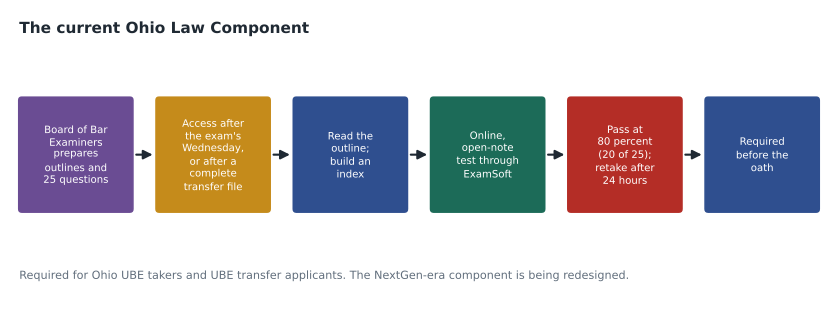
Ohio's UBE rules require every applicant admitted on the basis of a UBE score to satisfy a jurisdiction-specific requirement in addition to the exam. Ohio's requirement is the Ohio Law Component. It consists of two parts: a set of outlines on Ohio law prepared by the Board of Bar Examiners, and an online multiple-choice test, also developed by the Board, on the material in those outlines. The Court's UBE materials describe it as an online, open-book exam covering relevant Ohio-specific topics.
The Court's NextGen committee memo of February 2025 gave more detail about the current test. It consists of 25 multiple-choice questions, administered online through the ExamSoft platform. It is open note, and applicants receive a Court-produced outline to use. An applicant who fails may retake it as needed, after waiting 24 hours. The Court's contract with the testing vendor carries no cost to the Court; applicants pay the vendor directly for the test.
To pass, an applicant must score 80 percent or higher. On a 25-question test, that means at least 20 correct answers. The pass mark is fixed, not scaled, and the test is pass or fail: a score above 80 percent has no further effect.
Who must take it
Two groups must pass the Ohio Law Component. The first is every applicant who sits the UBE in Ohio. The second is every applicant who seeks admission in Ohio by transferring a UBE score earned elsewhere. The Court's materials state the requirement for both groups in the same terms: a passing score is a requirement for admission. Ohio's NCBE summary also lists the Ohio requirement for applicants transferring NextGen scores, with the NextGen-era version still to be announced.
Applicants for admission without examination under Section 10 of Rule I follow a different set of requirements built around their years of practice, and the Court's materials for that route do not list the Ohio Law Component. Lesson 11 compares the routes.
When it is taken
For applicants sitting the exam in Ohio, access opens after the Wednesday of the bar exam, the second exam day. The Office notifies applicants by email with instructions. Applicants may then take the test at any time before admission, and many take it within a few weeks of the exam, while results are still pending, so that the requirement is out of the way whatever happens.
For transfer applicants, instructions are emailed within roughly seven to ten business days after the transfer application is considered complete. Because transfer applicants are often already practicing elsewhere and moving on a schedule, the Ohio component is usually one of the first steps they finish.
The deadline is admission itself. The Court's admission ceremony materials list three score requirements an applicant must meet to be eligible to be sworn in: a passing bar exam score, an MPRE score of 85 or higher and an Ohio Law Component score of 80 percent or higher. An applicant who passes the bar exam but has not passed the Ohio component is not eligible for the ceremony.
Wesley decided to take it the week after the February exam. 'If I pass the bar, I want nothing else between me and the oath,' he said. 'And if I don't pass, I still won't have to take it again.' Hollis agreed that the timing was sensible, with one caution: 'Study the outline first. Open book does not mean you can skip reading it.'
How to prepare
The test is open book, but it is not a test of whether you can find words in a document. Questions apply the outline's rules to short fact patterns, and an applicant who has never read the outline will spend too long searching. Hollis suggested a four-step approach that takes most candidates one to two evenings.
First, read the whole outline once, quickly, to learn its structure. Second, read it again slowly, marking every number, deadline, list and exception, because those are the details multiple-choice questions turn on. Third, build a one-page index: each topic with the page or section where it appears. Fourth, take the test in a quiet place with the outline and index open, answer the questions you know first, and use the index for the rest. With 25 questions and a pass mark of 20, an applicant can afford a few misses but not many.
Because the outlines are prepared by the Board and updated by it, an applicant should always use the version the Office provides, not a copy from a friend who took the test years ago. Ohio law changes, and the questions are written to the current outline.
| Feature | Current Ohio Law Component |
|---|---|
| Prepared by | Board of Bar Examiners |
| Materials | Court-produced outlines on Ohio law |
| Format | 25 multiple-choice questions, online through ExamSoft, open note |
| Pass mark | 80 percent or higher |
| Access for exam takers | After the Wednesday of the bar exam, by email |
| Access for transfer applicants | About seven to ten business days after a complete application |
| Retakes | Allowed after a 24-hour wait |
| Deadline | Before admission; required for ceremony eligibility |
The criticism and the redesign
The NextGen committee's memo was frank that the current test does little to measure knowledge of Ohio law. An open-note, retake-as-needed test with a published outline measures whether an applicant read and can use the outline, which has value, but it does not show that she knows the law. That criticism, combined with NextGen's removal of traditional essays and the national exam's limited coverage of trusts and estates, led the committee to recommend replacing the current test with a substantive component for the NextGen era. The Court directed the Board of Bar Examiners to re-evaluate the Ohio Law Component, and as of November 2026 the NextGen-era requirement was listed as to be announced.
The committee named three areas the new component should test: wills and trusts, Ohio constitutional law and the structure of the Ohio court system. Lesson 7 covers the courts and Lesson 9 covers wills and probate. The rest of this lesson uses Ohio constitutional law to show how to study Ohio-specific material.
A worked example: the Ohio Constitution
Ohio's current constitution dates from 1851, and it has been amended many times since. It is long, detailed and easy to amend compared with the federal constitution: amendments can be proposed by the General Assembly or by citizens through initiative petitions, and are adopted by a simple majority of voters. Ohio added the initiative and referendum in 1912. Ohio voters regularly see constitutional amendments on the ballot, and several have changed Ohio law significantly in recent years.
Article I is Ohio's Bill of Rights. Some of its provisions track the federal Bill of Rights; others have no federal counterpart. Article I, Section 5 preserves the right of trial by jury and permits the General Assembly to authorize civil verdicts by not less than three-fourths of the jury. Article I, Section 16 provides that all courts shall be open and that every person, for an injury done him in his land, goods, person or reputation, shall have remedy by due course of law. That open-courts and due-course-of-law provision is the basis for many Ohio challenges to tort reform statutes, including the challenges to damages caps discussed in Lesson 8. Article I, Section 10a, adopted by voters in 2017 and commonly called Marsy's Law, gives crime victims specific rights in criminal proceedings. And in November 2023, voters adopted Article I, Section 22, which protects an individual's right to make reproductive decisions.
The Supreme Court of Ohio has said that the Ohio Constitution is a document of independent force. In Arnold v. Cleveland (1993), a challenge to a Cleveland firearms ordinance under the Ohio Constitution's right to bear arms, the Court declared that the Ohio Constitution is a document of independent force and that Ohio courts may read it to provide greater protection than its federal counterpart. Ohio lawyers who bring constitutional claims therefore consider both constitutions and argue them separately.
Article IV establishes the judicial branch. The Modern Courts Amendment of 1968 gave the Supreme Court of Ohio general superintendence over all Ohio courts and the power to adopt rules of practice and procedure. Under Article IV, Section 5(B), the Court files proposed rules with the General Assembly, and they take effect on the following July 1 unless the General Assembly adopts a concurrent resolution of disapproval. Rules adopted that way supersede conflicting laws on procedural matters but may not abridge, enlarge or modify any substantive right. That distinction between procedure and substance shapes many Ohio disputes about whether a statute or a rule controls.
Hollis showed Wesley how she would turn that material into study notes. Each provision gets one line: the section number, a five-word summary, and the one fact a question would test. 'Article I, Section 16: open courts, remedy by due course of law, tort reform challenges. Article IV, Section 5(B): Court rules, take effect July 1 unless disapproved, procedure not substance.' A page of lines like that, she said, is the right preparation for a multiple-choice test on any outline.
Worked problem
An open-book question
Suppose an Ohio Law Component outline section states that rules of practice and procedure adopted by the Supreme Court of Ohio take effect on July 1 unless the General Assembly disapproves them, and that such rules may not abridge, enlarge or modify a substantive right. A question asks: a new civil rule shortens the time to answer a complaint, and a statute sets a longer time. Which controls?
Show solution
- Identify the rule: Article IV, Section 5(B) of the Ohio Constitution.
- Ask whether the subject is procedural or substantive. The time to answer a complaint is a matter of procedure.
- Rules adopted under Section 5(B) supersede conflicting laws on procedural matters.
- Check that the rule did not abridge a substantive right; shortening a filing period does not.
Answer: The civil rule controls, because the time to answer is procedural and properly adopted Court rules supersede conflicting statutes on matters of procedure.
Common mistakes
MistakeThe Ohio Law Component is a third day of the bar exam.
InsteadIt is an online, open-book test taken after the exam days, at any time before admission.
MistakeA score of 70 percent passes the Ohio component.
InsteadOhio requires 80 percent or higher, 20 of 25 on the current test.
MistakeTransfer applicants are exempt from the Ohio component.
InsteadBoth exam takers and UBE transfer applicants must pass it.
MistakeOpen book means no preparation is needed.
InsteadQuestions apply the outline to facts; reading the outline and building an index is the efficient preparation.
Practice problems
Work each problem on paper first, then reveal the answer to check.
Who prepares the Ohio Law Component outlines and questions?
Show answer
The Board of Bar Examiners.
When does an Ohio exam taker get access to the Ohio component?
Show answer
After the Wednesday of the bar exam, by email.
What happens after a failed Ohio component attempt?
Show answer
The applicant may retake it after a 24-hour wait.
Which Ohio constitutional provision guarantees open courts and remedy by due course of law?
Show answer
Article I, Section 16.
Common problems with the component
Hollis listed the problems she sees most often with the Ohio component. The first is forgetting it. Applicants who pass the bar exam sometimes realize only when the ceremony instructions arrive that they never took the component, and then scramble to complete it before the ceremony date. The second is underestimating it. Because nearly everyone passes eventually, some applicants take it without reading the outline and fail, then must wait 24 hours and pay again. The third is technical: the test runs on exam software, and an applicant should install and test the software well before the day she plans to sit, on the computer she will use. The fourth is assuming that a transfer score excuses the component. It does not; transfer applicants take it too.
How the component fits with the rest of the file
The Ohio component is one of several items that must all be complete before an applicant can be admitted. Wesley built a one-page checklist with every item and the date he completed it: registration filed, MPRE passed, exam application filed, committee interview completed, law school certifications sent, final character approval received, exam taken, Ohio component passed, results received, ceremony scheduled, oath taken, attorney registration completed. Hollis recommended keeping copies of every confirmation email in a single folder. If a question ever arises about whether a step was completed, the applicant who can produce the confirmation resolves it in minutes.
Summary and key terms
- The Ohio Law Component is Ohio's jurisdiction-specific requirement for UBE applicants: outlines plus an online, open-note multiple-choice test.
- The current test has 25 questions, is given through ExamSoft and requires 80 percent; retakes are allowed after 24 hours.
- Exam takers get access after the Wednesday of the exam; transfer applicants after their application is complete.
- A passing score is required to be eligible for admission.
- The Court directed the Board of Bar Examiners to redesign the component for the NextGen era; the committee recommended testing wills and trusts, Ohio constitutional law and the Ohio courts.
- Ohio's 1851 constitution is easily amended and has independent force; Article I, Section 16 and Article IV, Section 5(B) come up often in practice.
- Ohio Law Component
- Ohio's online, open-book test on Board-prepared outlines of Ohio law, required before admission.
- open-note test
- A test the applicant may take with her outline and notes available.
- Modern Courts Amendment
- The 1968 amendment giving the Supreme Court of Ohio superintendence and rulemaking power.
- independent force
- The Supreme Court of Ohio's view that the Ohio Constitution can protect rights beyond the federal floor.
- due course of law
- The Ohio Constitution's guarantee in Article I, Section 16 of a remedy for injury through the courts.
Lesson quiz · 5 questions
Score 60% or more to complete this lesson.
Create a free account to save your progress, take quizzes and earn a certificate.