
BAR-236 · Lesson 2 of 12 · 20 min
Registering as a candidate: eligibility, education, deadlines and fees
▶ Video coming soon A video version of this lesson is on the way.
Hollis began the second session by asking Wesley a question most Ohio candidates cannot answer. 'How many separate applications have you filed with the Supreme Court of Ohio so far?' He thought about it and said two: the registration in his second year and the exam application in October. 'Right,' she said. 'And if you fail in February, there will be a third, the application for re-examination. If you were transferring a score or applying without exam, there would be different ones again. Ohio separates the registration that opens your file from the application for a particular exam. Once you see that, the calendar stops being confusing.'
This lesson covers who is eligible to sit the Ohio bar exam, the preliminary registration every candidate files during law school, the application for a specific exam, the certifications that must arrive before exam day, and the fees. The figures in this lesson come from Gov.Bar.R. I and from the Supreme Court of Ohio's published fee schedule and exam calendar as they stood in November 2026. Fees and dates change, so a candidate should confirm the current numbers in the Bar Admissions Portal before filing.
Education: the bachelor's degree
Ohio requires an undergraduate degree before admission. The registration must include an authenticated transcript showing a bachelor's degree, or, for an applicant in a combined program in which the first year of law school completes the undergraduate degree, a certificate from the dean so stating, with the transcript to follow before the exam. That three-plus-three arrangement is common in Ohio, and the rule anticipates it: the final college transcript showing the degree is one of the certifications that must arrive before the exam.
Applicants whose undergraduate education was received outside the United States need an evaluation showing the equivalent of at least three years of full-time post-secondary study, and they pay an evaluation fee of 150 dollars. The Office processes the registration while the evaluation is under way.
Education: the law degree
The standard route is a Juris Doctor from a law school approved by the American Bar Association, and almost every Ohio candidate takes it. Ohio's nine law schools are all ABA-approved, and graduates of ABA-approved schools in other states are eligible on the same terms. NCBE's summary of Ohio's rules notes that Ohio does not limit bar exam eligibility strictly to ABA graduates: graduates of some non-ABA-approved law schools in other states may be eligible if they meet additional requirements set out in the rules. A candidate in that position should read the current rule carefully and contact the Office before investing in the process.
Foreign-educated lawyers can qualify by completing additional study at an ABA-approved law school. Ohio requires an authenticated transcript showing 30 credit hours earned at an accredited law school within 48 calendar months, with 20 of those hours drawn from a list of subjects the Court specifies, together with an evaluation of the foreign legal education. Unlike the undergraduate evaluation, the Office does not process a foreign-educated applicant's registration until the Court has approved the legal education. For foreign lawyers, an early start matters even more than for domestic students.
The Application to Register as a Candidate for Admission
Every applicant who intends to take the Ohio bar examination must first file an Application to Register as a Candidate for Admission with the Office of Bar Admissions. Section 2 of Rule I sets the deadline: November 15 of the applicant's second year of law school. For a part-time student like Wesley, the second year means the second year of law study, which for him was the fall of 2023. He filed in early November 2023, a week before the deadline.
The registration has several parts. It includes a certificate from the law school dean that the applicant has begun the study of law; the authenticated college transcript or three-plus-three certificate; a copy of a driver's license, state identification card or passport-style photograph; the Court's registration fee; the fee NCBE charges for its character investigation and report; the completed character questionnaire in the form the Board of Commissioners on Character and Fitness prescribes; and signed authorization and release forms that allow investigators to obtain records. The character questionnaire is long. It asks about every address, every job, every school, every court case, every citation, every financial difficulty and every disciplinary matter, and it must be complete and accurate.
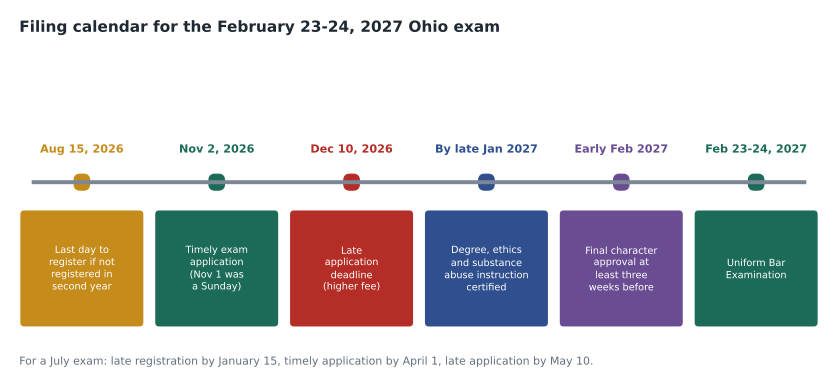
The registration fee on the Court's schedule is 75 dollars. A registration not filed by November 15 of the second year costs 275 dollars, a 200 dollar late penalty on top of the base fee. A student who misses the November 15 deadline altogether can still register, but must do so by a later deadline tied to the exam she wants to take: August 15 before a February exam and January 15 before a July exam. The Court's exam calendar for February 2027 showed the registration deadline for that exam as August 15, 2026.
'Why so early?' Wesley had asked his law school's bar advisor in 2023. The answer is the character investigation. The registration triggers NCBE's background check and the local admissions committee's review, and those take time. Filing in the second year gives the investigators a year or more to gather records and gives the applicant time to resolve any problems before the exam is close.
The Application to Take the Bar Examination
Registration opens the file. To sit a particular exam, a registered candidate files an Application to Take the Bar Examination. Under Section 3 of Rule I, the application for a February exam is due by November 1 before the exam, and the application for a July exam by April 1. Late applications are accepted, at a higher fee, until December 10 for February and May 10 for July. After the late deadline, no application for that exam is accepted.
Because November 1, 2026 fell on a Sunday, the Court's calendar for the February 2027 exam listed the timely deadline as November 2, 2026, with the late deadline on December 10, 2026. The Court's calendar also noted that applications for the July 2027 exam would be accepted after December 10, 2026.
The exam application contains new material, not just a repeat of the registration. The applicant files affidavits that she has read the Rules for the Government of the Bar, the Ohio Rules of Professional Conduct and the Code of Judicial Conduct, and that she has not engaged in the unauthorized practice of law. The law school dean or associate dean certifies that the school knows of no character or fitness concerns. The applicant completes a supplemental character questionnaire covering everything that has happened since the registration. And she pays the application fee.
The Court's fee schedule lists the Application to Take Bar Exam at 462 dollars and a late application at 562 dollars. Applicants who wish to type their answers pay a separate laptop fee, which NCBE's chart listed at 121 dollars. NCBE's own fees for the background investigation are paid directly to NCBE. NCBE's November 2026 summary of Ohio listed the same 462 dollar exam fee for first-time takers, attorneys and repeaters.
| Filing | When | Fee on the Court schedule |
|---|---|---|
| Application to Register as a Candidate | By November 15 of the second year of law school | 75 dollars |
| Late registration | After November 15; by August 15 for February or January 15 for July | 275 dollars |
| Application to Take Bar Exam | By November 1 for February; by April 1 for July | 462 dollars |
| Late application | By December 10 for February; by May 10 for July | 562 dollars |
| Application for re-examination | Same deadlines as the exam application | 462 dollars (late 562) |
| Foreign education evaluation | With the registration | 150 dollars |
Certifications due before the exam
Several documents cannot be filed with the application because they do not yet exist. Rule I requires them at least 30 days before the exam. The first is a certificate from the law school dean or associate dean that the applicant has received a law degree, has the knowledge to practice, and has completed a course of at least ten classroom hours of instruction in legal ethics. The second is a certificate that the applicant has received at least one hour of instruction on substance abuse, from the law school or from a continuing legal education sponsor whose course was accredited under Gov.Bar.R. X. The third, for three-plus-three applicants, is the final college transcript showing the bachelor's degree.
The substance abuse instruction requirement surprises candidates from other states. It is a small requirement, usually met by a session the law school schedules for third-year students, but a candidate who misses it cannot sit. Wesley checked his law school records during the session and found the substance abuse session listed from his third year. His ethics course, a three-credit professional responsibility class, more than covered the ten classroom hours.
For Wesley, the timing of the degree certificate needed attention. He finishes his courses in December 2026, the school confers degrees after grades are posted, and the dean must certify the degree at least 30 days before the February 23 exam, which means by late January 2027. He emailed the registrar the next morning to confirm the conferral date and the date the certification would go to the Office.
Final character approval three weeks out
The last pre-exam requirement is the one with the most consequences. An applicant may not sit the exam unless the Board of Commissioners on Character and Fitness has given final approval of her character, fitness and moral qualifications at least three weeks before the exam. Lesson 3 covers how that approval is reached. For calendar purposes, the point is that a file with unresolved issues in late January is a file that may miss the February exam.
About two weeks before the exam, qualified applicants receive confirmation and exam instructions through the Bar Admissions Portal. For the July 2026 exam, the Court tested applicants at sites in Cleveland, Toledo, Columbus and Cincinnati, with testing for applicants with approved accommodations at Case Western Reserve University School of Law and Capital University Law School. Applicants who need accommodations apply through the Office under the Court's process for applicants with disabilities, and should do so with the exam application rather than near the exam date.
Keeping the file current and keeping it alive
From registration until admission, an applicant has a continuing duty to keep her application current, including the character questionnaire, and to report promptly any change in the information it contains. A new job, a new address, a traffic citation, a lawsuit, a change in financial circumstances: each must be reported. Lesson 3 explains why failing to update a file is treated as seriously as failing to disclose in the first place.
An Ohio file does not stay open forever. Under Section 2 of Rule I, a registration is deemed withdrawn, unless the Board grants an extension, if the applicant does not take the bar exam within four years after filing it, or if she fails the exam and does not retake it within the next four exams. Ohio does not otherwise limit the number of attempts. A repeater files an application for re-examination for each new attempt, under the same deadlines and fee as the original application.
Worked problem
Planning a July 2027 attempt
Isaura Tasker, a hypothetical third-year student at an Ohio law school, never filed her registration in her second year because she was planning to practice in Pennsylvania. In December 2026 she accepts a job in Dayton and wants to sit the July 2027 Ohio exam. What must she file, by when, and what will it cost on the Court schedule?
Show solution
- She is not registered, so she must file the Application to Register as a Candidate. Because she missed November 15 of her second year, it is a late registration at 275 dollars, and for a July exam it must be filed by January 15, 2027.
- She then files the Application to Take the Bar Examination for July 2027, due April 1, 2027 at 462 dollars, or by May 10, 2027 at 562 dollars.
- NCBE's investigation fee and, if she wants to type, the laptop fee are additional.
- Her dean must certify her degree, ten hours of ethics instruction and one hour of substance abuse instruction at least 30 days before the exam, and she needs final character approval at least three weeks before it.
Answer: Isaura must register by January 15, 2027 with the 275 dollar late fee, then file the exam application by April 1, 2027 for 462 dollars, plus NCBE fees. Because her character investigation starts late, she should file the registration immediately and answer every follow-up quickly.
Common mistakes
MistakeThe registration and the exam application are the same document.
InsteadThe registration opens the file once, by November 15 of the second year; the exam application is filed for each exam.
MistakeThe February application deadline is in December.
InsteadThe timely deadline is November 1; December 10 is the last day for a late application at a higher fee.
MistakeAny ethics course will do.
InsteadThe dean must certify at least ten classroom hours of legal ethics instruction, plus one hour of substance abuse instruction.
MistakeAn Ohio application stays open indefinitely.
InsteadIt is deemed withdrawn if the applicant does not test within four years or fails and does not retake within four exams.
Practice problems
Work each problem on paper first, then reveal the answer to check.
When must an Ohio law student file the Application to Register as a Candidate?
Show answer
By November 15 of the second year of law school; later registration costs more and must meet an exam-specific deadline.
What is the last day to file a late application for a July exam?
Show answer
May 10.
What instruction certificates must arrive at least 30 days before the exam?
Show answer
The law degree and at least ten classroom hours of legal ethics, and at least one hour of substance abuse instruction.
What happens if an applicant fails and skips the next four exams?
Show answer
Her application is deemed withdrawn unless the Board grants an extension.
Summary and key terms
- Ohio requires a bachelor's degree and, ordinarily, a JD from an ABA-approved school; foreign lawyers need 30 credit hours at an accredited US school.
- Register as a candidate by November 15 of the second year (75 dollars; 275 late), or by August 15 or January 15 for a later exam.
- File the exam application by November 1 or April 1 (462 dollars), or late by December 10 or May 10 (562 dollars).
- Degree, ten hours of ethics and one hour of substance abuse instruction must be certified at least 30 days before the exam.
- Final character approval is required at least three weeks before the exam.
- The file must be kept current and is deemed withdrawn after four years without testing or four missed retakes.
- registration as a candidate
- The preliminary filing that opens an Ohio applicant's file and starts the character investigation.
- late filing deadline
- December 10 for February or May 10 for July, after which no exam application is accepted.
- three-plus-three program
- A combined program in which the first year of law school completes the bachelor's degree.
- substance abuse instruction
- At least one hour of instruction that Ohio requires before an applicant may sit the bar exam.
- deemed withdrawn
- The automatic closing of an Ohio application after four years without testing or four exams without a retake.
Lesson quiz · 5 questions
Score 60% or more to complete this lesson.
Create a free account to save your progress, take quizzes and earn a certificate.