
BAR-236 · Lesson 12 of 12 · 28 min
Capstone: Ohio practice questions and an exam-day plan
▶ Video coming soon A video version of this lesson is on the way.
The last session before the holidays was a test. Hollis sent Wesley a set of original Ohio problems an hour before the call, some on admission and some on Ohio law, and asked him to answer them in writing, in IRAC form, with no notes. Then they went through his answers together. 'None of this is on the UBE,' she reminded him. 'The UBE will test you on general law. But these are the questions you will be asked in your first year of practice, and some of them are the kind of material the Ohio Law Component covers. And the habit of answering in IRAC is exactly what the essays and the MPT reward.'
This lesson reproduces the problems, with model answers, followed by the exam-day plan Wesley and Hollis built for February 23 and 24, 2027, and the checklist of what happens after the exam. All of the problems are original hypotheticals written for this course, and every name in them is invented.
Problem 1: the calendar
Esperanza Wakeley, a hypothetical part-time student, will finish law school in December 2027 and wants to sit the Ohio bar exam in February 2028. She registered as a candidate in November of her second year. It is now October 2027. List her remaining filings and deadlines for that exam, and explain what happens if she fails it.
Worked problem
Model answer to Problem 1
Esperanza's filings and deadlines for February 2028, and the consequence of failing.
Show solution
- Issue: what Esperanza must file, by when, and what format a retake would use.
- Rule: Gov.Bar.R. I requires an Application to Take the Bar Examination by November 1 before a February exam, or late by December 10 at a higher fee; certifications of the law degree, ten classroom hours of legal ethics and one hour of substance abuse instruction at least 30 days before the exam; and final character approval at least three weeks before it. Ohio gives its last legacy UBE in February 2028 and its first NextGen exam in July 2028.
- Application: Esperanza is already registered, so she files the exam application by November 1, 2027 (462 dollars on the Court schedule), or by December 10, 2027 at the late fee. Her school must certify her December 2027 degree and her ethics and substance abuse instruction about four weeks before the exam, and her character approval must be final three weeks out. If she fails, her next attempt in July 2028 would be on the NextGen exam with a passing score of 620, possibly with a redesigned Ohio component.
Answer: Conclusion: Esperanza should file the exam application by November 1, 2027, make sure her school certifies her degree and required instruction in time, and respond quickly to any character inquiries. Because February 2028 is the last legacy Ohio UBE, a retake would mean switching to the NextGen format.
Problem 2: candor
Hollis's second problem was short. An applicant disclosed a 2020 DUI on his registration. In 2026, after filing his exam application, he receives a speeding ticket and pays it online. He does not mention it to anyone because it seems trivial. The exam is in February. Has he done anything wrong, and what should he do?
Wesley's answer: the issue is the continuing duty to update. Gov.Bar.R. I requires applicants to keep their applications current until admission and to report changes promptly, and Ohio's questionnaire asks about traffic citations. The ticket itself is minor, but failing to report it is a failure of candor, and because the applicant already has an alcohol-related driving offense on file, reviewers will want to see a careful, honest applicant. He should report the ticket immediately through the Bar Admissions Portal with a short explanation. Hollis gave him full marks and added one point: 'Reporting a trivial ticket takes five minutes. Explaining why you did not report it takes much longer.'
Problem 3: Ohio comparative fault and joint liability
On a rainy evening in Hamilton County, a hypothetical plaintiff, Casimir Rookwood, is struck in a crosswalk by a car driven by Clementine Underhill while he is looking at his phone and crossing against the signal. Underhill was speeding. A jury finds Casimir's damages to be 300,000 dollars, of which 120,000 dollars is economic and 180,000 dollars is noneconomic, and apportions fault: Casimir 30 percent, Underhill 55 percent, and a towing company whose truck blocked Underhill's view 15 percent. Casimir's injuries are serious but not catastrophic within the meaning of R.C. 2315.18. The towing company is uninsured and insolvent. What can Casimir collect from Underhill?
Worked problem
Model answer to Problem 3
Casimir's recovery against Underhill under Ohio law.
Show solution
- Issue: whether Casimir's fault bars or reduces his recovery, whether the noneconomic damages cap applies, and how liability is split between the defendants.
- Rule: Under R.C. 2315.33, a plaintiff whose fault is not greater than the combined fault of all others recovers damages reduced by his share. Under R.C. 2315.18, noneconomic damages for a non-catastrophic injury are capped at the greater of 250,000 dollars or three times economic loss, up to 350,000 dollars per plaintiff. Under R.C. 2307.22, a defendant more than 50 percent at fault is jointly and severally liable for economic damages; every defendant is liable only for its proportionate share of noneconomic damages.
- Application: Casimir's 30 percent is less than the others' combined 70 percent, so he recovers 70 percent: economic damages of 84,000 dollars and noneconomic damages of 126,000 dollars. The cap for a non-catastrophic injury is the greater of 250,000 dollars or three times 120,000 dollars (360,000 dollars), limited to 350,000 dollars; the jury's 180,000 dollar noneconomic finding is under the cap, so it is not reduced. Underhill is 55 percent at fault, more than 50 percent, so she is jointly and severally liable for all 84,000 dollars of economic damages. For noneconomic damages, she owes only her proportionate share: 55 percent of 180,000 dollars, or 99,000 dollars. The towing company's 15 percent share of noneconomic damages, 27,000 dollars, is collectible only from the insolvent company.
Answer: Conclusion: Casimir can collect 183,000 dollars from Underhill: 84,000 dollars of economic damages, for which she is jointly and severally liable, and 99,000 dollars of noneconomic damages, her proportionate share. He loses the towing company's 27,000 dollar share of noneconomic damages.
Hollis checked his arithmetic and pointed out the most common error on problems like this: applying the cap to the reduced figure instead of checking it against the statute's limits correctly, or treating noneconomic damages as joint and several. 'In Ohio, noneconomic damages are always proportionate. Write that on your list.'
Problem 4: the village pothole
A hypothetical cyclist, Rafaela Vosburgh, is thrown from her bicycle by a deep pothole on a village street in Licking County. Residents had reported the pothole to the village's street department three times in the six weeks before her accident, and the village had placed a cone near it, which had since blown away. The village says it decided to postpone street repairs until the next budget year. Analyze the village's immunity.
Worked problem
Model answer to Problem 4
Whether the village is immune from Rafaela's negligence claim under R.C. Chapter 2744.
Show solution
- Issue: whether the village, a political subdivision, is liable for injury caused by a pothole.
- Rule: R.C. 2744.02(A) grants political subdivisions general immunity for governmental and proprietary functions; the regulation and maintenance of roads is a governmental function. R.C. 2744.02(B)(3) removes immunity for negligent failure to keep public roads in repair and to remove obstructions. R.C. 2744.03 can restore immunity, for example where the injury resulted from the exercise of judgment or discretion in deciding how to use resources, unless that judgment was exercised with malicious purpose, in bad faith or in a wanton or reckless manner.
- Application: Tier one: the village is generally immune. Tier two: a pothole is a failure to keep a public road in repair, so the exception in 2744.02(B)(3) applies if Rafaela proves negligence; repeated reports and an inadequate warning support notice and negligence. Tier three: the village will argue that postponing repairs was a discretionary decision about resources under 2744.03(A)(5). Rafaela will respond that the failure to repair a known, reported hazard is routine maintenance, not a policy judgment, and that leaving it unrepaired and unmarked after three reports was at least reckless. If the court finds the defense applies and the conduct was not reckless, immunity is restored.
Answer: Conclusion: The road-repair exception likely applies, so the village is not immune at tier two. The outcome turns on tier three. Rafaela has a strong argument that repeatedly ignoring a reported hazard is not protected discretion, or was reckless. If she prevails, her damages are subject to R.C. 2744.05: no punitive damages, a reduction for collateral benefits, and in many cases a 250,000 dollar noneconomic limit. She must sue within two years, and the village can appeal a denial of immunity immediately.
Problem 5: a dissolution and an estate
Hollis's fifth problem combined two of Lesson 9's topics. A hypothetical couple, Lazarus and Ondine Fairweather, want to end their twelve-year marriage without a contested case. They agree on everything except whether Ondine's spousal support can be changed later. What procedure should they use, and what should their agreement say? Separately, Lazarus's father, a widower, dies without a will in Ohio, survived by Lazarus and Lazarus's sister. His probate estate is 32,000 dollars. How is it handled?
Wesley's answer: the couple should seek a dissolution, filing a joint petition with a separation agreement resolving property, support and any parenting issues, with a hearing between 30 and 90 days after filing at which both must appear and confirm their satisfaction with the agreement. Under R.C. 3105.18, the court can modify spousal support later only if the decree expressly reserves jurisdiction to do so, so the agreement must say clearly whether the support is modifiable, and on what terms. For the estate, with no spouse, the estate passes to the children equally under R.C. 2105.06, and because it is under 35,000 dollars, it is eligible for release from administration under R.C. 2113.03, a simplified probate procedure.
Problem 6: an Ohio fee agreement
A hypothetical new lawyer, Avalon Corvin, opens a solo practice in Toledo without malpractice insurance. Her first client hires her for a personal injury claim on a one-third contingent fee, and she sends him a one-page engagement letter, which he signs, describing the fee. The case settles. She sends him an itemized statement showing the settlement, her fee and his share, and wires his share. Has she complied with the Ohio Rules?
Worked problem
Model answer to Problem 6
Avalon's compliance with Prof.Cond.R. 1.4(c) and 1.5(c).
Show solution
- Issue: whether Avalon met Ohio's requirements on malpractice insurance disclosure and contingent fees.
- Rule: Prof.Cond.R. 1.4(c) requires a lawyer without malpractice insurance of at least 100,000 dollars per occurrence and 300,000 dollars in the aggregate to inform the client in writing at the engagement, using a notice the client signs. Prof.Cond.R. 1.5(c)(1) requires a contingent fee agreement in a writing signed by the client and the lawyer, stating the method of calculation, percentages and expenses. Prof.Cond.R. 1.5(c)(2) requires a closing statement signed by the client and the lawyer.
- Application: The facts do not show that Avalon gave the client a signed notice that she lacked insurance, so she likely violated 1.4(c). Her engagement letter was signed by the client, but the rule requires the lawyer's signature too, and it must state the method of calculation and the treatment of expenses. Her itemized statement after settlement was not signed by the client and by her, so it does not meet 1.5(c)(2).
Answer: Conclusion: Avalon likely violated Prof.Cond.R. 1.4(c) and 1.5(c)(2), and possibly 1.5(c)(1). She should use an Ohio-compliant engagement package from the start: a signed insurance notice, a contingent fee agreement signed by both, and a closing statement signed by both.
Ten quick questions
Hollis ended the problem set with ten short questions, answered aloud. What MPRE score does Ohio require? Eighty-five. What is Ohio's UBE passing score? Two hundred seventy. Which totals are regraded automatically? Two hundred sixty-eight and two hundred sixty-nine. When is the late deadline for a February exam application? December 10. How many questions are on the current Ohio Law Component, and what is the pass mark? Twenty-five, and 80 percent. When is Ohio's first NextGen exam? July 2028. Where must a money claim against the state be filed? The Court of Claims. How many jurors must agree on an Ohio civil verdict? Three-fourths. Can a contingent fee closing statement be signed by the lawyer alone? No. How many CLE hours does Ohio require every two years? Twenty-four, including 2.5 in professional conduct. Wesley got all ten.
The exam-day plan
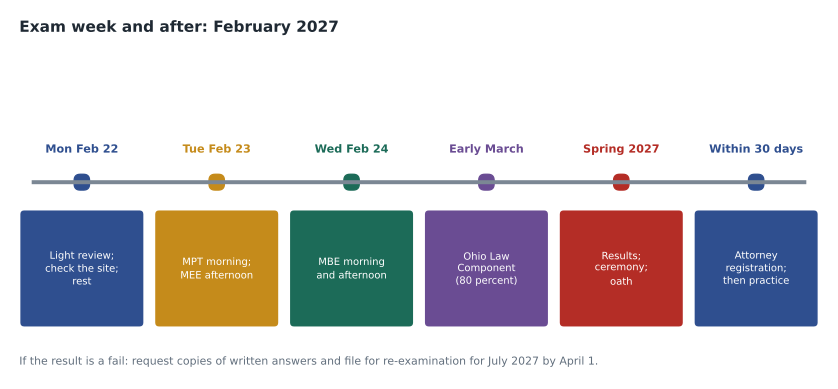
Wesley and Hollis wrote the plan down together. In the two weeks before the exam, he would take one full-length timed practice exam on two consecutive days, simulating the Tuesday and Wednesday schedule, and spend the remaining days reviewing his error log, the list of rules he had missed in practice, rather than learning anything new. He would read the Office's testing instructions when they arrived, about two weeks before the exam, and again the weekend before. He would install and test the exam software on his laptop at the first opportunity.
On Monday, February 22, he would do a light review in the morning, visit his assigned testing site if he could, lay out his identification and permitted items, and stop studying by early evening. On Tuesday, he would arrive early for the MPT, spend about 45 minutes reading and organizing each item before writing, and keep strictly to 90 minutes per item. In the afternoon, he would give each of the six MEE questions 30 minutes, outlining for five and writing for twenty-five, and never leave a question blank. On Wednesday, he would pace the MBE at about 33 questions per hour, answer every question, and mark difficult ones to revisit only if time remained. Between sessions he would not discuss answers with other applicants.
After the exam, he would take the Ohio Law Component within two weeks, having read the outline and built his index first. He would keep his character file current, report any change promptly, and watch the Bar Admissions Portal for results in the spring. If he passed, he would confirm his eligibility for the ceremony, take the oath, and complete attorney registration within 30 days. If he did not pass, he would request copies of his written answers, compare them with NCBE's analyses, and file his application for re-examination for July 2027 by April 1.
| When | What |
|---|---|
| Two weeks before | Full timed practice exam over two days; read testing instructions; test laptop software |
| Monday, February 22, 2027 | Light review; check the site; lay out identification; rest |
| Tuesday, February 23 | MPT in the morning (two items, 90 minutes each); MEE in the afternoon (six essays, 30 minutes each) |
| Wednesday, February 24 | MBE, 100 questions each session, about 33 per hour |
| Within two weeks after | Ohio Law Component, 80 percent |
| Spring 2027 | Results; ceremony; oath; attorney registration within 30 days |
'One more thing,' Hollis said at the end of the session. 'Your list of Ohio differences. How long is it?' Wesley counted: twenty-three lines, from 'greater than everyone else combined' to 'closing statement signed by both'. She told him to keep it and add to it for his first year of practice. 'That list is the course,' she said. 'The rest is detail.'
Common mistakes
MistakeTreating noneconomic damages as joint and several against a majority-fault defendant.
InsteadIn Ohio, only economic damages are joint and several, and only against a defendant more than 50 percent at fault.
MistakeAssuming road maintenance decisions are always protected discretion.
InsteadThe road-repair exception removes immunity; whether a discretion defense restores it depends on the facts and on recklessness.
MistakeLeaving the Ohio Law Component until after results.
InsteadAccess opens after the exam; taking it early removes one barrier to admission.
MistakeForgetting attorney registration after the oath.
InsteadAn Ohio lawyer may practice only after both the oath and registration, due within 30 days.
Practice problems
Work each problem on paper first, then reveal the answer to check.
A February 2028 Ohio candidate fails. What exam would she take in July 2028?
Show answer
The NextGen exam, with a 620 passing score.
An applicant receives a traffic ticket after filing her exam application. What should she do?
Show answer
Report it promptly; the duty to keep the application current runs until admission.
An Ohio plaintiff is 51 percent at fault. What does she recover?
Show answer
Nothing, because her fault is greater than the combined fault of all others.
What must be signed by both the client and the lawyer in an Ohio contingent fee case?
Show answer
The fee agreement and the closing statement.
Summary and key terms
- Answer Ohio problems in IRAC form, starting from the specific statute or rule.
- Admission problems turn on the calendar: registration, the exam application, pre-exam certifications and final character approval.
- Tort problems apply R.C. 2315.33, R.C. 2315.18 and R.C. 2307.22 in that order: fault, cap, split.
- Immunity problems use the three tiers of R.C. Chapter 2744.
- Fee problems check Prof.Cond.R. 1.4(c) and 1.5(c) signatures.
- The exam-week plan covers the two exam days, the Ohio Law Component and the steps through registration.
- IRAC
- Issue, rule, application, conclusion: the structure for answering legal problems.
- error log
- A running list of rules missed in practice, used for final review.
- release from administration
- Ohio's simplified procedure for small estates.
- three-tier analysis
- The method for applying Ohio's political subdivision immunity statute.
- exam application for re-examination
- The application a repeater files for each new Ohio exam.
Lesson quiz · 5 questions
Score 60% or more to complete this lesson.
Create a free account to save your progress, take quizzes and earn a certificate.