
BAR-236 · Lesson 5 of 12 · 20 min
Exam changes: Ohio's move to the NextGen bar exam in July 2028
▶ Video coming soon A video version of this lesson is on the way.
Wesley's first question at the fifth session was a worried one. 'Marcus said he took the NextGen exam in Missouri last July. Am I taking the wrong exam?' Hollis assured him he was not. 'Missouri moved early, in July 2026. Ohio decided to wait. You will sit the legacy UBE in February 2027, and so will everyone in Ohio through February 2028. The NextGen exam arrives in Ohio in July 2028. But you should understand the change anyway, for three reasons: if you need a second attempt you want to know your options, you may want to move your license someday, and the people you supervise in a few years will sit the new exam.'
This lesson covers what the NextGen bar exam is, how and why Ohio decided to adopt it in July 2028, what Ohio has already decided about passing scores and score transfer, what remains undecided, and what the transition means for candidates at different stages.
What NextGen is
The NextGen bar exam is NCBE's replacement for the Uniform Bar Examination. NCBE began developing it in 2018 after a study of what newly licensed lawyers actually do, and announced in 2023 that the legacy UBE would be phased out. The first NextGen administration was in July 2026, in a group of early-adopting jurisdictions that included Missouri. NCBE reported that 2,630 examinees sat that first exam, and released results in September 2026.
The new exam is shorter than the UBE, nine hours instead of twelve, given in three sessions of three hours over a day and a half. It has no traditional essays. Instead it combines standalone multiple-choice questions, some of which require selecting more than one answer; integrated question sets built around a common fact pattern with multiple-choice and short written answers; and performance tasks, in which the applicant works from a file and library of materials to produce written work, sometimes with legal research built into the task. NCBE describes the content as a set of foundational concepts and principles together with lawyering skills, such as legal research, legal writing, issue spotting and analysis, investigation and evaluation, client counseling and advising, negotiation and dispute resolution, and client relationship and management.
The foundational concepts cover much of the same law as the current MBE subjects, Civil Procedure, Constitutional Law, Contracts, Criminal Law and Procedure, Evidence, Real Property and Torts, plus Business Associations, with Family Law added to the concepts from July 2028. NCBE has said that trusts and estates may appear in performance tasks, with the necessary law supplied. NextGen scores are reported on a new scale that is not comparable point for point with the UBE's 400-point scale.
How Ohio decided
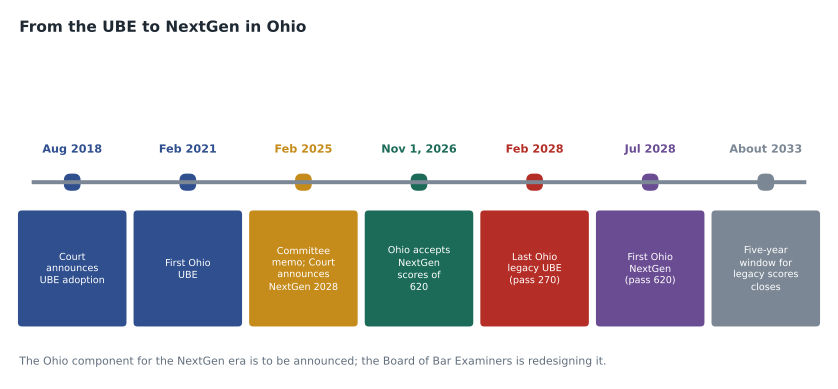
The Supreme Court of Ohio studied the question through a NextGen Advisory Committee chaired by Justice R. Patrick DeWine. In a memo dated February 13, 2025, addressed to Chief Justice Sharon L. Kennedy and the justices, the committee recommended that Ohio adopt the NextGen exam beginning with the July 2028 administration. The memo was candid that the recommendation came with some hesitation: the exam was not yet fully developed, and key information, including how scores would relate to the UBE, was still missing.
The Court accepted the recommendation and announced on February 19, 2025 that Ohio would give the NextGen exam starting in July 2028. Reports at the time counted Ohio as the thirty-fourth jurisdiction to commit to the new exam. The Court's announcement explained that NextGen is designed to align closely with the real-world responsibilities of newly licensed lawyers, and it directed the Board of Bar Examiners to re-evaluate the Ohio Law Component so that Ohio's own requirement would cover skills and concepts the national exam leaves out.
Ohio's timing put it in the later group of adopters. The committee's memo noted Kentucky's plan to begin in July 2027 and Indiana's and Illinois's plans to begin in 2028. Waiting until 2028 gave Ohio time to see the first administrations elsewhere and to redesign its own component.
What Ohio has already decided
By November 2026, several of the key numbers were settled. NCBE's summary of Ohio's rules shows the last legacy UBE in Ohio in February 2028 and the first NextGen exam in July 2028. Ohio's NextGen passing score is 620. And Ohio began accepting transferred NextGen scores of 620 or higher on November 1, 2026, so a lawyer who passed the NextGen exam in Missouri or another early jurisdiction can already use that score to seek admission in Ohio, subject to Ohio's other requirements.
Legacy UBE scores remain transferable into Ohio at 270 or higher, for five years after the exam. The committee's memo observed that, if the five-year rule stays the same, Ohio could still be accepting legacy UBE scores until February 2033, five years after the last legacy administration anywhere.
| Item | Ohio position as of November 2026 |
|---|---|
| Last legacy UBE in Ohio | February 2028 |
| First NextGen exam in Ohio | July 2028 |
| Legacy UBE passing score | 270 |
| NextGen passing score | 620 |
| Accepting transferred NextGen scores | Since November 1, 2026, at 620 or higher |
| Accepting transferred legacy UBE scores | At 270 or higher, within five years |
| Ohio-specific requirement with NextGen | To be announced; Board of Bar Examiners redesigning it |
What is still open: the Ohio component
The largest open question is what Ohio's own requirement will look like once NextGen arrives. The committee's memo was blunt about the current Ohio Law Component: it observed that the existing open-book, 25-question online test provides no real testing of substantive knowledge of Ohio law. It recommended replacing it with a new substantive component that tests Ohio law not covered by NextGen. The memo listed wills and trusts, Ohio constitutional law and the structure of the Ohio court system as subjects that should be tested.
The committee split on format. Some members wanted at least some essay questions, in part because of concern that NextGen lacks traditional IRAC-style writing; others preferred multiple-choice or similar formats for efficiency in grading. The memo left the choice to the Board of Bar Examiners, which was to recommend a format, timing and method of administration after further study. NCBE's summary of Ohio's rules, as of November 2026, listed the NextGen-era jurisdiction-specific requirement as to be announced.
Hollis told Wesley to watch for the Board's recommendation, but not to let it distract him. 'Whatever Ohio builds will apply to people sitting in July 2028 and after,' she said. 'Your component is the current one. If you pass in February, you will never take the new one.'
What the transition means for different candidates
For a candidate like Wesley, who sits in February 2027, nothing changes: legacy UBE, 270, current Ohio Law Component. If he needed a second attempt, he would still be on the legacy exam in July 2027 and February 2028, and his choice of retake dates would not change the format.
A candidate who fails in February 2028, the last legacy exam, faces a format change on retake: her next attempt in July 2028 would be the NextGen exam. Hollis's advice to anyone in that position is to start preparing for the new format immediately after results, because the question types and skills emphasis are different, and to use NCBE's NextGen sample questions and performance tasks from the beginning.
A student who entered law school in fall 2025 or later will typically sit the NextGen exam if she graduates on the normal schedule in 2028 or later. Ohio law schools have been adjusting their bar preparation and skills courses to match, and NCBE publishes content scope outlines and sample materials for the new exam.
A lawyer who passed the legacy UBE elsewhere and is moving to Ohio can transfer a score of 270 or higher within five years. A lawyer who passed the NextGen exam elsewhere can transfer a score of 620 or higher. Either way, she must still pass the Ohio Law Component and meet Ohio's character and MPRE requirements.
Worked problem
Choosing a retake strategy
Dagny Prewitt, a hypothetical candidate, sits the Ohio UBE in July 2027 and scores 262. She has a demanding job and is considering skipping February 2028 and retaking in July 2028. What should she weigh?
Show solution
- Her July 2027 score of 262 is below Ohio's 270, so she must sit again.
- February 2028 is the last legacy UBE in Ohio, in the same format she has already prepared for.
- July 2028 is Ohio's first NextGen exam, with a different structure, different question types, a new scale and a passing score of 620, and possibly a redesigned Ohio component.
- Skipping one exam does not trigger the four-exam withdrawal rule, but it would mean preparing for a new format from scratch.
Answer: Dagny should weigh the cost of switching formats heavily. Retaking in February 2028 lets her build on her legacy preparation; waiting until July 2028 means learning the NextGen format and whatever new Ohio component applies. Unless her job makes February impossible, the earlier retake is the stronger choice.
Common mistakes
MistakeOhio gives the NextGen exam now.
InsteadOhio gives the legacy UBE through February 2028; NextGen begins in Ohio in July 2028.
MistakeOhio does not accept NextGen scores until 2028.
InsteadOhio has accepted transferred NextGen scores of 620 or higher since November 1, 2026.
MistakeThe Ohio Law Component will stay the same under NextGen.
InsteadThe Court directed the Board of Bar Examiners to re-evaluate it; the committee recommended a new substantive component.
MistakeA 270 on the UBE equals a 620 on NextGen point for point.
InsteadThe two exams use different scales; Ohio set a separate passing score for each.
Practice problems
Work each problem on paper first, then reveal the answer to check.
When is Ohio's first NextGen bar exam?
Show answer
July 2028.
What is Ohio's NextGen passing score?
Show answer
620.
Which subjects did Ohio's committee say a new Ohio component should test?
Show answer
Wills and trusts, Ohio constitutional law and the structure of the Ohio court system.
Until when might Ohio accept legacy UBE scores under its current five-year rule?
Show answer
Until about February 2033.
Practical steps during the transition
Hollis gave Wesley a short list of transition rules that she shares with every Ohio candidate. First, know which exam you are sitting, and use preparation materials written for that exam. Commercial courses and NCBE publish separate materials for the legacy UBE and the NextGen exam, and mixing them wastes time. Second, keep track of your score and its age. A legacy UBE score is portable only for the period each receiving jurisdiction allows, and the number of jurisdictions still accepting legacy scores will shrink after 2028 as five-year windows close. Third, watch the Ohio component. The Board of Bar Examiners' redesign will apply to candidates sitting in July 2028 and after, and transfer applicants may face it too. Fourth, check the Court's announcements and the Bar Admissions Portal rather than relying on second-hand accounts; rule amendments are posted on the Court's website, often first as proposals for public comment.
Why the redesign matters to practicing lawyers
The transition is not only a concern for candidates. Ohio lawyers who hire and supervise new associates should expect the July 2028 and later cohorts to have prepared differently. NextGen candidates will have spent less time writing traditional timed essays and more time on integrated questions, performance tasks and legal research exercises. Firms and agencies may need to adjust training, for example by giving new lawyers more practice in drafting formal legal memoranda in the IRAC structure the committee worried NextGen might not test. Law schools have been adjusting their curricula for the same reason.
Reading the score scales correctly
A common source of confusion during the transition is the two score scales. A legacy UBE total runs on a 400-point scale, with Ohio's pass mark at 270. A NextGen score is reported on a different scale, and Ohio's pass mark on that scale is 620. A lawyer comparing her old UBE score with a colleague's NextGen score cannot compare the numbers directly. NCBE held standard-setting work in 2025 to help jurisdictions set NextGen passing scores that correspond to their legacy standards, and the Ohio committee asked the Board of Bar Examiners to report on that work and prepare rule changes on score transfers. The passing scores Ohio adopted, 270 for the legacy exam and 620 for NextGen, are the product of that process.
Questions to ask before choosing a jurisdiction
For a candidate who is not sure where she will practice, the transition adds a few questions. Is the jurisdiction giving the legacy UBE or NextGen on the date she plans to sit? What score will it require, and which other jurisdictions accept that score, and for how long? Does it have its own component, and is that component changing? Ohio's answers as of November 2026 are clear for the legacy period: the UBE through February 2028 at 270, with the current Ohio Law Component. A candidate who plans to move between states should still check every jurisdiction on her list, because adoption dates and passing scores vary.
What changes for the test taker
The skills emphasis is the biggest practical difference. On the legacy UBE, an applicant who memorizes rules thoroughly and writes clean essays is well positioned. On NextGen, rule knowledge still matters, but questions more often ask the applicant to do something with it: choose the best next step for a client, identify which fact needs investigation, decide which authority in a short library controls, or draft a short piece of analysis from a set of materials. Multiple-select questions, in which more than one answer is correct and the applicant must choose all of them, also change test-taking habits, because elimination strategies that work on four-option questions work less well.
Hollis described the difference with an example from her own grading years. 'On the old essays, I would see an applicant write a perfect paragraph on hearsay and then never apply it to the statement in the facts. On NextGen, the question gives you the statement and asks which exception, if any, lets it in, and why. You cannot get credit for the paragraph without the application.' She told Wesley that the habit of applying every rule to specific facts is worth building now, whichever exam he ends up taking, because it is what both exams reward and what practice demands.
Summary and key terms
- NextGen is NCBE's replacement for the UBE: nine hours, no traditional essays, integrated questions and performance tasks.
- Ohio's NextGen Advisory Committee recommended July 2028 in a February 13, 2025 memo, and the Court announced the decision on February 19, 2025.
- Ohio's last legacy UBE is February 2028; its NextGen passing score is 620.
- Ohio has accepted transferred NextGen scores of 620 or higher since November 1, 2026.
- The Ohio component for the NextGen era is being redesigned; the committee recommended testing wills and trusts, Ohio constitutional law and the Ohio courts.
- Candidates who might retake in 2028 should plan for the format change.
- NextGen bar exam
- NCBE's new bar exam, first given in July 2026 and in Ohio from July 2028.
- integrated question set
- A NextGen item built around one fact pattern with several related questions.
- performance task
- An exam item in which the applicant produces written work from a file and library.
- foundational concepts
- The areas of law NCBE tests on the NextGen exam.
- legacy UBE
- The Uniform Bar Examination in its current form, given in Ohio through February 2028.
Lesson quiz · 5 questions
Score 60% or more to complete this lesson.
Create a free account to save your progress, take quizzes and earn a certificate.