
BAR-225 · Lesson 9 of 12 · 21 min
Mississippi family law, wills and estates
▶ Video coming soon A video version of this lesson is on the way.
Two files landed on Tavaris's desk in the same week of November 2026. The first was a divorce Ora Lee Bankston had filed in September for a couple from Itta Bena, married eleven years with two children, who agreed the marriage was over but disagreed about who would keep the house and how much the husband should pay in support. The second was an estate. An elderly farmer from Sidon had died in October, and his niece brought in a single sheet of lined paper, written entirely in his hand and signed at the bottom, leaving his land to her. There were no witnesses. His stepson, who expected to inherit, said the paper was worthless.
'Both of those files would make good Mississippi essays,' Hollis Marchetti said when Tavaris described them. 'Domestic relations and wills are on the Board's list of essay subjects, and they are where Mississippi law departs most visibly from the general rules. Mississippi still has twelve statutory fault grounds for divorce. Its no-fault ground requires mutual consent. Its courts divide property and award alimony under multifactor tests that every Mississippi family lawyer can recite. And it recognizes handwritten wills without witnesses. Those are points a candidate earns only by knowing Mississippi law.'
This lesson covers the two routes to a Mississippi divorce, the property, alimony and custody tests the chancery courts use, child support, and the core Mississippi rules on wills, intestacy and a surviving spouse's rights.
The chancery court's role
Family and estate matters in Mississippi belong to the chancery court. Section 159 of the Mississippi Constitution gives chancery jurisdiction over divorce and alimony, matters testamentary and of administration and minors' business. A Mississippi essay on a divorce, custody dispute, will contest or estate administration should name chancery court as the forum. The chancellor decides these cases without a jury and has broad discretion, which is why the Mississippi Supreme Court's multifactor tests matter so much: they structure that discretion.
To file for divorce in Mississippi, at least one spouse must have been an actual resident of the state for six months before the action is filed. A spouse may not move to Mississippi solely to obtain a divorce. Members of the armed forces stationed in Mississippi, and their spouses, can satisfy the residency requirement.
Divorce on irreconcilable differences
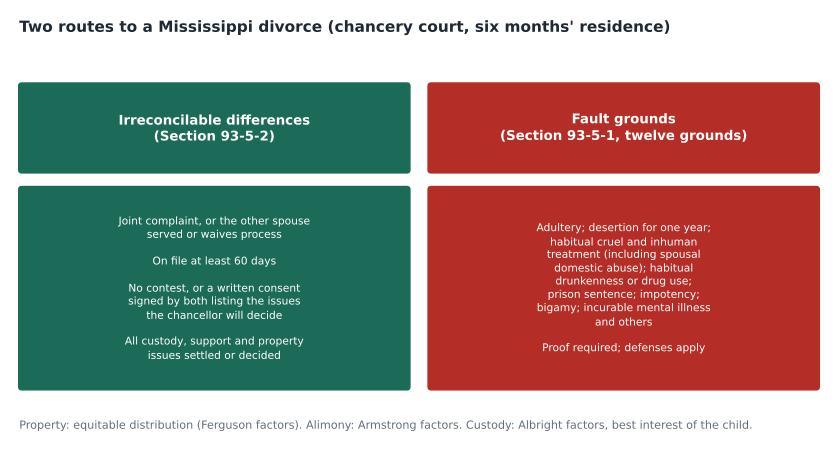
Mississippi's no-fault ground is irreconcilable differences under Section 93-5-2 of the Mississippi Code. It is more restrictive than no-fault divorce in most states because it depends on consent. The divorce may be granted on a joint complaint of both spouses, or on the complaint of one spouse if the other has been personally served or has entered an appearance by written waiver of process. The complaint must have been on file for at least 60 days before the court hears it.
If the defendant contests the divorce, it generally cannot be granted on irreconcilable differences unless the contest is withdrawn with the court's permission. Where the spouses agree on ending the marriage but not on everything else, they may sign a written consent, personally, asking the court to decide specific issues, such as custody, support or the division of property, and acknowledging that the court's decision will be binding. The consent must list the issues to be decided. Once the court has begun any proceeding on those issues, a spouse cannot withdraw the consent without the court's permission. No divorce is granted until every custody, support and property issue raised in the pleadings has been settled by approved agreement or decided by the court.
For the Itta Bena couple, that route fit. They agreed to divorce and to a schedule for the children, but not about the house or support. Ora Lee Bankston prepared a consent for both to sign, listing the marital home, alimony and child support as the issues for the chancellor.
The fault grounds
When one spouse will not consent, the other must prove a fault ground. Section 93-5-1 lists twelve grounds: natural impotency; adultery, unless it was condoned or the parties colluded; being sentenced to a penitentiary without being pardoned; willful, continued and obstinate desertion for one year; habitual drunkenness; habitual and excessive use of opium, morphine or other similar drugs; habitual cruel and inhuman treatment, which the statute now defines to include spousal domestic abuse; mental illness or intellectual disability at the time of marriage if the complaining spouse did not know of it; marriage to someone already married; pregnancy of the wife by another person at the time of marriage if the husband did not know of it; marriage within the prohibited degrees of kinship; and incurable mental illness after a period of institutionalization.
Fault grounds require proof, often corroborated, and the defendant may raise defenses such as condonation of adultery or recrimination in some forms. Fault can also matter in the property division and alimony analysis, since marital misconduct is one of the factors chancellors weigh.
Equitable distribution
Mississippi divides marital property by equitable distribution, not community property. The chancellor first classifies assets as marital or separate. In general, assets acquired during the marriage through either spouse's efforts are marital, while assets owned before the marriage or received by gift or inheritance are separate, unless they have been commingled or used for family purposes in a way that converts them. The chancellor then values the marital assets and divides them under the factors set out by the Mississippi Supreme Court in Ferguson v. Ferguson.
The Ferguson factors include each spouse's contribution to the accumulation of property, including direct economic contributions and contributions to the stability and harmony of the home; each spouse's use or disposal of marital assets; the market and emotional value of the assets; the value of each spouse's separate estate; tax and other economic consequences; the extent to which property division can reduce the need for alimony; and each spouse's needs. An equitable division need not be equal. A chancellor who divides property without addressing the Ferguson factors risks reversal on appeal.
Alimony
After dividing property, the chancellor considers whether alimony is needed. Mississippi recognizes several forms: periodic alimony, which ends on the recipient's remarriage or either spouse's death and can be modified; lump-sum alimony, which is a fixed amount that vests and cannot be modified; rehabilitative alimony, which supports a spouse for a limited period while becoming self-supporting; and reimbursement alimony, which repays a spouse who supported the other's education or career.
The factors for alimony come from Armstrong v. Armstrong. They include each spouse's income and expenses, health and earning capacity, needs, obligations and assets, the length of the marriage, the presence of minor children, the spouses' ages, their standard of living during the marriage, the tax consequences, fault or misconduct, wasteful dissipation of assets and any other equitable factor. The Mississippi Supreme Court has emphasized that property division comes first and alimony is considered only if the division leaves a deficit for one spouse.
Child custody and support
Custody decisions turn on the best interest of the child, analyzed under the factors from Albright v. Albright. They include the child's age, health and sex; which parent had continuity of care before separation; parenting skills and willingness to provide primary care; each parent's employment and responsibilities; each parent's physical and mental health and age; the emotional ties between parent and child; each parent's moral fitness; the child's home, school and community record; the child's preference, if the child is old enough by statute to express one; the stability of each home; and other relevant factors. A chancellor must address the applicable Albright factors on the record.
Child support follows statutory guidelines in Section 43-19-101 of the Mississippi Code, which set the award as a percentage of the paying parent's adjusted gross income, rising with the number of children, beginning at 14 percent for one child. The chancellor may deviate from the guidelines with written findings that applying them would be unjust or inappropriate. Support generally continues until the child reaches the age set by statute, which in Mississippi is later than in many states.
| Issue | Mississippi test | Key point |
|---|---|---|
| Property division | Ferguson factors | Classify, value, then divide equitably; equal is not required |
| Alimony | Armstrong factors | Considered after property division |
| Custody | Albright factors | Best interest of the child; findings on the record |
| Child support | Section 43-19-101 guidelines | Percentage of adjusted gross income; 14 percent for one child |
| No-fault divorce | Section 93-5-2 | Requires consent; 60 days on file |
| Fault divorce | Section 93-5-1 | Twelve statutory grounds, including habitual cruel and inhuman treatment |
Holographic and attested wills
Mississippi recognizes two kinds of wills. An attested will must be in writing, signed by the testator or by someone at the testator's direction in the testator's presence, and attested by at least two credible witnesses in the testator's presence. A holographic will is valid in Mississippi under Section 91-5-1 if it is wholly written and subscribed by the testator, with no witnesses required. Many states do not recognize holographic wills at all, and some require only the material provisions to be handwritten. Mississippi requires the entire document to be in the testator's handwriting.
For the Sidon estate, the lined sheet written and signed in the farmer's hand could be a valid holographic will, even without witnesses. The stepson might challenge it by disputing the handwriting, arguing lack of testamentary capacity or undue influence, or claiming it was not intended as a will. Those are fact questions for the chancellor. But the absence of witnesses is not a defect for a holographic will.
Worked problem
Testing a handwritten will
A Mississippi essay describes a typed letter, signed by the testator, leaving her house to her neighbor. At the bottom she added in handwriting: "And my car goes to my nephew." There are no witnesses.
Show solution
- A holographic will must be wholly written and subscribed by the testator.
- The typed body of the letter is not in her handwriting, so the document as a whole is not holographic.
- Without two attesting witnesses, it is not a valid attested will either.
- The handwritten line alone is not signed beneath it, so it is unlikely to stand as a separate holographic will.
Answer: The document likely fails as a will; the estate would pass under any earlier valid will or by intestacy.
Intestacy and the surviving spouse
When a Mississippi resident dies without a valid will, the estate passes under the intestacy statutes. In general, if the decedent leaves a spouse and children, the spouse takes a share equal to each child's share. If the decedent leaves a spouse and no descendants, the spouse takes the whole estate. If there is no spouse, the children take equally, with further rules for more distant relatives.
A surviving spouse who is dissatisfied with a will may renounce it under Mississippi's statute and take the share the spouse would have received by intestacy, subject to a limit of one half of the estate, and subject to adjustments based on the spouse's own separate property. The renunciation must be filed within the time the statute allows after the will is probated. This is Mississippi's version of an elective share, and it is a common essay issue when a will leaves a spouse little or nothing.
Estates are administered in chancery court. A will is probated by petition to the chancery court of the county where the decedent lived, and a person who wants to contest a will admitted to probate generally must do so within the period the statute allows after probate. Missing that window can make even a strong challenge untimely.
Common mistakes
MistakeMississippi grants no-fault divorce on one spouse's request alone.
InsteadIrreconcilable differences under Section 93-5-2 requires consent; a contested case needs a fault ground under Section 93-5-1.
MistakeMississippi is a community property state.
InsteadMississippi uses equitable distribution under the Ferguson factors.
MistakeA will without witnesses is always invalid.
InsteadMississippi recognizes holographic wills wholly written and signed by the testator.
MistakeAlimony is decided before property is divided.
InsteadProperty is divided first; alimony is considered only if the division leaves a deficit.
Modification and enforcement
Divorce judgments involving children and periodic alimony are not the end of the matter. A parent seeking to modify custody must generally show a material change in circumstances since the last order that adversely affects the child, and that modification is in the child's best interest. A party seeking to modify child support or periodic alimony must show a material change in circumstances that was not anticipated at the time of the original order. Lump-sum alimony and property division, by contrast, are final and cannot be modified.
Enforcement usually comes through contempt. A party who fails to pay support or follow a custody order may be held in contempt by the chancellor, who can order payment of arrearages, attorney's fees and, in serious cases, incarceration until the party complies. Inability to pay, if proven, is a defense to contempt. Contempt and modification actions are among the matters that require a Rule 81 summons, which is a frequent source of procedural error.
The Itta Bena divorce and the Sidon estate
By the third week of November both files had moved. The Itta Bena couple had signed the consent prepared by Ms. Bankston, listing the marital home, alimony and child support as the issues for the chancellor, and the complaint, filed in September, had been on file more than the required 60 days. Tavaris drafted a short trial memo organized around the Ferguson factors for the house and the Armstrong factors for alimony, with the child support calculation under the statutory guidelines attached.
In the Sidon estate, the niece petitioned the Leflore County Chancery Court to probate the handwritten paper as a holographic will, with affidavits from two people familiar with the farmer's handwriting. The stepson filed a contest alleging that the farmer lacked capacity in his last months. 'That is a real fight,' Ms. Bankston told Tavaris, 'but it is a fight about capacity and handwriting. Nobody can win it by saying there were no witnesses.'
Family law on the essay
A Mississippi family law essay rewards structure. Start with the forum and the residency requirement. Identify the ground for divorce and whether consent is present or a fault ground must be proven. Classify, value and divide the property under Ferguson. Consider alimony under Armstrong only after the division. Decide custody under Albright, addressing the relevant factors, and set child support under the guidelines. Each step is a heading, and each heading is a chance for points.
Summary and key terms
- Divorce, custody and estates belong to chancery court; one spouse must have six months' residence before filing for divorce.
- Irreconcilable differences requires consent and 60 days on file; contested issues may be submitted by a written consent signed by both spouses.
- Section 93-5-1 lists twelve fault grounds, including habitual cruel and inhuman treatment, which includes spousal domestic abuse.
- Property is divided equitably under the Ferguson factors; alimony follows under the Armstrong factors; custody follows the Albright factors.
- Child support guidelines begin at 14 percent of adjusted gross income for one child.
- Mississippi recognizes holographic wills wholly written and subscribed by the testator; a surviving spouse may renounce a will and take up to half the estate.
- 0
- irreconcilable differences
- 1
- fault grounds
- 2
- equitable distribution
- 3
- Ferguson factors
- 4
- Armstrong factors
- 5
- Albright factors
- 6
- holographic will
- 7
- renunciation
Practice problems
Work each problem on paper first, then reveal the answer to check.
How long must an irreconcilable differences complaint be on file before it can be heard?
Show answer
At least 60 days.
Which Mississippi case supplies the factors for equitable distribution?
Show answer
Ferguson v. Ferguson.
Is a will written and signed entirely in the testator's hand, with no witnesses, valid in Mississippi?
Show answer
Yes, as a holographic will under Section 91-5-1.
What residence is required to file for divorce in Mississippi?
Show answer
At least one spouse must have been an actual resident for six months before filing.
Lesson quiz · 5 questions
Score 60% or more to complete this lesson.
Create a free account to save your progress, take quizzes and earn a certificate.