
BAR-225 · Lesson 1 of 12 · 20 min
Becoming a lawyer in Mississippi
▶ Video coming soon A video version of this lesson is on the way.
Tavaris Pickens grew up in Greenwood, in Leflore County, close enough to the Yazoo River that his grandfather used to measure a wet spring by how far the water came up the levee road. He finished law school at a Mississippi law school in May 2026. He had planned to sit for the July 2026 bar exam, but his mother needed surgery that spring, and he chose to spend the summer driving her to appointments in Jackson and working part time. Since June 2026 he has been a law clerk at Bankston & Reed, a three-lawyer firm on Howard Street in Greenwood that handles divorces, estates and land partitions in chancery court, car wrecks in circuit court and the occasional claim against a county. In August 2026 he filed his application for the February 2027 Mississippi bar examination, and in the fall he joined Hollis Marchetti's online study group.
At his first one-on-one session with Marchetti, Tavaris laid out what was bothering him. 'Half my classmates who moved to Tennessee and Alabama talk about the UBE and score transfer as if it were the only exam in the country,' he said. 'Ms. Bankston took the Mississippi exam decades ago and remembers essays on chancery practice and Mississippi wills. A friend told me Mississippi is switching to NextGen soon. I need to know which exam I am taking in February, what it covers and what else I have to finish before I can be sworn in.'
Marchetti nodded. 'Mississippi is one of the few states that still writes part of its own exam. It is not a UBE state. On the first day you write six essays prepared by the Mississippi Board of Bar Admissions on Mississippi law, plus six Multistate Essay Examination questions and one Multistate Performance Test task. The second day is the Multistate Bar Examination. You need a combined score of 132 on a 200-point scale. The Supreme Court of Mississippi has ordered the move to NextGen, but no first date has been set, so February 2027 is the current format. Alongside the exam you need a character and fitness clearance and an MPRE score of 75. This course keeps all of those tracks in view, and then it spends real time on the Mississippi law that appears on those six essays and in your first year of practice.'
This lesson maps the whole process: who controls admission in Mississippi, the bodies that do the work, the routes into practice and the usual order of events for a first-time candidate. Later lessons take each step in detail and then turn to the distinctive Mississippi law a new lawyer meets in Greenwood, Tupelo, Hattiesburg, Jackson or on the Gulf Coast.
The Supreme Court of Mississippi controls admission
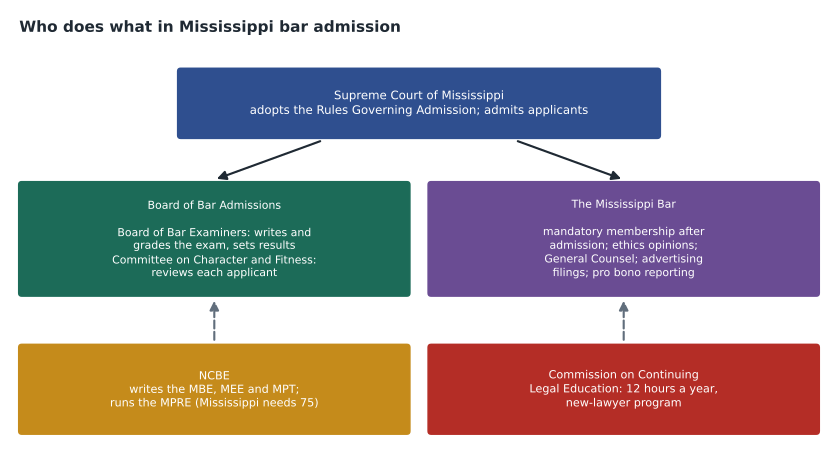
Admission to practice law in Mississippi is a judicial function. The Supreme Court of Mississippi adopts the Rules Governing Admission to the Mississippi Bar, and it alone admits applicants. Everything a candidate does, from the first registration form to the oath, happens under those Rules. When the Court changes the exam, as it did when it ordered the adoption of the NextGen bar examination in July 2025, it does so by order, and the Board of Bar Admissions then carries out the change.
That structure matters in practice. A candidate who wants an exception to a deadline, a ruling on eligibility or a review of a character and fitness decision deals first with the Board under the Rules and, if the matter goes further, with the Supreme Court. Classmates' advice, bar review company summaries and even older lawyers' memories are useful background, but the Rules and the Board's current instructions are the only authority. Tavaris keeps a folder with the current Rules, the application instructions for the February 2027 exam and every email he receives from the Board.
The Board of Bar Admissions and its two parts
The Mississippi Board of Bar Admissions administers the process. It works through two bodies. The Board of Bar Examiners prepares and grades the examination, including the six Mississippi essay questions, and certifies who has passed. The Committee on Character and Fitness reviews each applicant's background and decides whether the applicant has shown the good moral character and fitness that the Rules require. The Board's staff handles registrations, applications, fee payments and correspondence, and the Board's website posts the application instructions, forms and exam schedules for each administration.
The Board's address is a post office box in Jackson, and its forms are numbered. Form 8A, for example, is the authorization a candidate signs to use a prior Multistate Bar Examination score. Candidates who treat each numbered form as its own deadline-bearing task make fewer mistakes than those who try to remember everything at the end.
The Mississippi Bar after admission
The Mississippi Bar is the integrated, mandatory bar association for the state. A candidate has little to do with it before admission, but once sworn in, every practicing Mississippi lawyer is a member. The Mississippi Bar's Office of General Counsel handles lawyer discipline complaints for the Court, its Ethics Committee issues ethics opinions and approves certain client financial assistance under Rule 1.8(e), and lawyers file copies of their advertisements with the Office of General Counsel. Continuing legal education is run by the Commission on Continuing Legal Education under rules adopted by the Supreme Court: twelve hours a year, including one hour of ethics or professionalism, with a special program for newly admitted lawyers.
NCBE's part
The National Conference of Bar Examiners writes three of the four parts of the Mississippi exam: the Multistate Bar Examination, the Multistate Essay Examination and the Multistate Performance Test. It also administers the Multistate Professional Responsibility Examination, on which Mississippi requires a scaled score of 75. NCBE does not decide who is admitted. Mississippi decides how to weight the NCBE parts, how to grade the essays, what passing score to use and whether to accept scores from elsewhere. NCBE's jurisdiction pages are a convenient summary, but when they and the Board differ, the Board controls.
Routes into practice
There are three main ways a lawyer begins practicing in Mississippi. The first is admission by examination, which is the route for every new graduate and for experienced lawyers who do not qualify for anything else. The second is admission on motion, sometimes called comity or reciprocity admission, for lawyers with at least five years of practice in a jurisdiction that admits Mississippi lawyers on a comparable basis. The third is temporary permission to appear in a single case, known as pro hac vice admission, which requires association with a Mississippi lawyer. In addition, Rule 5.5 of the Mississippi Rules of Professional Conduct allows certain in-house and federally authorized lawyers to work in Mississippi after registering with the Mississippi Bar. Lesson 11 covers these routes in detail.
Mississippi does not offer a diploma privilege today. For a short transitional period, students who were enrolled at the University of Mississippi School of Law by November 1, 1981, could be admitted on graduation without the exam if they graduated before November 1, 1984. That privilege ended by its own terms in 1984. Every graduate since then, from every law school, has needed to pass the bar exam.
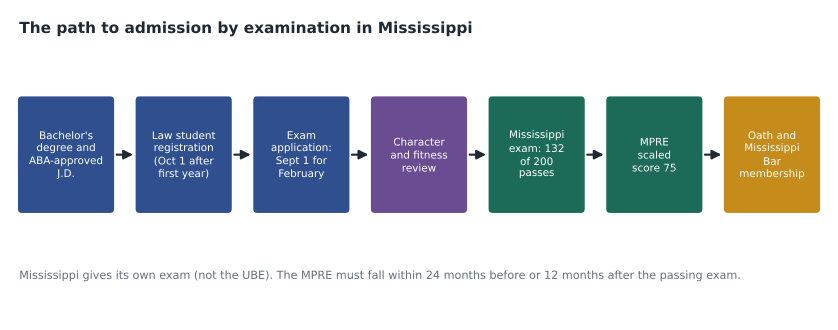
| Step | What it involves | Who handles it |
|---|---|---|
| Law student registration | Register with the Board after completing two semesters of law school; deadline October 1 | Board of Bar Admissions |
| Education | Bachelor's degree and a J.D. from an ABA-approved law school | Board checks transcripts |
| Exam application | September 1 for February, February 1 for July; late filing allowed at a higher fee | Board of Bar Admissions |
| Character and fitness | Investigation of the application, references and records | Committee on Character and Fitness |
| Bar exam | Six Mississippi essays, MEE, MPT and MBE; 132 of 200 passes | Board of Bar Examiners |
| MPRE | Scaled score of 75, within the time window in the Rules | NCBE administers; Board checks |
| Admission | Oath and enrollment; Mississippi Bar membership; CLE begins | Supreme Court; Mississippi Bar |
The usual order of events
Most Mississippi candidates follow the same rhythm. In the fall after the first year of law school, they register as law students with the Board. Registration starts the character and fitness review early and lowers the later exam application fee. During the second or third year, many take the MPRE. In the final year they file the exam application by the deadline for their chosen administration. The character and fitness review continues while they study. They sit the exam, receive their results and, once the Board certifies that every requirement is met, take the oath and are admitted.
Tavaris followed most of that path. He registered as a law student in September 2024, after his first two semesters, and took the MPRE in November 2025, scoring 92. When his plans changed in the spring of 2026, he skipped the July application and filed for February 2027 on August 20, 2026, well before the September 1 deadline. Because he had registered as a student, his application fee was the lower registered-student amount.
Why Mississippi's exam is different
Most states that use NCBE materials have adopted the Uniform Bar Examination, which tests only general principles and produces a portable score. Mississippi chose a different design. It uses the MBE, the MEE and the MPT, but it adds six essays written by its own Board, and those essays carry thirty percent of the total score, twice the weight of the six MEE questions. The Board's published list of possible subjects includes Mississippi practice and procedure, the Mississippi Constitution, the Mississippi Rules of Professional Conduct, domestic relations, wills and estates, business organizations and the Uniform Commercial Code, plus every MBE subject.
The result is an exam that rewards knowing where Mississippi law departs from the general rule. A candidate who writes a perfect multistate answer about modified comparative negligence on a Mississippi essay has missed the point: Mississippi uses pure comparative fault. A candidate who says a divorce case belongs in circuit court has missed the chancery court's constitutional role. Lessons 6 through 10 are built around those points of departure.
Worked problem
Sorting out who to ask
Tavaris has three questions in October 2026: whether his November 2025 MPRE score will still count if he passes in February 2027, whether he needs to tell the Board about a new address, and whether he must join the Mississippi Bar before the exam.
Show solution
- The MPRE window is set by the Rules: a score earned within 24 months before, or 12 months after, the exam the applicant passes. November 2025 to February 2027 is about 15 months, so it counts.
- Address changes and other updates go to the Board of Bar Admissions, which expects applicants to keep their information current while the application is pending.
- Mississippi Bar membership follows admission. There is nothing to join before the oath.
Answer: His MPRE counts, the address update goes to the Board, and Mississippi Bar membership comes after he is admitted.
Building a study year around the process
Marchetti asked Tavaris to sketch the next four months on one page. At the top he wrote the exam dates, February 23 and 24, 2027. Beneath that he listed his open administrative items: confirm the Board has his final transcript, keep the character and fitness file current, and watch for the Board's instructions about laptops and admission tickets. The rest of the page went to study: the MBE subjects, the six-essay Mississippi component, the MEE and the MPT.
'The administrative side should take an hour a month if you stay on top of it,' Marchetti told him. 'The trouble comes when candidates let a request from the Board sit for three weeks while they study torts. Answer every letter the week it arrives.'
Tavaris also asked how much of his clerk work would help. Marchetti's answer was practical. Drafting a divorce complaint on irreconcilable differences, reading a chancellor's opinion on equitable distribution or calculating a Tort Claims Act notice deadline gives him the Mississippi rules in context. But the exam expects organized written analysis under time pressure, and that skill comes only from timed practice essays. He decided to keep his clerk hours at thirty a week through December and drop to fifteen in January.
What this course covers
Lessons 2 and 3 cover eligibility, deadlines, fees, character and fitness and the MPRE. Lesson 4 explains the exam's format, weighting and scoring, including the reappraisal band just below 132. Lesson 5 looks at the NextGen transition and what is and is not settled. Lesson 6 covers the Mississippi essay component and how Mississippi law appears on the exam. Lessons 7 through 10 teach Mississippi courts and procedure, Mississippi torts and damages, family law and estates, and the Mississippi Rules of Professional Conduct. Lesson 11 covers score transfer, admission on motion and life after admission, and Lesson 12 is a capstone with original practice questions and an exam-day plan.
Common mistakes
MistakeMississippi is a UBE state, so my score will transfer anywhere.
InsteadMississippi gives its own exam with six Mississippi essays and does not accept or produce UBE scores. Only the MBE score component may be usable elsewhere, under the receiving state's rules.
MistakeThe Mississippi Bar runs the bar exam.
InsteadThe Board of Bar Admissions, under rules adopted by the Supreme Court, runs the exam and the character review. The Mississippi Bar is the mandatory association lawyers join after admission.
MistakeOle Miss graduates are admitted without the exam.
InsteadThe diploma privilege was transitional and ended in 1984. All graduates now must pass the exam.
MistakeNextGen starts in Mississippi in 2027.
InsteadThe Supreme Court ordered adoption in July 2025, but as of November 2026 the first Mississippi administration has not been set. February 2027 uses the current format.
Summary and key terms
- The Supreme Court of Mississippi adopts the Rules Governing Admission and admits applicants.
- The Board of Bar Admissions works through the Board of Bar Examiners, which writes and grades the exam, and the Committee on Character and Fitness.
- Mississippi gives its own exam: six Mississippi essays, six MEE questions, one MPT task and the MBE, with 132 of 200 needed to pass.
- An MPRE scaled score of 75 is required, earned within 24 months before or 12 months after the passing exam.
- Routes into practice are examination, admission on motion after five years of practice in a reciprocal jurisdiction, and pro hac vice appearance.
- The University of Mississippi diploma privilege was transitional and ended in 1984.
- 0
- Board of Bar Admissions
- 1
- Board of Bar Examiners
- 2
- Committee on Character and Fitness
- 3
- Rules Governing Admission
- 4
- Mississippi Bar
- 5
- admission on motion
- 6
- pro hac vice
- 7
- diploma privilege
Practice problems
Work each problem on paper first, then reveal the answer to check.
Which body adopts the rules that govern admission to the Mississippi bar?
Show answer
The Supreme Court of Mississippi, which also admits applicants.
What two bodies make up the working parts of the Board of Bar Admissions?
Show answer
The Board of Bar Examiners, which writes and grades the exam, and the Committee on Character and Fitness.
Does Mississippi give the Uniform Bar Examination?
Show answer
No. It uses the MBE, MEE and MPT but adds six Mississippi essays and is not a UBE jurisdiction.
When did the Mississippi diploma privilege end?
Show answer
It was transitional and ended in 1984, for students enrolled at the University of Mississippi School of Law by November 1, 1981.
Lesson quiz · 5 questions
Score 60% or more to complete this lesson.
Create a free account to save your progress, take quizzes and earn a certificate.