
BAR-225 · Lesson 5 of 12 · 20 min
Exam changes ahead: Mississippi and the NextGen bar exam
▶ Video coming soon A video version of this lesson is on the way.
In late October 2026 a classmate texted Tavaris a screenshot: a bar review company's chart showing dozens of states moving to the NextGen bar exam, with Mississippi colored in. 'Are we doing NextGen in February?' the text asked. Tavaris forwarded it to Hollis Marchetti with a single question mark.
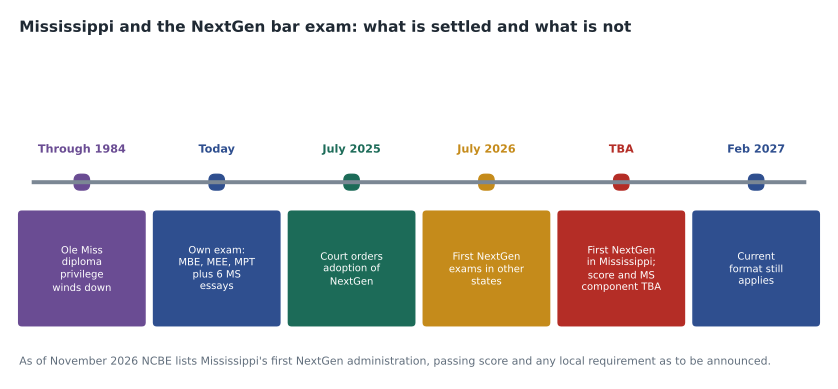
At their next session Marchetti put the chart next to the National Conference of Bar Examiners' own page for Mississippi. 'The chart is right that Mississippi has committed to NextGen,' she said. 'The Supreme Court of Mississippi ordered its adoption in July 2025. What the chart does not show is the date. As of today NCBE lists Mississippi's first NextGen administration as not yet set, and it lists the passing score and any Mississippi-specific requirement as to be announced. February 2027 is the same exam Mississippi has been giving: six Mississippi essays, the MEE, one MPT and the MBE. You do not need to study for NextGen. You do need to understand it, because if you have to sit again, or if you advise younger classmates, the timing could matter.'
This lesson explains what the NextGen exam is, what Mississippi has decided and what it has not, how the change could affect candidates who sit before and after the switch, and a short history of how Mississippi's exam reached its current form.
What NextGen is
The NextGen bar examination is NCBE's replacement for its current tests: the MBE, the MEE and the MPT. NCBE designed it after a multiyear study of what newly licensed lawyers actually do. Instead of separate multiple-choice, essay and performance components given on different days, NextGen integrates them. It tests a narrower set of legal doctrines in greater depth, alongside foundational lawyering skills such as legal research, legal writing, issue spotting, investigation and evaluation, client counseling and advising, negotiation and dispute resolution, and client relationship and management.
The doctrine list is shorter than the current MBE and MEE lists combined. NCBE identifies nine foundational areas: business associations, civil procedure, constitutional law, contract law, criminal law, evidence, real property, torts, and family law. Some current MEE subjects, such as conflict of laws, secured transactions and trusts and estates, do not appear as standalone topics. The exam uses a mix of question formats, including standalone multiple-choice questions, integrated question sets built around a common fact pattern and performance tasks.
NextGen was first given in July 2026 in a group of early-adopting jurisdictions. NCBE has said it will continue offering the current exam through February 2028, giving jurisdictions time to transition. Scores on NextGen are reported on a new scale, and NCBE has said NextGen scores will serve as the basis for score portability among jurisdictions that adopt it.
What Mississippi has decided
In July 2025 the Supreme Court of Mississippi ordered the adoption of the NextGen Uniform Bar Examination. NCBE announced the order in a news release on July 18, 2025, and noted that Mississippi's first administration date had not yet been finalized. As of November 2026, NCBE's jurisdiction information for Mississippi still lists the first NextGen administration as to be announced. It lists acceptance of NextGen scores from other jurisdictions, Mississippi's minimum passing score on NextGen and any Mississippi-specific requirement as to be announced as well.
The phrase in the Court's order matters: Mississippi adopted the NextGen Uniform Bar Examination. That is a significant change for a state that has never been a UBE jurisdiction. When Mississippi switches, it will presumably join the group of states whose NextGen scores are portable among one another. What happens to Mississippi's own essay component is one of the open questions. Many UBE states require a separate state law component, such as an online course and test; Mississippi could choose something similar, or nothing at all. Until the Board or the Court announces a decision, candidates should not assume either way.
| Question | Status as of November 2026 |
|---|---|
| Has Mississippi adopted NextGen? | Yes, by Supreme Court order in July 2025 |
| When is the first Mississippi NextGen exam? | Not yet announced |
| What is the NextGen passing score in Mississippi? | Not yet announced |
| Will Mississippi accept NextGen scores from other states? | Not yet announced |
| Will there be a Mississippi law component? | Not yet announced |
| What format is the February 2027 exam? | The current format: Mississippi essays, MEE, MPT and MBE |
How to read the open questions
Marchetti offered Tavaris three practical rules for watching the transition. First, rely on primary sources. The Supreme Court's orders, the Board's announcements and NCBE's jurisdiction page are authoritative. Bar review charts, social media posts and law school newsletters are secondhand and sometimes stale. Second, look for dates on everything. An announcement that does not say which exam it applies to is not useful for planning. Third, expect lead time. States that have adopted NextGen have generally announced the first administration well in advance, because law schools and candidates need time to adjust.
'If Mississippi announced NextGen for a specific exam, you would see it on the Board's site and in NCBE's chart,' she said. 'Neither says anything about February or July 2027 being NextGen.'
Effects on candidates who sit before and after the switch
For most current candidates, the switch will make no difference: they will pass under the current format. The candidates who need to think about the transition are those who might sit more than once across the changeover. A candidate who fails the last current-format exam would retake under NextGen, with a different structure and a different list of subjects. A candidate's prior MBE score, which can currently be transferred into Mississippi for 20 months, may not carry the same meaning once the MBE is no longer part of Mississippi's exam. How the Board handles those transitional cases is another question it will need to address.
Score portability is the other side. Today, a Mississippi candidate earns a Mississippi score that does not transfer as a UBE score. Once Mississippi gives the NextGen UBE, a passing score earned in Mississippi may become portable to other NextGen jurisdictions, and scores earned elsewhere may be accepted in Mississippi. For candidates who want flexibility to move, that may be a significant advantage, depending on the minimum scores and time limits each state sets.
Worked problem
Advising a younger classmate
A second-year law student at Tavaris's former school asks whether she should start studying NextGen materials now, because she expects to graduate in May 2028.
Show solution
- Check the Board and NCBE pages for any announced first administration date. As of November 2026, none is listed.
- NCBE has said the current exam remains available through February 2028, so a July 2028 exam is likely to be NextGen somewhere, but each jurisdiction decides its own date.
- She should register as a law student, take the MPRE and watch for the Board's announcement, which is likely to come with substantial notice.
- Doctrinal courses in the nine NextGen areas and in Mississippi practice, family law and estates will help under either format.
Answer: She should watch for the Board's announcement rather than guess; her coursework choices help either way.
A short history of the Mississippi exam
Mississippi's current format reflects a long sequence of changes. For a time, graduates of the University of Mississippi School of Law could be admitted without examination. That diploma privilege was narrowed and then wound down by statute: students enrolled by November 1, 1981, could still be admitted on graduation if they graduated before November 1, 1984, and the privilege ended by its own terms after that date. A federal court described the arrangement as transitional when it addressed a challenge to it in 1985. Since then every applicant has taken the bar exam.
Over the following decades Mississippi adopted NCBE components while keeping its own essays. Today it uses the MBE, the MEE and the MPT, and it adds six Board-written essays weighted at 30 percent. That hybrid is unusual. Most states that once wrote their own essays moved to the UBE in the 2010s and early 2020s. Mississippi kept a substantial state-law component, and its move to NextGen will be the first time it joins a uniform exam.
What stays the same
Whatever form the exam takes, several parts of admission in Mississippi are unlikely to change. The Supreme Court will still adopt the Rules and admit applicants. The Committee on Character and Fitness will still review each applicant, and the applicant will still bear the burden of proof. The MPRE will still be required unless the Court says otherwise. And the Mississippi law that new lawyers need in practice, such as chancery jurisdiction, the Tort Claims Act deadlines, the divorce statutes and the state's professional conduct rules, will still matter on the first day of work, whether or not it appears on the exam.
A checklist for watching the transition
Marchetti suggested a short checklist that Tavaris could share with younger students at his old law school. Bookmark the Board of Bar Admissions page and NCBE's Mississippi jurisdiction page, and check them each semester. Read any Supreme Court order on admission in full, not a summary. Note which exam an announcement applies to. Ask the Board in writing about any transitional question that affects you personally, such as how a prior MBE score will be treated. And keep studying the doctrinal subjects that appear on both formats, because they are useful either way.
Tavaris added a line of his own: 'Do not let a chart in an advertisement change your study plan.' Marchetti laughed. 'That should be the first line.'
Common mistakes
MistakeMississippi switches to NextGen in February 2027.
InsteadAs of November 2026 no Mississippi NextGen date has been set; February 2027 uses the current format.
MistakeOnce Mississippi adopts NextGen, its Mississippi essays will definitely remain.
InsteadAny Mississippi-specific requirement is listed as to be announced.
MistakeMississippi already gives the UBE.
InsteadMississippi has never been a UBE jurisdiction; its NextGen order would be its first uniform exam.
MistakeNextGen tests the same subjects as the current exam.
InsteadNextGen covers nine foundational doctrine areas plus lawyering skills; some current MEE subjects are not standalone topics.
How NextGen differs in the testing room
Candidates who have heard about NextGen from friends in early-adopting states often describe it as feeling very different from the current exam. Instead of a day of essays followed by a day of 200 multiple-choice questions, NextGen mixes formats throughout. A single set of facts may support several questions in a row, some multiple choice and some short written answers. Performance tasks ask candidates to research a provided library and draft a document. Legal research is tested directly, by giving candidates materials and asking them to find and apply the controlling authority.
NCBE has also said NextGen places less weight on memorizing fine details and more on applying core principles. The doctrine is narrower, but the questions go deeper into it. For candidates, that means study methods will need to shift: less time on rare exceptions and more time on applying the core rules of the nine foundational areas to realistic facts, with practice in the integrated formats.
What a Mississippi decision would need to settle
When the Board and the Court announce the details of Mississippi's transition, several decisions will matter to candidates. The first is the date of the first NextGen administration in Mississippi and whether there will be an overlap period in which both formats are available. The second is the passing score on the NextGen scale. The third is whether Mississippi will accept NextGen scores earned in other jurisdictions, and with what time limits. The fourth is what, if anything, will replace the six Mississippi essays, such as a Mississippi law course, an online test or a separate component. The fifth is how the Board will treat candidates in transition, including those with prior MBE scores or those who fail the last current-format exam.
Each of these choices has been made differently by different states. Some UBE states require a jurisdiction-specific course or test completed online before admission; others require nothing. Some accept scores for two years, others for three or five. Until Mississippi announces its choices, any prediction is guesswork, and candidates should plan around the current rules.
Why the Mississippi law in this course still matters
Some candidates ask whether learning Mississippi law is worth the effort if the Mississippi essays may disappear. For anyone taking the February or July 2027 exam, the answer is plainly yes: the essays are 30 percent of the score. But the answer is yes even for later candidates. The Mississippi law in Lessons 7 through 10, including the chancery and circuit divide, the Tort Claims Act deadlines, the divorce statutes and Rule 1.8(e), is what a new Mississippi lawyer uses in the first weeks of practice. Missing a Tort Claims Act notice deadline or filing a divorce on the wrong ground costs a client real money whether or not the bar exam tested the rule.
Ora Lee Bankston put it more bluntly when Tavaris mentioned the NextGen debate at the office. 'The exam changes every generation,' she said. 'The Tort Claims Act notice deadline does not care what exam you took.'
Keeping perspective
For Tavaris, the practical lesson was to stop reading about NextGen and get back to work. The February 2027 exam would use the format he had been studying, and nothing on the Board's site or NCBE's page suggested otherwise. He made a note to check both sites once in January, in case anything changed, and returned to his Mississippi essay practice.
Summary and key terms
- The Supreme Court of Mississippi ordered adoption of the NextGen Uniform Bar Examination in July 2025.
- As of November 2026, the first Mississippi NextGen date, the passing score, score acceptance and any Mississippi requirement are all to be announced.
- February 2027 uses the current format: six Mississippi essays, six MEE questions, one MPT and the MBE.
- NextGen integrates doctrine and skills, covers nine foundational areas and was first given in July 2026 in early-adopting jurisdictions.
- Mississippi's University of Mississippi diploma privilege was transitional and ended in 1984.
- 0
- NextGen bar examination
- 1
- foundational skills
- 2
- integrated question set
- 3
- score portability
- 4
- transition
- 5
- diploma privilege
Practice problems
Work each problem on paper first, then reveal the answer to check.
When did the Supreme Court of Mississippi order adoption of the NextGen UBE?
Show answer
July 2025; NCBE announced it on July 18, 2025.
What format will the February 2027 Mississippi exam use?
Show answer
The current format: six Mississippi essays, six MEE questions, one MPT and the MBE.
Name three things about Mississippi's NextGen transition that remain to be announced.
Show answer
The first administration date, the passing score and whether there will be a Mississippi-specific requirement; score acceptance is also open.
When did NCBE first administer NextGen?
Show answer
July 2026, in early-adopting jurisdictions.
Lesson quiz · 5 questions
Score 60% or more to complete this lesson.
Create a free account to save your progress, take quizzes and earn a certificate.