
BAR-225 · Lesson 10 of 12 · 20 min
Mississippi Rules of Professional Conduct
▶ Video coming soon A video version of this lesson is on the way.
Mrs. Coleman called the firm in late October 2026, close to tears. Her short-term disability payments had ended, the bank had sent a letter about her car note, and she asked whether the firm could lend her enough to keep the car until the case settled. Mavis Reed took the call, then walked into Tavaris's office. 'You studied the MPRE last year,' she said. 'Can we give her money?' Tavaris started to say no, that the Model Rules allow lawyers to advance only court costs and litigation expenses. Then he stopped. 'Under the Model Rules, no,' he said slowly. 'But I think Mississippi is different.'
He was right, and when he told Hollis Marchetti about it that evening, she used it to open the lesson. 'The MPRE tests the ABA Model Rules. Mississippi practice, and the Mississippi essays, use the Mississippi Rules of Professional Conduct. Most of the rules match, but several differ in ways that matter: financial help for litigation clients, fee division, the pro bono reporting requirement, advertising filings and the rules for out-of-state lawyers. A candidate who answers a Mississippi ethics essay with the Model Rules loses points exactly where the Board is testing.'
This lesson covers the Mississippi Rules of Professional Conduct, where they come from, how they are enforced, and the most important differences from the Model Rules for the exam and for the first year of practice.
Where the rules come from
The Supreme Court of Mississippi adopted the Mississippi Rules of Professional Conduct, based on the ABA Model Rules, effective July 1, 1987, and has amended them many times since. The rules apply to every lawyer admitted in Mississippi and to lawyers from other jurisdictions who provide or offer legal services in the state. The Court has final authority over lawyer discipline. The Mississippi Bar's Office of General Counsel investigates complaints and prosecutes discipline, and complaints are heard by a Complaint Tribunal or reviewed by the Court, which imposes discipline ranging from private reprimand to disbarment.
The Mississippi Bar's Ethics Committee issues ethics opinions in response to lawyers' questions. Those opinions are not binding on the Court, but they are persuasive and widely followed, and lawyers rely on them to plan conduct. The Ethics Committee also has a specific role under Rule 1.8(e), as explained below.
Financial assistance to litigation clients: Rule 1.8(e)
Model Rule 1.8(e) prohibits lawyers from giving financial assistance to clients in connection with pending or contemplated litigation, with narrow exceptions for court costs and litigation expenses and, since 2020, modest gifts for basic living expenses to indigent clients in pro bono matters. Mississippi's Rule 1.8(e) takes a different path.
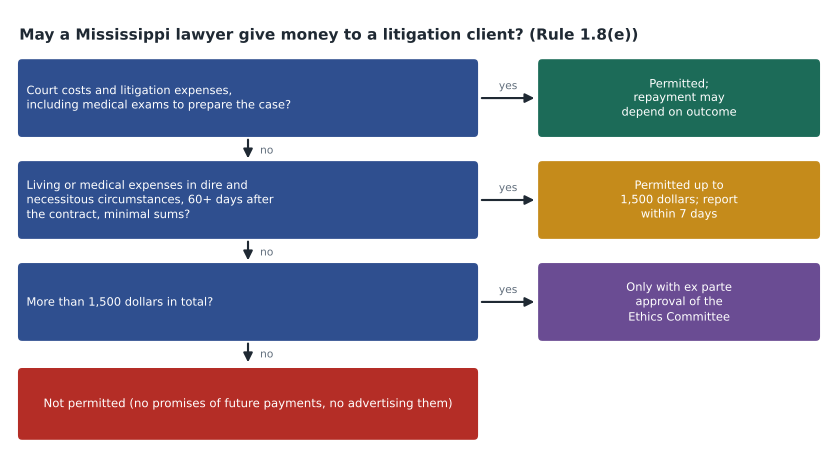
Under Mississippi Rule 1.8(e)(1), a lawyer may advance court costs and expenses of litigation, including reasonable medical expenses necessary to prepare the case for hearing or trial, and repayment may be contingent on the outcome. Under Rule 1.8(e)(2), a lawyer may also advance reasonable and necessary medical expenses associated with treatment of the injury that gave rise to the litigation, and reasonable and necessary living expenses, with repayment due upon successful conclusion of the matter.
The second category comes with strict limits. Advances are allowed only in dire and necessitous circumstances and are limited to minimal living expenses in small sums, such as amounts needed to prevent foreclosure or repossession, or for necessary medical treatment. No payment may be made until 60 days after the client signs the contract of employment with counsel. The lawyer may not promise future payments, may not advertise the availability of such assistance and may advance funds only after due diligence into the client's circumstances. Total payments to any party from any lawyer or group of lawyers during the litigation may not exceed 1,500 dollars without ex parte approval from the Mississippi Bar's Ethics Committee. The lawyer must check whether prior attorneys in the same litigation have made such payments, and payments of 1,500 dollars or less must be reported to the Ethics Committee within seven days of each payment. Those applications and reports are confidential.
Worked problem
Helping Mrs. Coleman
Mrs. Coleman signed the firm's contingent fee contract on April 2, 2026. In late October she faces repossession of her car for a missed 600-dollar payment. The firm has made no prior advances to her, and no prior lawyer represented her.
Show solution
- More than 60 days have passed since she signed the contract, so the waiting period is satisfied.
- Facing repossession because her disability payments ended is the kind of dire and necessitous circumstance the rule describes.
- A single 600-dollar payment is a small sum, below the 1,500-dollar limit, so no prior approval is needed.
- The firm must document its inquiry into her circumstances, make no promise of future payments and report the payment to the Ethics Committee within seven days.
Answer: The firm may advance the 600 dollars, repayable from a successful outcome, and must report it within seven days.
Fees and fee division: Rule 1.5
Mississippi Rule 1.5 follows the Model Rule in most respects. A contingent fee agreement must be in writing and signed by the client, state the method of calculating the fee, including the percentages for settlement, trial or appeal, and say whether expenses are deducted before or after the fee is calculated. At the end of the matter the lawyer must give the client a written closing statement. Rule 1.5(d) prohibits contingent fees in domestic relations matters when the fee depends on securing a divorce or on the amount of alimony, support or property settlement. The comment to the Mississippi rule notes that this does not prohibit a contingent fee for collecting past-due alimony or child support.
Fee division between lawyers in different firms differs from the Model Rule. Under Mississippi Rule 1.5(e), lawyers may divide a fee either in proportion to the services each performs or, by written agreement with the client, where each lawyer assumes joint responsibility for the representation. The client must be advised of the arrangement and not object, and the total fee must be reasonable. The comment explains that the client need not be told each lawyer's share. The Model Rule, by contrast, requires the client to agree to the arrangement, including the share each lawyer will receive, with the agreement confirmed in writing.
Confidentiality: Rule 1.6
Mississippi Rule 1.6 contains the familiar permissive exceptions for preventing death or substantial bodily harm, preventing or remedying certain client crimes or frauds, securing ethics advice, establishing claims or defenses in controversies with clients, and complying with other law or a court order. Mississippi adds provisions addressing the Lawyers and Judges Assistance Committee, which helps lawyers with substance use and mental health problems. Information that a lawyer receives while participating in an approved assistance program is protected, subject to the specific monitoring procedures the rule describes.
Pro bono reporting: Rule 6.1
Mississippi Rule 6.1 states that every lawyer has a professional responsibility to provide legal services to those unable to pay. A lawyer may discharge that responsibility by providing at least 20 hours of pro bono legal services to the poor each year, or by contributing at least 200 dollars through the Mississippi Bar as the rule provides, among other options. The hours goal is aspirational and not a basis for discipline. What makes the Mississippi rule different is the reporting requirement in Rule 6.1(e): lawyers must report their pro bono service or contributions, and that reporting is mandatory.
| Topic | ABA Model Rule | Mississippi rule |
|---|---|---|
| Living expenses for litigation clients | Only modest gifts to indigent pro bono clients | Advances in dire circumstances, after 60 days, up to 1,500 dollars without approval; report within 7 days |
| Fee division | Client agrees to each lawyer's share, confirmed in writing | Proportional or joint responsibility by written client agreement; shares need not be disclosed |
| Pro bono | Aspirational 50 hours; no reporting | 20 hours or 200 dollars; reporting is mandatory |
| Advertising | No filing requirement | Copies submitted to the Mississippi Bar's Office of General Counsel |
| Advertised fees | No specific rule | Must be honored for at least 90 days |
| In-house lawyers from elsewhere | Permitted under Rule 5.5(d) | Must register with the Mississippi Bar and pay an annual fee |
Advertising and solicitation: Rule 7
Mississippi regulates lawyer advertising more closely than the Model Rules. Rule 7.1 prohibits false, misleading or deceptive communications. Under Rule 7.2, a lawyer who advertises a fee must honor it for at least 90 days unless the advertisement specifies a longer period. An advertisement must disclose the city and state of at least one office of the lawyer or firm, or direct readers to a number at the Mississippi Bar. And under Rule 7.2(h), a copy of each advertisement must be submitted to the Mississippi Bar's Office of General Counsel as provided in Rule 7.5. Rule 7.3 restricts in-person, live telephone and real-time electronic solicitation where a significant motive is the lawyer's financial gain and the lawyer has no family, close personal or prior professional relationship with the person.
Multijurisdictional practice: Rule 5.5
Mississippi Rule 5.5 prohibits a lawyer not admitted in Mississippi from establishing an office or other systematic and continuous presence in the state for the practice of law, unless another rule or law authorizes it. Rule 5.5(c) permits temporary practice in limited circumstances, such as work done in association with a Mississippi lawyer who actively participates. Rule 5.5(d) permits in-house lawyers and lawyers authorized by federal law to provide services in Mississippi, but those relying on it must register with the Mississippi Bar and pay an annual fee. An out-of-state lawyer who wants to appear in a Mississippi court must seek pro hac vice admission with local counsel.
Trust accounts
Like every state, Mississippi requires lawyers to keep client and third-party funds separate from their own in a trust account, to keep complete records, to promptly notify clients of funds received and to promptly deliver funds the client is entitled to receive. Nominal or short-term client funds are placed in an interest-bearing trust account whose interest supports legal services programs. Trust account violations are among the most common reasons for serious discipline, and the Court treats misappropriation of client funds severely.
Answering a Mississippi ethics essay
Marchetti's advice for a Mississippi ethics essay is to start by naming the Mississippi rule, then explain how it differs from the Model Rule only if the difference matters. 'The grader wants to see that you know Mississippi Rule 1.8(e) allows a limited living-expense advance with specific conditions,' she said. 'Then apply each condition to the facts: the 60 days, the circumstances, the amount, the report. On the MPRE you would answer the opposite way. Keep the two sets of rules in separate compartments.'
Common mistakes
MistakeA Mississippi lawyer may never advance living expenses to a litigation client.
InsteadMississippi Rule 1.8(e)(2) allows minimal advances in dire and necessitous circumstances, after 60 days, up to 1,500 dollars without approval.
MistakeMississippi requires the client to be told each lawyer's share of a divided fee.
InsteadUnder Mississippi Rule 1.5(e) and its comment, the client must be advised and not object, but need not be told each share.
MistakePro bono reporting in Mississippi is voluntary.
InsteadThe hours are aspirational, but reporting under Rule 6.1(e) is mandatory.
MistakeLawyer advertisements in Mississippi need no filing.
InsteadRule 7.2(h) requires a copy to be submitted to the Mississippi Bar's Office of General Counsel.
Conflicts of interest in a small-town practice
Mississippi's conflict rules track the Model Rules in structure: Rule 1.7 for current clients, Rule 1.9 for former clients and Rule 1.10 for imputation within a firm. In small communities, conflicts arise constantly. A firm in Greenwood may have represented both spouses' families over the years, drafted wills for a decedent and several heirs, or represented a farm lender and the farmers who borrow from it. New lawyers should run a conflict check before every intake meeting, not after.
Mississippi Rule 1.8 also contains a provision on lawyers who are closely related. When lawyers who are related as parent, child, sibling or spouse represent opposing parties, the related lawyer may not represent a client in the matter without informed consent, and the comment explains that this disqualification is personal and is not imputed to other lawyers in the firm. In a state where family members often practice in the same county, that rule comes up more than candidates expect.
Discipline and the duty to report
Mississippi lawyers have a duty under Rule 8.3 to report another lawyer's misconduct that raises a substantial question about honesty, trustworthiness or fitness, subject to the confidentiality rules and the protections for information learned through the lawyers' assistance program. Discipline in Mississippi can range from a private reprimand to a public reprimand, suspension or disbarment, and the Court considers aggravating and mitigating factors in deciding the sanction.
Using Mississippi ethics opinions
When a practical ethics question arises, Mississippi lawyers often start with the Mississippi Bar's ethics opinions and the comments to the Mississippi rules. The comment to Rule 1.5, for example, cites a Mississippi Bar ethics opinion on contingent fees for collecting past-due support. Ethics opinions do not bind the Supreme Court, but they show how the Bar's Ethics Committee reads the rules, and a lawyer who follows a relevant opinion has a strong argument that the conduct was reasonable. A new lawyer with a question can also call the Bar's ethics staff for informal guidance before acting.
Mavis Reed made the 600-dollar advance to Mrs. Coleman the following week, after documenting the repossession letter and the end of the disability payments in a short memo to the file. Tavaris calendared the seven-day report to the Ethics Committee and drafted it himself. 'Two years ago I would have said no without thinking,' he told Marchetti. 'Now I know the Mississippi answer is yes, but only if you follow every condition.'
Summary and key terms
- The Mississippi Rules of Professional Conduct, effective July 1, 1987, are based on the ABA Model Rules but differ in key places.
- Rule 1.8(e)(2) allows limited advances for medical and living expenses in dire circumstances, after 60 days, up to 1,500 dollars without Ethics Committee approval, reported within seven days.
- Rule 1.5(e) allows fee division by joint responsibility with the client advised and not objecting; shares need not be disclosed.
- Rule 6.1 sets a goal of 20 pro bono hours or a 200-dollar contribution, and reporting is mandatory.
- Advertisements must be filed with the Mississippi Bar's Office of General Counsel, show an office location and honor advertised fees for 90 days.
- Rule 5.5(d) lawyers must register with the Mississippi Bar and pay an annual fee.
- 0
- Mississippi Rules of Professional Conduct
- 1
- Rule 1.8(e)
- 2
- dire and necessitous circumstances
- 3
- Ethics Committee
- 4
- joint responsibility
- 5
- pro bono reporting
- 6
- Office of General Counsel
- 7
- trust account
Practice problems
Work each problem on paper first, then reveal the answer to check.
How long after the client signs the contract must a Mississippi lawyer wait before advancing living expenses?
Show answer
Sixty days.
What is the limit on Rule 1.8(e)(2) advances without Ethics Committee approval?
Show answer
1,500 dollars in total per party during the litigation.
What must a Mississippi lawyer do with a copy of an advertisement?
Show answer
Submit it to the Mississippi Bar's Office of General Counsel.
Is pro bono reporting mandatory in Mississippi?
Show answer
Yes. The hours are aspirational, but reporting under Rule 6.1(e) is mandatory.
Lesson quiz · 5 questions
Score 60% or more to complete this lesson.
Create a free account to save your progress, take quizzes and earn a certificate.