
BAR-225 · Lesson 8 of 12 · 23 min
Mississippi torts: comparative fault, damages caps and the Tort Claims Act
▶ Video coming soon A video version of this lesson is on the way.
The car-wreck case Ora Lee Bankston had in circuit court started on Highway 82 east of Greenwood. Her client, a home health aide named Mrs. Coleman, was driving to a patient's house in the rain when a delivery van crossed the center line. A Leflore County road crew truck was parked partly in the lane ahead, without its warning lights on, and Mrs. Coleman swerved and hit it. She admitted she was going a little over the speed limit. Her injuries were serious: a broken pelvis, two surgeries and months away from work.
Tavaris spent a week on the file. When he described it to Hollis Marchetti, he listed the questions he could see: How much does her speeding hurt her? Can the van company and the county each be made to pay everything? Is there a limit on pain and suffering? Does a claim against the county work differently? 'Every one of those has a Mississippi answer,' Marchetti said, 'and on the Mississippi essays every one is a point. Mississippi tort law is mostly familiar, but four statutes change the outcome in almost every case: pure comparative fault, several liability, the caps on noneconomic damages and the Tort Claims Act.'
This lesson works through each of those rules, with the Coleman file as a running example, and closes with the medical malpractice notice rule and the limitations periods that frame every Mississippi tort case.
Pure comparative negligence
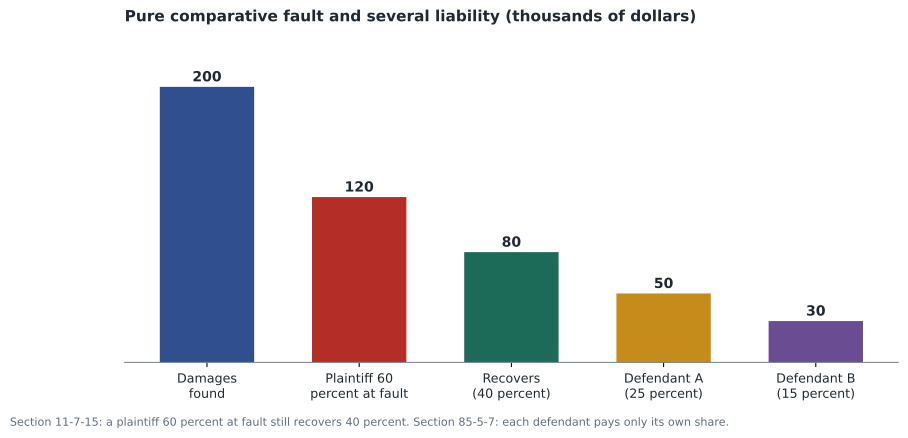
Mississippi was one of the first states to abandon contributory negligence, and it uses a pure form of comparative negligence. Section 11-7-15 of the Mississippi Code provides that the contributory negligence of the injured person does not bar recovery, but the damages are diminished in proportion to the amount of negligence attributable to the injured person. There is no threshold. A plaintiff who is 60 percent at fault still recovers 40 percent of her damages. Only a plaintiff who is entirely at fault recovers nothing.
That differs from the modified comparative negligence used in most states, where a plaintiff who is 50 or 51 percent at fault recovers nothing. On the MBE and MEE, which test general principles, candidates should apply whatever system the question specifies. On a Mississippi essay, the answer is pure comparative fault under Section 11-7-15, and a candidate who applies a 50 percent bar has made a significant error.
For Mrs. Coleman, a jury might find that her speeding contributed to the crash. If her damages are 400,000 dollars and she is found 15 percent at fault, her recovery is reduced by 15 percent, to 340,000 dollars. Her fault reduces her recovery but does not defeat it.
Several liability and allocation of fault
The second statute determines how the plaintiff's recovery is divided among defendants. Section 85-5-7 of the Mississippi Code abolished joint and several liability in most fault-based actions. Liability is several only: each defendant pays only the share of damages that matches its own percentage of fault. If one defendant cannot pay, the plaintiff bears that loss, not the other defendants.
There are important exceptions. Defendants who consciously and deliberately pursue a common plan or design to commit a tortious act, or who actively take part in it, remain jointly and severally liable. An employer and employee, or principal and agent, are treated as one party for allocation when the liability arises from the employee's or agent's conduct. And the fact finder must allocate fault to every party alleged to be at fault, including an immune party, and fault allocated to an immune party or one whose liability is limited by law cannot be reassigned to the other defendants.
Worked problem
Allocating fault in the Coleman case
A jury finds Mrs. Coleman's damages are 400,000 dollars. It allocates fault: Mrs. Coleman 15 percent, the van company 60 percent, and Leflore County 25 percent.
Show solution
- Under Section 11-7-15, her recovery is reduced by her own 15 percent, to 340,000 dollars.
- Under Section 85-5-7, the van company owes 60 percent of 400,000 dollars, which is 240,000 dollars.
- The county owes 25 percent of 400,000 dollars, which is 100,000 dollars, subject to the Tort Claims Act.
- If the van company were insolvent, the county would not pay its share; liability is several only.
Answer: She recovers 240,000 dollars from the van company and 100,000 dollars from the county, a total of 340,000 dollars.
Caps on noneconomic damages
The third statute limits noneconomic damages. Section 11-1-60 of the Mississippi Code, enacted as part of tort reform legislation in the early 2000s, caps noneconomic damages, such as pain and suffering, inconvenience, mental anguish, loss of enjoyment of life and loss of consortium. In medical malpractice actions against health care providers, noneconomic damages are capped at 500,000 dollars. In other civil actions, they are capped at 1,000,000 dollars. The jury is not told about the cap; the court applies it after the verdict.
The caps do not apply to economic damages, such as medical expenses, lost wages and lost earning capacity, which remain unlimited. Nor do they apply to punitive damages, which are governed separately. Section 11-1-65 sets out a procedure for punitive damages, including a separate evidentiary hearing after compensatory damages are awarded, a clear and convincing evidence standard, and caps on punitive awards tied to the defendant's net worth.
The constitutionality of the noneconomic damages cap has been challenged, but the Mississippi Supreme Court has not squarely ruled on it. In a federal product liability case, Learmonth v. Sears, Roebuck and Co., the Fifth Circuit certified the question to the Mississippi Supreme Court, which declined to answer it in 2012. The Fifth Circuit then held in 2013 that the 1,000,000-dollar cap did not violate the Mississippi Constitution. In 2012 a Coahoma County circuit judge held the cap unconstitutional under the state's jury-trial guarantee in a wrongful death case, but the parties settled in 2014 before the Mississippi Supreme Court could hear the appeal. As of November 2026, the cap remains in force.
| Type of damages | Mississippi rule | Source |
|---|---|---|
| Economic (medical bills, lost wages) | No cap | Section 11-1-60 |
| Noneconomic, medical malpractice | Capped at 500,000 dollars | Section 11-1-60 |
| Noneconomic, other civil actions | Capped at 1,000,000 dollars | Section 11-1-60 |
| Punitive damages | Separate hearing, clear and convincing evidence, caps tied to net worth | Section 11-1-65 |
| Claims against the government | Total capped at 500,000 dollars; no punitive damages | Section 11-46-15 |
The Mississippi Tort Claims Act
The fourth statute governs claims against the state and its political subdivisions, including counties, cities, school districts and public hospitals. The Mississippi Tort Claims Act, in Chapter 46 of Title 11 of the Mississippi Code, waives sovereign immunity for torts of governmental employees acting in the course and scope of their employment, but only on the Act's terms. Those terms are strict, and missing one of them is often fatal.
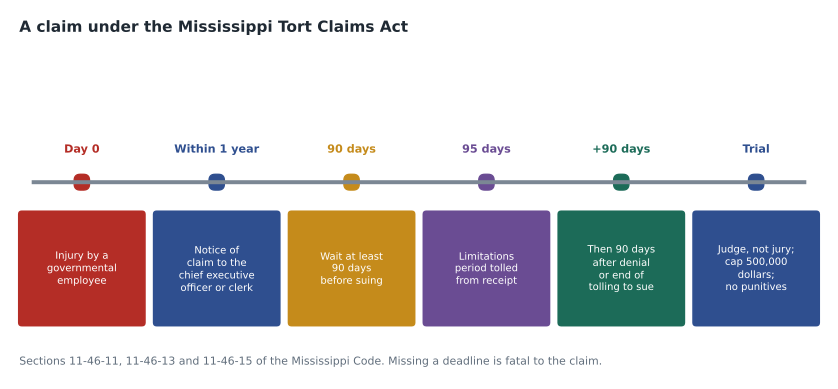
First, notice. Under Section 11-46-11, at least 90 days before filing suit, the claimant must file a written notice of claim with the chief executive officer of the governmental entity. For a county, notice goes to the chancery clerk of the county; for a municipality, to the city clerk. The notice must be delivered in person or by registered or certified mail and must state the facts of the claim: how the injury occurred, its extent, the time and place, the names of known persons involved, the damages sought and the claimant's residence at the time of injury and at filing.
Second, limitations. The claim must be brought within one year of the conduct on which liability is based. Filing a notice of claim within that year tolls the limitations period for 95 days from the date the chief executive officer or designated official receives it. The claimant may not sue until the entity denies the claim or the tolling period ends, whichever comes first, and then has 90 additional days to file suit. Missing that 90-day window bars the claim.
Third, limits on recovery and trial. Section 11-46-15 caps total liability at 500,000 dollars for claims arising after July 1, 2001, and prohibits punitive damages. Under Section 11-46-13, claims under the Act are tried by the judge without a jury. The Act also lists exemptions from liability in Section 11-46-9, such as claims based on discretionary functions and claims arising from police and fire protection unless the employee acted in reckless disregard of the safety of others. And conduct by an employee that amounts to fraud, malice, libel, slander, defamation or a criminal offense falls outside the course and scope of employment for purposes of the Act.
Worked problem
Running the Tort Claims Act clock
Mrs. Coleman's accident happened on March 10, 2026. Ora Lee Bankston's firm delivered a notice of claim to the Leflore County chancery clerk on August 3, 2026. The county had not responded by early November.
Show solution
- The notice was delivered within one year of the accident, so it tolls the limitations period for 95 days from August 3, 2026, to about November 6, 2026.
- The firm may not file suit against the county before the county denies the claim or the 95-day period ends.
- After the tolling period ends without a denial, the firm has 90 more days to file, until about early February 2027.
- Any trial against the county will be to the judge, recovery is capped at 500,000 dollars, and no punitive damages are available.
Answer: The firm should calendar the end of tolling and the following 90 days and file within that window.
Medical malpractice and other special rules
Medical negligence claims have their own rules. Under Section 15-1-36, the plaintiff must sue within two years from the date the alleged act, omission or neglect was or reasonably should have been discovered, with a general seven-year repose period subject to limited exceptions for foreign objects left in the body and fraudulent concealment. The plaintiff must also give the defendant at least 60 days' prior written notice of the intent to sue, describing the legal basis of the claim and the type of loss. Noneconomic damages in these cases are capped at 500,000 dollars under Section 11-1-60.
Mississippi retains the traditional common law categories for premises liability, distinguishing among invitees, licensees and trespassers, with the owner's duty varying by category. Candidates should be ready to classify the plaintiff and apply the corresponding duty on a Mississippi essay.
Writing a Mississippi tort essay
Marchetti's checklist for a Mississippi tort essay has five lines. Name the forum, usually circuit court for a damages claim. Identify the duty and breach under ordinary negligence principles. Apply pure comparative fault under Section 11-7-15 to the plaintiff's conduct. Allocate fault among defendants under Section 85-5-7, noting any concert-of-action exception and any immune party. Then check the damages: the noneconomic caps in Section 11-1-60, punitive damages under Section 11-1-65, and, if a governmental defendant is involved, the Tort Claims Act's notice, limitations, cap, bench trial and exemptions.
Common mistakes
MistakeA Mississippi plaintiff who is more than 50 percent at fault recovers nothing.
InsteadMississippi uses pure comparative negligence; recovery is reduced by the plaintiff's percentage of fault, with no threshold.
MistakeEach defendant in Mississippi is liable for the entire judgment.
InsteadSection 85-5-7 makes liability several only, except for defendants acting in concert.
MistakeThe noneconomic damages cap has been struck down by the Mississippi Supreme Court.
InsteadThe Mississippi Supreme Court has not ruled on it; the Fifth Circuit upheld it in 2013 and it remains in force.
MistakeA Tort Claims Act case against a county is tried to a jury.
InsteadSection 11-46-13 provides for a bench trial; recovery is capped at 500,000 dollars and punitive damages are barred.
Exemptions under the Tort Claims Act
Even when notice is perfect and the claim is timely, the Act's exemptions in Section 11-46-9 can defeat a claim. The best known is the discretionary function exemption, which protects governmental entities from liability for the exercise or performance of a discretionary function or duty, whether or not the discretion is abused. Mississippi courts distinguish between discretionary functions, which involve policy judgment, and ministerial duties, which are imposed by statute, regulation or policy and leave no room for judgment. The analysis can turn on whether a statute or regulation required the specific act the plaintiff says was not done.
Another frequently litigated exemption covers police and fire protection. A governmental entity is not liable for claims arising from an employee engaged in police or fire protection activities unless the employee acted in reckless disregard of the safety and well-being of a person not engaged in criminal activity at the time of injury. That reckless disregard standard requires more than ordinary negligence. On an essay involving a police chase or an emergency response, candidates should identify the exemption and apply the reckless disregard standard.
Individual employees
The Act also protects individual governmental employees. An employee is not held personally liable for acts or omissions within the course and scope of employment; the claim is against the entity. But conduct that amounts to fraud, malice, libel, slander, defamation or a criminal offense falls outside the course and scope of employment for purposes of the Act, which means the entity is not liable for it and the employee may be sued personally. A strong answer separates the claim against the entity from any claim against the employee individually.
Putting the Coleman case together
By the end of the week Tavaris had a one-page analysis for Ora Lee Bankston. The claim against the van company would proceed in Leflore County Circuit Court, with a jury, a three-year limitations period, pure comparative fault and the 1,000,000-dollar noneconomic damages cap. The claim against the county was governed by the Tort Claims Act: proper notice had been delivered to the chancery clerk in August, the tolling period had run, and suit had to be filed within the following 90 days. That claim would be tried to the judge, capped at 500,000 dollars and subject to the county's defenses, including any argument that leaving a truck in the lane without lights involved a discretionary decision. Ms. Bankston thought that argument weak, since parking a truck safely is the kind of ministerial duty that safety regulations govern, but she wanted it addressed.
Summary and key terms
- Section 11-7-15 adopts pure comparative negligence: a plaintiff's fault reduces but does not bar recovery.
- Section 85-5-7 makes liability several only, with exceptions for concerted action; fault allocated to immune parties is not reallocated.
- Section 11-1-60 caps noneconomic damages at 500,000 dollars in medical malpractice cases and 1,000,000 dollars in other civil actions; economic damages are uncapped.
- The Fifth Circuit upheld the cap in Learmonth in 2013; the Mississippi Supreme Court has not decided its constitutionality.
- The Tort Claims Act requires notice at least 90 days before suit, a one-year limitations period with 95-day tolling and a 90-day window to sue, a bench trial, a 500,000-dollar cap and no punitive damages.
- Medical malpractice claims require 60 days' notice and must be filed within two years of discovery, subject to a seven-year repose period.
- 0
- pure comparative negligence
- 1
- several liability
- 2
- noneconomic damages
- 3
- punitive damages
- 4
- Mississippi Tort Claims Act
- 5
- notice of claim
- 6
- tolling
- 7
- discretionary function
Practice problems
Work each problem on paper first, then reveal the answer to check.
A plaintiff is 70 percent at fault for her injuries, which total 100,000 dollars. What does she recover in Mississippi?
Show answer
30,000 dollars, under pure comparative negligence.
What is the noneconomic damages cap in a Mississippi medical malpractice case?
Show answer
500,000 dollars.
To whom is a Tort Claims Act notice sent when the defendant is a county?
Show answer
The chancery clerk of the county.
Is a jury available in a Tort Claims Act case?
Show answer
No. Section 11-46-13 provides for trial by the judge without a jury.
Lesson quiz · 5 questions
Score 60% or more to complete this lesson.
Create a free account to save your progress, take quizzes and earn a certificate.