
BAR-225 · Lesson 7 of 12 · 21 min
Mississippi courts and civil procedure
▶ Video coming soon A video version of this lesson is on the way.
On a Monday in early November 2026 Tavaris spent the morning at the Leflore County Courthouse with Ora Lee Bankston, the senior partner at his firm. At nine o'clock she argued a temporary custody motion before the chancellor. At eleven she walked down the hall to circuit court for a status conference in a car-wreck case. In the afternoon she filed a petition in chancery to have a guardian appointed for an elderly client's affairs. 'Three different matters, two different trial courts, one building,' she told him on the drive back. 'Get the court wrong in Mississippi and you lose time, money and sometimes the client's patience.'
That evening Tavaris told Hollis Marchetti about the day. 'I knew Mississippi has chancery courts,' he said. 'I did not realize how much of a small-town practice runs through them.' Marchetti smiled. 'Mississippi is one of the few states that still keeps separate courts of equity. The line between chancery and circuit is in the state constitution, and the Mississippi essays love it. A candidate who names the right court in the first sentence starts with the grader on her side.'
This lesson covers the structure of the Mississippi courts, the constitutional division between chancery and circuit courts, what happens when a case is filed in the wrong one, the Mississippi Rules of Civil Procedure and a few practical deadlines every new lawyer needs.
The appellate courts
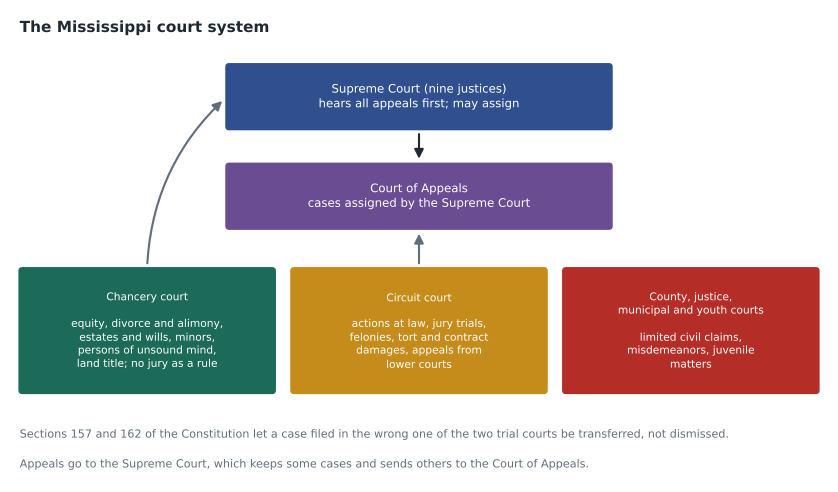
The Supreme Court of Mississippi is the state's highest court, with nine justices elected from three districts. Appeals from the trial courts are filed with the Supreme Court, which keeps some cases and assigns others to the Court of Appeals. The Court of Appeals, created in the 1990s to share the appellate caseload, decides the cases assigned to it. A party who loses in the Court of Appeals may ask the Supreme Court to review the decision by a petition for writ of certiorari, which the Supreme Court grants at its discretion.
That assignment system differs from states where intermediate appellate courts hear appeals of right first. In Mississippi, every appeal starts at the Supreme Court's door. The Supreme Court generally retains certain categories, such as cases involving the death penalty, constitutional questions of first impression and matters of broad public importance, and assigns many routine appeals to the Court of Appeals.
Chancery courts
Chancery courts are Mississippi's courts of equity. Section 159 of the Mississippi Constitution gives the chancery court full jurisdiction over all matters in equity, divorce and alimony, matters testamentary and of administration, minors' business, and cases involving persons of unsound mind, along with all cases the chancery court handled under the laws in force when the Constitution took effect. In practice that means divorce, custody, child support, adoption, estates and wills, guardianships and conservatorships, commitments, land title disputes, partition, injunctions, specific performance and other equitable remedies.
Chancery cases are tried by a chancellor without a jury as a general rule. The chancellor finds facts and decides the law, and appellate courts review the chancellor's findings with substantial deference. Chancery districts often cover several counties, and chancellors travel among county seats.
Circuit courts
Circuit courts are Mississippi's trial courts of general jurisdiction for actions at law. Under Section 156 of the Constitution, the circuit court has original jurisdiction in civil and criminal matters not vested in another court. Circuit courts try felony prosecutions, civil damage actions in tort and contract, and jury trials generally. They also hear appeals from county, justice and municipal courts in many matters.
In counties that have them, county courts share some of the circuit court's civil jurisdiction up to a statutory amount and handle youth court matters. Justice courts hear small civil claims and misdemeanors, and municipal courts handle violations of city ordinances and misdemeanors within city limits.
| Court | Main jurisdiction | Jury? |
|---|---|---|
| Chancery court | Equity, divorce and alimony, custody, estates and wills, minors, guardianships, commitments, land title | Generally no |
| Circuit court | Actions at law, felony cases, tort and contract damages, appeals from lower courts | Yes |
| County court | Limited civil jurisdiction up to a statutory amount; youth court in many counties | Yes, in civil cases |
| Justice court | Small civil claims and misdemeanors | Limited |
| Supreme Court | All appeals filed here; assigns some to the Court of Appeals | No |
| Court of Appeals | Appeals assigned by the Supreme Court | No |
When the right court is not obvious
Many disputes involve both legal and equitable claims. A homeowner may sue a builder for damages and also ask to rescind the contract. A widow may challenge a will and also claim the decedent's bank accounts were held in trust for her. Mississippi courts resolve these by looking at the substance of the case. When the main relief sought is equitable, or the case involves a subject listed in Section 159, chancery court has jurisdiction and can decide related legal claims as well under the doctrine of pendent or ancillary jurisdiction. When the case is fundamentally one at law, circuit court is the proper forum.
A candidate on a Mississippi essay should state the test and apply it: identify the core of the dispute, ask whether it falls within Section 159 or is primarily equitable, and conclude which court hears it, noting that the chancery court may also resolve closely related legal claims to avoid splitting the case.
Filing in the wrong court
The Mississippi Constitution softens the consequences of choosing the wrong trial court. Under Section 157, when a case is brought in circuit court that should have been brought in chancery, the circuit court transfers it to chancery rather than dismissing it. Section 162 does the reverse: a chancery court transfers a case that belongs in circuit court. And Section 147 provides that no judgment or decree shall be reversed on appeal merely because the chancery court decided a case that belonged in circuit court, or the reverse, so long as the case was otherwise properly decided. The practical upshot is that a mistake about forum costs time, but rarely the case.
Worked problem
Choosing the court
A Greenwood client wants to stop her neighbor from building a fence across a driveway she has used for twenty years, and she also wants 5,000 dollars for damage the neighbor's contractor did to her mailbox.
Show solution
- The main relief is an injunction and a declaration of an easement, both equitable and both concerning land title.
- Those claims fall within the chancery court's equity jurisdiction under Section 159.
- The 5,000-dollar property damage claim is legal, but it arises from the same dispute and the chancery court can decide it as an ancillary claim.
- If the lawyer files in circuit court instead, Section 157 calls for transfer to chancery, not dismissal.
Answer: File in chancery court; the chancellor can decide the easement, the injunction and the related damages claim together.
The Mississippi Rules of Civil Procedure
Mississippi adopted the Mississippi Rules of Civil Procedure in the early 1980s, modeled on the Federal Rules of Civil Procedure. Most of the structure will feel familiar: notice pleading, motions to dismiss, summary judgment, liberal joinder, broad discovery, and directed verdicts and judgments notwithstanding the verdict. For MBE and MEE purposes, a candidate can rely on federal rules. For Mississippi essays and practice, the candidate should know that the Mississippi rules track the federal rules closely but not perfectly.
One Mississippi rule deserves particular attention. Rule 81 lists types of proceedings that are governed in whole or in part by statutes or special procedures, and it provides a special form of summons for certain chancery matters, such as divorce, custody modification, contempt, guardianship and estate proceedings. Under Rule 81, those matters are often set for a hearing on a specific date, and the summons tells the defendant when and where to appear, rather than requiring an answer within thirty days. Practitioners who serve an ordinary Rule 4 summons in a Rule 81 matter risk a void judgment.
Courts also follow uniform local rules adopted by the Supreme Court: the Uniform Chancery Court Rules and the Uniform Rules of Circuit and County Court Practice. These cover scheduling, motion practice and the details of trial procedure.
Deadlines a new lawyer needs
Three groups of deadlines come up again and again in Mississippi practice. The first is the limitations period. Under Section 15-1-49 of the Mississippi Code, the general limitations period for actions with no other prescribed period, including most negligence claims, is three years. Intentional torts such as assault, battery, false imprisonment, defamation and malicious arrest have a one-year period under Section 15-1-35. Medical malpractice claims must be filed within two years of when the injury was or reasonably should have been discovered, subject to a seven-year repose period with limited exceptions, under Section 15-1-36, and the plaintiff must give the defendant at least 60 days' written notice before suing.
The second is service. Under Rule 4, a plaintiff generally has 120 days after filing the complaint to serve the summons and complaint, and a plaintiff who misses that window without good cause risks dismissal. Because a dismissal can leave the limitations period expired, prompt service matters.
The third is appeal. A notice of appeal from a final judgment must generally be filed within 30 days after entry of the judgment, under the Mississippi Rules of Appellate Procedure. Post-trial motions filed on time can extend that deadline until they are decided.
| Claim or step | Mississippi deadline | Source |
|---|---|---|
| Most negligence claims | Three years | Miss. Code Section 15-1-49 |
| Intentional torts (assault, battery, defamation) | One year | Section 15-1-35 |
| Medical malpractice | Two years from discovery; 60 days' notice before suit | Section 15-1-36 |
| Claims against the government | One year, after notice of claim | Section 11-46-11 |
| Service of process | 120 days after filing | Rule 4(h) |
| Appeal deadline | 30 days after judgment | Rules of Appellate Procedure |
Venue
Venue rules decide which county within the right court system hears the case. For most civil actions against individuals and businesses, Mississippi's venue statute allows suit in the county where the defendant resides, or in the county where a substantial act or omission occurred or a substantial event that caused the injury occurred. Mississippi tightened its venue statute in tort reform legislation in the early 2000s, in part to curb forum shopping. A defendant who believes venue is improper raises it by motion early in the case.
Bringing it together
Marchetti asked Tavaris to write a one-paragraph answer to a simple call: a client's father died, the will leaves everything to a stepdaughter, and the client wants to contest it and recover a truck the stepdaughter sold. Tavaris wrote that a will contest is a matter testamentary within the chancery court's Section 159 jurisdiction, that the truck claim arises from the same estate and can be decided by the chancellor, and that the contest must be brought within the time allowed after probate. Marchetti marked it with a single word: 'Yes.'
Common mistakes
MistakeA Mississippi divorce is filed in circuit court.
InsteadDivorce and alimony are within the chancery court's constitutional jurisdiction under Section 159.
MistakeA case filed in the wrong trial court is dismissed.
InsteadSections 157 and 162 call for transfer between circuit and chancery, and Section 147 prevents reversal merely for that reason.
MistakeThe Court of Appeals hears every appeal first.
InsteadAll appeals are filed with the Supreme Court, which assigns some to the Court of Appeals.
MistakeAn ordinary Rule 4 summons works in every chancery case.
InsteadRule 81 requires a special summons for many chancery matters, such as divorce and contempt.
Discovery and motion practice
Discovery under the Mississippi Rules of Civil Procedure follows the familiar federal tools: interrogatories, requests for production, requests for admission and depositions. Requests for admission deserve special care, because a party who fails to respond on time may be deemed to have admitted the matters requested, and deemed admissions can decide a case. Summary judgment under Rule 56 is available when there is no genuine issue of material fact and the movant is entitled to judgment as a matter of law, and Mississippi courts apply a standard close to the federal one.
Motions in chancery and circuit courts are governed by the Mississippi Rules of Civil Procedure and the uniform rules for each court, which set requirements for notice, hearing dates and proposed orders. A new lawyer should read the uniform rules for the court before filing a first motion and ask the court administrator or a senior colleague how the local chancellor or circuit judge handles scheduling.
Jury trials and their limits
The right to a jury trial in Mississippi depends on the court and the claim. Circuit court actions at law carry the right to a jury. In chancery court, the chancellor decides the case without a jury in most matters, although the chancellor may empanel an advisory jury, and certain statutes provide for jury trials on particular issues, such as will contests. Claims under the Tort Claims Act are tried without a jury even though they would otherwise be legal claims. On an essay, stating whether a jury is available is often worth a sentence.
Appeals in practice
A party who loses at trial and wants to appeal files a notice of appeal with the clerk of the trial court within 30 days after entry of the judgment, and pays the required costs. The record is then prepared and sent to the Supreme Court, and the parties file briefs. The Supreme Court decides whether to keep the case or assign it to the Court of Appeals. Appellate courts review a chancellor's findings of fact for manifest error and questions of law de novo, which is one reason a careful record and specific findings matter so much in chancery practice.
Thinking like a Mississippi trial lawyer
Ora Lee Bankston has a habit Tavaris now copies. Before opening a new file, she writes four lines at the top of the first page: the court, the county, the limitations period and any notice requirement. 'If you get those four right,' she says, 'you have avoided most of the ways a lawyer can lose a case before it starts.' The same four lines, written at the top of an essay outline, are a good way to make sure a Mississippi answer starts on solid ground.
Summary and key terms
- Appeals are filed with the Supreme Court of Mississippi, which keeps some and assigns others to the Court of Appeals.
- Chancery courts hear equity, divorce and alimony, estates, minors' business and persons of unsound mind under Section 159, generally without a jury.
- Circuit courts hear actions at law, felonies and jury trials under Section 156.
- Sections 157 and 162 transfer misfiled cases; Section 147 bars reversal solely for choosing the wrong one of the two courts.
- The Mississippi Rules of Civil Procedure track the federal rules, but Rule 81 sets special procedures and summons for many chancery matters.
- Key deadlines: three years for most negligence, one year for intentional torts, two years for medical malpractice with 60 days' notice, 120 days for service and 30 days to appeal.
- 0
- chancery court
- 1
- circuit court
- 2
- chancellor
- 3
- Section 159
- 4
- Rule 81 summons
- 5
- Court of Appeals
- 6
- writ of certiorari
- 7
- venue
Practice problems
Work each problem on paper first, then reveal the answer to check.
Which section of the Mississippi Constitution defines chancery jurisdiction?
Show answer
Section 159.
A negligence suit for damages is filed in chancery court by mistake. What happens?
Show answer
Under Section 162 the chancery court transfers it to circuit court rather than dismissing it.
What is the limitations period for a battery claim in Mississippi?
Show answer
One year, under Section 15-1-35.
Where is a Mississippi appeal filed?
Show answer
With the Supreme Court, which may keep it or assign it to the Court of Appeals.
Lesson quiz · 5 questions
Score 60% or more to complete this lesson.
Create a free account to save your progress, take quizzes and earn a certificate.