
BAR-225 · Lesson 3 of 12 · 21 min
Character and fitness and the MPRE
▶ Video coming soon A video version of this lesson is on the way.
Tavaris had one item on his application that worried him. In 2020, during his junior year of college, his driver's license was suspended for a few weeks because he had not paid a speeding ticket from a trip to Oxford. He paid the ticket and the reinstatement fee, and the license came back. He also had a private student loan that had gone thirty days past due in 2023 before he set up automatic payments. Neither seemed serious, but the application asked about both, and he had read online that small things could delay admission.
Hollis Marchetti listened, then asked a single question. 'Did you disclose both, fully, with dates and how they were resolved?' He had. 'Then you have done the most important thing. Mississippi's character and fitness review is about whether you can be trusted with clients' money, secrets and cases. A paid ticket and a loan you brought current are not what keeps people out. What keeps people out is hiding things, or conduct that shows a pattern of dishonesty or irresponsibility. Candor is the whole game.'
This lesson explains the standard the Committee on Character and Fitness applies, the conduct it looks at, how the process works and what happens when there is a problem. It then covers the Multistate Professional Responsibility Examination, on which Mississippi requires a scaled score of 75 within a defined window.
The standard and the burden
Under the Rules Governing Admission, the applicant bears the burden of proving good moral character and fitness to practice. The applicant must satisfy a majority of the Committee on Character and Fitness to its reasonable satisfaction. That allocation matters. The Committee does not have to prove that an applicant is unfit; the applicant has to show that he or she is fit. Gaps, evasions and inconsistent answers work against the applicant because they leave the Committee unable to be satisfied.
The purpose is protective. A lawyer holds clients' money in trust, keeps confidences, makes representations to courts and acts for people in their most serious moments. The Committee asks whether an applicant's past conduct suggests a risk to clients, courts or the public.
Conduct the Committee looks at
The Rules direct the Committee to consider conduct that bears on honesty and responsibility. That includes unlawful conduct, academic misconduct, false statements including omissions on the application, acts involving dishonesty, fraud or deceit, neglect of financial responsibilities, neglect of professional obligations, violation of court orders, evidence of mental or emotional instability that affects the ability to practice, and evidence of drug or alcohol dependence. The Committee weighs the seriousness of the conduct, how recent it was, the applicant's age at the time, the circumstances, the pattern if any, evidence of rehabilitation and the applicant's candor during the review.
The Rules also identify conduct that is generally not disqualifying on its own. Minor traffic violations, domestic relations matters that do not involve criminal conduct, and conduct remote in time are examples. That does not mean they can be left off the application. It means that, disclosed and explained, they rarely decide the outcome.
Felony convictions
Mississippi's Rules treat a felony conviction as a serious bar. Under the Rules, a conviction of a felony, other than manslaughter or certain federal tax offenses, generally disqualifies the applicant from admission. This is stricter than the case-by-case approach of many states. A candidate with a felony conviction in his or her past should read the current Rules carefully and contact the Board well before investing in law school or the exam, because the outcome may not turn on rehabilitation evidence the way it would elsewhere.
| Factor | Weighs against the applicant | Weighs for the applicant |
|---|---|---|
| Candor | Omissions, minimizing, inconsistent answers | Full, prompt disclosure with documents |
| Timing | Recent conduct | Conduct long ago, especially when young |
| Pattern | Repeated incidents | An isolated event |
| Financial | Unpaid judgments, ignored debts | Debts brought current, payment plans kept |
| Rehabilitation | No change in behavior | Treatment, restitution, stable record since |
How the process works
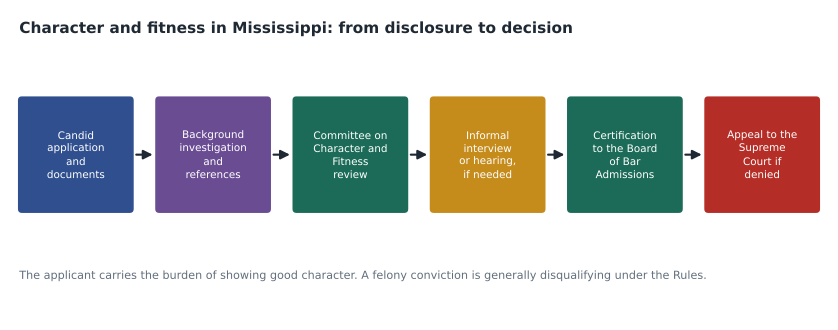
The review begins with the application itself, which asks detailed questions about education, employment, residences, criminal and traffic history, civil litigation, finances, prior bar applications and certain health matters that affect the ability to practice. Applicants authorize the Board to obtain records and contact references and employers. For law students who registered early, much of this work happens during law school; for those who did not, it begins with the exam application.
Staff review the file and verify the information. If questions arise, the Committee may ask for more documents or an explanation. When a file raises a real concern, the Committee may hold an informal interview with the applicant, and in more serious cases a formal hearing where the applicant may be represented by counsel and present evidence. If the Committee is satisfied, it certifies the applicant's character and fitness. If not, the applicant may seek review before the Supreme Court.
Candor in practice
Most character and fitness trouble comes from nondisclosure. An applicant leaves off a college disciplinary matter, a dismissed charge or a civil judgment because it seemed minor or was supposedly expunged. The Committee finds it through a records check or a reference, and now the question is no longer the old incident but the applicant's honesty on a sworn application. The Rules list false statements and omissions as conduct the Committee considers in its own right.
The safest rule is to disclose anything the question could reasonably cover and explain it. If an expunged record or a sealed juvenile matter raises a real question about whether disclosure is required, read the application's instructions on that exact point and, if still uncertain, ask the Board in writing. Never guess in the direction of leaving something out.
Worked problem
Disclosing the small things
A candidate received a citation for possession of an open container at a football game in Starkville when he was 20. He paid a fine. On his bar application he wonders whether to mention it, since it was a misdemeanor citation and four years old.
Show solution
- The application asks about citations and charges, not just convictions, so the question covers it.
- The conduct is minor, remote and isolated, the kind the Rules treat as generally not disqualifying.
- Leaving it off would create a candor problem far worse than the citation.
- He should disclose it with the date, the court, the disposition and proof the fine was paid.
Answer: Disclose it fully and briefly; a paid misdemeanor citation from age 20 is unlikely to matter, but an omission would.
Financial responsibility
The Committee pays attention to how applicants handle money because lawyers handle clients' money. Defaulted loans, unpaid judgments, unfiled tax returns and debts sent to collection are common issues. Student loan debt itself is not a problem; ignoring it is. An applicant with financial trouble does best by showing a plan and a record of following it: a payment agreement, an account brought current, a tax return filed late with the balance paid.
Tavaris attached a one-page letter from his loan servicer confirming that his account had been current and on automatic payment since late 2023. For the license suspension he attached the court receipt and the Department of Public Safety reinstatement notice. 'Documents answer questions before they are asked,' Marchetti said.
Updating the file
An applicant's duty of candor continues until admission. If something happens after filing, such as a new citation, a lawsuit, a change in employment or a mental health matter that the application's questions cover, the applicant must update the Board promptly. Tavaris's October move within Greenwood went in an email the same week. A candidate who waits to report a new matter until the Committee discovers it has turned a small item into a candor question.
The MPRE requirement
Mississippi requires a scaled score of 75 on the Multistate Professional Responsibility Examination. The MPRE is a two-hour, sixty-question multiple-choice test written and administered by NCBE several times a year. It tests the ABA Model Rules of Professional Conduct, the Model Code of Judicial Conduct and generally accepted principles of lawyer regulation, not Mississippi's own rules. Scores run from 50 to 150, and the 75 Mississippi requires is lower than the requirement in many other states.
The MPRE score must be earned within a window. Under the Rules, a candidate needs the score within 24 months before, or within 12 months after, the date of the Mississippi exam the candidate passes. A score from three years before the exam is too old. A candidate who passes the bar exam but has not yet taken the MPRE has a year to do so.
Tavaris's score of 92 from November 2025 falls about 15 months before the February 2027 exam, comfortably within the window. If he passes in February, his MPRE requirement is satisfied. If he does not pass until July 2027, the score will be about 20 months old, still within 24 months. Only if he needed to sit again after that would the score expire.
| MPRE date | Mississippi exam passed | Within the window? |
|---|---|---|
| November 2025 | February 2027 | Yes, about 15 months before |
| March 2024 | February 2027 | No, more than 24 months before |
| August 2027 | February 2027 | Yes, within 12 months after |
| April 2028 | February 2027 | No, more than 12 months after |
Preparing for the MPRE
Because the MPRE tests the ABA Model Rules, preparation is the same everywhere. Most candidates spend two to three weeks working through a professional responsibility outline and several hundred practice questions. The traps are predictable: the difference between what a lawyer must do and what a lawyer may do, the exceptions to confidentiality, conflicts involving former clients, and the judicial conduct questions that many students skip.
There is one Mississippi wrinkle worth knowing. The MPRE tests the Model Rules, but the Mississippi essays and Mississippi practice use the Mississippi Rules of Professional Conduct, which differ in several places. Rule 1.8(e), for example, allows limited advances for living expenses in Mississippi that the Model Rules do not. Lesson 10 covers those differences. On the MPRE, answer under the Model Rules; on a Mississippi essay, answer under Mississippi's rules.
Common mistakes
MistakeA minor matter can be left off the application if it was dismissed or expunged.
InsteadDisclose anything the question reasonably covers; if unsure about an expunged record, read the instructions and ask the Board in writing.
MistakeThe Committee must prove an applicant is unfit.
InsteadThe applicant bears the burden of proving good character and fitness.
MistakeAny MPRE score of 75 works no matter when it was earned.
InsteadIt must fall within 24 months before or 12 months after the exam the applicant passes.
MistakeThe MPRE tests the Mississippi Rules of Professional Conduct.
InsteadIt tests the ABA Model Rules; Mississippi's own rules appear on the Mississippi essays.
References and employment history
The application asks for references and a full employment history, and the Committee contacts some of them. Candidates sometimes treat these sections as formalities and list only the jobs they are proud of. That is a mistake. A gap in the employment history, or a job that ended badly and was left off, raises exactly the kind of question the Committee is trained to notice. List every job the application asks for, including part-time and summer work, give accurate dates and explain any termination briefly and honestly.
For references, choose people who know the applicant well and can speak to character, not just to legal skill. A supervising attorney, a professor who taught a small seminar, a clinic director or a long-time employer can each speak to reliability and honesty. Tell each reference in advance that the Board may contact them, and give them accurate contact details. A reference who does not respond can slow the file.
Mental health questions
Bar applications across the country have moved away from broad questions about mental health diagnoses and treatment, focusing instead on conduct and current impairment that affects the ability to practice. Candidates should read Mississippi's current questions carefully and answer exactly what they ask. Seeking counseling or treatment is not, by itself, a reason to deny admission, and candidates should never avoid getting help out of fear of the bar application. If a question applies, a short, factual answer with documentation of current fitness is usually enough. The Lawyers and Judges Assistance program discussed in Lesson 10 exists precisely because the profession recognizes that lawyers, like everyone else, sometimes need support.
When the Committee has concerns
If the Committee has questions it cannot resolve on paper, it may invite the applicant to an informal interview. Candidates should treat the interview seriously: arrive prepared, bring documents, answer directly and avoid minimizing. An applicant facing a formal hearing should consider retaining a lawyer experienced in bar admission matters. The hearing gives the applicant a chance to present evidence of rehabilitation, such as letters from employers, proof of restitution, treatment records or evidence of years of responsible conduct.
Delays are common when a file raises questions, and they can postpone admission even after a passing score. That is another reason to register early as a law student, disclose fully at the start and respond to every request within days. The Committee's goal is to be satisfied, and an applicant who makes that easy usually finds the process far less stressful than the stories suggest.
The MPRE and the Mississippi exam calendar
Because the MPRE is given several times a year, candidates have flexibility about when to take it. Many take it during the second year of law school, after a professional responsibility course, so that it is finished before bar study begins. Others take it in the months after the bar exam, using the twelve-month window after a passing exam. Tavaris took it in November of his third year. 'It was one less thing during bar study,' he said. The only rule is to stay within the window and to register with NCBE early, since testing seats fill up.
Candidates should also make sure NCBE reports the MPRE score to Mississippi. NCBE sends scores to jurisdictions the candidate designates, and a candidate who forgot to designate Mississippi, or who took the MPRE before deciding to sit in Mississippi, can request a score transfer from NCBE. The Board needs the official score; a screenshot from an NCBE account is not enough.
Summary and key terms
- The applicant must prove good moral character and fitness to the reasonable satisfaction of a majority of the Committee.
- The Committee weighs dishonesty, financial irresponsibility, unlawful conduct, false statements and substance problems, along with recency, pattern and rehabilitation.
- A felony conviction, other than manslaughter or certain federal tax offenses, generally disqualifies an applicant under the Rules.
- Candor is the most important factor; omissions are treated as misconduct in their own right.
- Mississippi requires an MPRE scaled score of 75, earned within 24 months before or 12 months after the passing exam.
- 0
- character and fitness
- 1
- burden of proof
- 2
- candor
- 3
- rehabilitation
- 4
- MPRE
- 5
- scaled score
Practice problems
Work each problem on paper first, then reveal the answer to check.
Who bears the burden in a Mississippi character and fitness review?
Show answer
The applicant, who must prove good character and fitness to the Committee's reasonable satisfaction.
What MPRE scaled score does Mississippi require?
Show answer
75.
A candidate took the MPRE in January 2025 and passes the Mississippi exam in July 2027. Is the score valid?
Show answer
No. It is about 30 months old, outside the 24-month window.
Name two kinds of conduct the Rules say are generally not disqualifying on their own.
Show answer
Minor traffic violations and domestic relations matters without criminal conduct; remote conduct is another.
Lesson quiz · 5 questions
Score 60% or more to complete this lesson.
Create a free account to save your progress, take quizzes and earn a certificate.