
BAR-225 · Lesson 2 of 12 · 21 min
Eligibility, education, deadlines and fees
▶ Video coming soon A video version of this lesson is on the way.
In early October 2026 Tavaris opened his study session with a question from the office. Mavis Reed, the younger partner at Bankston & Reed, had asked him whether a summer associate from a law school in another state could sit for the Mississippi exam after graduating, and whether a friend of hers, a lawyer trained in Nigeria, could take it at all. 'I realized I know my own path,' Tavaris said, 'but not the rules behind it.'
Hollis Marchetti pulled up the Rules Governing Admission. 'That is the right instinct. Eligibility in Mississippi turns on a short list of requirements: age, a bachelor's degree, a J.D. from an ABA-approved law school and a clean enough record on prior attempts. Then there is a calendar of deadlines and a fee schedule that rewards people who file early. Learn those now, because the exam essays occasionally test admission and professional conduct rules, and because a missed deadline costs a full exam cycle.'
This lesson walks through each eligibility requirement, the filing calendar for the February and July exams, the fees and the limit on the number of attempts. Figures here come from the Rules Governing Admission and the Board's application instructions as of November 2026. The Board can change fees and procedures, so a candidate should always confirm the current instructions for the administration they plan to take.
The basic eligibility requirements
An applicant for the Mississippi bar exam must be at least 21 years old. The applicant must hold a bachelor's degree from an accredited college or university. The Rules recognize one alternative: equivalent credit earned in an integrated program that combines prelaw and law study over six years. The applicant must also have completed, or be within 60 days of completing, the course of study at a law school approved by the American Bar Association's Section of Legal Education and Admissions to the Bar.
The 60-day allowance lets a student who graduates in May sit for the July exam, but admission still waits until the degree is conferred and certified. The Board requires a certificate from the law school dean confirming the degree, and an applicant whose graduation slips past the window can find the application held or deferred.
The ABA requirement and foreign-trained lawyers
Mississippi's education rule is strict. A J.D. from an ABA-approved law school is required, and NCBE's summary of Mississippi's rules lists foreign law graduates as not eligible. Unlike some states, Mississippi does not offer a route in which a foreign-trained lawyer can qualify by earning an American LL.M. degree. Graduates of law schools that are not ABA-approved, including correspondence and online schools without ABA approval, are likewise outside the Rules.
That answered Mavis Reed's second question. A lawyer trained only in Nigeria cannot sit for the Mississippi exam on that education alone. The summer associate from an out-of-state ABA-approved school, by contrast, is eligible on the same terms as a Mississippi graduate. Where the law school is located makes no difference; ABA approval is what counts.
| Requirement | Mississippi rule | Practical point |
|---|---|---|
| Age | At least 21 | Rarely an issue for J.D. graduates |
| Undergraduate | Bachelor's degree from an accredited college, or credit in an integrated six-year program | Final transcript sent to the Board |
| Law school | J.D. from an ABA-approved school, completed or within 60 days of completion | Dean's certificate confirms graduation |
| Foreign education | Not eligible | No LL.M. route for foreign-trained lawyers |
| Attempts | An applicant who has failed four times is ineligible | Plan every sitting seriously |
Law student registration
Mississippi has a law student registration step that many states lack. Students register with the Board by October 1 after completing two semesters of law school. The registration fee is 100 dollars. A student who misses October 1 can still register late, by March 1 or August 1 depending on which exam they plan to take, for a late registration fee of 300 dollars.
Registration does two things. It lets the Committee on Character and Fitness begin its review long before the exam, which means problems surface while there is still time to resolve them. And it lowers the exam application fee later. An applicant who registered as a law student pays 525 dollars to file the exam application on time. One who never registered pays 825 dollars, because the Board must start the full background review at once.
Tavaris registered in September 2024, a few weeks before the October 1 deadline, after finishing his first year. 'I almost waited until spring,' he admitted. 'A second-year student at the clinic told me it was worth the hundred dollars to save three hundred later and get the background check out of the way.'
Exam application deadlines
The Mississippi bar exam is given twice a year, in February and July. The regular filing deadline is September 1 for the February exam and February 1 for the July exam. A late application window follows each deadline: from September 2 through November 1 for February, and from February 2 through April 1 for July. Late applications cost more. An applicant who filed on time with prior student registration pays 525 dollars; the same applicant filing late pays 725 dollars. An applicant without prior registration pays 825 dollars on time or 1,025 dollars late.
Applicants retaking the exam follow a separate calendar. The reexamination application is due November 1 for a February exam and May 1 for a July exam, and the reexamination fee is 550 dollars. Because results from the July exam arrive in the fall, the November 1 date gives a July taker who did not pass time to decide on February.
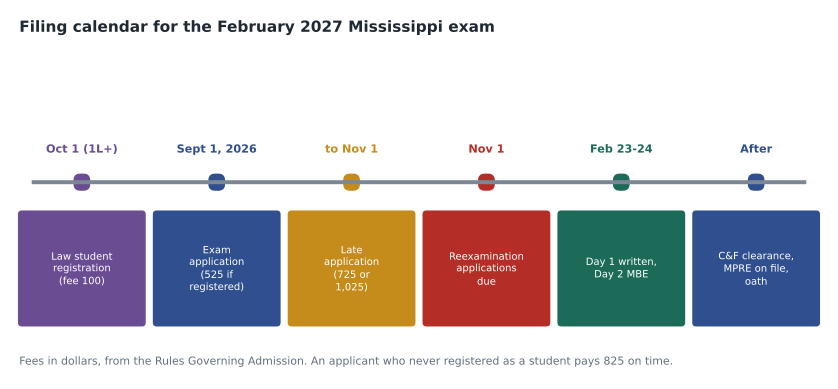
The fee schedule in one place
Candidates sometimes lose track of which fee applies. The table below collects the main amounts from the Rules. Character and fitness investigation costs for applicants already licensed elsewhere, and laptop fees where the Board permits laptops, are separate and announced in the instructions.
| Item | Fee in dollars | Notes |
|---|---|---|
| Law student registration | 100 | Late registration 300 |
| Exam application after student registration | 525 | Late: 725 |
| Exam application without student registration | 825 | Late: 1,025 |
| Reexamination | 550 | Due November 1 or May 1 |
| Deferment after the first | 325 | For moving to a later exam |
| Admission on motion | 1,500 | Plus investigation costs |
Deferring to a later exam
An applicant who files for one exam and then cannot sit may ask to defer to a later administration. The Rules allow deferment, and after the first deferment a fee of 325 dollars applies. Deferment is not automatic, and an applicant who simply fails to appear may forfeit fees and need to reapply. Tavaris did not need to defer, since he never applied for July 2026, but a classmate who applied for July and then had a family emergency deferred to February 2027 and paid nothing extra because it was her first deferment.
The limit on attempts
Mississippi caps the number of times an applicant may fail. Under the Rules, an applicant who has failed the exam at least four times is not eligible to take it again. NCBE's summary describes the same rule as four attempts without special permission. This is stricter than many states, and it means every sitting counts. A candidate who is not ready should consider deferring rather than sitting for practice.
Worked problem
Which fee applies?
A graduate of an ABA-approved law school in Arkansas never registered as a law student in Mississippi. She decides in mid-October 2026 to take the February 2027 Mississippi exam. What does she pay, and is she on time?
Show solution
- The regular deadline for February was September 1, 2026, so she is filing in the late window, which runs through November 1.
- She did not register as a law student, so the base fee is 825 dollars.
- The late fee for an applicant without prior registration is 1,025 dollars.
- Her character and fitness review starts from scratch, so she should file the full application immediately.
Answer: She is in the late window and pays 1,025 dollars; filing after November 1 would push her to July 2027.
Accommodations and special requests
Applicants who need testing accommodations because of a disability must request them through the Board, with supporting documentation, by the deadline in the application instructions. Requests take time to review, so a candidate who expects to ask for extra time or a separate room should file the request with the application, not weeks later. The same is true of requests related to religious observance or nursing. Each request is decided on its documentation, and the Board's instructions list what it needs.
Keeping the application current
An application is a living document while it is pending. Applicants must report changes that bear on their answers: a new address, a new job, a traffic citation, a lawsuit, a change in financial circumstances. Lesson 3 explains why candor matters so much in the character and fitness review. For now, the practical habit is simple. When something changes, update the Board within days, in writing, and keep a copy.
Tavaris moved within Greenwood in October 2026, from his mother's house to a small apartment near the courthouse square, and emailed the Board the new address the same week. 'It felt silly for a move of two miles,' he said. 'But the instructions say to report every change, and I would rather the Board have too much from me than too little.'
Answering Mavis Reed
By the end of the session Tavaris had a short memo for the firm. The summer associate from the out-of-state ABA-approved school is eligible once she graduates, and if she wants the lower fee she should register as a Mississippi law student by the deadline that applies to her. Mavis Reed's friend with only a Nigerian law degree cannot sit for the Mississippi exam; she would need a J.D. from an ABA-approved school first. Mavis was surprised. 'I assumed an LL.M. would do it,' she said. 'Some states allow that. Mississippi does not.'
Marchetti added one more point for the memo. 'Whenever someone asks you about admission rules in the future, say which administration and which version of the Rules you checked. Fees and dates change. A good answer has a date on it.'
Working out a personal deadline map
Marchetti asked every candidate in the group to build a personal deadline map, starting from the exam date and working backward. For Tavaris, the map was short because he had already filed: confirm the final law school certificate is on file, respond to any character and fitness inquiries within a week, watch for admission ticket and laptop instructions in January, and mark February 23 and 24 in red. For a candidate starting from scratch, the map is longer: register as a student if still in school, take the MPRE, file the exam application by September 1 or February 1, gather documents for the character file and plan accommodation requests.
The habit of building the map from the official instructions, not from memory, is the real lesson. Dates shift from year to year when a deadline falls on a weekend, and the Board's instructions for each administration are the final word.
Common mistakes
MistakeA foreign-trained lawyer with an American LL.M. can sit for the Mississippi exam.
InsteadMississippi requires a J.D. from an ABA-approved law school, and NCBE lists foreign law graduates as not eligible.
MistakeLaw student registration is optional and makes no difference.
InsteadIt starts the character review early and lowers the exam application fee from 825 to 525 dollars.
MistakeThe February exam deadline is November 1.
InsteadThe regular deadline is September 1; November 1 is the end of the late window and the reexamination deadline.
MistakeAn applicant can retake the exam as many times as needed.
InsteadAn applicant who has failed four times is no longer eligible under the Rules.
Documents the Board will want
A complete application is more than the form itself. The Board's instructions list the supporting documents, and missing items are the most common reason an application stalls. Most candidates need a final undergraduate transcript showing the bachelor's degree, the law school dean's certificate confirming the J.D., proof of identity, the authorizations that let the Board obtain records, and the fee. Candidates who are already licensed elsewhere add certificates of good standing from each jurisdiction where they are admitted. Candidates who have changed their names provide the legal documents showing the change, so that every record the Board collects can be matched to the right person.
Tavaris kept a simple checklist in his folder. Each item had three columns: requested, sent and confirmed received. When his law school's registrar sent the dean's certificate in June 2026, he emailed the Board two weeks later to confirm it had arrived. 'It takes thirty seconds to ask,' Marchetti told the group, 'and it saves you from learning in January that a document went to the wrong office in July.'
Timing the application around life
Candidates often ask whether to file early in the regular window or closer to the deadline. Filing early has real advantages in Mississippi. The character and fitness review needs time, and an applicant who files in June or July gives the Committee months to resolve any questions before the exam. An applicant who files on the last day of the late window, by contrast, may find the review still open when results are released, which can delay admission even after a passing score.
There is also the question of which exam to take. A May graduate who is ready to study full time in June and July usually takes the July exam. A graduate with family or work obligations in the summer, as Tavaris had, may do better with February, when the pool of candidates includes more repeat takers and more people studying part time. Neither choice is wrong. What matters is matching the exam to the months when real study is possible and filing for that exam on time.
Questions to ask the Board
The Board's staff answers questions about the Rules and procedures, and candidates should not hesitate to ask, in writing, when the instructions do not cover their situation. Good questions are specific: whether a particular document is acceptable, whether a deferment request can be filed by email, whether a prior MBE score from a given administration qualifies. A written answer from the Board is far more reliable than a classmate's recollection, and it creates a record if the issue comes up later.
Summary and key terms
- Applicants must be at least 21, hold a bachelor's degree and have a J.D. from an ABA-approved law school, or be within 60 days of finishing.
- Foreign law graduates are not eligible, and there is no LL.M. route.
- Law students register by October 1 after two semesters (100 dollars; late 300 dollars).
- Exam applications are due September 1 for February and February 1 for July, with late windows to November 1 and April 1.
- Fees are 525 dollars with prior registration and 825 without; late fees are 725 and 1,025; reexamination is 550 dollars.
- An applicant who has failed four times is no longer eligible.
- 0
- law student registration
- 1
- late application
- 2
- reexamination
- 3
- deferment
- 4
- ABA-approved law school
- 5
- dean's certificate
Practice problems
Work each problem on paper first, then reveal the answer to check.
What is the regular filing deadline for the February Mississippi exam?
Show answer
September 1 of the preceding year.
How much does a registered law student pay to file an on-time exam application?
Show answer
525 dollars.
Can a lawyer educated only abroad sit for the Mississippi exam?
Show answer
No. A J.D. from an ABA-approved law school is required.
When is the reexamination application due for a July exam?
Show answer
May 1.
Lesson quiz · 5 questions
Score 60% or more to complete this lesson.
Create a free account to save your progress, take quizzes and earn a certificate.