
BAR-217 · Lesson 9 of 12 · 16 min
Suing the government: the Kansas Tort Claims Act
▶ Video coming soon A video version of this lesson is on the way.
The culvert case came into the Hays firm in late summer. A township road crossing a creek in rural Ellis County had washed out after a June storm, and a neighbor's grain truck had dropped a wheel into the gap at night and rolled into the ditch. The driver was hurt and the truck was a total loss. The partner handed Jolene the file with three questions on a sticky note: Who owns the road? Is anyone immune? Did anybody send notice?
'On the MBE, sovereign immunity is a paragraph in an outline,' Jolene told Marchetti. 'Here it is the whole case.'
'Kansas made a choice in 1979,' Marchetti said. 'It turned the usual rule upside down. Governmental entities are liable like private persons unless a specific exception applies. That makes the exceptions, the cap and the notice statute the three things you check before you check anything else.'
This lesson covers the Kansas Tort Claims Act: its basic rule of liability, its exceptions, its limits on damages, the notice requirement for claims against municipalities, the position of employees and how to work a claim against a Kansas governmental entity from intake to filing.
The basic rule
The Kansas Tort Claims Act, found in K.S.A. 75-6101 and the sections that follow, took effect in 1979. It applies to the state and to municipalities, a term that covers counties, townships, cities, school districts and other political or taxing subdivisions. Its central provision, K.S.A. 75-6103, makes each governmental entity liable for damages caused by the negligent or wrongful act or omission of its employees acting within the scope of their employment, under circumstances where the entity, if a private person, would be liable under Kansas law.
The structure matters. Under the Act, liability is the rule and immunity is the exception. A plaintiff suing a Kansas county over a negligently driven road grader begins from the position that the county is liable as a private employer would be. The burden is on the governmental entity to show that one of the statutory exceptions applies. Kansas courts have described the Act as an open-ended statute of liability with closed-ended exceptions, and they construe the exceptions narrowly.
That approach is the opposite of the traditional sovereign immunity model, which the MBE's outlines describe, under which the government is immune unless it has waived immunity for a particular kind of claim. An examinee answering an MBE question about governmental immunity should apply the question's stated rule or the general principles; a Kansas lawyer evaluating a claim against a Kansas county applies the Act.
The exceptions
K.S.A. 75-6104 lists the circumstances in which a governmental entity or employee acting within the scope of employment is not liable for damages. The list is long, and the statute says it is not exclusive. The exceptions that come up most often in practice include the following.
| Exception | What it covers | Limits on the exception |
|---|---|---|
| Legislative and judicial functions | Adopting or failing to adopt laws, ordinances and regulations; judicial acts | Does not cover carrying out a law negligently |
| Enforcement of law | Enforcing or failing to enforce a law, valid or invalid | Courts distinguish enforcement from negligent operations |
| Discretionary function | Claims based on performing or failing to perform a discretionary function, whether or not discretion is abused | Applies to policy-level judgment, not routine ministerial tasks |
| Inspections | Failing to inspect, or inspecting negligently, property not owned by the entity | Does not cover the entity's own property |
| Snow, ice and temporary conditions | Snow or ice or other temporary or natural conditions on a public way | Unless the condition is affirmatively caused by the entity's negligence |
| Plans and designs | Plans or designs for public improvements approved in advance and prepared to prevailing standards | Requires approval and conformity to standards at the time |
| Traffic signs and signals | Malfunction or removal of signs and signals, and discretionary placement | Liability returns if not corrected within a reasonable time after notice |
| Police and fire protection | Failing to provide police or fire protection, or the method of providing it | |
| Recreational use | Injuries from use of public parks, playgrounds or open areas for recreation | Unless the entity or employee is guilty of gross and wanton negligence |
| Unimproved property and minimum maintenance roads | Natural condition of unimproved public property; properly declared and signed minimum maintenance roads | Signing and declaration requirements must be met |
Three exceptions dominate rural practice. The discretionary function exception protects decisions involving policy judgment, such as how to allocate a road budget among competing projects, but generally not the routine maintenance of a road once the entity has undertaken it. The snow and ice exception protects an entity from claims based on weather conditions on roads and sidewalks unless the entity's own negligence affirmatively caused the condition. And the minimum maintenance road exception protects counties and townships that have formally declared a rural road to be minimum maintenance and posted signs saying so.
Jolene's culvert case turned on those distinctions. If the township had declared the road minimum maintenance and posted the signs, the exception might apply. If it had not, the question became whether repairing a culvert after a known washout was a discretionary policy decision or a routine maintenance duty, and whether the township had notice of the washout before the accident. The partner's sticky note had already asked the right questions.
Limits on damages
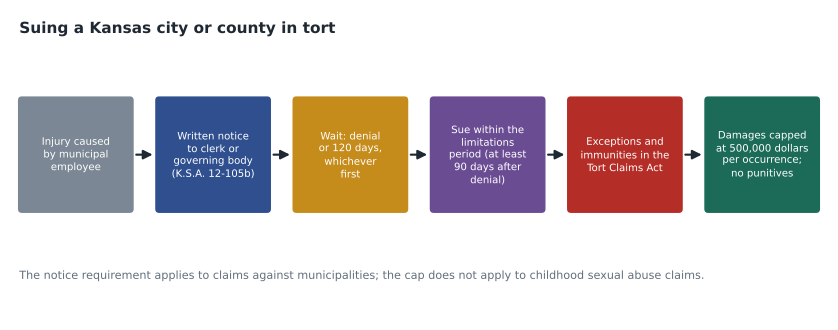
Even when no exception applies, the Act limits what a plaintiff can recover. Under K.S.A. 75-6105, liability for claims within the scope of the Act may not exceed 500,000 dollars for any number of claims arising out of a single occurrence or accident. If several claimants are injured in the same occurrence and their combined judgments exceed the cap, the court apportions the 500,000 dollars among them.
The Act also bars punitive or exemplary damages against a governmental entity and bars prejudgment interest. An employee may be liable for punitive damages in some circumstances involving actual fraud or actual malice, but the entity is not.
The cap has an important exception added by the Legislature: it does not apply to claims arising from childhood sexual abuse. And the cap does not apply to claims outside the Act, such as federal civil rights claims, which are governed by federal law.
In Ashley Clinic, LLC v. Coates, decided in 2024, the Kansas Supreme Court rejected a challenge to the Act's damages limit based on the jury trial right, so the general noneconomic cap struck down in Hilburn and the Tort Claims Act cap now stand on different footing. A new lawyer should treat the 500,000-dollar cap as enforceable and read Ashley Clinic before advising a client otherwise.
The ordinary tort rules from Lesson 8 still apply inside the Act. A claim against a county is subject to modified comparative fault under K.S.A. 60-258a, so a plaintiff found 50 percent at fault recovers nothing, and liability remains several, so a county pays only its own share even when a private co-defendant cannot pay. The cap then applies to whatever the governmental entity owes after fault is compared. In the culvert case, if a jury found the township 60 percent at fault, the truck driver 30 percent and the truck's owner 10 percent, the township's share of the driver's damages would be measured first and then held to the cap.
The notice requirement for municipalities
A claim against a municipality has a procedural step that a claim against a private defendant does not: written notice before suit. K.S.A. 12-105b(d) requires any person with a claim against a municipality that could give rise to an action under the Tort Claims Act to file a written notice with the clerk or governing body of the municipality before beginning the action.
The statute lists what the notice must contain: the name and address of the claimant and of the claimant's attorney, if any; a concise statement of the factual basis of the claim, including the date, time, place and circumstances; the name and address of any public officer or employee involved, if known; a concise statement of the nature and extent of the injury claimed; and a statement of the amount of monetary damages requested. Kansas courts accept substantial compliance with the content requirements, but the notice itself must be filed.
Once the notice is filed, the municipality has time to investigate and respond. The claimant may not begin the action until the claim has been denied in whole or in part, or until 120 days have passed after the notice was filed, whichever comes first. A claim is deemed denied if the municipality does not act within the 120 days. The statute protects the claimant against losing the claim while the municipality considers it: it provides for the limitations period during the consideration time and gives the claimant at least ninety days after the denial to file suit. A lawyer should still read the current text carefully when a claim is filed close to the end of the limitations period.
The notice requirement is a condition precedent to suit against a municipality. Filing suit without first giving notice can lead to dismissal. A new lawyer should file the notice early, calendar the 120-day mark and the denial-based deadline and keep proof of filing with the clerk.
Worked problem
The washed-out culvert
The accident happened on June 28, 2026, on a township road in Ellis County. The client retained the firm on August 10, 2026. On August 17 the firm filed a written notice with the township clerk containing all the elements of K.S.A. 12-105b(d), requesting 180,000 dollars. The township has not responded. When can the firm file suit, and what limits apply?
Show solution
- The township is a municipality, so notice under K.S.A. 12-105b(d) is a condition of suit.
- Absent an earlier denial, the firm may sue once 120 days have passed from filing the notice, which is December 15, 2026; silence through that date is a deemed denial.
- The two-year limitations period of K.S.A. 60-513 runs to June 28, 2028, so there is ample time, and the notice statute guarantees at least ninety days after denial in any event.
- The firm must show that no exception in K.S.A. 75-6104 applies, including the minimum maintenance road exception and the discretionary function exception.
- Recovery for all claims arising from the occurrence is capped at 500,000 dollars, and no punitive damages are available against the township.
Answer: The firm may file suit on or after December 15, 2026 unless the township denies the claim sooner; it should develop evidence on the township's maintenance practices and road designation, and value the claim within the 500,000-dollar cap.
Employees
The Act also governs claims against individual government employees. An employee acting within the scope of employment is protected by the same exceptions that protect the entity. The Act generally requires the governmental entity to provide a defense to an employee sued for conduct within the scope of employment and to indemnify the employee for judgments, with exceptions where the employee acted with actual fraud or actual malice. That framework means most plaintiffs sue the entity and, where useful, the employee, knowing that the entity will ultimately pay.
Claims against the state
Claims against the State of Kansas and its agencies are also governed by the Act, with the same rule of liability, the same exceptions and the same cap. The notice statute discussed above, K.S.A. 12-105b, applies to municipalities. A lawyer bringing a claim against the state should check the procedural requirements that apply to that particular agency and claim, and should not assume that the municipal notice procedure governs.
Federal claims
Not every claim against a Kansas governmental entity is a state tort claim. A claim that a police officer used excessive force, for example, may also be brought under 42 U.S.C. section 1983 for violation of federal constitutional rights, in state or federal court. Federal claims are not subject to the Kansas Tort Claims Act's cap or notice statute, but they have their own defenses, such as qualified immunity for individual officers and the rule that municipalities are liable only for their own policies or customs. Many Kansas cases plead both state and federal claims.
Working a claim against a Kansas governmental entity
Marchetti gave Jolene a checklist for the first week of any claim against a governmental defendant in Kansas.
Identify the entity. Determine who owns, operates or employs the person or thing that caused the harm: the state, a county, a township, a city, a school district or another body. Rural roads are often township roads; highways may be state or county responsibility.
Check the exceptions. Work through K.S.A. 75-6104 and identify every exception the defense is likely to raise. Gather evidence, such as maintenance logs, road designations and prior complaints, that bears on each.
File the notice. If the defendant is a municipality, file a complete notice under K.S.A. 12-105b(d) with the clerk or governing body, keep proof of filing and calendar the 120-day mark.
Value the claim within the cap. Remember the 500,000-dollar per-occurrence cap, the bar on punitive damages and the possibility of other claimants sharing the cap.
Consider federal claims. Where constitutional rights are involved, consider whether a section 1983 claim adds value or complications.
Common mistakes
MistakeKansas governmental entities are immune unless they waive immunity.
InsteadUnder the Kansas Tort Claims Act, liability is the rule and immunity is the exception.
MistakeThe cap is 500,000 dollars per claimant.
InsteadThe cap is 500,000 dollars for all claims arising out of a single occurrence.
MistakeA plaintiff can sue a city immediately after an injury.
InsteadWritten notice under K.S.A. 12-105b(d) must be filed first, and suit waits for a denial or 120 days.
MistakeThe snow and ice exception protects every weather-related claim.
InsteadIt does not apply if the entity's own negligence affirmatively caused the condition.
MistakePunitive damages are available against a county for reckless conduct.
InsteadThe Act bars punitive damages against governmental entities.
Summary and key terms
- Under K.S.A. 75-6103, Kansas governmental entities are liable for employees' negligence as a private person would be.
- K.S.A. 75-6104 lists exceptions, including discretionary functions, snow and ice, recreational use and minimum maintenance roads, construed narrowly.
- K.S.A. 75-6105 caps liability at 500,000 dollars per occurrence and bars punitive damages and prejudgment interest; childhood sexual abuse claims are excepted.
- Ashley Clinic, LLC v. Coates (2024) upheld the Act's limits against a jury trial challenge.
- Claims against municipalities require written notice under K.S.A. 12-105b(d), and suit waits for a denial or 120 days.
- Kansas Tort Claims Act
- The 1979 statute, K.S.A. 75-6101 and following, governing tort claims against the state and municipalities.
- Discretionary function exception
- The exception for claims based on policy-level decisions, whether or not discretion is abused.
- Municipality
- Under the Act, a county, township, city, school district or other political or taxing subdivision.
- Claim notice
- The written notice required by K.S.A. 12-105b(d) before suing a municipality.
- Per-occurrence cap
- The 500,000-dollar limit on all claims arising from a single occurrence.
Lesson quiz · 5 questions
Score 60% or more to complete this lesson.
Create a free account to save your progress, take quizzes and earn a certificate.