
BAR-217 · Lesson 1 of 12 · 18 min
Becoming a lawyer in Kansas
▶ Video coming soon A video version of this lesson is on the way.
Jolene Pfannenstiel grew up on a wheat and cattle operation outside Hays, in Ellis County, where her family has farmed the same quarter sections for four generations. She finished law school in May 2026 and took a job as a law clerk at a three-lawyer firm in Hays that handles farm leases, estate plans, a steady stream of car-wreck cases and the occasional fight with a county over a damaged culvert. She joined Hollis Marchetti's online study group late in the fall, and at her first one-on-one session she admitted that she had been coasting on an assumption. 'Everyone told me Kansas is a UBE state, so I figured the national materials covered everything,' she said. 'Then a partner asked me whether I had filed my fingerprint card, and I realized I did not know what else I had missed.'
Marchetti smiled. 'The good news is that your classmates were right about the exam. Kansas gives the Uniform Bar Examination, it has no Kansas law essay, and it will not change to the NextGen exam until July 2028. The less good news is that the exam is only one of five requirements, and the other four have their own deadlines. And the day after you are sworn in, you will be practicing Kansas law, not the generic law the exam tests. So we will do two things in this course: get you admitted, and get you ready for the Kansas rules you will meet in your first year at the firm.'
This lesson maps the whole process: the institutions involved, the routes to practice, the requirements for the examination route and the usual order of events. Later lessons take each step in detail and then turn to the Kansas law a new lawyer in Hays, Wichita or Overland Park meets first, from comparative fault and the Kansas Tort Claims Act to the elective share and the homestead.
Who controls admission
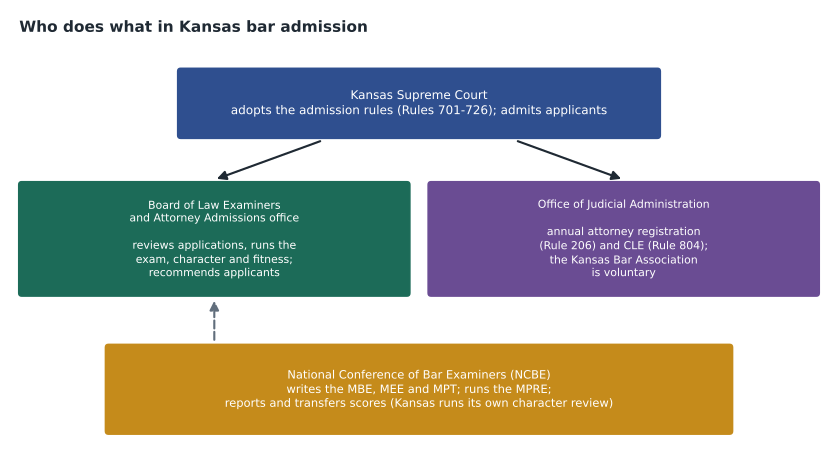
Admission to practice law in Kansas is controlled by the Kansas Supreme Court. The court's authority over the practice of law rests on the judicial power that the Kansas Constitution vests in the court system, and the court exercises it through its own rules. The admission rules form a block of the Kansas Supreme Court Rules running from Rule 701 to Rule 726. They define who may apply, what the examination is, which scores the court will accept, how character and fitness are reviewed, how lawyers from other states may be admitted without sitting the Kansas exam, and how admission finally happens.
The court does its admissions work through the Kansas Board of Law Examiners, a body of lawyers the court appoints, and through the Attorney Admissions office, the court's staff that processes applications. Both operate out of the Kansas Judicial Center at 301 SW 10th Avenue in Topeka, the same building that houses the Supreme Court and the Court of Appeals. The Board administers the examination, reviews each application, conducts or directs the character and fitness investigation and recommends applicants to the court. The court makes the final decision and admits the successful applicants, usually at a ceremony in Topeka after each set of results.
Two consequences follow from this arrangement. The first is that every rule that matters to you is a court rule, published with the other Kansas Supreme Court Rules and amended by court order. When you check a deadline or a fee, the authoritative source is the rule itself or the Attorney Admissions office's current instructions, not a study guide written two years ago. The second is that the court can, and does, change those rules. Rule 717, which governs transferred scores, was amended at the end of December 2025 to deal with NextGen scores. Rule 719, which governs admission without examination, was amended in January 2024 and again in March 2025. A rule that looks settled can move.
The Office of Judicial Administration and the Kansas Bar Association
Once you are admitted, a different office becomes important. The Kansas judicial branch's Office of Judicial Administration handles annual attorney registration under Rule 206, and the Kansas Continuing Legal Education Commission administers the continuing legal education requirement under Rule 804. Every Kansas lawyer must register each year, pay the registration fee and complete twelve hours of approved continuing legal education, two of them in ethics and professionalism, in each compliance year that ends June 30.
Kansas does not have a mandatory unified bar. The Kansas Bar Association is a voluntary organization. It runs sections, publishes the Journal of the Kansas Bar Association, offers practice resources and continuing education programs, and supports young lawyers, but membership is a choice. That is a real difference from states such as Hawaii or Texas, where every licensed lawyer must belong to the state bar. In Kansas the regulatory functions that a unified bar performs elsewhere, registration, continuing education and discipline, all sit with the Supreme Court and its offices. Discipline is handled through the Office of the Disciplinary Administrator and the Kansas Board for Discipline of Attorneys, with the Supreme Court deciding the serious cases.
The role of NCBE
The National Conference of Bar Examiners (NCBE), a national nonprofit, supplies most of the testing. NCBE writes the Multistate Bar Examination (MBE), the Multistate Essay Examination (MEE) and the Multistate Performance Test (MPT), which together make up the Uniform Bar Examination that Kansas gives. NCBE scales the scores, combines them into a UBE score and transfers that score to other UBE jurisdictions when an examinee asks. NCBE also runs the Multistate Professional Responsibility Examination (MPRE), the separate ethics test Kansas requires.
One job NCBE does for many states but not for Kansas is the character and fitness investigation. Some jurisdictions send every applicant through NCBE's character investigation service. Kansas conducts its own review through the Board and the Attorney Admissions office. That shapes the application: Kansas collects your fingerprints, your waivers and your disclosures directly, and it will not accept your application as complete until the fingerprint packet arrives.
Why Kansas looks simple, and where it is not
Three features make Kansas one of the more straightforward jurisdictions for a new graduate. First, Kansas is a UBE jurisdiction and has been since it first gave the UBE in February 2016. It adds no Kansas component of its own: no Kansas law essays, no state ethics test, no required Kansas law course before or after admission. NCBE's jurisdiction chart for Kansas lists no jurisdiction-specific component at all. A Kansas score is a portable UBE score that other UBE jurisdictions can accept, subject to their own rules.
Second, Kansas is open to lawyers and examinees from elsewhere. It accepts transferred UBE scores and, since July 2026, transferred NextGen scores. It offers admission without examination to experienced lawyers who have actively practiced for five of the last seven years, and that route is not limited to lawyers from states that return the favor. NCBE's chart notes that Kansas accepts MBE scores from other jurisdictions under its rules and sets no limit on the number of times an applicant may sit the examination.
Third, the passing score is middle of the range. Kansas passes UBE examinees at 266 on the 400-point scale, the most common passing score in the country alongside 270 in a smaller group of states. Its MPRE requirement is 80, which is also typical.
The places where Kansas is not simple are the ones Jolene almost missed. Kansas requires a J.D. from an ABA-approved law school with no alternative route for graduates of foreign or non-approved schools. Its application windows open and close months before the examination, and its fingerprint requirement means an application can sit incomplete while the deadline passes. The MPRE score and law school transcript have their own due dates. And once admitted, a Kansas lawyer practices under Kansas statutes and Kansas Supreme Court decisions that differ in important ways from the national law the examination tests.
The routes to practice
Kansas offers three main routes to a full license, each with its own rule.
| Route | Rule | Who uses it | Key limits |
|---|---|---|---|
| Admission by examination | Rule 716 and related rules | Graduates of ABA-approved law schools | Pass the Kansas UBE with 266 and the MPRE with 80 |
| Admission by transferred score | Rule 717 | Examinees with a passing UBE or NextGen score from another jurisdiction | Score within 60 months; UBE 266 or NextGen at the testing jurisdiction's passing score; MPRE 80 |
| Admission without examination | Rule 719 | Lawyers admitted by exam elsewhere with an active license | Active practice for five of the last seven years |
| Pro hac vice | Rule 116 | Out-of-state lawyers in a particular case | Requires Kansas local counsel; case by case |
For a new graduate like Jolene, only the first route is realistic. The transfer route serves examinees who sat the exam elsewhere, such as a Missouri graduate who passed in Missouri and wants a Kansas license for cross-border work. The admission without examination route serves lawyers with several years of practice. Pro hac vice admission is a case-by-case permission for an out-of-state lawyer to appear with Kansas counsel and does not create a license.
The five requirements on the examination route
For an applicant seeking admission by examination, the requirements come down to five.
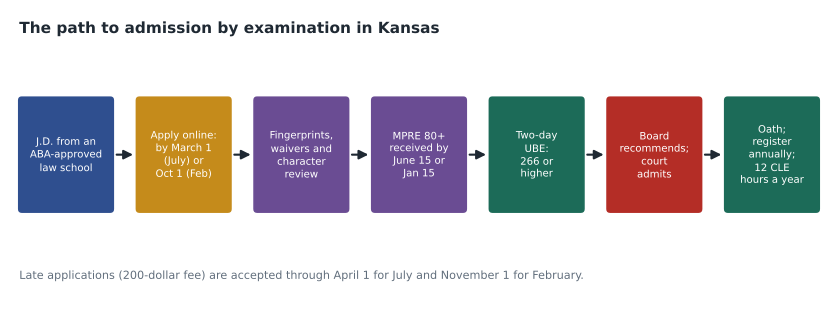
First, eligibility and education. You must hold a J.D. from a law school approved by the American Bar Association. Kansas makes no exception for graduates of foreign law schools or of schools not approved by the ABA, whatever their experience. Kansas has two ABA-approved schools, the University of Kansas School of Law in Lawrence and Washburn University School of Law in Topeka, but a J.D. from any ABA-approved school in the country qualifies.
Second, a complete and timely application. The application is filed online with the Attorney Admissions office. For the July examination the window runs from November 2 to March 1, with late filing through April 1; for the February examination it runs from March 2 to October 1, with late filing through November 1. Late filing costs an additional 200 dollars. The examination fee is 700 dollars.
Third, character and fitness. The Board must be satisfied that you have the honesty, trustworthiness and judgment a lawyer needs. You disclose your history in the application, sign waivers that let the Board collect records and submit a fingerprint card for a criminal history check. Lesson 3 covers this step in detail.
Fourth, the MPRE. You must achieve a scaled score of at least 80, and the score must reach the Attorney Admissions office by June 15 for the July examination or January 15 for the February examination.
Fifth, the examination. You must pass the Kansas UBE with a combined scaled score of at least 266. The examination is given on the last consecutive Tuesday and Wednesday of February and July, which in 2027 means February 23 and 24 and July 27 and 28.
Look at what is not on the list. There is no Kansas law course, no Kansas essay, no residency requirement and no requirement of a clerkship or apprenticeship before admission. Once the five requirements are met, the Board recommends you, the court admits you, and you take the oath.
Two numbers to remember: 266 and 80
The passing score of 266 applies to the combined UBE score, not to any one part. A strong MBE can carry weaker essays and the reverse; Kansas does not set a minimum on any component. Because Kansas uses the standard UBE, a score earned in Kansas is reported on the same 400-point scale as a score earned in New York or Missouri, and a Kansas examinee who scores 266 to 269 passes in Kansas but would fall short of the 270 that some other UBE jurisdictions require. Examinees who plan to transfer their score should look at the destination's passing score before deciding where to sit.
The MPRE requirement of 80 sits at the low end of the national range, which runs from 75 to 86. A score that satisfies a stricter neighbor will satisfy Kansas. Whatever date you sit the MPRE, the score must be reported to the Attorney Admissions office by the published due date, so check the office's current instructions on how the score must be sent and how recent it may be. The transfer rule requires a qualifying MPRE score as well.
The order of events
Most Kansas applicants move through the process in a predictable order. They take the MPRE in the second or third year of law school, often in March or August, so the score is in hand long before the reporting deadline. They file the application early in the window and immediately schedule the fingerprinting, because the application is not accepted until the fingerprint packet arrives. Law school transcripts showing the degree follow after graduation, again by June 15 or January 15. The Board's character and fitness review runs in parallel with study. Applicants who need testing accommodations file that request by April 1 for July or November 1 for February.
In the weeks before the examination, the Board sends seating information and the rules for the testing day, including the laptop policy for the written day. After the examination, the Board grades the written answers, NCBE scales the scores, and results are released. Applicants who passed and have cleared character and fitness are recommended for admission and sworn in, and the court issues the wall certificate at the swearing-in.
Worked problem
Planning Jolene's path
Jolene graduated in May 2026 from an ABA-approved law school and scored 92 on the MPRE in August 2025. She filed her application for the February 2027 examination on September 21, 2026, had her fingerprints taken the following week and mailed the card with her signed waivers. What must she still do before she can be admitted, and what must she do afterward?
Show solution
- Eligibility: her J.D. is from an ABA-approved school, so she meets the education requirement.
- Application: she filed before the October 1 regular deadline, so she owes no late fee; her application became complete when the fingerprint packet arrived.
- MPRE: 92 exceeds 80. She must make sure NCBE reports the score to the Attorney Admissions office by January 15, 2027.
- Transcript: her final transcript showing the J.D. must also arrive by January 15, 2027.
- Character and fitness: she must answer any Board questions promptly and update her application if anything changes before admission.
- Exam: she must score 266 or more on the February 23 and 24, 2027 examination.
- After admission: she must register annually and complete continuing legal education, although new admittees are exempt until the first full compliance period after admission.
Answer: Jolene still needs her MPRE score and transcript on file by January 15, 2027, character and fitness approval and a passing score of 266; registration and continuing legal education follow admission.
Common mistakes
MistakeKansas has a Kansas law essay or component.
InsteadKansas gives the standard UBE with no jurisdiction-specific component.
MistakeThe Kansas Bar Association licenses lawyers.
InsteadThe Kansas Supreme Court admits lawyers; the Kansas Bar Association is a voluntary organization.
MistakeNCBE investigates Kansas applicants' character and fitness.
InsteadKansas runs its own character and fitness review through the Board and the Attorney Admissions office.
MistakeA graduate of a foreign law school can qualify with enough experience.
InsteadKansas requires a J.D. from an ABA-approved law school; foreign law graduates are not eligible to sit.
MistakePassing the examination lets you start practicing.
InsteadYou must meet every requirement and be admitted by the court before you may practice.
Summary and key terms
- The Kansas Supreme Court controls admission through Rules 701 to 726 and acts on the Board of Law Examiners' recommendations.
- The Attorney Admissions office in the Kansas Judicial Center in Topeka processes applications; the Board runs the exam and character review.
- Kansas is a UBE jurisdiction with no Kansas component; it passes examinees at 266 and requires an MPRE score of 80.
- Kansas accepts transferred UBE and NextGen scores under Rule 717 and admits experienced lawyers without examination under Rule 719.
- The Kansas Bar Association is voluntary; registration, continuing legal education and discipline sit with the court and its offices.
- Kansas Board of Law Examiners
- The court-appointed body that administers the Kansas bar examination, reviews applications and recommends applicants for admission.
- Attorney Admissions office
- The Kansas Supreme Court staff office that processes applications for admission.
- Uniform Bar Examination (UBE)
- The NCBE examination made up of the MBE, MEE and MPT, scored on a 400-point scale and portable among UBE jurisdictions.
- Rule 206
- The Kansas Supreme Court rule requiring annual attorney registration.
- Voluntary bar
- A bar association that lawyers may choose to join; in Kansas, licensing and discipline are separate from bar membership.
Lesson quiz · 5 questions
Score 60% or more to complete this lesson.
Create a free account to save your progress, take quizzes and earn a certificate.