
BAR-217 · Lesson 3 of 12 · 17 min
Character and fitness and the MPRE
▶ Video coming soon A video version of this lesson is on the way.
Jolene arrived at her third session with a list. During college at Fort Hays State she had received a minor-in-possession citation at a party, completed a diversion agreement and had the record expunged. In law school she had fallen behind on a credit card after a hospital stay and had paid it off a year later. And she had once been fined by a county for burning pasture without a permit, a common enough event in western Kansas but one that left a record. 'The application asks whether I have ever been cited or charged with anything,' she said. 'Does an expunged diversion count? Does the burn permit count? I do not want to look like I am hiding something, but I also do not want to confess to things that do not matter.'
Marchetti had heard versions of this question for fifteen years. 'Read the question exactly as written, and answer exactly what it asks,' she said. 'If it says ever, it means ever. If it says expunged or sealed records must be disclosed, disclose them. When in doubt, disclose and explain. I have never seen anyone denied admission for an old diversion they reported. I have seen people get into real trouble for leaving one out.'
This lesson covers the Kansas character and fitness review, the standard the Board applies, how the process runs, common issues and how to present them, and the Multistate Professional Responsibility Examination (MPRE), which Kansas requires with a scaled score of at least 80.
Why character and fitness matters
Every jurisdiction requires applicants to show that they have the character and fitness to practice law. The idea is protective, not punitive. A license tells clients, courts and opposing parties that the lawyer can be trusted with confidential information, client money and the duty of candor to the court. The admission process asks whether the applicant's past conduct gives reason to doubt that.
In Kansas, the burden is on the applicant. The admission rules require an applicant to establish good moral character and the mental and emotional fitness to practice, and the Board of Law Examiners will not recommend an applicant until it is satisfied. That framing matters. The Board does not have to prove that an applicant is unfit; the applicant has to show that he or she is fit, through full disclosure, honest explanation and, where needed, evidence of rehabilitation.
How the Kansas process runs
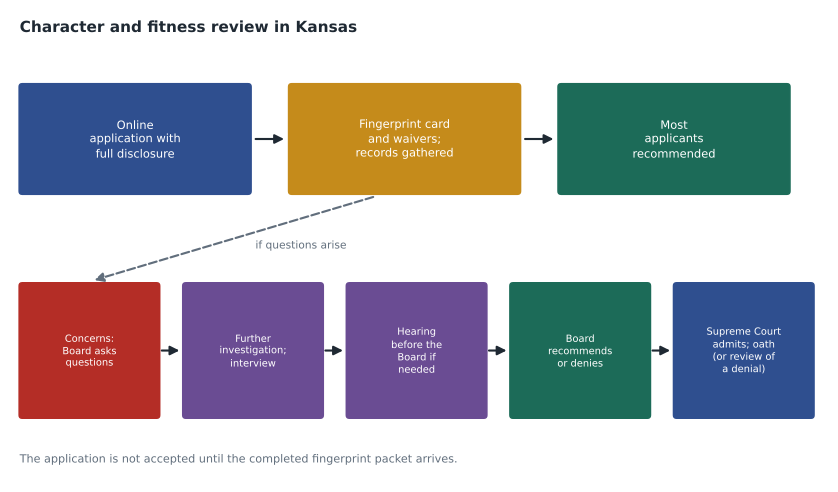
Kansas conducts its own character and fitness review. It does not send applications to NCBE's investigation service, as many states do. The review begins with the application itself, which asks detailed questions about the applicant's education, employment, residences, finances, legal proceedings, criminal history, licenses and prior bar applications. The applicant signs authorizations and waivers allowing the Board to obtain records from schools, employers, courts, law enforcement and others, and submits a fingerprint card so a criminal history check can be run. The application is not accepted until the fingerprint packet arrives.
The Attorney Admissions office and the Board then review the file. For most applicants, the review confirms what the application says and raises no concerns, and the applicant is cleared to be recommended for admission once he or she passes the examination. When the review raises questions, the Board may ask the applicant for more information, request documents, contact references or interview the applicant. If concerns remain, the matter can be set for a hearing before the Board, where the applicant may appear, present evidence and be represented by counsel.
If the Board decides that an applicant has not established the required character and fitness, the admission rules provide a procedure for the applicant to seek review by the Kansas Supreme Court. The court has the final word on admission, as it does on every other part of the process.
The duty of candor
The most important rule of character and fitness is candor. The Kansas Rules of Professional Conduct, which apply to bar applicants as well as lawyers in this respect, make it misconduct to knowingly make a false statement of material fact in connection with a bar admission application or to fail to disclose a fact necessary to correct a misapprehension known to have arisen in the matter. Rule 8.1 of the Kansas Rules is the source.
A failure of candor is often more serious than the underlying conduct. A minor-in-possession citation at age nineteen, disclosed and explained, is unlikely to delay admission. The same citation omitted from the application and discovered by the Board raises a new and more troubling question: whether the applicant will be honest when honesty is inconvenient. Boards across the country, and courts reviewing them, treat a lack of candor in the application as strong evidence of unfitness in its own right.
The duty is also continuing. An applicant must update the application if anything relevant changes before admission: a new address or job, a new arrest, a new lawsuit, a new debt in collection, a disciplinary matter at work. The update must be prompt.
Common issues and how to present them
Most character and fitness issues fall into a handful of categories.
| Issue | What the Board looks for | How to present it |
|---|---|---|
| Criminal history, including diversions and expunged records | The nature of the conduct, how long ago it was, whether it was repeated | Disclose as the question requires; attach court records; explain briefly and take responsibility |
| Traffic and regulatory citations | A pattern of disregard for rules, unpaid fines, license suspensions | Disclose what the question asks for; show fines paid |
| Financial problems | Whether debts were incurred irresponsibly and whether the applicant is dealing with them | Show a plan and payments; explain circumstances such as illness |
| Academic misconduct | Honesty and how the applicant responded | Attach the school's records; explain what changed |
| Employment problems | Dishonesty or misconduct, as opposed to a bad fit | Explain the circumstances; give references |
| Prior bar or license matters | Discipline, denials or misrepresentations elsewhere | Disclose fully and attach the records |
Several principles cut across the categories. First, answer the question asked. Read each question carefully, including definitions and instructions about expunged, sealed or juvenile matters, and answer that question. Do not narrow the question to fit what you would prefer to disclose.
Second, attach records rather than relying on memory. If you report a citation, include the court record showing how it was resolved. If you report a debt, include proof of payment or a payment plan. Records make the Board's job easier and make your account more credible.
Third, explain briefly and take responsibility. A short, factual explanation that acknowledges what happened and what you learned is better than a long account that blames others. The Board is not looking for perfection; it is looking for honesty, judgment and evidence that past problems are past.
Fourth, show rehabilitation where it matters. For serious issues, rehabilitation is the central question. Evidence can include the passage of time without further problems, treatment or counseling, restitution, community service, letters from people who know the applicant well and a consistent record of responsible conduct.
Mental health and substance use
Many applicants worry about questions involving mental health or substance use. The trend across jurisdictions has been to focus bar applications on conduct rather than diagnosis or treatment, so that applicants are not discouraged from seeking help. Applicants should read the current Kansas application carefully to see exactly what it asks. Where a question asks about conduct, such as a period when the applicant was unable to meet obligations, the applicant should answer it honestly, and evidence of treatment and stability is generally a point in the applicant's favor rather than against it. The Kansas Lawyers Assistance Program offers confidential help to lawyers, judges and law students, including applicants.
Jolene's three issues
Marchetti walked Jolene through each issue against the questions on the form. The diversion had to be disclosed if the question asked about any citation or charge, including those that were dismissed, diverted or expunged, and the question on the form she was completing was written that broadly. Jolene would disclose it, attach the diversion agreement and the expungement order, and explain in two sentences that she was nineteen, completed diversion without incident and had no further problems.
The credit card delinquency had to be disclosed if a question asked about accounts more than a certain number of days past due or sent to collection within the covered period. Jolene would disclose it, explain the hospital stay and attach proof that the account was paid in full. The burn permit fine was a regulatory citation; she would report it under the question that asked about citations and fines, with the county's record showing it was paid.
'None of these is serious,' Marchetti said. 'Disclosed, they will probably add nothing to your review. Hidden, any one of them would.'
The MPRE
Kansas requires every applicant for admission by examination to pass the MPRE with a scaled score of at least 80. The same requirement applies to applicants who transfer a score under Rule 717 and, under the current rules, to other admission routes as the rules specify.
The MPRE is written and administered by NCBE. It is a two-hour, sixty-question multiple-choice examination, of which fifty questions are scored and ten are unscored pretest questions. It is given on computer at testing centers, usually three times a year, in March, August and November. Scores are reported on a scale of 50 to 150. Each jurisdiction sets its own passing score; the national range runs from 75 to 86, and Kansas's 80 sits in the lower half of that range.
The MPRE tests the law governing lawyers. Its content is based mainly on the ABA Model Rules of Professional Conduct and the ABA Model Code of Judicial Conduct, together with generally accepted principles from court decisions and the law of agency and procedure as they apply to lawyers. It does not test the Kansas Rules of Professional Conduct as such. Where the Kansas Rules differ from the Model Rules, the MPRE answer follows the Model Rules. Lesson 11 notes some Kansas variations a new lawyer must know in practice.
The main topics include regulation of the legal profession, the client-lawyer relationship, client confidentiality, conflicts of interest, competence and malpractice, litigation and other forms of advocacy, transactions and communications with persons other than clients, the different roles of the lawyer, safekeeping funds and property, communications about legal services, lawyers' duties to the public and the legal system, and judicial conduct. Conflicts of interest and the client-lawyer relationship carry the most weight.
When to take the MPRE
Most applicants take the MPRE during law school, after taking a professional responsibility course. The March or August administration in the second or third year works well for a July examination, and the score is then on hand well before the June 15 due date. An applicant who waits until the November before a February examination is cutting it close: the score must reach the Attorney Admissions office by January 15, so there is no room for a retake.
An MPRE score is reported to Kansas by NCBE when the examinee asks. Applicants should request the report as soon as their score is released and confirm that Kansas has received it.
Preparing for the MPRE
The MPRE rewards a particular kind of preparation. Because it tests the Model Rules rather than any one state's rules, the best study materials are the Model Rules themselves, their comments and practice questions written to the MPRE's style. Most applicants need two to four weeks of focused study, often alongside a semester of classes or a job.
Marchetti recommends three habits. First, learn the vocabulary of permission. The MPRE distinguishes carefully among what a lawyer must do, what a lawyer may do and what a lawyer must not do, and many wrong answers turn on confusing a permissive rule with a mandatory one. A lawyer may reveal information to prevent reasonably certain death or substantial bodily harm, for example, but is not required to under the Model Rules.
Second, master the conflict rules, because they carry the most weight. Know when a conflict exists, when it can be cured by informed consent confirmed in writing, when it cannot be cured at all and how conflicts are imputed to other lawyers in a firm.
Third, read each question for the role the lawyer is playing. The same conduct may be proper for a prosecutor and improper for defense counsel, or proper in negotiation and improper before a tribunal. Questions often hide the answer in a single phrase identifying whether the lawyer is an advocate, an adviser, a supervisor or a third-party neutral.
Jolene had already passed the MPRE with a 92, so for her the MPRE was finished. But the same rules would return in practice, and Lesson 11 takes up the places where the Kansas Rules part company with the Model Rules she studied.
Worked problem
Planning the MPRE for a July sitting
Priya, a hypothetical second-year student at an ABA-approved law school, plans to graduate in May 2028 and sit the Kansas examination in July 2028, Kansas's first NextGen administration. When should she take the MPRE, and what score does she need?
Show solution
- Kansas requires a scaled MPRE score of 80.
- For a July examination, the MPRE score and transcript are due June 15.
- Taking the MPRE in March or August 2027, after her professional responsibility course, leaves time for a retake in November 2027 or March 2028 if needed.
- She should request that NCBE report her score to Kansas once it is released.
Answer: Priya should take the MPRE in March or August 2027, aiming for 80 or higher, and have the score reported to Kansas well before June 15, 2028.
Common mistakes
MistakeAn expunged record never needs to be disclosed.
InsteadRead the question; Kansas asks broadly, and applicants generally must disclose expunged or diverted matters if the question covers them.
MistakeThe Board has to prove an applicant is unfit.
InsteadThe applicant bears the burden of establishing good moral character and fitness.
MistakeOnce the application is filed, nothing more needs to be reported.
InsteadThe duty to update the application continues until admission.
MistakeThe MPRE tests the Kansas Rules of Professional Conduct.
InsteadThe MPRE tests the ABA Model Rules and general principles of the law governing lawyers.
MistakeKansas requires an MPRE score of 85.
InsteadKansas requires 80.
Summary and key terms
- Kansas runs its own character and fitness review, and the applicant bears the burden of showing good moral character and fitness.
- The application asks about criminal history, finances, employment, schools and licenses, and is supported by waivers and a fingerprint check.
- Candor is the central requirement: a false statement or omission can be worse than the underlying conduct, and the duty to update continues until admission.
- Concerns may lead to questions, an interview and a hearing before the Board, with review by the Kansas Supreme Court.
- Kansas requires an MPRE scaled score of 80; the MPRE tests the ABA Model Rules, not the Kansas Rules.
- Character and fitness
- The requirement that an applicant show the honesty, trustworthiness and judgment needed to practice law.
- Candor
- Full and truthful disclosure in the bar application, required by Rule 8.1 of the Kansas Rules of Professional Conduct.
- Rehabilitation
- Evidence that an applicant has overcome past misconduct, such as time, treatment, restitution and a record of responsible conduct.
- MPRE
- The Multistate Professional Responsibility Examination, NCBE's sixty-question test of the law governing lawyers.
- Kansas Lawyers Assistance Program
- A confidential program offering help to lawyers, judges and law students in Kansas.
Lesson quiz · 5 questions
Score 60% or more to complete this lesson.
Create a free account to save your progress, take quizzes and earn a certificate.