
BAR-217 · Lesson 5 of 12 · 16 min
Exam changes ahead: NextGen in July 2028
▶ Video coming soon A video version of this lesson is on the way.
Marcus Bell joined Jolene's fifth session as a guest. He had taken the first NextGen bar examination in Missouri in July 2026 and passed with a score of 648, well above Missouri's passing score of 610, and he now practices at a small firm in Kansas City, Missouri. Half his firm's clients live or do business across State Line Road in Johnson County, Kansas, and he wanted a Kansas license. 'I wrote to the Kansas board in October asking whether they would take my NextGen score, even though Kansas will not give NextGen until 2028,' he said. 'I have not heard back. Hollis says the answer is already in the rules.'
'It is,' Marchetti said. 'Kansas amended its transfer rule at the end of last year to deal with exactly your situation. We will get to that. First, Jolene needs to know what the change means for her, which is mostly nothing, and what it will mean for the students who come after her.'
This lesson explains the NextGen bar examination, Kansas's decision to adopt it in July 2028, the last legacy UBE in February 2028, how Kansas treats NextGen scores from other jurisdictions in the meantime and what an examinee in the transition years should do.
What NextGen is
The NextGen bar examination is NCBE's replacement for the UBE's three components. NCBE developed it over several years after a national study of what newly licensed lawyers actually do, and it first became available to jurisdictions in July 2026. Missouri was among the jurisdictions that gave it at that first administration.
NextGen differs from the legacy UBE in three main ways. First, it integrates knowledge and skills. Instead of separate multiple-choice, essay and performance components, the examination mixes question types throughout, including standalone multiple-choice questions, integrated question sets built around a single client matter and performance tasks that require research in a provided library and written work product.
Second, it tests a narrower body of doctrine in more depth, together with a defined set of lawyering skills. NCBE's published content scope lists foundational concepts and principles in a group of core subjects, including civil procedure, contract law, evidence, torts, business associations, constitutional law, criminal law and real property, with family law joining the tested concepts from July 2028, the month of Kansas's first NextGen administration, and it lists skills such as legal research, legal writing, issue spotting and analysis, investigation and evaluation, client counseling and advising, negotiation and dispute resolution and client relationship management. Some subjects tested on the legacy MEE, such as secured transactions, conflict of laws and trusts and estates, are not part of NextGen's scope.
Third, it is shorter and computer-based. NextGen takes nine hours over a day and a half, in three three-hour sections, and examinees answer on laptops rather than in paper booklets.
NextGen scores are reported as a single scaled score on a new scale running from 500 to 750, not on the UBE's 400-point scale. A NextGen score of 648 and a UBE score of 266 cannot be compared directly, and each jurisdiction sets a NextGen passing score separately.
Why NCBE changed the examination
NCBE began the work that led to NextGen with a practice analysis: a national survey of newly licensed lawyers and their supervisors about which tasks new lawyers perform and which knowledge and skills those tasks require. A testing task force then recommended an examination that would test fewer subjects, test them in more depth and test lawyering skills directly instead of mainly through recall of rules.
The criticism of the legacy examination was familiar to anyone who has studied for it. The MBE and MEE reward memorization of a very large body of rules, many of which a new lawyer will never use, while the skills a new lawyer uses every week, such as researching an unfamiliar question, counseling a client or drafting a document, are tested only on the MPT. NextGen tries to move the balance toward what new lawyers do, while still testing the core doctrine every lawyer needs.
Whether NextGen achieves that balance will be judged over several years. For Kansas examinees, the practical point is that the examination they sit depends on when they sit it, and that preparation for each is different.
Kansas's decision
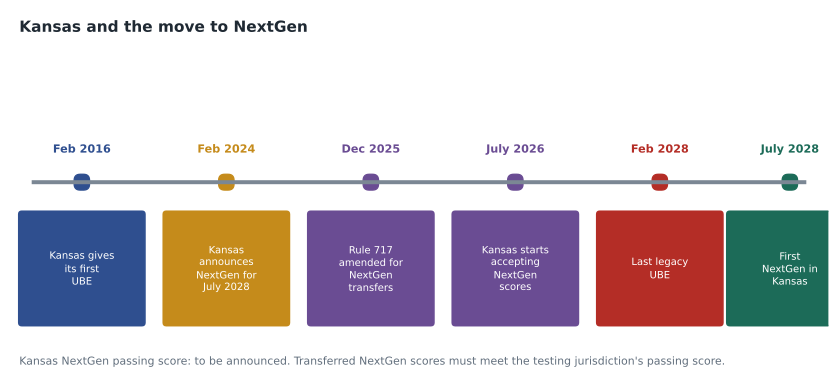
The Kansas Supreme Court announced in February 2024 that Kansas would adopt NextGen, with the first Kansas administration in July 2028. NCBE published the announcement on February 22, 2024. The court's announcement quoted Justice Melissa Taylor Standridge on the decision. The practical effect of waiting two years after NextGen's national debut is plain: Kansas law schools gain time to adjust their teaching, students who entered law school expecting the legacy UBE can still sit it, and Kansas can watch the first NextGen administrations in other jurisdictions before giving its own.
That two-year delay sets Kansas's calendar. Kansas will continue to give the legacy UBE through the February 2028 examination, which will be its last. The July 2028 examination will be Kansas's first NextGen administration. NCBE's jurisdiction chart for Kansas lists the Kansas NextGen passing score as to be announced.
Who takes which exam
The calendar sorts examinees into groups.
| Examinee | Kansas examination | Notes |
|---|---|---|
| Graduating May 2026 to December 2027 | Legacy UBE | Jolene sits in February 2027 |
| Graduating in December 2027 or early 2028 | Legacy UBE in February 2028, or NextGen in July 2028 | February 2028 is the last legacy administration |
| Graduating in May 2028 or later | NextGen | First Kansas NextGen is July 2028 |
| Failing the February 2028 legacy UBE | NextGen in July 2028 | No legacy retake is available in Kansas after February 2028 |
The last row deserves attention. An examinee who sits the February 2028 legacy examination and fails cannot retake the legacy UBE in Kansas. The next Kansas examination is NextGen, which tests a different body of content in a different format. An examinee in that position might sit a legacy UBE elsewhere, if another jurisdiction is still giving it and the examinee is eligible there, and transfer the score; or prepare for NextGen. For examinees at risk, the safest course is to sit the legacy examination early enough to leave a legacy retake available, for example in July 2027.
For Jolene, the change means little. She sits the legacy UBE in February 2027. If she passes, her score remains a UBE score that Kansas and other UBE jurisdictions can accept for as long as their rules allow. If she does not pass, she can retake the legacy UBE in July 2027 or February 2028.
How Kansas treats NextGen scores before 2028
Kansas will not give NextGen until July 2028, but it will accept NextGen scores earned elsewhere before then. Rule 717, the Kansas transfer rule, was adopted in July 2022 and amended on December 29, 2025 to cover NextGen scores. NCBE's chart records that Kansas accepts transferred NextGen scores beginning with the July 2026 administration.
The amended rule sets a simple standard. An applicant may transfer a NextGen score if it meets the passing score of the jurisdiction where the examinee took it. For a UBE score, the standard is Kansas's own passing score of 266. For NextGen, Kansas has not yet set a passing score of its own, so it borrows the testing jurisdiction's. A score must also have been earned within the time the rule allows: the rule refers to scores earned within sixty months, and NCBE's chart records that Kansas accepts NextGen scores up to five years old.
That is the answer to Marcus's letter. His 648 meets Missouri's passing score of 610. He took the examination in July 2026, so his score is well within the sixty-month window. Kansas accepts NextGen scores from July 2026 onward. Under Rule 717, Marcus can apply for admission in Kansas by transferred score, provided he meets the rule's other requirements, including a passing MPRE score of 80, character and fitness approval and the transfer fee of 1,250 dollars.
Marchetti told him to file rather than wait for a reply to his letter. 'The rule is the answer,' she said. 'The application is the question they will actually respond to.'
What changes in 2028
When Kansas begins giving NextGen in July 2028, several things will change for Kansas examinees, and others will stay the same.
What changes: the content tested, the format and question types, the length, the computer delivery and the score scale. The Board will announce a Kansas NextGen passing score before the first administration. Study materials and review courses for Kansas examinees will shift to NextGen.
What stays the same: the Kansas Supreme Court's control of admission, the education requirement, the application windows and fingerprint requirement, character and fitness, the MPRE requirement of 80 and admission by transferred score and without examination. The NextGen examination will still be NCBE's, and Kansas still adds no Kansas component.
Portability during the transition
The transition creates a period in which two kinds of score circulate at once. Some jurisdictions give NextGen, some still give the legacy UBE, and many accept both kinds of transferred score under different rules. Kansas's own position is now clear: it accepts transferred legacy UBE scores of 266 or higher and transferred NextGen scores that meet the testing jurisdiction's passing score, in each case within the rule's time limit.
Other jurisdictions are not all alike. Some accept NextGen scores only once they give NextGen themselves; some accept legacy UBE scores only for a limited period after their own switch; some set a fixed NextGen passing score for transferred scores. An examinee who expects to seek admission in more than one state should check each state's current rule rather than assume that a score earned anywhere will transfer everywhere.
Jolene's February 2027 legacy UBE score, if she passes, will be portable to jurisdictions that accept legacy scores under their rules. Because she plans to practice in western Kansas, portability matters less to her than to Marcus, whose practice straddles a state line. But Marchetti urged her to keep a copy of her score report and to know the date it was earned, because transfer rules count months from the examination date.
Questions to watch before 2028
Several details of Kansas's NextGen administration remain to be announced as of late 2026, and examinees planning for 2028 should watch for them. The most important is the Kansas NextGen passing score, which the Board will set before the July 2028 examination. Others include the testing sites and delivery arrangements, the accommodation procedures for a computer-based examination and any changes to the application calendar. The Attorney Admissions office and the Board will publish these on their pages, and NCBE's jurisdiction chart for Kansas will be updated as well.
Preparing for NextGen as a student
Students who will sit in July 2028 or later should prepare for NextGen from the start. Three steps help.
First, use NCBE's published materials. NCBE publishes the content scope, sample questions and information about the question types, and those are the authoritative description of what will be tested. Marcus found that the sample performance tasks were the most useful single resource.
Second, practice skills as well as rules. NextGen tests legal research in a provided library, drafting and client counseling directly. Law school clinics, legal writing courses and externships build those skills; so does practice with timed performance tasks.
Third, do not rely on legacy materials. A legacy MEE outline in secured transactions or conflict of laws will not help on NextGen, and legacy MBE question banks test some subjects in more breadth than NextGen does. Examinees should check that their study materials are built for NextGen.
Fourth, learn the software early. Because NextGen is delivered on computer, comfort with the testing interface is part of preparation. Marcus said the most useful thing he did in June 2026 was to work through NCBE's tutorial and sample items in the testing software until navigating between a question set and its documents felt automatic. 'On the day, you do not want to spend a single minute figuring out where the library tab is,' he said.
Marcus also offered a caution about the integrated question sets. Because a set follows one client matter through several questions, an early misreading of the facts can carry through the whole set. His habit was to spend the first minutes of each set building a short list of the parties, dates and documents, and to check each answer against that list. It is a habit that also helps on the legacy MPT, which Jolene will see in February.
Worked problem
A Missouri NextGen score in Kansas
Marcus took the NextGen examination in Missouri in July 2026 and scored 648; Missouri's passing score is 610. He took the MPRE in 2025. Can he seek admission in Kansas without sitting the Kansas examination, and what must he show?
Show solution
- Rule 717, as amended on December 29, 2025, allows transfer of a NextGen score that meets the testing jurisdiction's passing score.
- Kansas accepts transferred NextGen scores from the July 2026 administration onward.
- His score of 648 exceeds Missouri's 610, and it was earned within sixty months.
- He must also show an MPRE scaled score of at least 80, so he should confirm that his 2025 score meets the Kansas standard, which is higher than some states require, and pass character and fitness review.
- He files a Rule 717 application with the 1,250-dollar fee.
Answer: Yes. Marcus can apply for Kansas admission by transferred NextGen score under Rule 717, subject to the MPRE, character and fitness and fee requirements.
Common mistakes
MistakeKansas will give NextGen starting in 2026.
InsteadKansas gives the legacy UBE through February 2028 and its first NextGen examination in July 2028.
MistakeKansas will not accept NextGen scores until it gives NextGen itself.
InsteadKansas has accepted transferred NextGen scores since the July 2026 administration under amended Rule 717.
MistakeA transferred NextGen score must meet a Kansas NextGen passing score.
InsteadKansas has not set one yet; the score must meet the testing jurisdiction's passing score.
MistakeAn examinee who fails the February 2028 legacy UBE can retake it in Kansas in July 2028.
InsteadThe July 2028 Kansas examination is NextGen; no legacy retake is available in Kansas.
MistakeNextGen scores can be compared directly with UBE scores.
InsteadNextGen uses a different score scale from the UBE's 400-point scale.
Summary and key terms
- NextGen is NCBE's integrated, computer-based examination testing core doctrine and lawyering skills; it debuted nationally in July 2026.
- Kansas announced in February 2024 that its first NextGen examination will be in July 2028; its last legacy UBE is February 2028.
- Rule 717, amended December 29, 2025, lets Kansas accept NextGen scores that meet the testing jurisdiction's passing score.
- Kansas accepts transferred NextGen scores from July 2026 onward, up to five years old.
- Examinees at risk of failing in February 2028 face a NextGen retake in Kansas, so earlier legacy sittings are safer.
- NextGen bar examination
- NCBE's new bar examination integrating doctrine and skills, first given in July 2026.
- Legacy UBE
- The Uniform Bar Examination of MBE, MEE and MPT that NextGen replaces.
- Integrated question set
- A NextGen item built around one client matter, combining several question types.
- Testing jurisdiction
- The jurisdiction where an examinee sat the examination; its passing score governs NextGen transfers into Kansas.
- Content scope
- NCBE's published list of the concepts and skills NextGen tests.
Lesson quiz · 5 questions
Score 60% or more to complete this lesson.
Create a free account to save your progress, take quizzes and earn a certificate.