
BAR-217 · Lesson 7 of 12 · 16 min
Kansas courts, civil procedure and the Kansas Constitution
▶ Video coming soon A video version of this lesson is on the way.
The first court filing Jolene drafted at the Hays firm was a petition, not a complaint. The partner who reviewed it circled the caption and wrote in the margin: Ellis County District Court, Twenty-Third Judicial District, Kansas uses petitions. A week later he asked her to calendar a deadline under K.S.A. 60-212 and to check whether a summary judgment motion complied with Supreme Court Rule 141. 'I knew Federal Rule 12 and Rule 56 cold for the MBE,' she told Marchetti. 'I did not know Kansas renumbered them and then added its own rules on top.'
'Kansas did not renumber them so much as borrow them,' Marchetti said. 'Then it kept its own courts, its own constitution and its own Supreme Court, and those are what decide your client's case.'
This lesson introduces the Kansas court system, how Kansas judges and justices are chosen, the main features of the Kansas Code of Civil Procedure and the parts of the Kansas Constitution that have shaped recent Kansas law. None of it is tested on the UBE. All of it matters from the first week of practice.
The Kansas courts
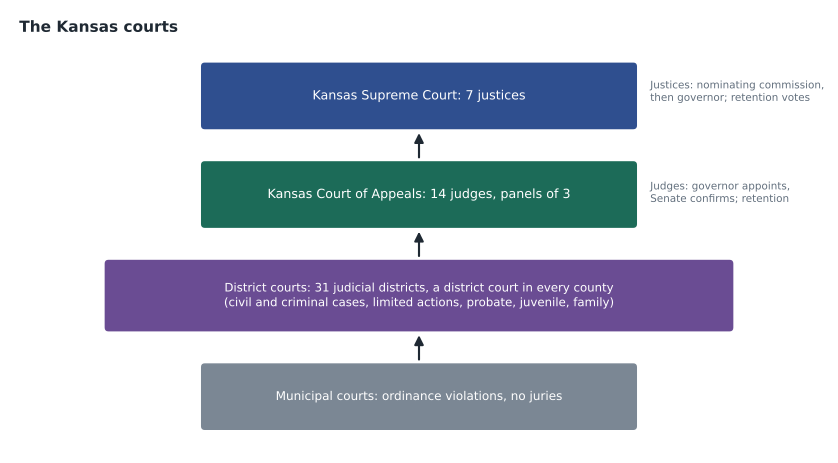
Kansas has a unified court system with three levels of state courts of general authority, plus municipal courts.
The Kansas Supreme Court sits at the top. It has seven justices, one of whom serves as chief justice, and it sits in Topeka in the Kansas Judicial Center. It hears appeals in the most serious criminal cases directly, reviews decisions of the Court of Appeals on petitions for review, decides questions certified to it and exercises general administrative authority over the courts. It also regulates the practice of law, including admission and discipline.
The Kansas Court of Appeals is the intermediate appellate court. It has fourteen judges who hear cases in panels of three, often traveling to courthouses around the state. Most appeals from district courts go first to the Court of Appeals, and its decisions are final unless the Supreme Court grants review.
The district courts are the trial courts of general jurisdiction. Kansas is divided into thirty-one judicial districts, each with a chief judge, and there is a district court in every one of the state's 105 counties. District courts hear civil and criminal cases of every size, as well as probate, juvenile, family, care and treatment and limited actions matters. Some district courts have district magistrate judges who handle limited matters such as small claims and traffic cases.
Municipal courts handle violations of city ordinances, including traffic offenses and minor criminal violations. They have no juries; a defendant convicted in municipal court may appeal to the district court for a new trial.
How Kansas chooses its judges
Kansas uses different systems for different courts, and the system for the Supreme Court has been a subject of public debate.
Supreme Court justices are chosen by a merit selection system written into the Kansas Constitution. When a vacancy occurs, the Supreme Court Nominating Commission, a nine-member body of lawyers and nonlawyers, reviews applicants and sends three names to the governor, who appoints one. A new justice stands for a retention election after the first year in office, and if retained serves a six-year term, standing for retention again at the end of each term.
Court of Appeals judges are chosen differently. Since a 2013 statute, the governor appoints Court of Appeals judges directly, subject to confirmation by the Kansas Senate. They serve four-year terms and stand for retention votes.
District judges are chosen in one of two ways, depending on the district. In some districts, a local nominating commission sends names to the governor and judges then stand for retention. In others, district judges are elected in partisan elections.
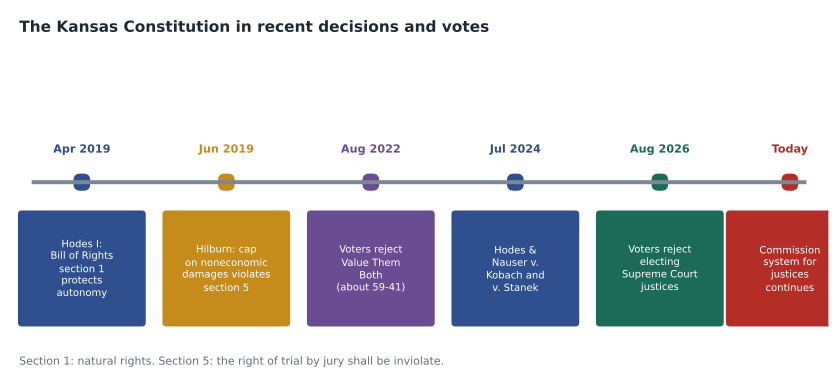
In 2026 the Legislature placed on the August 4 primary ballot a constitutional amendment that would have replaced the commission system for Supreme Court justices with direct elections. Kansas voters rejected the amendment by a wide margin. The commission system therefore continues for the Supreme Court.
The Kansas Code of Civil Procedure
Civil cases in the district courts are governed by the Kansas Code of Civil Procedure, which occupies most of chapter 60 of the Kansas Statutes Annotated, along with the Kansas Supreme Court's rules for district courts. Smaller claims may proceed under the Code of Civil Procedure for Limited Actions in chapter 61, which has simpler procedures, and small claims have their own procedure.
The chapter 60 rules follow the structure of the Federal Rules of Civil Procedure. The general pattern is that a federal rule's number, added to 200, gives the corresponding Kansas section: K.S.A. 60-208 governs general rules of pleading like federal Rule 8; K.S.A. 60-212 governs defenses and objections like Rule 12; K.S.A. 60-226 governs discovery like Rule 26; K.S.A. 60-256 governs summary judgment like Rule 56. The pattern is a convenient memory aid, though not every section lines up exactly.
Several Kansas differences matter early in practice.
Terminology. A Kansas civil action begins with a petition, not a complaint, and the parties are plaintiff and defendant. Many Kansas lawyers still speak of the petition and answer, and pleadings are captioned with the district court and county.
Commencement and service. Under K.S.A. 60-203, an action is commenced when the petition is filed if service is obtained within ninety days, a period the court may extend by thirty days for good cause. If service comes later, the action is commenced only on the date of service. The rule matters for the statute of limitations: a petition filed the day before the period expires does not stop the clock unless service follows within the allowed time.
Supreme Court Rule 141. Summary judgment motions in Kansas district courts must comply with Kansas Supreme Court Rule 141, which requires the moving party to set out the uncontroverted facts in numbered paragraphs with precise references to the record, and requires the opposing party to respond to each paragraph. A motion or response that ignores the rule's format can be denied or treated as conceding facts.
Appeals. In civil cases, a notice of appeal must ordinarily be filed within thirty days after the entry of judgment, under K.S.A. 60-2103. The deadline is jurisdictional, and a late notice generally cannot be cured.
| Kansas provision | Federal counterpart | Point to remember |
|---|---|---|
| K.S.A. 60-203 | Rule 3 and Rule 4(m) | Filing commences the action only if service follows within 90 days (extendable 30) |
| K.S.A. 60-208 | Rule 8 | The initial pleading is a petition |
| K.S.A. 60-212 | Rule 12 | Defenses and objections, including motions to dismiss |
| K.S.A. 60-226 | Rule 26 | Discovery scope and limits |
| K.S.A. 60-256 and Supreme Court Rule 141 | Rule 56 | Numbered statements of uncontroverted fact with record citations |
| K.S.A. 60-2103 | Appellate Rule 4 | Thirty days to file a notice of appeal in most civil cases |
Limitations periods
Kansas's general statutes of limitations are also in chapter 60. The two-year period of K.S.A. 60-513 covers most tort actions, including actions for injury to the person or property and wrongful death, and it has special accrual rules for injuries whose cause is not reasonably ascertainable at first, with outer limits. Other sections set longer periods for written contracts and other actions. A new lawyer handling a car-wreck case should calendar the two-year date on the day the file opens and remember the service requirement of K.S.A. 60-203.
The Kansas Constitution
The Kansas Constitution, adopted in 1859 at Wyandotte and effective on statehood in 1861, has its own Bill of Rights. Several of its sections have become central to Kansas law in recent years, often reaching results different from the federal Constitution.
Section 1 of the Kansas Constitution Bill of Rights declares that all men are possessed of equal and inalienable natural rights, among which are life, liberty and the pursuit of happiness. In Hodes & Nauser, MDs, P.A. v. Schmidt, decided in April 2019 by a 6 to 1 vote, the Kansas Supreme Court held that section 1 protects a right of personal autonomy that includes the decision whether to continue a pregnancy, and that laws burdening that right are subject to strict scrutiny.
The Legislature responded by proposing a constitutional amendment, known as Value Them Both, that would have stated there is no state constitutional right to abortion. At the August 2, 2022 primary election, Kansas voters rejected it by about 59 percent to 41 percent, with turnout unusually high for a primary. In July 2024, in Hodes & Nauser, MDs, P.A. v. Kobach and Hodes & Nauser, MDs, P.A. v. Stanek, the Supreme Court applied its 2019 decision to strike down a statute banning a common second-trimester procedure and a set of clinic licensing requirements. The section 1 cases show how the Kansas Constitution can protect rights more broadly than the federal Constitution as interpreted after 2022.
Section 5 of the Bill of Rights provides that the right of trial by jury shall be inviolate. In Hilburn v. Enerpipe Ltd., decided on June 14, 2019, the Supreme Court held that the statutory cap on noneconomic damages in personal injury actions, K.S.A. 60-19a02, violated section 5 as applied to a negligence claim. The plurality opinion overruled the approach of Miller v. Johnson, a 2012 decision that had upheld the cap as a valid substitute remedy. Lesson 8 explains what Hilburn means for damages today.
Section 18 of the Bill of Rights guarantees that all persons, for injuries suffered in person, reputation or property, shall have remedy by due course of law. Kansas litigants often raise section 18 alongside section 5 when a statute limits a common-law remedy.
Why this matters for a new lawyer
The UBE tests federal procedure and federal constitutional law. Kansas practice adds a layer the exam ignores. Three habits help a new Kansas lawyer.
First, look up the Kansas section every time. The federal rule is a good guide to what a chapter 60 section probably says, but the Kansas text and Kansas cases control. Differences in timing and form, such as the ninety-day service rule and Rule 141, are exactly the details that cost cases.
Second, read the local rules. Each judicial district may have local rules and standing orders on scheduling, motions and courtroom practice. A filing that complies with chapter 60 and the Supreme Court Rules may still fall short of a district's local requirements.
Third, consider the Kansas Constitution separately from the federal Constitution. The Kansas Supreme Court has held more than once that the Kansas Bill of Rights is not simply a mirror of the federal Bill of Rights. A claim that would fail under federal law may succeed under sections 1, 5 or 18, and the reverse.
Reading Kansas appellate decisions
Kansas research has a few conventions worth learning early. Opinions of the Supreme Court and the Court of Appeals are published in the Kansas Reports and the Kansas Court of Appeals Reports, and both courts post their opinions on the judicial branch website on the day they are filed. Each opinion begins with syllabus paragraphs, prepared by the court, that state the points of law decided. Kansas lawyers quote the syllabus often, but the opinion itself controls if the two differ.
The Court of Appeals issues many of its decisions as unpublished opinions. Under the Supreme Court's rules, an unpublished opinion is not binding precedent, and citing one is discouraged unless it has persuasive value on a point no published opinion addresses as well, with a copy provided to the court and the parties. Jolene's first research memo cited three unpublished Court of Appeals cases on culvert maintenance; the partner sent it back with a note to find the published authority first and to check the citation rule before keeping any of the three.
Worked problem
Calendaring a Kansas petition
On November 2, 2026, a client walks into the Hays firm about a collision that happened on December 1, 2024. The partner asks Jolene to calendar the limitations deadline and the service deadline if the petition is filed on November 20, 2026. What dates should she enter?
Show solution
- K.S.A. 60-513 gives two years for a personal injury action, so the limitations period runs out on December 1, 2026.
- Filing on November 20, 2026 is within the period.
- Under K.S.A. 60-203, the filing commences the action as of November 20 only if service is obtained within ninety days, by February 18, 2027.
- The court can extend the ninety days by thirty days for good cause, but the firm should not plan on it.
- If service is obtained after the allowed time, the action commences on the date of service, which would be after December 1, 2026, and the claim would be time-barred.
Answer: Jolene should calendar December 1, 2026 as the limitations date and February 18, 2027 as the service deadline, and arrange service immediately after filing.
Common mistakes
MistakeA Kansas civil action begins with a complaint.
InsteadA Kansas civil action begins with a petition.
MistakeFiling the petition always stops the statute of limitations.
InsteadUnder K.S.A. 60-203, filing commences the action only if service is obtained within ninety days, extendable by thirty days for good cause.
MistakeKansas voters approved electing Supreme Court justices in 2026.
InsteadVoters rejected the August 4, 2026 amendment; the commission system continues.
MistakeThe Kansas Constitution protects only the rights the federal Constitution protects.
InsteadThe Kansas Supreme Court has read sections 1 and 5 of the Kansas Bill of Rights more broadly in key cases.
MistakeCourt of Appeals judges go through the Supreme Court Nominating Commission.
InsteadSince 2013, the governor appoints Court of Appeals judges with Senate confirmation.
Summary and key terms
- Kansas has a seven-justice Supreme Court, a fourteen-judge Court of Appeals, district courts in thirty-one judicial districts and municipal courts.
- Justices are chosen through a nominating commission and the governor and face retention votes; voters rejected a 2026 amendment to elect them.
- The Kansas Code of Civil Procedure in K.S.A. chapter 60 follows the federal rules' structure, with Kansas differences such as the petition, ninety-day service rule and Rule 141.
- Most tort actions must be brought within two years under K.S.A. 60-513.
- Sections 1 and 5 of the Kansas Bill of Rights produced Hodes & Nauser (2019) and Hilburn (2019), reaching beyond federal law.
- Petition
- The initial pleading in a Kansas civil action.
- Supreme Court Rule 141
- The Kansas rule setting the format for summary judgment motions and responses.
- Retention election
- A vote on whether a sitting judge or justice should remain in office.
- Supreme Court Nominating Commission
- The nine-member body that sends three names to the governor when a Kansas Supreme Court seat is vacant.
- Section 5
- The Kansas Bill of Rights provision declaring the right of trial by jury inviolate.
Lesson quiz · 5 questions
Score 60% or more to complete this lesson.
Create a free account to save your progress, take quizzes and earn a certificate.