
BAR-217 · Lesson 8 of 12 · 15 min
Kansas torts: comparative fault, several liability and damages
▶ Video coming soon A video version of this lesson is on the way.
The highway case that filled Jolene's summer had three moving parts. A pickup driven by the firm's client, a retired farmer named Leonard, was struck by a semi that drifted across the center line on U.S. Highway 183 south of Hays. The trucking company blamed the shipper, which had loaded the trailer unevenly. Both blamed Leonard, who had slowed to turn into a field entrance without signaling. And the semi's driver said a car he could not identify had forced him over. 'On the MBE,' Jolene said, 'I would add up the fault, reduce Leonard's damages by his share and let him collect the rest from whichever defendant has money. The partner says that is wrong in three ways.'
'Four,' Marchetti said. 'Kansas compares fault differently, bars recovery at a lower threshold, splits liability among defendants instead of making them share it, and lets the jury put fault on that car nobody can find. Then there are the damages rules. This is the lesson that will keep you out of trouble in your first car-wreck case.'
This lesson covers Kansas's modified comparative fault statute, the abolition of joint and several liability for negligence, the comparison of fault with nonparties, the Kansas law of damages after the 2019 Hilburn decision, the wrongful death limit, punitive damages and the limitations period.
Modified comparative fault under K.S.A. 60-258a
Kansas replaced the old contributory negligence bar with comparative negligence by statute in the 1970s. The statute, K.S.A. 60-258a, sets three basic rules.
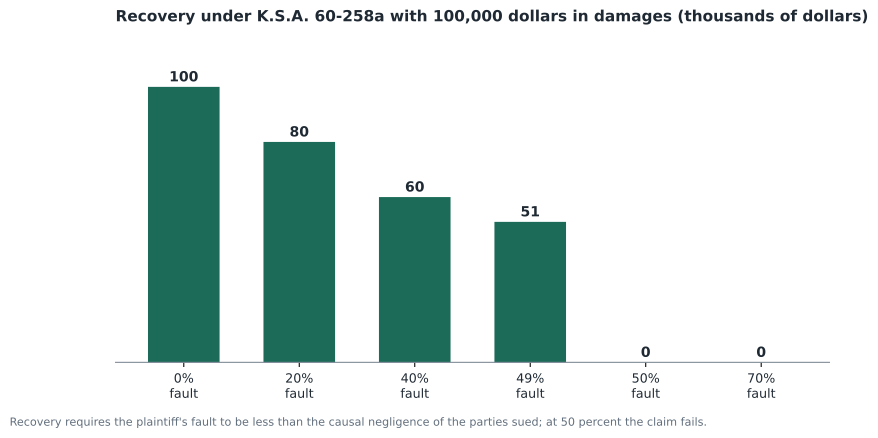
First, a plaintiff's own negligence does not bar recovery if it was less than the causal negligence of the party or parties against whom the claim for recovery is made. The statute's word is less: a plaintiff whose share of fault equals that of the defendants recovers nothing. In practice that means a plaintiff found 49 percent at fault can recover, and a plaintiff found 50 percent at fault cannot. Kansas is therefore a modified comparative fault state of the 50 percent bar variety, sometimes called the not as great as rule.
Second, a plaintiff who recovers has the damages reduced in proportion to the plaintiff's own share of fault. A plaintiff found 20 percent at fault with damages of 100,000 dollars recovers 80,000 dollars.
Third, the jury, or the court in a bench trial, makes special findings: the total damages that would have been recoverable without regard to fault, and the percentage of fault attributable to each party. The court then enters judgment according to those findings.
The comparison with the exam's default
The MBE tells examinees to assume pure comparative fault unless otherwise stated. Under pure comparative fault, a plaintiff 70 percent at fault still recovers 30 percent of damages. Under the Kansas statute, that plaintiff recovers nothing. Among modified comparative fault states, some bar recovery only when the plaintiff's fault is greater than the defendants', so a plaintiff found exactly 50 percent at fault recovers half; Kansas's statute uses less than, so the same plaintiff recovers nothing. Where an MBE or MEE question states that the jurisdiction follows modified comparative negligence, read the question to see which version it describes.
Several liability only
The fourth rule of K.S.A. 60-258a is the one that most surprises lawyers trained on the exam's defaults. Subsection (d) provides that, where the comparative negligence of the parties is an issue, each party against whom a claim is made is liable for that party's proportionate share of the total damages. In other words, liability is several, not joint and several.
The Kansas Supreme Court confirmed that reading in Brown v. Keill, decided in 1978. The court held that the comparative negligence statute abolished joint and several liability among negligent defendants and that the fault of all persons who contributed to the occurrence should be determined, whether or not they are parties to the lawsuit. Each defendant then pays only the percentage of the total damages that matches its own share of fault.
The consequences are large. If one defendant is insolvent or immune, its share is not shifted to the others; the plaintiff bears the loss. A plaintiff has every reason to join every potentially responsible person, and a defendant has every reason to point to someone else, including someone who cannot be sued.
Comparing fault with nonparties
Because Brown v. Keill requires the jury to consider the fault of everyone who contributed to the occurrence, a Kansas jury may assign fault to persons who are not parties: a phantom driver who cannot be identified, an employer protected by workers' compensation immunity, a settling defendant or a person over whom the court has no jurisdiction. Kansas lawyers often call this putting fault on the empty chair.
The statute also lets a party bring others into the case for purposes of comparison. Under K.S.A. 60-258a(c), on motion of any party, a person whose causal negligence is claimed to have contributed to the injury may be joined as an additional party so that fault can be compared. Joinder lets fault be determined in one proceeding and binds the joined person to the findings.
For a plaintiff's lawyer, the lesson is to investigate everyone and to be ready to rebut fault assigned to absent persons, because every percentage point placed on an empty chair comes out of the plaintiff's recovery. For a defense lawyer, the lesson is to identify every other contributor early and to give notice of the intent to compare their fault.
Worked problem
Leonard's case
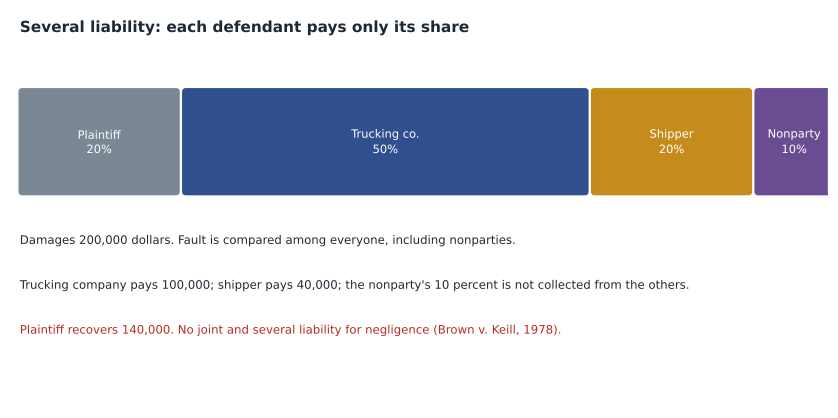
At trial the jury finds Leonard's total damages to be 200,000 dollars and assigns fault as follows: Leonard 20 percent, the trucking company 50 percent, the shipper 20 percent and the unidentified car 10 percent. The trucking company has liability insurance; the shipper is solvent. What judgment does Leonard receive, and from whom?
Show solution
- Leonard's 20 percent is less than the combined 80 percent of the others, so he is not barred.
- His recovery is reduced by his own 20 percent share.
- Liability is several only under K.S.A. 60-258a(d): the trucking company owes 50 percent of 200,000, or 100,000 dollars; the shipper owes 20 percent, or 40,000 dollars.
- The unidentified car's 10 percent, 20,000 dollars, cannot be collected from the trucking company or the shipper.
- Total recovery: 140,000 dollars, compared with 160,000 dollars under the exam's joint and several default.
Answer: Leonard receives judgments of 100,000 dollars against the trucking company and 40,000 dollars against the shipper; the 20,000 dollars attributed to the unidentified car is lost.
Damages after Hilburn
For many years Kansas capped noneconomic damages, such as pain and suffering, in personal injury actions. The cap, in K.S.A. 60-19a02, was 250,000 dollars for many years and was scheduled to rise in steps under 2014 amendments. In Miller v. Johnson, decided in 2012, the Kansas Supreme Court upheld the cap against a challenge under the jury trial right, reasoning that the Legislature had provided an adequate substitute remedy, a quid pro quo, in the form of mandatory medical malpractice insurance.
In Hilburn v. Enerpipe Ltd., decided on June 14, 2019, the court changed course. Diana Hilburn was injured in a highway collision with a truck owned by Enerpipe. A jury awarded her about 335,000 dollars, of which about 301,509 dollars was noneconomic. The district court applied the cap and reduced the noneconomic award to 250,000 dollars, for a total judgment of about 283,491 dollars. The Supreme Court reversed. In a plurality opinion by Justice Carol Beier, the court held that section 5 of the Kansas Constitution Bill of Rights, which declares the right of trial by jury inviolate, protects the jury's determination of damages, and that a statute that overrides the jury's award of noneconomic damages violates that right. The plurality rejected Miller's quid pro quo test for section 5 claims. Justice Stegall concurred in the result, and Justice Luckert dissented.
After Hilburn, the K.S.A. 60-19a02 cap cannot be applied to reduce a jury's noneconomic award in a personal injury action at common law. Kansas plaintiffs' lawyers treat noneconomic damages as uncapped in ordinary negligence cases, and Kansas defense lawyers have had to adjust their valuations accordingly.
The wrongful death limit
Hilburn did not decide the separate limit in the wrongful death statute. Under K.S.A. 60-1903, nonpecuniary damages in a wrongful death action may not exceed 250,000 dollars in the aggregate, plus costs. The jury is not told of the limit; if its nonpecuniary award, after any reduction for comparative fault, exceeds 250,000 dollars, the court enters judgment for 250,000 dollars. Pecuniary losses suffered by the heirs, such as lost financial support and services, are not capped, and the verdict must itemize them separately.
The difference in treatment rests on the nature of the claim. A wrongful death action is a creation of statute rather than a common-law action that existed when the Kansas Constitution was adopted, and Kansas courts have treated the Legislature as having more power to shape a remedy it created. A new lawyer handling a fatal accident should not assume that Hilburn removed the wrongful death limit.
| Claim | Limit on noneconomic or nonpecuniary damages | Source |
|---|---|---|
| Personal injury (negligence) | No enforceable statutory cap after Hilburn | Hilburn v. Enerpipe Ltd. (2019); Bill of Rights section 5 |
| Wrongful death | 250,000 dollars on nonpecuniary damages; pecuniary losses uncapped | K.S.A. 60-1903 |
| Punitive damages | Lesser of the defendant's highest annual gross income in the prior five years or 5 million dollars, with exceptions | K.S.A. 60-3702 |
| Claims against governmental entities | 500,000 dollars per occurrence; no punitive damages | Kansas Tort Claims Act, K.S.A. 75-6105 (Lesson 9) |
Punitive damages
Kansas regulates punitive damages by statute. Under K.S.A. 60-3702, the trier of fact first decides whether punitive damages should be allowed. The plaintiff must prove by clear and convincing evidence that the defendant acted toward the plaintiff with willful conduct, wanton conduct, fraud or malice. If punitive damages are allowed, the court, not the jury, holds a separate proceeding to determine the amount.
In setting the amount the court may consider the likelihood of serious harm at the time of the conduct and the defendant's awareness of it, the profitability of the misconduct, its duration and any concealment, the defendant's conduct after discovery, the defendant's financial condition and the deterrent effect of other damages and penalties. The award generally may not exceed the lesser of the defendant's highest annual gross income in any one of the five years before the conduct or 5 million dollars. If the court finds the income-based figure clearly inadequate, it may use up to 50 percent of the defendant's net worth instead, and if the profit the defendant gained or expected from the misconduct exceeds the limit, the limit becomes one and a half times that profit.
The court's role in fixing the amount is a distinctive Kansas feature. Kansas jurors decide whether a defendant deserves punishment, but a judge decides how much.
Car-wreck cases and no-fault
Leonard's case is a motor vehicle case, and Kansas motor vehicle cases have one more layer. Kansas has a no-fault automobile insurance system under the Kansas Automobile Injury Reparations Act, which requires personal injury protection benefits for medical expenses and lost income regardless of fault. The Act limits tort actions for pain and suffering in less serious cases: an injured person may bring such a claim only if the injury meets a statutory threshold, defined by the amount of medical treatment or by the type of injury, such as a fracture, permanent injury or disfigurement. A Kansas lawyer evaluating a car-wreck claim checks the threshold before anything else.
The limitations period
Most Kansas tort actions must be brought within two years under K.S.A. 60-513, including actions for injury to the person or to property and wrongful death. The period generally runs from the time the injury occurred, but where the fact of injury is not reasonably ascertainable at first, it runs from when the injury becomes reasonably ascertainable, subject to outer limits in the statute. Medical malpractice and other special claims have their own accrual rules and outer limits. As Lesson 7 explained, filing the petition stops the clock only if service follows within ninety days, extendable by thirty days for good cause.
Common mistakes
MistakeKansas follows pure comparative fault.
InsteadKansas bars recovery unless the plaintiff's fault is less than that of the parties sued; at 50 percent the plaintiff recovers nothing.
MistakeNegligent defendants in Kansas are jointly and severally liable.
InsteadK.S.A. 60-258a(d) and Brown v. Keill make liability several only; each defendant pays its own share.
MistakeThe jury can compare fault only among parties to the lawsuit.
InsteadThe fault of all persons who contributed to the occurrence may be compared, including nonparties.
MistakeHilburn removed every Kansas damages limit.
InsteadHilburn struck the personal injury noneconomic cap; the wrongful death limit and punitive damages limits remain.
MistakeThe jury sets the amount of punitive damages in Kansas.
InsteadThe jury decides whether punitive damages are allowed; the court sets the amount.
Summary and key terms
- Under K.S.A. 60-258a, a plaintiff recovers only if less at fault than the parties sued, and recovery is reduced by the plaintiff's share.
- Liability for negligence is several only; Brown v. Keill (1978) abolished joint and several liability and allowed comparison of nonparty fault.
- Hilburn v. Enerpipe Ltd. (2019) held the personal injury noneconomic damages cap unconstitutional under section 5.
- Wrongful death nonpecuniary damages remain limited to 250,000 dollars under K.S.A. 60-1903; pecuniary losses are uncapped.
- Punitive damages require clear and convincing evidence; the court sets the amount within the K.S.A. 60-3702 limits.
- Modified comparative fault
- A system in which a plaintiff's fault reduces recovery and bars it at a set threshold; in Kansas, at 50 percent.
- Several liability
- Liability limited to a defendant's own share of fault.
- Empty chair
- A nonparty to whom a jury may assign a share of fault.
- Noneconomic damages
- Damages for pain, suffering, mental anguish and similar losses that have no direct monetary measure.
- Nonpecuniary damages
- In a wrongful death action, damages for losses such as companionship and comfort, limited in Kansas to 250,000 dollars.
Lesson quiz · 5 questions
Score 60% or more to complete this lesson.
Create a free account to save your progress, take quizzes and earn a certificate.