
BAR-217 · Lesson 10 of 12 · 17 min
Kansas property, family and estates law
▶ Video coming soon A video version of this lesson is on the way.
The estate that occupied Jolene's autumn belonged to Margaret, a widow from Ellis County who had married her second husband, Walt, eleven years before her death. Her will, signed at a kitchen table with two neighbors as witnesses, left her quarter section and the house on it to her two children from her first marriage and nothing to Walt. Walt came to the firm with a question the will did not answer: did he have to move out of the house, and did he get anything at all?
'On the MEE, I would talk about the elective share in general terms and mention the Uniform Probate Code,' Jolene said. 'The partner pulled out the Kansas statute and a chart with percentages by year of marriage. Then he asked me about the homestead, which I had never heard of outside a history class.'
'Western Kansas practice is property, family and estates,' Marchetti said. 'Farms pass through wills and probate, marriages end and families blend. The national rules give you the vocabulary. The Kansas statutes give you the answers.'
This lesson covers the Kansas law of wills, intestate succession, the surviving spouse's elective share, the homestead, nonprobate transfers and the main features of Kansas divorce law, including property division and maintenance.
Executing a valid will
K.S.A. 59-606 sets the formal requirements for a Kansas will. Except for certain oral wills in narrow circumstances, every will must be in writing and signed at the end by the testator, or by some other person in the testator's presence and by the testator's express direction. It must be attested and subscribed in the presence of the testator by two or more competent witnesses who saw the testator subscribe or heard the testator acknowledge the signature.
Three features of the Kansas rule deserve attention. First, the signature must be at the end of the will. Material added after the signature can raise questions about what the testator actually signed.
Second, the witnesses must sign in the testator's presence. Kansas does not require the witnesses to sign in each other's presence, but each must see the testator sign or hear the testator acknowledge the signature.
Third, Kansas has no separate category of valid unwitnessed holographic wills. A handwritten will signed by the testator but not witnessed does not satisfy K.S.A. 59-606, however clearly it states the testator's wishes. The MEE sometimes asks about holographic wills because many states recognize them; a Kansas lawyer must tell a client that a handwritten, unwitnessed will is not enough in Kansas.
Kansas also permits a self-proving affidavit. When the testator and the witnesses sign an affidavit before a notary at the time of execution, the will can be admitted to probate without testimony from the witnesses, which simplifies probate considerably. Most Kansas lawyers attach a self-proving affidavit to every will they supervise.
Margaret's will met these requirements. It was typed, signed by Margaret at the end and signed by two adult neighbors who watched her sign, with a self-proving affidavit notarized at the same sitting.
Intestate succession
When a Kansas resident dies without a valid will, the Kansas intestate succession statutes in chapter 59 determine who inherits. In broad terms, a surviving spouse takes the entire estate if the decedent left no children or descendants of deceased children. If the decedent left a spouse and children, the spouse takes one-half and the children take the other half. If there is no surviving spouse, the children take everything. Kansas does not distinguish, in these basic shares, between children of the marriage and children from a prior relationship.
The intestate rules matter even when there is a will, because a will may fail in whole or in part, and because the elective share discussed next is meant to protect spouses whom a will leaves out.
The elective share
A surviving spouse who is unhappy with what the decedent's will provides may elect to take an elective share instead. Kansas uses an augmented estate approach, modeled on the Uniform Probate Code. Instead of measuring the share against the probate estate alone, which a decedent could empty by transferring property outside probate, the augmented estate includes the decedent's probate estate and many nonprobate transfers, such as property held in revocable trusts and certain transfers to others during the marriage, along with the surviving spouse's own property and nonprobate transfers to the spouse.
The elective share percentage, set by K.S.A. 59-6a202, depends on how long the couple was married. A spouse married less than one year receives a supplemental amount only. The percentage is 3 percent for one year of marriage and rises by 3 percentage points each year to 30 percent at ten years. After that it rises by 4 percentage points a year, to 34 percent at eleven years, 38 percent at twelve, 42 percent at thirteen and 46 percent at fourteen, reaching 50 percent at fifteen years or more.
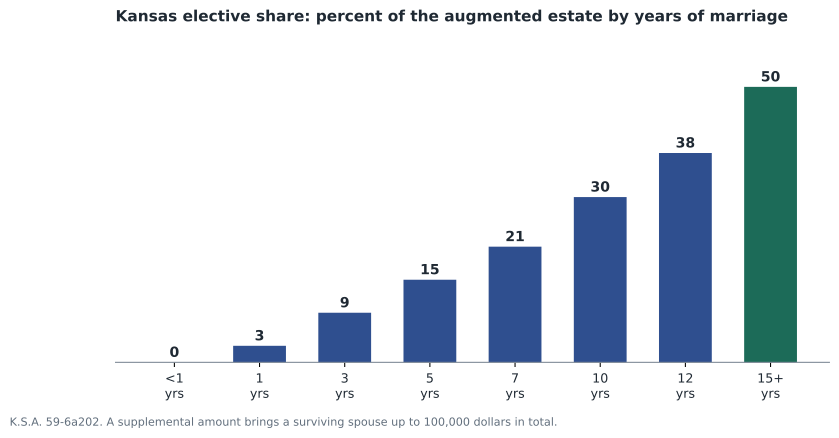
The statute also protects a surviving spouse with few assets of his or her own. If the spouse's own property, the spouse's share of the decedent's estate and other amounts counted under the statute total less than 100,000 dollars, the spouse is entitled to a supplemental amount that brings the total to 100,000 dollars.
The election is not automatic. The surviving spouse must make it within the time and in the manner the Probate Code requires, usually by filing a written election in the probate proceeding. A lawyer for a spouse in Walt's position must calendar that deadline at the first meeting.
Worked problem
Walt's elective share
Margaret and Walt were married for eleven years. Margaret's augmented estate, including her probate estate, her nonprobate transfers and the property counted from Walt's side, is valued at 1,200,000 dollars. Her will leaves Walt nothing. What elective share percentage applies, and roughly what is the elective share amount before any credit for property Walt already owns or receives?
Show solution
- K.S.A. 59-6a202 sets the percentage by years of marriage.
- At ten years the percentage is 30 percent; it then rises by 4 percentage points a year.
- At eleven years the percentage is 34 percent.
- 34 percent of 1,200,000 dollars is 408,000 dollars.
- The statute then credits property Walt already owns and amounts he receives, so the amount payable from Margaret's estate and nonprobate transfers may be less.
Answer: The elective share percentage is 34 percent, about 408,000 dollars measured against the augmented estate before credits.
The homestead
Walt's second question was about the house. Kansas protects the family home through a homestead provision in the Kansas Constitution, Article 15, section 9, implemented by statute. A homestead is exempt from forced sale under most creditors' claims.
The Kansas homestead is defined by area, not value. It may include up to 160 acres of farming land or one acre within the limits of an incorporated town or city, together with the improvements on it, occupied as a residence by the family or the owner. There is no dollar limit on the value of the protected homestead, which makes Kansas one of a small group of states with unlimited homestead protection. The exemption does not protect against sales for taxes, obligations for the purchase of the property, obligations for improvements on it or liens to which both spouses consented.
The homestead provision also protects spouses. The homestead may not be alienated, meaning sold or mortgaged, without the joint consent of husband and wife when that relation exists. A deed or mortgage of the homestead signed by only one spouse is generally ineffective.
At death, the Probate Code gives a surviving spouse and minor children rights in the homestead and a family allowance that take priority over many claims. Whether those rights let Walt remain in the farmhouse despite Margaret's will, and for how long, depends on the specific statutes and how the homestead and elective share interact in the estate. The partner told Jolene to research the homestead and allowance provisions of chapter 59 before the next meeting with Walt.
| Topic | Kansas rule | Source |
|---|---|---|
| Will execution | In writing, signed at the end, attested by two competent witnesses in the testator's presence | K.S.A. 59-606 |
| Holographic wills | No separate rule; an unwitnessed handwritten will is not valid | K.S.A. 59-606 |
| Elective share | Augmented estate; 3 percent per year to 30 percent at ten years, then 50 percent at fifteen years | K.S.A. 59-6a202 |
| Supplemental amount | Brings the surviving spouse to 100,000 dollars | K.S.A. 59-6a202 |
| Homestead | 160 acres of farmland or one acre in town; no value limit; spouses must join in sale or mortgage | Kansas Constitution Article 15, section 9 |
| Intestacy with spouse and children | Spouse takes one-half; children take one-half | K.S.A. chapter 59 |
Probate in Kansas
Kansas probate proceedings are heard in the district court of the county where the decedent lived, under the Kansas Probate Code in chapter 59. A typical testate estate begins with a petition to admit the will to probate and to appoint the executor named in it. The court sets a hearing, notice goes to the heirs, the beneficiaries and others entitled to it, and once the will is admitted the executor receives letters testamentary and takes charge of the estate.
Creditors are handled through a published notice. The personal representative publishes notice to creditors, and creditors who do not present their claims within the time the Probate Code allows after the first publication are generally barred, with special rules for creditors the representative knows about or can reasonably find. The short claims period is one reason Kansas lawyers often open a probate estate even when most assets pass outside it.
Kansas also offers simplified procedures. Small estates can sometimes be collected by affidavit without any court proceeding, and estates without serious disputes can be administered under a simplified procedure with less court supervision. The choice among full administration, simplified administration and a proceeding to determine descent, which can transfer land many years after death, is one of the first decisions a Kansas estate lawyer makes.
Nonprobate transfers
Much Kansas farm wealth now passes outside probate. Kansas has long allowed transfer-on-death deeds for real estate, which let an owner name a beneficiary who receives the land at the owner's death without probate, while the owner keeps full control during life. Payable-on-death bank accounts, transfer-on-death registration of securities and vehicles, joint tenancy with right of survivorship and revocable trusts are also common.
Nonprobate transfers simplify an estate, but they do not escape the elective share. Because Kansas measures the share against the augmented estate, a surviving spouse's lawyer must trace transfer-on-death deeds, trusts and other nonprobate transfers the decedent made, and a lawyer drafting an estate plan for a married client must explain that leaving a spouse out of the will does not necessarily leave the spouse out of the estate.
Divorce in Kansas
Kansas divorce law is part of the Kansas Family Law Code in chapter 23. K.S.A. 23-2701 sets the grounds for divorce: incompatibility, failure to perform a material marital duty or obligation, and incompatibility by reason of mental illness or mental incapacity of one or both spouses. Incompatibility is by far the most common ground, and in practice Kansas divorce is no-fault. The same grounds apply to separate maintenance. A statutory waiting period applies between filing and the decree, which the court may shorten only in an emergency.
Kansas is not a community property state. In a divorce, the court divides the marital property in a just and reasonable manner, considering factors such as the age of the parties, the duration of the marriage, the property owned by each, their present and future earning capacities, the time, source and manner of acquisition of property, family ties and obligations, any allowance of maintenance, dissipation of assets and the tax consequences. Kansas treats all property owned by either spouse, whether acquired before or during the marriage and however titled, as marital property from the commencement of the divorce action, so property a spouse brought into the marriage or inherited can be divided, although its source is an important factor.
Maintenance
Kansas permits the court to award maintenance, sometimes called spousal support, in an amount the court finds fair, just and equitable. K.S.A. 23-2904 limits the duration. The court may not award maintenance for a period of more than 121 months. If the original order reserves the court's power to do so, the recipient may move to reinstate maintenance before the original period ends, but each reinstatement may not exceed another 121 months. Parties can agree to different terms in a separation agreement the court approves.
The 121-month limit is unusual. Many states allow indefinite maintenance after long marriages; Kansas does not, unless the parties agree. A lawyer advising a spouse in a long marriage must explain the limit and the importance of reserving the right to seek reinstatement.
Child custody and support
Kansas uses the terms legal custody and residency rather than physical custody, and courts decide custody, residency and parenting time according to the best interests of the child, considering a list of statutory factors. Child support is set under the Kansas Child Support Guidelines, which the Kansas Supreme Court adopts and periodically revises. The guidelines use a worksheet based on both parents' incomes and the number and ages of the children, with adjustments for parenting time, child care and health insurance.
Common mistakes
MistakeA handwritten will signed by the testator is valid in Kansas without witnesses.
InsteadK.S.A. 59-606 requires two competent witnesses; Kansas has no separate holographic will rule.
MistakeThe elective share is a fixed one-third of the probate estate.
InsteadKansas measures a percentage of the augmented estate that rises with the length of the marriage to 50 percent at fifteen years.
MistakeThe Kansas homestead exemption is capped at a dollar amount.
InsteadThe homestead is limited by acreage, 160 acres of farmland or one acre in town, with no value limit.
MistakeKansas divides property as community property.
InsteadKansas divides marital property in a just and reasonable manner; it is not a community property state.
MistakeA Kansas court may award maintenance indefinitely after a long marriage.
InsteadK.S.A. 23-2904 limits maintenance to 121 months unless reinstated under a reservation, or the parties agree otherwise.
Summary and key terms
- Kansas wills must be in writing, signed at the end and attested by two competent witnesses; unwitnessed holographic wills are not valid.
- The elective share is a percentage of the augmented estate, from 3 percent after one year of marriage to 50 percent after fifteen years, with a 100,000-dollar supplemental amount.
- The constitutional homestead covers 160 acres of farmland or one acre in town, without a dollar limit, and requires both spouses to join in a sale or mortgage.
- Kansas divorce grounds are incompatibility, failure to perform a material marital duty and incompatibility by reason of mental illness or incapacity.
- Maintenance is limited to 121 months under K.S.A. 23-2904, subject to reinstatement if reserved.
- Augmented estate
- The base for the elective share, including the probate estate and many nonprobate transfers.
- Elective share
- The share of the augmented estate a surviving spouse may take instead of the will's provisions.
- Homestead
- The family residence and land protected from forced sale by the Kansas Constitution.
- Self-proving affidavit
- A notarized affidavit by the testator and witnesses that allows a will to be probated without witness testimony.
- Maintenance
- Court-ordered support from one former spouse to the other, limited in Kansas to 121 months.
Lesson quiz · 5 questions
Score 60% or more to complete this lesson.
Create a free account to save your progress, take quizzes and earn a certificate.