
BAR-217 · Lesson 11 of 12 · 16 min
Score transfer, admission without examination and practice after admission
▶ Video coming soon A video version of this lesson is on the way.
Marcus came back for a second guest session with his Rule 717 application half finished and a list of questions. Jolene had questions of her own, about what she would have to do once she was admitted: register, take continuing education, open a trust account. A senior partner at the Hays firm, admitted in Kansas in the 1990s, had also asked her to look into whether a Colorado lawyer the firm wanted to hire could be admitted without sitting the Kansas exam.
'Three routes in and one set of obligations once you are there,' Marchetti said. 'Marcus is using the transfer route. The Colorado lawyer may be able to use the admission without examination route. And all of you, once admitted, live under the same registration, continuing education and conduct rules.'
This lesson covers admission by transferred UBE or NextGen score under Rule 717, admission without examination under Rule 719, temporary and limited practice, and the obligations of a Kansas lawyer after admission, including annual registration, continuing legal education under Rule 804 and the Kansas Rules of Professional Conduct.
Admission by transferred score: Rule 717
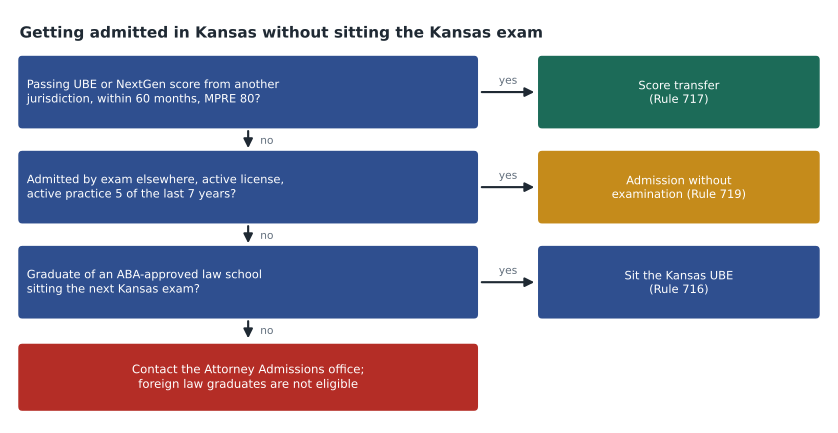
Rule 717 lets an applicant who earned a passing score on the UBE or the NextGen examination in another jurisdiction be admitted in Kansas without sitting the Kansas examination. The Kansas Supreme Court adopted the rule in its current form effective July 1, 2022 and amended it on December 29, 2025 to address NextGen scores.
The main requirements are these. The applicant must have earned the score within sixty months before the Kansas application. A UBE score must be at least 266, Kansas's own passing score, whatever the passing score was where it was earned. A NextGen score must meet the passing score of the jurisdiction where the applicant took the examination. The applicant must have an MPRE scaled score of at least 80, must meet Kansas's character and fitness standards and must not be subject to discipline or have pending disciplinary proceedings elsewhere. The applicant pays the 1,250-dollar fee and files through the Attorney Admissions office.
The UBE rule has a consequence that catches some applicants. An examinee who passed in Alabama with 262, above Alabama's 260 but below Kansas's 266, cannot transfer that score to Kansas. An examinee who passed in Missouri with 266 can. For NextGen, the rule is different because Kansas has not yet set a NextGen passing score; the testing jurisdiction's standard controls until it does.
An applicant may pursue a Rule 717 application at the same time as an application to sit the Kansas examination, for example while waiting for results elsewhere. The rules allow such concurrent applications, and the Attorney Admissions office explains how fees and files are handled.
Marcus's application fits the rule. His July 2026 NextGen score of 648 meets Missouri's passing score of 610; it was earned within sixty months; Kansas has accepted NextGen transfers since July 2026. He needs an MPRE score of 80, which he is confirming with NCBE, and a clean character and fitness review, which he expects because Missouri admitted him in the fall. Because he practices in Kansas City, Missouri, and has never practiced in Kansas, nothing in his history raises an unauthorized practice question, but Marchetti reminded him that until Kansas admits him he must not hold himself out as licensed in Kansas or advise clients on Kansas matters except as Missouri's rules and Kansas's temporary practice rules allow.
Admission without examination: Rule 719
Rule 719 offers admission without examination to experienced lawyers. The applicant must have been admitted to practice by examination in another jurisdiction and must hold an active license there. The applicant must have been engaged in the active practice of law for at least five of the seven years immediately before the application.
The rule defines active practice broadly. It includes representing clients, serving as corporate or government counsel, teaching law full time at an ABA-approved law school and serving as a judge or as a judicial clerk in a position that requires a law license. Practice must have been lawful where it occurred.
Two features make Kansas's rule more open than some. First, it is not limited to lawyers from jurisdictions that offer the same treatment to Kansas lawyers. Many states have reciprocity requirements; Kansas, according to NCBE's chart, does not. Second, the rule has been amended to accommodate lawyers who begin working in Kansas while their applications are pending: an applicant may practice under supervision during the pendency of the application, subject to the rule's conditions. The rule was adopted in its current form in 2022 and amended in January 2024 and March 2025.
Two limits matter as well. A lawyer admitted elsewhere through diploma privilege, without passing a bar examination, is not eligible under the rule. And the applicant must meet the same character and fitness and MPRE requirements as other applicants, pay the 1,250-dollar fee and satisfy the rule's other conditions.
The Colorado lawyer the Hays firm wanted to hire had passed the Colorado bar examination in 2018 and practiced continuously since. She qualified on the experience requirement easily. The partner asked Jolene to confirm the MPRE score and to check that the Colorado license was active.
| Route | Rule | Key requirements | Fee |
|---|---|---|---|
| Transferred UBE score | 717 | UBE score of 266 or higher within sixty months; MPRE 80; character and fitness; no discipline | 1,250 dollars |
| Transferred NextGen score | 717 | Score meeting the testing jurisdiction's passing score within sixty months; MPRE 80; character and fitness | 1,250 dollars |
| Admission without examination | 719 | Admitted by examination elsewhere; active license; active practice five of the last seven years; not reciprocity-limited | 1,250 dollars |
| Admission by examination | 716 and related rules | ABA-approved J.D.; Kansas UBE score of 266; MPRE 80; character and fitness | 700 dollars |
Moving a Kansas score to another state
Transfer works in both directions. A Kansas examinee who passes the Kansas UBE earns a UBE score that other UBE jurisdictions may accept under their own rules. The examinee asks NCBE to transfer the score, pays NCBE's transfer fee and then applies to the other jurisdiction, which applies its own passing score, its own time limit on score age, its own MPRE score and its own character and fitness review. Some jurisdictions also require a state law course or test for transferred-score applicants.
For a Kansas examinee, the most common destination is Missouri, because the Kansas City metropolitan area spans the state line. Lawyers in Johnson and Wyandotte Counties often hold both licenses, and many firms expect new associates to obtain the second license within a year or two. An examinee planning on dual admission should check the destination's passing score before deciding where to sit; an examinee who scores 266 in Kansas passes in Kansas but cannot transfer to a jurisdiction that requires 270.
Jolene, who plans to stay in Hays, has less reason to think about a second license. But Marchetti told her to keep her score report and to note the month she sat, because transfer windows are measured from the examination date, and plans change. A Colorado firm or a federal agency in Denver may be part of her career in five years, and a still-valid UBE score is far easier to use than a new examination.
Temporary and limited practice
Lawyers not admitted in Kansas can appear in a particular Kansas case through pro hac vice admission, which requires association with a Kansas lawyer and the court's permission in that case. Kansas's version of Rule 5.5 of the Rules of Professional Conduct also permits some temporary practice by lawyers admitted elsewhere, such as work reasonably related to a matter in the lawyer's home jurisdiction. Temporary practice is not a substitute for admission for a lawyer who will regularly handle Kansas matters.
After admission: registration
Every Kansas lawyer must register annually with the Office of Judicial Administration under Rule 206 and pay the annual registration fee. Registration keeps the lawyer's contact information current, records whether the lawyer is on active or inactive status and supports the court's disciplinary and continuing education systems. A lawyer who fails to register is suspended after the procedures in the rule run their course, and practicing while suspended is itself misconduct.
Continuing legal education: Rule 804
Rule 804 requires each Kansas lawyer on active status to complete twelve hours of approved continuing legal education in each compliance period, which runs from July 1 to June 30. At least two of the twelve hours must be in ethics and professionalism. The hours must be completed by June 30, and the lawyer must report compliance to the Kansas Continuing Legal Education Commission by July 31.
The rule includes several details new lawyers should know. Up to ten general hours earned beyond the requirement can be carried over to the next compliance period. Extra ethics hours carry over only as general hours. A newly admitted lawyer is exempt until the first full compliance period after admission, so Jolene, if admitted in spring 2027, would not owe hours for the period ending June 30, 2027, but would owe twelve hours for the period ending June 30, 2028. Lawyers who miss the deadlines face noncompliance fees, starting at 75 dollars, and eventually suspension.
| Item | Requirement |
|---|---|
| Hours per period | 12, including at least 2 in ethics and professionalism |
| Compliance period | July 1 to June 30 |
| Complete by | June 30 |
| Report by | July 31 |
| Carryover | Up to 10 general hours; extra ethics hours carry over only as general hours |
| New admittees | Exempt until the first full compliance period after admission |
| Noncompliance | Fees beginning at 75 dollars; suspension if not cured |
The Kansas Rules of Professional Conduct
Kansas lawyers are governed by the Kansas Rules of Professional Conduct, adopted by the Kansas Supreme Court as Rule 226. The Kansas Rules follow the ABA Model Rules in structure and most content, so a lawyer who studied for the MPRE knows the framework. But Kansas has not adopted every Model Rule amendment, and in a few places its rules differ.
The best-known difference concerns Rule 8.4. In 2016 the ABA added Model Rule 8.4(g), which makes it misconduct to engage in conduct the lawyer knows or reasonably should know is harassment or discrimination on listed bases in conduct related to the practice of law. Kansas has not adopted that provision. Kansas's Rule 8.4(g) is instead a broader catch-all: it makes it misconduct to engage in any other conduct that adversely reflects on the lawyer's fitness to practice law. Kansas disciplinary decisions use that catch-all for conduct that does not fit the other paragraphs of Rule 8.4.
New Kansas lawyers should read the Kansas Rules themselves, including the comments, rather than relying on MPRE outlines. Where the MPRE taught the Model Rule, the Kansas rule may say something slightly different, and the Kansas rule is the one a disciplinary panel will apply.
Discipline
Lawyer discipline in Kansas is administered by the Office of the Disciplinary Administrator, which investigates complaints and prosecutes formal cases, and by the Kansas Board for Discipline of Attorneys, whose hearing panels hear formal complaints and make recommendations. The Kansas Supreme Court decides the discipline in serious cases, and its disciplinary opinions are published. Reading a few recent ones is one of the fastest ways for a new lawyer to learn which rules Kansas enforces most often; trust account problems, neglect of client matters and failures of communication recur constantly.
Jolene's first year checklist
Marchetti closed the session by drafting a first-year checklist for Jolene: take the oath and collect the wall certificate at the swearing-in; complete the first annual registration and keep a copy of the confirmation; set up the firm trust account records under the Kansas version of Rule 1.15 and learn the firm's reconciliation process; calendar the first CLE compliance period and plan the ethics hours; read Rule 226 from start to finish, marking where it differs from the Model Rules; and keep a list of the Kansas statutes and rules she uses most.
Worked problem
Can the Alabama examinee transfer?
Ruth, a hypothetical lawyer, passed the February 2025 UBE in Alabama with a score of 262, above Alabama's passing score of 260. She has an MPRE score of 88, no discipline and now lives in Wichita. Can she transfer her score to Kansas under Rule 717, and if not, what are her options?
Show solution
- Rule 717 requires a transferred UBE score of at least 266, Kansas's passing score.
- Her 262 passed in Alabama but falls below 266, so it cannot be transferred to Kansas.
- She has practiced in Alabama only since 2025, so she does not have five of the last seven years of active practice under Rule 719.
- Her options are to sit the Kansas examination, where a new score of 266 is needed, or to wait until she has five years of active practice and apply under Rule 719.
Answer: Ruth cannot use Rule 717 with a 262. She must sit the Kansas examination or later qualify for admission without examination under Rule 719.
Common mistakes
MistakeAny passing UBE score can be transferred to Kansas.
InsteadA transferred UBE score must be at least 266, Kansas's passing score.
MistakeA transferred NextGen score must meet a Kansas NextGen passing score.
InsteadUnder amended Rule 717, it must meet the testing jurisdiction's passing score.
MistakeKansas admits lawyers without examination only from reciprocal states.
InsteadRule 719 is not limited by reciprocity.
MistakeA lawyer admitted by diploma privilege elsewhere can use Rule 719.
InsteadRule 719 requires admission by examination in another jurisdiction.
MistakeKansas has adopted Model Rule 8.4(g) on harassment and discrimination.
InsteadKansas Rule 8.4(g) is a catch-all provision on conduct adversely reflecting on fitness to practice.
Summary and key terms
- Rule 717 allows transfer of a UBE score of 266 or higher, or a NextGen score meeting the testing jurisdiction's passing score, earned within sixty months, with MPRE 80.
- Rule 719 admits lawyers admitted by examination elsewhere with an active license and five of the last seven years of active practice, without a reciprocity requirement.
- Kansas lawyers register annually under Rule 206.
- Rule 804 requires twelve CLE hours a year, two in ethics and professionalism, completed by June 30 and reported by July 31.
- The Kansas Rules of Professional Conduct (Rule 226) follow the Model Rules closely, but Kansas Rule 8.4(g) is a fitness catch-all rather than the ABA's anti-harassment rule.
- Rule 717
- The Kansas rule allowing admission by transferred UBE or NextGen score.
- Rule 719
- The Kansas rule allowing admission without examination for experienced lawyers.
- Rule 804
- The Kansas rule requiring continuing legal education.
- Rule 226
- The Kansas Supreme Court rule containing the Kansas Rules of Professional Conduct.
- Compliance period
- The July 1 to June 30 year in which Kansas lawyers must complete their CLE hours.
Lesson quiz · 5 questions
Score 60% or more to complete this lesson.
Create a free account to save your progress, take quizzes and earn a certificate.