
BAR-140 · Lesson 9 of 12 · 20 min
Communications about legal services
▶ Video coming soon A video version of this lesson is on the way.
On the evening of November 9, Ngozi sends the group chat a screenshot of a billboard she passed on the drive home: a personal injury firm's ad showing a smiling lawyer, the words 'We Win Big', and a phone number. 'Is this allowed?' she asks. In Nigeria, she explains, lawyer advertising is still tightly restricted. Marchetti replies that she will save the question for the Thursday session, and that the answer starts with a Supreme Court case from 1977 involving two Arizona lawyers who ran a newspaper ad for their legal clinic.
Communications about legal services, mainly advertising and solicitation, make up about 4 to 10 percent of the MPRE. This area is unusual because the rules are shaped by the First Amendment: lawyer advertising is commercial speech, and states may regulate it only within constitutional limits. This lesson covers the constitutional framework, the ban on false or misleading communications, the rules on paying for recommendations and referrals, solicitation, statements about specialization, firm names, and political contributions to obtain government work. The ABA substantially restructured these rules in 2018, consolidating several of them, and the MPRE tests the current versions.
The constitutional framework
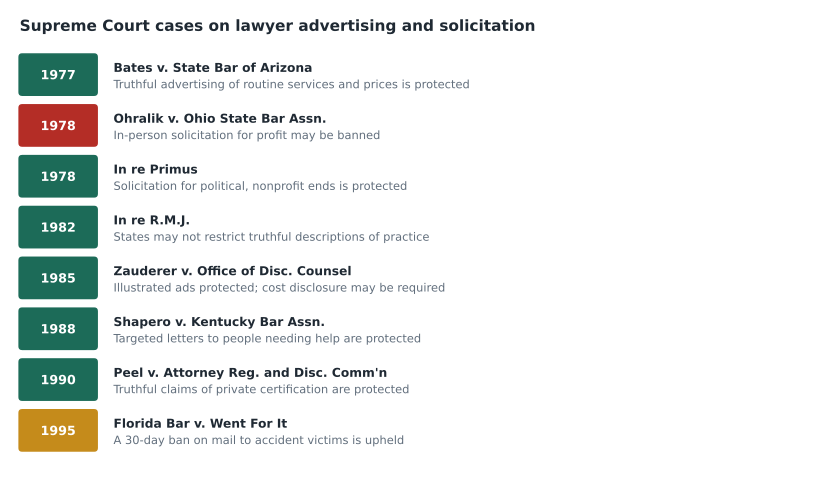
In Bates v. State Bar of Arizona (1977), the Supreme Court held that states may not ban truthful advertising of routine legal services and their prices, because such advertising is commercial speech protected by the First Amendment. States may still prohibit false, deceptive or misleading advertising, and may regulate the time, place and manner of lawful advertising. Later cases filled in the details. In In re R.M.J. (1982) the Court struck down rules limiting the words lawyers could use to describe their practices, and in Zauderer v. Office of Disciplinary Counsel (1985) it protected an illustrated newspaper ad offering legal advice to women injured by a contraceptive device, while upholding a requirement that contingent fee ads disclose that clients might owe costs even if they lost.
In-person solicitation is treated differently. In Ohralik v. Ohio State Bar Association (1978) the Court upheld discipline of a lawyer who visited an accident victim in the hospital to sign her up, because in-person solicitation for profit presents dangers of undue influence, overreaching and intimidation that justify a prophylactic ban. But in In re Primus (1978), decided the same day, the Court protected an ACLU lawyer who wrote to a woman offering free representation, because the solicitation was political expression and association rather than a pursuit of fees. Shapero v. Kentucky Bar Association (1988) protected targeted letters to people facing foreclosure, holding that written solicitation does not carry the same risks as face-to-face contact. And Florida Bar v. Went For It, Inc. (1995) upheld a 30-day ban on direct-mail solicitation of accident victims and their families, finding that the state's interest in protecting privacy and the profession's reputation was substantial.
Peel v. Attorney Registration and Disciplinary Commission (1990) protected a lawyer's truthful statement on his letterhead that he was certified as a civil trial specialist by a private organization, holding that the statement was not inherently misleading. Together these cases explain why the Model Rules generally allow truthful advertising and targeted written solicitation, but forbid live person-to-person solicitation for profit.
False or misleading communications: Model Rule 7.1
Rule 7.1 says a lawyer shall not make a false or misleading communication about the lawyer or the lawyer's services. A communication is false or misleading if it contains a material misrepresentation of fact or law, or omits a fact necessary to make the statement considered as a whole not materially misleading. The rule applies to all communications about the lawyer's services, including websites, social media profiles, business cards and letterhead, not just paid ads.
The comments explain that truthful statements can still mislead. A statement about a lawyer's past results, such as 'we have won millions for our clients,' can create an unjustified expectation that the same results can be obtained for others without reference to the specific facts of each client's case. An unsubstantiated comparison, such as 'the best divorce lawyer in the state,' may be misleading if it cannot be factually verified. Including a disclaimer or qualifying language may prevent a statement from being misleading. So Ngozi's billboard is permissible as advertising in general; whether 'We Win Big' crosses the line depends on context, and many states would require the firm to be able to substantiate it or add qualifying language. Using an actor to portray a lawyer, or a fictional client testimonial, without disclosure is misleading.
Firm names and letterhead are governed by Rule 7.1 too, since the ABA folded the old Rule 7.5 into its comments in 2018. A firm may use a trade name, such as 'Springfield Legal Clinic,' if it is not misleading. It is misleading to imply a connection with a government agency or a public or charitable legal services organization, to use the name of a lawyer not associated with the firm, or to suggest a partnership that does not exist. Lawyers who share office space but are not partners may not call themselves 'Smith and Jones' if that implies a firm. A lawyer who holds public office may not have the firm continue to use the lawyer's name during any substantial period in which the lawyer is not actively and regularly practicing with it. A firm with offices in more than one jurisdiction may use the same name in each, but must indicate the jurisdictional limitations of lawyers not licensed where an office is located.
Paying for recommendations: Model Rule 7.2
Rule 7.2(a) permits a lawyer to communicate information about the lawyer's services through any media. Rule 7.2(b) then says a lawyer shall not compensate, give or promise anything of value to a person for recommending the lawyer's services, with listed exceptions. A lawyer may pay the reasonable costs of advertisements or communications permitted by the rules, such as buying ad space, paying a web designer or paying for online directory listings that do not recommend the lawyer. A lawyer may pay the usual charges of a legal service plan or a not-for-profit or qualified lawyer referral service; a qualified service is one approved by an appropriate regulatory authority. A lawyer may pay for a law practice under Rule 1.17.
A lawyer may also refer clients to another lawyer or a nonlawyer professional under an agreement that provides for the other person to refer clients to the lawyer, if the reciprocal arrangement is not exclusive and the client is informed of its existence and nature. And since 2018, a lawyer may give nominal gifts as an expression of appreciation that are neither intended nor reasonably expected to be a form of compensation for recommending the lawyer's services. A small holiday basket to a friend who sent a client is allowed; a promise of 100 dollars for every client referred is not.
Any communication made under Rule 7.2 must include the name and contact information of at least one lawyer or law firm responsible for its content.
| Payment or gift | Permitted under Rule 7.2(b)? |
|---|---|
| Buying a television ad or a billboard | Yes, reasonable costs of advertising |
| Paying a not-for-profit or approved lawyer referral service its usual charge | Yes |
| A nonexclusive reciprocal referral agreement with an accountant, disclosed to clients | Yes |
| A nominal thank-you gift to a friend who referred a client, not expected as payment | Yes |
| Paying a tow-truck driver for each accident victim referred | No, payment for recommending the lawyer |
| Paying a for-profit online service a fee per client it sends | No, unless it is an approved referral service or merely an advertising cost |
Specialization
Under Rule 7.2(c), a lawyer may state or imply that the lawyer is a certified specialist in a particular field of law only if the lawyer has been certified as a specialist by an organization that has been approved by an appropriate authority of the state or the District of Columbia or a US territory, or that has been accredited by the American Bar Association, and the name of the certifying organization is clearly identified in the communication. A lawyer may say that the lawyer practices in, focuses on or concentrates in a field, or even specializes in it in a general sense, so long as the statement is not false or misleading. Patent lawyers admitted to practice before the Patent and Trademark Office may use the designation 'Patent Attorney,' and lawyers in admiralty may use 'Proctor in Admiralty,' by long tradition.
Solicitation: Model Rule 7.3
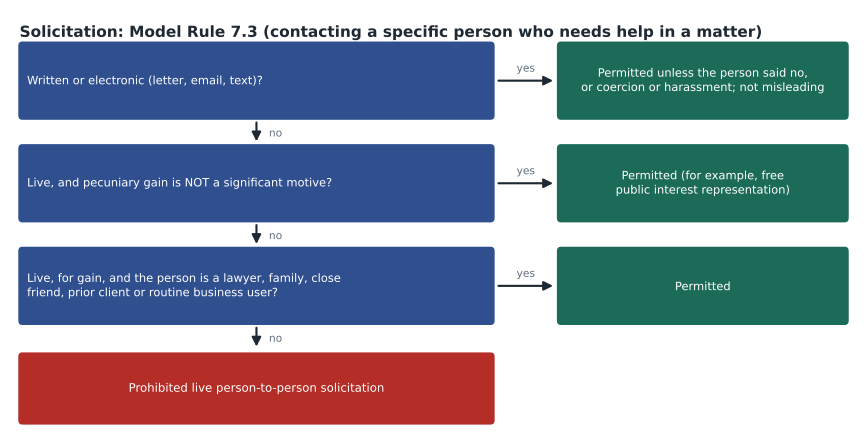
Rule 7.3 defines solicitation as a communication initiated by or on behalf of a lawyer or law firm that is directed to a specific person the lawyer knows or reasonably should know needs legal services in a particular matter, and that offers to provide, or reasonably can be understood as offering to provide, legal services for that matter. General advertising to the public, such as a billboard or a website, is not solicitation, and neither is a response to a request for information.
Rule 7.3(b) says a lawyer shall not solicit professional employment by live person-to-person contact when a significant motive for doing so is the lawyer's or the firm's pecuniary gain, unless the contact is with a lawyer; a person who has a family, close personal or prior business or professional relationship with the lawyer or firm; or a person who routinely uses for business purposes the type of legal services offered by the lawyer. Live person-to-person contact means in-person, face-to-face, live telephone and other real-time visual or auditory person-to-person communications, such as video calls, where the person is subject to a direct personal encounter without time for reflection. It does not include chat rooms, text messages or other written communications that recipients can easily disregard.
Rule 7.3(c) forbids any solicitation, even otherwise permitted written or electronic solicitation, if the target has made known a desire not to be solicited, or if the solicitation involves coercion, duress or harassment. Rule 7.3(d) says the solicitation rules do not prohibit communications authorized by law or ordered by a court, such as class action notices. Rule 7.3(e) lets lawyers participate in prepaid or group legal service plans that use live person-to-person contact to enroll members, if the plan is not owned or directed by the lawyer and the contacts are not with people known to need legal services in a particular matter. And because Primus protects nonprofit and political solicitation, a lawyer whose motive is not pecuniary gain, such as a public interest lawyer offering free representation in a civil rights case, is not covered by the live-contact ban.
The Model Rule no longer requires written solicitations to be labeled 'Advertising Material,' a requirement removed in 2018, though many states still require it and some impose waiting periods after accidents like the one upheld in Went For It. Lawyers may not do through others what they cannot do themselves, so a lawyer who sends an investigator, a runner or a paid 'case manager' to the hospital to sign up clients violates Rule 7.3 and Rule 8.4(a).
Worked problem
Three contacts after an accident
After a highway bus crash, a lawyer (1) phones a passenger who is a former client and offers to represent him; (2) sends an email to a passenger she has never met, offering to represent her, with accurate information about the lawyer's experience; and (3) sends her paralegal to the hospital to give passengers her business card and offer a free consultation. Which contacts are proper under the Model Rules?
Show solution
- (1) is a live telephone contact for pecuniary gain, but the passenger is a former client, a prior professional relationship, so it is allowed.
- (2) is written electronic solicitation, which is allowed if not false or misleading and the person has not asked not to be contacted. State rules may impose a waiting period.
- (3) is in-person solicitation through an agent. The lawyer cannot do through the paralegal what she cannot do herself, so it violates Rule 7.3 and Rule 8.4(a).
Answer: Contacts (1) and (2) are proper under the Model Rules; contact (3) is not.
Political contributions: Model Rule 7.6
Rule 7.6 forbids a lawyer or firm from accepting a government legal engagement or an appointment by a judge if the lawyer or firm makes a political contribution or solicits political contributions for the purpose of obtaining or being considered for that type of engagement or appointment. The rule targets 'pay to play,' such as contributing to a county executive's campaign to get bond counsel work. It does not forbid political contributions generally, or engagements obtained on merit after contributions made for other reasons. The judicial counterpart, the limits on campaign contributions to judges and judicial candidates, appears in the Model Code of Judicial Conduct, covered in Lesson 11.
Practice problems
Work each problem on paper first, then reveal the answer to check.
May a state ban truthful newspaper advertising of a lawyer's fees for routine services?
Show answer
No. Bates v. State Bar of Arizona (1977) protects truthful advertising as commercial speech.
May a lawyer phone a stranger whose house just burned down to offer to handle the insurance claim for a fee?
Show answer
No. Live person-to-person solicitation for pecuniary gain is prohibited unless an exception applies.
May a lawyer say she is a "certified specialist in family law"?
Show answer
Only if certified by an ABA-accredited or state-approved organization that she names in the communication.
May a lawyer pay an online directory a flat fee for a listing?
Show answer
Yes, if the listing is an advertising cost and the directory does not recommend the lawyer for a fee per client.
Common mistakes
MistakeAll targeted solicitation is forbidden.
InsteadTargeted written and electronic solicitation is generally permitted; live person-to-person contact for profit is not.
MistakeA true statement can never be misleading.
InsteadTruthful statements about results or comparisons can mislead without context.
MistakeA lawyer may pay anyone a small fee per referral if it is disclosed.
InsteadPayment for recommendations is forbidden; nominal thank-you gifts not intended as compensation are allowed.
Summary and key terms
- Lawyer advertising is protected commercial speech (Bates, Zauderer, Shapero, Peel); in-person solicitation for profit may be banned (Ohralik), but political solicitation is protected (Primus).
- Rule 7.1 forbids false or misleading communications, including misleading results claims, comparisons and firm names.
- Rule 7.2 forbids paying for recommendations, except advertising costs, approved referral services and legal service plans, disclosed nonexclusive reciprocal referrals, practice purchases and nominal thank-you gifts.
- A lawyer may claim certification only from an ABA-accredited or state-approved body named in the communication.
- Rule 7.3 bans live person-to-person solicitation for pecuniary gain except of lawyers, family, close friends, prior clients and routine business users; Rule 7.6 bars pay-to-play contributions.
- Commercial speech
- Speech proposing a commercial transaction, such as advertising, protected by the First Amendment with room for regulation.
- Solicitation
- A lawyer-initiated communication to a specific person known to need legal services in a matter, offering to provide them.
- Live person-to-person contact
- In-person, live telephone and real-time video or audio communication, but not texts, chats or email.
- Qualified lawyer referral service
- A referral service approved by an appropriate regulatory authority, whose usual charges a lawyer may pay.
- Pay to play
- Making political contributions to obtain government legal work, forbidden by Rule 7.6.
Lesson quiz · 5 questions
Score 60% or more to complete this lesson.
Create a free account to save your progress, take quizzes and earn a certificate.