
BAR-140 · Lesson 12 of 12 · 52 min
Capstone: a full MPRE practice set
▶ Video coming soon A video version of this lesson is on the way.
On Thursday, November 19, 2026, the Thursday workshop meets one last time. Ngozi and Eddie have both taken the exam, Ngozi on November 12 at a Pearson VUE center outside New York City and Eddie on November 13 in Baton Rouge. Neither will have a score for several weeks. Ngozi says she flagged six questions and changed two answers on review, each time because she could name the rule. Eddie says two questions surprised him: one on a judge's gifts and one on reporting up in an organization. 'Good,' Marchetti says. 'Surprises mean the exam was testing the rules and not your instincts.'
She then turns the session over to Dana and Sofia, who are both preparing for February bar exams. Sofia uses the MPRE material to review ethics because California's essays regularly test professional responsibility. Dana, who passed the MPRE in the spring, says she wants to keep the rules fresh for her clerkship and to help Sofia drill. 'This is what I want everyone to do before they finish this course,' Marchetti says. 'Sit a full set, under time, and then spend longer reviewing it than you spent taking it.'
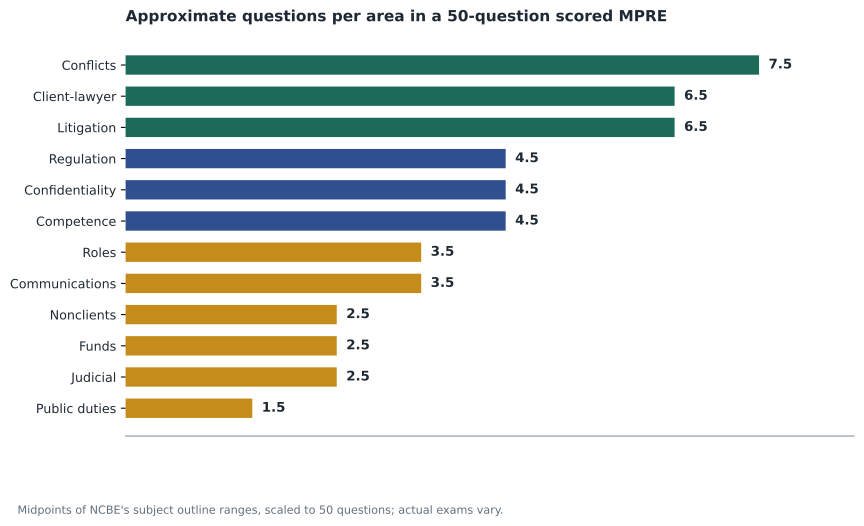
This lesson is that full set. The 30 questions below cover all twelve areas of the MPRE outline, roughly in proportion to their weight on the real exam. Together with the 20-question final exam for this course, they make 50 questions, the same number of scored questions as the MPRE. For a realistic rehearsal, set a timer for 100 minutes, answer all 50 in one sitting at two minutes a question, and only then check your answers. Every question here is original; none is drawn from NCBE's released questions.
How to use this practice set
Treat it as a dress rehearsal. Sit at a desk with nothing but the questions and a timer, as you will at the test center. Do not look up rules. Answer every question, because there is no penalty for guessing, and flag any question that takes more than three minutes, choose your best answer, and move on. When the time is up, stop, even if you have not finished, and note where you stopped: pacing is part of what you are measuring.
After the timed sitting, review every question, including the ones you got right. For each wrong answer, write down three things in your error log: the rule that governs the question, the specific fact that triggered it, and why the answer you chose was tempting. For each right answer you were unsure about, write the rule as well. The goal is to find patterns. Most candidates find that their errors cluster in two or three areas, often conflicts, confidentiality and the difference between 'may' and 'must'.
Reading questions under time pressure
Read the call of the question first, the last sentence, so you know whether you are deciding discipline, permission, obligation, liability or privilege. Then read the facts, looking for the trigger words that signal a rule: a gift, a former client, a confidential remark, a represented person, an unrepresented person, a judge's relative. Decide yes or no before you look at the choices, and then choose the reason that states the rule correctly. If two choices both seem right, look for the one that states the controlling rule rather than a related principle, and be wary of absolute words such as 'never' and 'always,' which are wrong more often than right in this subject.
Watch for the classic traps. A morally appealing answer that has the lawyer disclose a confidence to do good is often wrong unless a Rule 1.6(b) exception applies. A choice that says a lawyer 'must' disclose under Rule 1.6(b) is almost always wrong, because the exceptions are permissive; Rule 3.3 is the main place where disclosure becomes mandatory. A choice that relies on the client's consent may be wrong if the conflict is not consentable or the consent lacks the required writing. And a choice that relies on the lawyer's good intentions is usually wrong, because most rules turn on conduct and knowledge, not motive, except in solicitation, where pecuniary motive is the test.
| Trigger in the facts | Rule to check first |
|---|---|
| A gift, a loan, a business deal or financial help between lawyer and client | 1.8 |
| A lawyer changing firms or leaving government | 1.9, 1.10, 1.11 |
| A secret, a confession, a court subpoena or a request to disclose | 1.6, privilege, 3.3 |
| Lying under oath, false documents, or evidence destroyed | 3.3, 3.4 |
| Contact with someone who has a lawyer, or with someone who does not | 4.2, 4.3 |
| An ad, a website, a letter to a potential client, or a phone call to one | 7.1, 7.2, 7.3 |
| Client money, a settlement check, or a disputed fee | 1.15, 1.5 |
| A judge, a law clerk, a campaign or a gift to a judge | Model Code of Judicial Conduct |
The practice set
Answer all 30 questions before reading the explanations. Each question is followed by the correct answer and a short explanation. Then take the 20-question final exam for this course to complete the 50-question rehearsal.
Practice problems
Work each problem on paper first, then reveal the answer to check.
A lawyer licensed only in State A answers a friend's question at a party about State B's landlord law and says, "You should withhold rent." Is the lawyer subject to discipline? (A) No, because the advice was free. (B) No, because a single casual answer to a friend is not the unauthorized practice of law in State B. (C) Yes, because a lawyer may never discuss another state's law. (D) Yes, because the lawyer created a client relationship.
Show answer
(B). Casual advice to a friend, without holding out or a systematic presence in State B, is not a 5.5 violation, though it may create civil liability if relied on.
A lawyer learns that a partner in her firm has been billing clients for hours he did not work. The information did not come from a client. Must she report it? (A) No, because the partner is in her own firm. (B) No, unless a client complains. (C) Yes, to the appropriate disciplinary authority. (D) Yes, but only to the firm's managing partner.
Show answer
(C). Billing fraud raises a substantial question of honesty; Rule 8.3(a) requires reporting to the disciplinary authority, and same-firm status is no exception.
A client asks her lawyer what sentence she would face if she lied on a federal loan application. The lawyer explains the statute and typical sentences. The client later lies on an application. Is the lawyer subject to discipline? (A) Yes, because the lawyer should have reported the client. (B) Yes, because the lawyer assisted a crime. (C) No, because a lawyer may discuss the legal consequences of proposed conduct. (D) No, because the client did not tell the lawyer she would definitely lie.
Show answer
(C). Rule 1.2(d) expressly allows explaining legal consequences.
A defendant in a civil case offers to settle for 40,000 dollars. The plaintiff has told her lawyer she wants to hear about every offer. The lawyer, thinking the offer far too low, rejects it without telling her. Is the lawyer subject to discipline? (A) No, because the offer was clearly too low. (B) Yes, because the decision to settle belongs to the client and the offer had to be communicated. (C) No, because rejecting the offer helped the client. (D) Yes, because only a court may reject offers.
Show answer
(B). Rules 1.2(a) and 1.4: settlement decisions belong to the client, and offers must be communicated unless the client has previously indicated that such an offer is acceptable or unacceptable. This client asked to hear every offer.
A lawyer represents a corporation. The CFO tells her privately that he has been paying bribes to win contracts, and asks her to keep it between them. What must the lawyer do? (A) Keep the information confidential from the board, as the CFO asked. (B) Report the conduct to higher authority in the corporation, up to the board if necessary. (C) Report the CFO to the police immediately. (D) Withdraw without telling anyone.
Show answer
(B). The corporation is the client; Rule 1.13(b) requires reporting up when a constituent's violation is likely to cause substantial injury.
A client tells his lawyer that he plans to hurt his former business partner badly tomorrow. The lawyer believes him. May the lawyer warn the police? (A) No, because the information is confidential. (B) Yes, to the extent reasonably necessary to prevent reasonably certain substantial bodily harm. (C) Yes, but only after withdrawing. (D) No, unless the lawyer's services were used.
Show answer
(B). Rule 1.6(b)(1) does not require use of the lawyer's services.
A lawyer represents two clients forming a business. Before formation, one tells the lawyer privately that he plans to take a competing job. The clients had agreed at the outset that information would be shared. What should the lawyer do? (A) Keep the secret, because confidentiality protects each client. (B) Tell the other client, consistent with the joint representation agreement. (C) Withdraw without explanation and keep the secret. (D) Tell only the bank financing the business.
Show answer
(B). Joint clients generally cannot keep secrets from each other, especially when they agreed to share information.
A firm represents a tenant against a landlord. A lawyer who joins the firm previously represented the same landlord in the same dispute and learned its strategy. What allows the firm to continue under the Model Rules? (A) Nothing; the firm must withdraw. (B) The new lawyer's promise not to discuss the case. (C) A timely screen, no share of the fee for the new lawyer, and prompt written notice to the landlord. (D) The tenant's consent alone.
Show answer
(C). Rule 1.10(a)(2) lateral screen with notice to the former client.
A former federal prosecutor who personally handled an investigation of a company joins a firm. The company asks the firm to defend it in that same matter. What does the Model Rule require for the firm to proceed? (A) The government agency's consent to the former prosecutor's participation. (B) Nothing, if the prosecutor left more than a year ago. (C) Screening the former prosecutor, no fee share, and prompt written notice to the agency. (D) The company's waiver alone.
Show answer
(C). Rule 1.11(b). The former prosecutor personally cannot work on it without the agency's informed consent.
A lawyer drafts a will for her aunt that leaves the lawyer a valuable piano. Is the lawyer subject to discipline? (A) Yes, because a lawyer may never draft a will giving herself a gift. (B) Yes, unless the aunt had independent counsel. (C) No, because the lawyer is related to the client. (D) No, because pianos are personal property.
Show answer
(C). Rule 1.8(c) excepts relatives.
A lawyer agrees to represent a client in a personal injury case and pays the client's rent for three months so the client can hold out for a better settlement. The client is paying a contingent fee. Is the lawyer subject to discipline? (A) No, if the client repays from the recovery. (B) No, because the client is indigent. (C) Yes, because financial assistance for living expenses in litigation is prohibited here. (D) Yes, because contingent fees are improper in personal injury cases.
Show answer
(C). Rule 1.8(e); the humanitarian exception covers only indigent pro bono clients.
An insurance company pays a lawyer to defend its insured. The insurer instructs the lawyer not to file a meritorious motion because it would cost too much, although the insured would benefit. What should the lawyer do? (A) Follow the insurer's instruction, because it pays. (B) Exercise independent judgment in the insured's interest. (C) Withdraw immediately without explanation. (D) Ask the court to decide.
Show answer
(B). Rules 1.8(f) and 5.4(c): the payer may not direct the lawyer's professional judgment.
A lawyer's written contingent fee agreement, signed by the client, gives the lawyer one third of any recovery, but does not say whether expenses are deducted before or after the fee. Is the lawyer subject to discipline? (A) No, because the agreement is signed. (B) No, because one third is reasonable. (C) Yes, because the agreement must state whether expenses are deducted before or after the fee is calculated. (D) Yes, because contingent fees must be approved by a court.
Show answer
(C). Rule 1.5(c).
A lawyer collects a 60,000 dollar settlement. The client is entitled to 40,000 dollars, the lawyer to 15,000 dollars, and a hospital claims 5,000 dollars under a valid statutory lien that the client disputes. What should the lawyer do with the 5,000 dollars? (A) Pay it to the client, who disputes the lien. (B) Pay it to the hospital, because the lien is valid. (C) Hold it in the trust account until the dispute is resolved, while promptly distributing the undisputed amounts. (D) Keep it as an additional fee.
Show answer
(C). Rule 1.15(e).
A lawyer uses a generative AI tool to draft a brief and files it without checking the citations. Two cited cases do not exist. Which rules are most directly implicated? (A) Rule 7.1 only. (B) Competence (Rule 1.1) and candor toward the tribunal (Rule 3.3), with supervision duties under Rule 5.3. (C) Rule 1.8 only. (D) No rule, because the tool made the error.
Show answer
(B). Formal Opinion 512: lawyers must verify output; filing fake citations implicates competence and candor.
In a civil case, a lawyer knows of a decision from the state's highest court directly adverse to her client that the other side has not cited. Must she disclose it? (A) No, because it is the other side's job. (B) Yes, but she may argue it is distinguishable or wrongly decided. (C) Only if the judge asks. (D) No, because disclosure would hurt her client.
Show answer
(B). Rule 3.3(a)(2).
A criminal defense lawyer suspects, but does not know, that her client will testify falsely. The client insists on testifying. What should the lawyer do? (A) Refuse to call the client. (B) Allow the client to testify, resolving doubts in the client's favor. (C) Tell the judge of her suspicion. (D) Withdraw immediately.
Show answer
(B). The perjury duties require knowledge; a criminal defendant has a right to testify.
A plaintiff's lawyer pays an eyewitness 1,000 dollars "for his time" plus a bonus of 5,000 dollars if the plaintiff wins. Is the lawyer subject to discipline? (A) No, because witnesses may be compensated. (B) Yes, because payment contingent on the outcome is prohibited. (C) No, if the payment is disclosed to the jury. (D) Yes, because witnesses may never be paid anything.
Show answer
(B). Rule 3.4(b) and comments: reasonable expenses are allowed; contingent payments are not.
During a high-profile criminal trial, the prosecutor tells reporters that the defendant failed a polygraph test. Is the prosecutor subject to discipline? (A) No, because polygraph results are public. (B) Yes, because the statement has a substantial likelihood of materially prejudicing the proceeding. (C) No, because prosecutors may comment freely. (D) Yes, but only if the defendant is acquitted.
Show answer
(B). Rule 3.6 and 3.8(f); polygraph results are a classic prejudicial subject.
A lawyer represents a buyer in negotiating to purchase a building and says, "My client won't pay a dollar over 2 million." The client has authorized up to 2.3 million. Is the lawyer subject to discipline? (A) Yes, because the statement is false. (B) No, because statements of a party's intentions about an acceptable price are ordinarily not taken as statements of material fact. (C) Yes, because lawyers must disclose their authority. (D) No, because the seller had a lawyer.
Show answer
(B). Rule 4.1 comment [2].
A lawyer knows the opposing party in a contract dispute is represented. The opposing party's CEO calls the lawyer and asks to discuss settlement without lawyers. May the lawyer do so? (A) Yes, because the CEO called. (B) Yes, because the CEO controls the company. (C) No, unless the company's lawyer consents. (D) No, because the CEO is not a party.
Show answer
(C). Rule 4.2 covers constituents who can obligate the organization.
A lawyer sends a personalized letter to a homeowner facing foreclosure offering to represent her. The letter is truthful and not misleading. Is the lawyer subject to discipline under the Model Rules? (A) Yes, because targeted solicitation is prohibited. (B) No, because written solicitation that is not false or misleading is permitted. (C) Yes, unless the letter says "Advertising Material." (D) No, but only if the homeowner is a former client.
Show answer
(B). Shapero; Rule 7.3 bans live contact, not truthful letters. Some states add labeling rules.
A lawyer pays a hospital orderly 200 dollars for each patient he refers to her. Is the lawyer subject to discipline? (A) No, if the patients are told. (B) Yes, because a lawyer may not pay a person for recommending her services. (C) No, because the orderly is not a lawyer. (D) Yes, but only if a patient complains.
Show answer
(B). Rule 7.2(b).
A lawyer's website states that she is a "Certified Specialist in Estate Planning." She has been certified by a private group that is neither ABA-accredited nor state-approved. Is she subject to discipline? (A) No, because the statement is true. (B) Yes, because certification claims require an ABA-accredited or state-approved certifying organization, named in the communication. (C) No, because websites are not advertising. (D) Yes, because lawyers may never use the word "specialist."
Show answer
(B). Rule 7.2(c).
A judge's law clerk discusses a pending case with the judge. Is this an improper ex parte communication? (A) Yes, because the parties were not present. (B) No, because judges may consult court staff whose function is to aid them. (C) Yes, unless the parties consent. (D) No, but only for scheduling matters.
Show answer
(B). Model Code of Judicial Conduct Rule 2.9(a)(3).
A judge owns 100 shares of a large public company through a mutual fund she does not manage. The company is a party before her. Must she disqualify? (A) Yes, because any ownership requires disqualification. (B) No, because an interest in a mutual fund the judge does not manage is not an economic interest. (C) Yes, unless the parties consent. (D) No, because 100 shares is always de minimis.
Show answer
(B). The Code's definition of economic interest excludes such funds.
A judicial candidate personally phones lawyers who practice before her court to ask for campaign contributions. Is this proper under the Model Code? (A) Yes, because the Supreme Court protects campaign speech. (B) No, because contributions must be solicited through a campaign committee. (C) Yes, if the amounts are small. (D) No, because judicial candidates may not accept contributions at all.
Show answer
(B). Rule 4.1(A)(8); Williams-Yulee upheld the ban.
A lawyer leaves a firm and takes a client's file, refusing to give it to the client's new lawyer until the client pays an overdue bill, although the client needs the file for a hearing next week. Which statement is correct? (A) The lawyer may always hold the file until paid. (B) The lawyer must take reasonable steps to protect the client's interests, which ordinarily means surrendering papers the client needs, subject to other law on liens. (C) The lawyer must destroy the file. (D) Only the court may decide.
Show answer
(B). Rule 1.16(d) and comments.
A lawyer represents a client in a slip-and-fall case. The lawyer, without the client's consent, accepts a settlement offer the lawyer considers excellent. Is the lawyer subject to discipline? (A) No, because the result was excellent. (B) Yes, because the decision to settle belongs to the client. (C) No, if the client later approves. (D) Yes, but only if the client loses money.
Show answer
(B). Rule 1.2(a).
A law firm and an accounting firm form a joint venture that gives both legal and tax advice and shares profits. Is the lawyer subject to discipline under the Model Rules? (A) No, because both are licensed professionals. (B) Yes, because a lawyer may not form a partnership with a nonlawyer if any of its activities consist of the practice of law. (C) No, if clients are informed. (D) Yes, but only in states without alternative business structures.
Show answer
(B). Rule 5.4(b). Arizona and Utah differ, but the MPRE follows the Model Rule.
After the set: reviewing and planning
When Dana and Sofia finish the set, Marchetti asks them to score it by area. Dana misses two conflicts questions, one on the lateral screen and one on joint clients, and one on reporting up. Sofia misses the adverse authority question and the expert witness payment question. Both get every judicial conduct question right, which surprises them. Marchetti points out that the areas they missed are among the most heavily weighted on the exam, and tells them to reread Lessons 5, 6 and 8 and to do twenty more questions in each area before their February exams.
For candidates sitting the MPRE soon, the last week matters. Take one more full timed set five to seven days before the exam, review it thoroughly, and then stop doing new questions two days before. Reread your error log the day before, not the rules from start to finish. Confirm your appointment, the test center address, the time you must arrive and the identification you will bring. On the day, arrive early, use the locker, and once the exam starts, keep a steady pace of about 15 questions per half hour.
Most candidates who prepare in a structured way pass the MPRE comfortably; the national mean of about 95 in 2025 is well above every jurisdiction's passing score. If you do not pass, the score report tells you only your scaled score, so your error log is the best guide to what to study for the next administration. Remember that you cannot transfer a registration, so register early for the next date, and that many jurisdictions accept a passing score for several years, so you may well be able to complete the MPRE well before or after your bar exam.
What comes next
This course is part of the US Bar Exam Prep program. If you have not yet taken BAR-101, it explains how the MPRE fits into the larger admission process: applications, character and fitness, the bar exam itself and score transfer. The core review courses cover the subjects of the Multistate Bar Examination, the essay and performance tests, and the NextGen bar exam. Each jurisdiction course explains that jurisdiction's MPRE score requirement and any local professional responsibility component, such as a state-specific ethics course or exam, and the ways its own rules of professional conduct differ from the Model Rules you have studied here.
Marchetti ends the workshop by reading out a line from the preamble to the Model Rules, which says that a lawyer, as a member of the legal profession, is a representative of clients, an officer of the legal system and a public citizen having special responsibility for the quality of justice. 'That is what this exam is about,' she says. 'It is a short test of a long tradition. Pass it, and then keep the rules where you can find them, because the real questions start on your first day of practice.'
Summary and key terms
- Take this 30-question set and the 20-question final exam together, in 100 minutes, to rehearse a 50-question scored MPRE.
- Read the call first, decide yes or no from the rule, then pick the choice that states the rule correctly.
- Watch for traps: permissive versus mandatory disclosure, nonconsentable conflicts, missing writings, and answers based on good intentions.
- Review every question and keep an error log by rule; most errors cluster in conflicts, confidentiality and litigation.
- In the last week, take one more full set, stop new questions two days out, confirm logistics and keep a steady pace on the day.
- Call of the question
- The final sentence of an MPRE question, which states what you must decide.
- Error log
- A record of each missed rule, the triggering fact and why the wrong answer tempted you.
- Blind review
- Reviewing flagged questions again before checking answers, to separate knowledge from luck.
- Trigger word
- A fact in a question, such as a gift or a former client, that signals which rule applies.
- Dress rehearsal
- A full timed practice set taken under test conditions.
Lesson quiz · 5 questions
Score 60% or more to complete this lesson.
Create a free account to save your progress, take quizzes and earn a certificate.