
BAR-140 · Lesson 3 of 12 · 23 min
The client-lawyer relationship
▶ Video coming soon A video version of this lesson is on the way.
Marchetti begins the October 15 workshop with a story from her own early practice. A man phoned the firm, described a dispute with his landlord for twenty minutes, and asked whether he should withhold rent. The young lawyer who took the call told him he probably should. The man never signed an engagement letter and never paid a fee, but when the landlord evicted him, he sued the firm for malpractice. 'Was he a client?' she asks. Dana says no, because he never hired them. Ngozi says yes, because he relied on the advice. Marchetti tells them that Ngozi's answer is closer to the law, and that this lesson is about exactly that kind of question.
The client-lawyer relationship is the second block of the MPRE outline and accounts for about 10 to 16 percent of the questions. It covers how the relationship forms, how scope and objectives are set, who decides what, the lawyer's duty to stay within the law when counseling, communication, clients with decision-making limitations, and how the relationship ends. Fees, which the outline also places here, are covered with competence in Lesson 7.
How the relationship forms
A client-lawyer relationship can be formed without a written contract or payment. Under the Restatement (Third) of the Law Governing Lawyers, section 14, a relationship arises when a person manifests an intent that the lawyer provide legal services, and the lawyer either manifests consent or fails to manifest lack of consent when the lawyer knows or reasonably should know that the person reasonably relies on the lawyer to provide the services. A court appointment also creates a relationship. So the lawyer in Marchetti's story, by giving specific advice the caller plainly relied on, probably created a relationship, and with it duties of competence and confidentiality.
Lawyers are generally free to decline representation, with some limits. A lawyer must decline if the representation would violate the rules or other law, such as when the lawyer has a disqualifying conflict or lacks competence and cannot gain it in time. Court appointments are different: under Rule 6.2, a lawyer should not seek to avoid an appointment except for good cause, such as that the representation would violate the rules, impose an unreasonable financial burden, or involve a client or cause so repugnant to the lawyer as to impair the relationship or the lawyer's ability to represent the client.
Some duties arise before a relationship forms. Under Model Rule 1.18, a person who consults a lawyer about the possibility of forming a relationship is a prospective client, and the lawyer must protect information learned in the consultation even if no representation follows. Lesson 6 covers the conflict consequences of that duty.
Duty to inquire before accepting a matter
In August 2023 the ABA amended Model Rule 1.16 and its comments in response to concerns about lawyers being used in money laundering and fraud. Rule 1.16(a) now says a lawyer shall inquire into and assess the facts and circumstances of each representation to determine whether the lawyer may accept or continue the representation. The comments explain that the inquiry is risk-based: the amount of due diligence depends on factors such as the identity of the client, the nature of the services, the jurisdictions involved and any red flags. ABA Formal Opinion 513 (2024) elaborates on the duty. Not every state has adopted the amendment, but it is now part of the Model Rule the MPRE tests.
The duty connects to Rule 1.2(d), which forbids a lawyer from counseling a client to engage, or assisting a client, in conduct the lawyer knows is criminal or fraudulent. Knowledge can be inferred from circumstances, and a lawyer who deliberately avoids finding out may be treated as knowing. The amended rule makes explicit that a lawyer must look at the facts rather than look away.
Scope and objectives
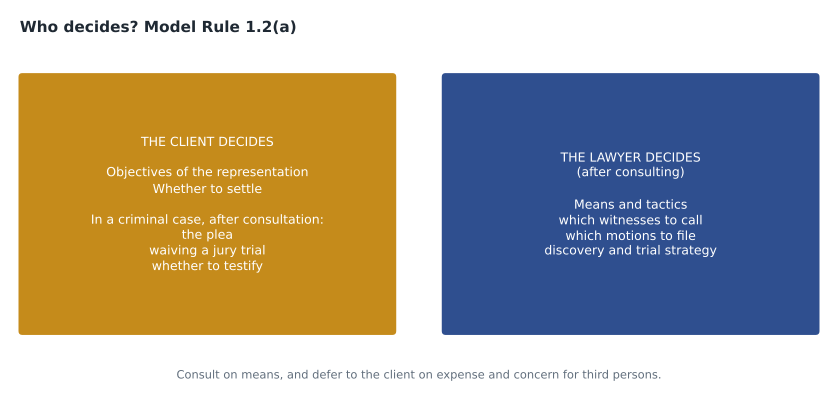
Model Rule 1.2(a) divides decision-making between client and lawyer. The client decides the objectives of the representation, and the lawyer must abide by those decisions and consult with the client about the means to pursue them. Certain decisions belong to the client alone: whether to settle a matter, and in a criminal case, after consulting the lawyer, what plea to enter, whether to waive a jury trial, and whether the client will testify. Lawyers generally control technical and tactical matters, such as which witnesses to call, what motions to file and how to conduct cross-examination, though they must consult with the client and should defer to the client on matters such as expense and concern for third persons.
A lawyer who settles a case without the client's authority, or who rejects a settlement offer without telling the client, violates Rule 1.2(a) and Rule 1.4. Even a generous offer must go to the client. Marchetti's quick rule: if the decision affects whether the client wins, loses or settles, or gives up a constitutional right in a criminal case, it is the client's.
Rule 1.2(b) adds that representing a client does not endorse the client's political, economic, social or moral views or activities. Rule 1.2(c) permits a lawyer to limit the scope of a representation if the limitation is reasonable under the circumstances and the client gives informed consent. Limited-scope representation, sometimes called unbundling, lets a lawyer draft a single document or coach a self-represented litigant for one hearing. The limitation must be reasonable: a lawyer may not limit a representation so narrowly that competent help is impossible, such as agreeing to give advice in a complex matter after only a brief phone call.
Counseling within the law
Rule 1.2(d) is one of the most tested lines in the rules. A lawyer must not counsel or assist a client in conduct the lawyer knows is criminal or fraudulent. But a lawyer may discuss the legal consequences of any proposed course of conduct with a client and may counsel or assist a client to make a good-faith effort to determine the validity, scope, meaning or application of the law. Explaining what the law forbids and what the penalties are is lawful advice, even when the client later uses it to break the law. Helping the client structure a transaction to hide assets from creditors, drafting false documents, or advising on how to avoid detection is assistance and is forbidden.
If a lawyer discovers in the middle of a representation that the client is using the lawyer's services to commit a crime or fraud, the lawyer must stop. Rule 1.16(a)(1) requires withdrawal if continuing will result in a violation of the rules or other law, and Rule 1.6(b)(2) and (3) may permit disclosure, as Lesson 4 explains. The lawyer may also need to disaffirm documents the lawyer prepared, sometimes called a noisy withdrawal.
Worked problem
Advice or assistance?
A client who owns a restaurant asks his lawyer what happens to employers who pay workers in cash without withholding taxes. The lawyer explains the civil and criminal penalties and the likelihood of audits. The client then does it anyway. Is the lawyer subject to discipline?
Show solution
- Rule 1.2(d) forbids counseling or assisting conduct the lawyer knows is criminal or fraudulent.
- It expressly allows discussing the legal consequences of a proposed course of conduct.
- The lawyer explained consequences; the lawyer did not help design or hide the scheme.
Answer: No. Explaining the law and its penalties is permitted even if the client later breaks it. If the client had asked the lawyer to set up the cash payroll so it would not be detected, helping would be a violation.
Communication
Model Rule 1.4 requires a lawyer to promptly inform the client of any decision or circumstance requiring the client's informed consent, reasonably consult with the client about the means of pursuing the client's objectives, keep the client reasonably informed about the status of the matter, promptly comply with reasonable requests for information, and consult with the client about relevant limitations on the lawyer's conduct when the client expects assistance the rules do not allow. The lawyer must also explain a matter to the extent reasonably necessary to permit the client to make informed decisions.
The duty is ongoing. A lawyer who goes months without returning calls, who fails to tell a client that the case was dismissed, or who does not pass on a settlement offer violates Rule 1.4, often alongside Rule 1.3, diligence. The comments allow a lawyer to delay transmitting information when the client would be likely to react imprudently to an immediate communication, for example a psychiatric diagnosis that a doctor advises should be given by the doctor, but a lawyer may not withhold information to serve the lawyer's own interest or convenience, or because a court order forbids it to someone else.
In August 2026 the ABA added a new comment [8] to Rule 1.4 stating that a lawyer should promptly inform a current client of a material error in the representation, with factors for deciding whether an error is material, and noting that the duty does not extend to former clients. This codifies the approach of ABA Formal Opinion 481 (2018). Because NCBE tests amendments after a lead time, expect questions on this to follow the earlier opinion's reasoning: a material error, meaning one a disinterested lawyer would conclude a reasonable client would want to know about, must be disclosed to a current client promptly.
Clients with decision-making limitations
Model Rule 1.14 governs representation of a client whose capacity to make adequately considered decisions is limited, whether because of minority, mental impairment or another reason. In February 2026 the ABA adopted a substantially rewritten Rule 1.14 that replaces the phrase 'diminished capacity' with 'decision-making limitations', recognizes that such limitations can be situational and can change, names supported decision-making as an accommodation that can strengthen a client's ability to decide, and encourages lawyers to consider the least restrictive protective measures before guardianship. Conforming comment changes to Rules 1.2, 1.4 and 1.16 followed in August 2026.
The core duties are stable across both versions. The lawyer must, as far as reasonably possible, maintain a normal client-lawyer relationship with the client. When the lawyer reasonably believes the client is at risk of substantial physical, financial or other harm unless action is taken and cannot adequately act in the client's own interest, the lawyer may take reasonably necessary protective action, such as consulting family members or professionals or, as a last resort, seeking appointment of a guardian. In doing so the lawyer is impliedly authorized to reveal information about the client, but only to the extent reasonably necessary to protect the client's interests. A lawyer may not simply substitute the lawyer's judgment for the client's because the lawyer disagrees with the client's choices.
Ending the relationship
Model Rule 1.16 sets out when a lawyer must and may withdraw. A lawyer must withdraw if the representation will result in a violation of the rules or other law, if the lawyer's physical or mental condition materially impairs the lawyer's ability to represent the client, or if the lawyer is discharged. A client may discharge a lawyer at any time, with or without cause, subject to liability for fees already earned.
A lawyer may withdraw for several reasons: if withdrawal can be accomplished without material adverse effect on the client's interests; if the client persists in a course of action involving the lawyer's services that the lawyer reasonably believes is criminal or fraudulent; if the client has used the lawyer's services to perpetrate a crime or fraud; if the client insists on action the lawyer considers repugnant or with which the lawyer has a fundamental disagreement; if the client fails substantially to fulfill an obligation to the lawyer, such as paying fees, after reasonable warning; if the representation will result in an unreasonable financial burden or has been rendered unreasonably difficult by the client; or for other good cause. ABA Formal Opinion 516 (2025) explains what counts as a material adverse effect that blocks withdrawal under the first ground, such as withdrawing on the eve of trial.
If a matter is before a tribunal, the lawyer must comply with rules requiring the tribunal's permission, and must continue the representation if ordered to, even when good cause exists. ABA Formal Opinion 519 (2025) cautions that a motion to withdraw should reveal only what is necessary, often no more than that professional considerations require withdrawal. On any termination, Rule 1.16(d) requires the lawyer to take reasonable steps to protect the client's interests: give reasonable notice, allow time to employ other counsel, surrender papers and property to which the client is entitled, and refund any advance payment of fees or expenses that has not been earned. A lawyer may keep papers only to the extent other law, such as a retaining lien, permits, and the comments discourage holding a file hostage in a way that prejudices the client.
| Must withdraw | May withdraw (examples) |
|---|---|
| Continuing will violate the rules or other law | No material adverse effect on the client |
| The lawyer's condition materially impairs representation | Client persists in conduct the lawyer believes criminal or fraudulent |
| The lawyer is discharged | Client used the lawyer's services for a crime or fraud |
| Repugnant objectives or fundamental disagreement | |
| Client fails to pay after warning; unreasonable financial burden; other good cause |
Worked problem
Withdrawal before trial
A client in a civil case has not paid the lawyer's bills for four months despite two written warnings. Trial is set for next month. The lawyer moves to withdraw, and the judge denies the motion. What must the lawyer do?
Show solution
- Nonpayment after warning is a permissive ground under Rule 1.16(b)(5).
- But Rule 1.16(c) requires the lawyer to continue if a tribunal orders it.
Answer: The lawyer must continue representing the client competently through trial. The lawyer may still pursue the fee later.
Practice problems
Work each problem on paper first, then reveal the answer to check.
Can a client-lawyer relationship arise without a fee agreement?
Show answer
Yes. It arises when the person seeks legal services and the lawyer agrees, or fails to decline when the lawyer knows the person reasonably relies on the lawyer.
Who decides whether to accept a settlement offer?
Show answer
The client, always. The lawyer must communicate every offer.
What did the 2023 amendment to Rule 1.16(a) add?
Show answer
A duty to inquire into and assess the facts and circumstances of each representation to decide whether the lawyer may accept or continue it.
May a lawyer explain to a client the penalties for a crime the client is considering?
Show answer
Yes. Discussing legal consequences is permitted; assisting is not.
Common mistakes
MistakeNo fee, no client.
InsteadA relationship can form from reliance and the lawyer's failure to decline, without payment.
MistakeThe lawyer controls settlement because the lawyer knows the case.
InsteadSettlement belongs to the client.
MistakeGood cause to withdraw lets the lawyer leave a case regardless of the court.
InsteadA lawyer must continue if a tribunal orders it.
Summary and key terms
- A relationship forms when a person seeks legal help and the lawyer agrees or fails to decline despite reasonable reliance; prospective clients get confidentiality protection.
- Clients decide objectives, settlement and, in criminal cases, the plea, jury waiver and testifying; lawyers decide means after consultation.
- Rule 1.2(d) forbids counseling or assisting crime or fraud but permits explaining legal consequences; Rule 1.16(a) now requires inquiry into each representation.
- Rule 1.4 requires prompt communication of offers, status and material errors to current clients.
- Rule 1.14, rewritten in 2026, uses "decision-making limitations" and favors the least restrictive protective action; Rule 1.16 governs mandatory and permissive withdrawal.
- Informed consent
- Agreement after the lawyer explains the material risks and reasonably available alternatives.
- Limited-scope representation
- Representation limited by agreement to part of a matter, permitted if reasonable and with informed consent.
- Prospective client
- A person who consults a lawyer about possibly forming a client-lawyer relationship.
- Decision-making limitations
- The 2026 Model Rule 1.14 term for limits on a client's capacity to make adequately considered decisions.
- Noisy withdrawal
- Withdrawing and disaffirming work product to avoid assisting a client's fraud.
Lesson quiz · 5 questions
Score 60% or more to complete this lesson.
Create a free account to save your progress, take quizzes and earn a certificate.