
BAR-140 · Lesson 5 of 12 · 24 min
Conflicts of interest: current clients
▶ Video coming soon A video version of this lesson is on the way.
Conflicts of interest are the largest block on the MPRE, about 12 to 18 percent of the scored questions, and Marchetti spends two workshops on them. At the October 29 session she starts with a practical exercise. She describes a small firm with three lawyers and asks the group to imagine the firm's intake form. 'Every time a new matter comes in, someone has to ask: does this hurt a current client, a former client, a prospective client, or the lawyer?' Sofia, who worked at a two-lawyer office in Fresno during law school, says hers just asked the receptionist whether the name sounded familiar. Marchetti laughs. 'That is how firms end up disqualified.'
This lesson covers conflicts involving current clients under Model Rules 1.7 and 1.8: direct adversity, material limitation, consent and when it is not enough, joint representation, and the specific prohibited transactions in Rule 1.8, including business dealings with clients, gifts, financial assistance, third-party payment, aggregate settlements and sexual relations. Lesson 6 covers former clients, prospective clients, imputation to the firm and government lawyers.
The general rule: Model Rule 1.7
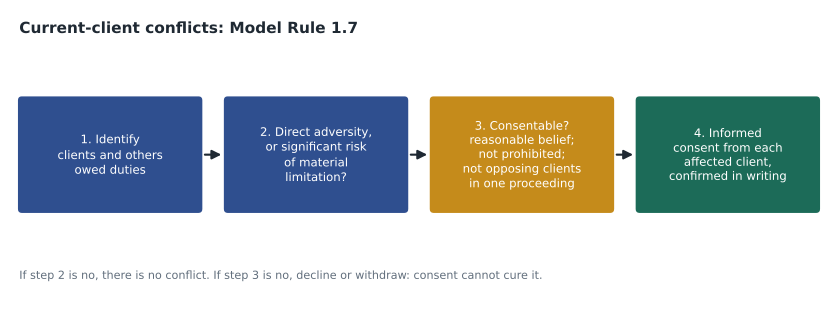
Rule 1.7(a) says a concurrent conflict of interest exists if the representation of one client will be directly adverse to another client, or if there is a significant risk that the representation of one or more clients will be materially limited by the lawyer's responsibilities to another client, a former client or a third person, or by a personal interest of the lawyer. A lawyer must not represent a client if a concurrent conflict exists unless the conditions in Rule 1.7(b) are met.
Direct adversity is the simpler category. A lawyer may not sue a current client on behalf of another client, even in an unrelated matter, without both clients' informed consent, because the client being sued would reasonably feel betrayed by its own lawyer. Cross-examining a current client as an adverse witness can also be direct adversity. Representing competing economic interests, such as two businesses bidding for the same contract, is generally not direct adversity unless the lawyer must act against one of them in the matter.
Material limitation is broader and more subtle. It asks whether the lawyer's other duties or interests create a significant risk that the lawyer will not be able to recommend or carry out an appropriate course of action for the client. Examples include representing two co-defendants whose best defenses point at each other, representing several people forming a business whose interests in the deal differ, or representing a client against a company in which the lawyer owns a large block of stock. The mere possibility of later harm is not enough; the question is whether there is a significant risk.
When consent cures a conflict
Rule 1.7(b) allows a lawyer to proceed despite a concurrent conflict only if four conditions are all met. First, the lawyer reasonably believes that the lawyer will be able to provide competent and diligent representation to each affected client. Second, the representation is not prohibited by law. Third, the representation does not involve the assertion of a claim by one client against another client represented by the lawyer in the same litigation or other proceeding before a tribunal. Fourth, each affected client gives informed consent, confirmed in writing.
The first three conditions decide whether a conflict is consentable at all. If a disinterested lawyer would conclude that the client should not agree, the lawyer cannot ask. A lawyer can never represent both the plaintiff and the defendant in the same lawsuit, whatever they say. Some jurisdictions forbid one lawyer from representing multiple defendants in a capital case. And the lawyer's belief must be objectively reasonable, not just sincere.
The fourth condition has two parts. Informed consent requires that the lawyer explain the material risks and reasonably available alternatives, including the effect on confidentiality and the attorney-client privilege. 'Confirmed in writing' means either the client's written consent or a writing the lawyer promptly sends the client confirming an oral consent. The writing does not have to be signed by the client; that stricter requirement applies to some Rule 1.8 transactions. A lawyer who discloses the conflict but gets consent only orally and never confirms it in writing is subject to discipline even if the representation goes well.
Worked problem
Suing a current client in an unrelated matter
A firm represents a regional bank in its loan collections. A small business asks the firm to sue the same bank for breach of an unrelated equipment lease. The lawyers who would handle the lease case have never worked on the bank's collections. May the firm take the case?
Show solution
- Suing a current client is direct adversity, regardless of whether the matters are related, so a conflict exists under 1.7(a)(1).
- Is it consentable? The firm could reasonably believe it can represent both competently, it is not prohibited by law, and the bank is not a client in the lease lawsuit on the other side of one of the firm's own clients in the same matter, so yes.
- Both the bank and the business must give informed consent, confirmed in writing.
Answer: Only if both clients give informed consent, confirmed in writing. Without the bank's consent, the firm must decline.
Joint representation
Lawyers often represent more than one client in the same matter: spouses in estate planning, partners forming a business, co-plaintiffs in an accident case. Joint representation is permitted when the clients' interests are generally aligned and the conflicts are consentable. The comments to Rule 1.7 warn about two features the lawyer must explain at the outset. First, as between jointly represented clients, the attorney-client privilege usually does not apply, so if they later sue each other, their communications with the lawyer can be used. Second, the lawyer generally cannot keep secrets from one client for another, because each is entitled to the information; the clients should agree at the start how information will be shared.
If the clients' interests later diverge sharply, the lawyer may have to withdraw from representing all of them, and may be unable to keep representing one against the other because of duties to the former client under Rule 1.9. That is one reason careful lawyers decline joint representation when there is significant tension from the start, such as co-defendants with inconsistent accounts of a crime. In criminal cases, the Sixth Amendment adds constitutional weight: Holloway v. Arkansas (1978) and Cuyler v. Sullivan (1980) address when joint representation of co-defendants violates the right to effective counsel.
The lawyer's own interests
A lawyer's personal interests can materially limit a representation. A lawyer who is negotiating for a job with the law firm on the other side of a client's matter has a material limitation conflict and must disclose it and obtain consent, or stop the negotiations; the comments say this explicitly. A lawyer whose own conduct is at issue in the matter, such as one who may have made a mistake that hurt the client, may have a conflict in advising the client about it. Close family relationships matter too: comment [11] to Rule 1.7 says lawyers related as parent, child, sibling or spouse ordinarily may not represent opposing clients in the same matter without informed consent, though the conflict is personal and is not imputed to their firms.
Positional conflicts, in which a lawyer argues for one legal position for one client and the opposite position for another client in a different case, usually do not create a conflict. They do when there is a significant risk that the lawyer's action for one client will materially limit the representation of the other, for example when the same appellate court is likely to decide both cases and a win for one client would create precedent seriously harming the other.
Specific prohibited transactions: Model Rule 1.8
Rule 1.8 lists particular situations that the drafters considered especially risky. Some are allowed only with specific safeguards, and some are flatly forbidden. The MPRE tests these heavily because the details are precise.
| Rule | Situation | Rule summary |
|---|---|---|
| 1.8(a) | Business transactions with a client, or acquiring an interest adverse to the client | Allowed only if terms are fair and reasonable and fully disclosed in writing; client advised in writing to seek independent counsel and given a reasonable opportunity; client gives informed consent in a writing signed by the client |
| 1.8(b) | Using a client's information to the client's disadvantage | Forbidden without informed consent |
| 1.8(c) | Soliciting a substantial gift, or preparing an instrument giving the lawyer or a relative a substantial gift | Forbidden unless the lawyer or recipient is related to the client |
| 1.8(d) | Literary or media rights about the representation | No agreement before the representation ends |
| 1.8(e) | Financial assistance to a client in litigation | Forbidden, except advancing court costs and expenses; paying costs for indigent clients; modest humanitarian gifts for indigent pro bono clients |
| 1.8(f) | Compensation from someone other than the client | Allowed only with informed consent, no interference with independence, and confidentiality preserved |
| 1.8(g) | Aggregate settlements for two or more clients | Each client must give informed consent in a signed writing after disclosure of all claims and each person's share |
| 1.8(h) | Limiting the lawyer's malpractice liability | No prospective limitation unless the client is independently represented; settling a claim with an unrepresented client requires written advice to seek counsel |
| 1.8(i) | Proprietary interest in the cause of action | Forbidden, except liens to secure fees and reasonable contingent fees in civil cases |
| 1.8(j) | Sexual relations with a client | Forbidden unless a consensual relationship existed before the representation began |
Business transactions under Rule 1.8(a) catch many lawyers because the rule applies even when the client is sophisticated and the deal is fair. If a lawyer takes a share of a client's start-up company as payment, invests in a client's real estate project, or lends money to a client, all three requirements must be met: fair and reasonable terms fully disclosed in writing in a manner the client can understand, written advice of the desirability of seeking independent counsel with a reasonable opportunity to do so, and the client's informed consent in a writing signed by the client describing the essential terms and the lawyer's role, including whether the lawyer is representing the client in the transaction. The rule does not apply to standard commercial transactions in which the lawyer is just a customer, such as buying goods from a client's store on ordinary terms.
The gift rule in Rule 1.8(c) forbids a lawyer from soliciting a substantial gift from a client or preparing an instrument, such as a will, giving the lawyer or the lawyer's relative a substantial gift, unless the lawyer or recipient is related to the client. A client may give an unsolicited gift; a holiday present or a modest token of appreciation is fine. But a lawyer who drafts a client's will naming the lawyer as a major beneficiary violates the rule unless the client is a relative. The proper course is for the client to have another lawyer draft that part.
The financial assistance rule in Rule 1.8(e) forbids a lawyer from giving a client financial help in connection with pending or contemplated litigation, because it would give lawyers too great a financial stake and encourage lawsuits. Lawyers may advance court costs and litigation expenses, with repayment contingent on the outcome, and may pay those costs outright for an indigent client. A 2020 amendment added a narrow humanitarian exception: a lawyer representing an indigent client pro bono, through a nonprofit legal services organization or a law school clinic, may give the client modest gifts for food, rent, transportation, medicine and other basic living expenses, but may not promise such help to win the client or seek repayment.
Third-party payment under Rule 1.8(f) is common: parents pay for an adult child's defense, an employer pays for an employee's lawyer, and liability insurers pay for the lawyers who defend their insureds. It is permitted only if the client gives informed consent, there is no interference with the lawyer's independence of professional judgment or with the client-lawyer relationship, and information relating to the representation is protected under Rule 1.6. Rule 5.4(c) says the same: the person who pays does not direct the lawyer. In insurance defense, the lawyer's client is the insured, and in many states also the insurer, but the lawyer must never follow an insurer's instruction that harms the insured's interests.
Aggregate settlements under Rule 1.8(g), in which a lawyer representing two or more clients settles their claims together, require each client's informed consent in a writing signed by the client, after the lawyer discloses the existence and nature of all the claims and each person's participation in the settlement. A lawyer cannot get advance agreement that the majority will decide for everyone. Class actions are governed by court rules instead.
Under Rule 1.8(h), a lawyer may not make an agreement prospectively limiting the lawyer's malpractice liability unless the client is independently represented in making the agreement, and may not settle a malpractice claim with an unrepresented client or former client without advising the client in writing that independent counsel is desirable and giving a reasonable opportunity to get it. Under Rule 1.8(i), a lawyer may not acquire a proprietary interest in the cause of action, except for a lien authorized by law to secure fees or expenses and a reasonable contingent fee in a civil case. And Rule 1.8(j) forbids sexual relations with a client unless a consensual sexual relationship existed when the client-lawyer relationship began. For an organizational client, it reaches relations with the person who supervises or regularly consults the lawyer about the matter.
Rule 1.8(k) imputes most of these prohibitions to every lawyer in the firm: if one lawyer could not enter a business deal with a client under 1.8(a) without meeting the requirements, no lawyer in the firm can. The exception is 1.8(j), sexual relations, which is personal to the lawyer involved.
Worked problem
A fee in stock
A lawyer forms a corporation for two founders and agrees to take 3 percent of the shares as her fee. She explains the terms orally and the founders, both engineers, sign a one-line agreement saying "Lawyer gets 3 percent." Is the lawyer subject to discipline?
Show solution
- Taking an ownership interest in a client's business is a business transaction under 1.8(a).
- The terms may be fair, but the lawyer did not disclose them in a detailed writing, did not advise in writing that independent counsel was desirable, and did not get a signed writing describing the essential terms and her role.
- The clients' sophistication does not excuse the requirements.
Answer: Yes. Every requirement of Rule 1.8(a) must be met, in writing, even with sophisticated clients and fair terms.
Practice problems
Work each problem on paper first, then reveal the answer to check.
Can a lawyer sue a current client in a matter unrelated to the work the lawyer does for that client?
Show answer
Only with both clients' informed consent, confirmed in writing, and only if the conflict is consentable.
Does "confirmed in writing" require the client's signature?
Show answer
No. A writing from the lawyer promptly confirming oral consent is enough; signed writings are required for 1.8(a) and 1.8(g).
May a lawyer draft a will for a longtime client that leaves the lawyer a valuable painting?
Show answer
No, unless the lawyer is related to the client. The client should use another lawyer for that gift.
May a lawyer lend rent money to a fee-paying litigation client?
Show answer
No. Financial assistance is forbidden except costs and expenses, and the humanitarian exception covers only indigent pro bono clients.
Common mistakes
MistakeConsent always cures a conflict.
InsteadSome conflicts are not consentable, such as representing opposing parties in the same lawsuit.
MistakeA fair deal with a sophisticated client needs no formalities.
InsteadRule 1.8(a) requires the written disclosures, written advice and signed consent regardless.
MistakeThe person who pays the fee directs the lawyer.
InsteadThe lawyer's duties run to the client; the payer may not interfere with professional judgment.
Summary and key terms
- A concurrent conflict exists with direct adversity or a significant risk of material limitation from duties to others or the lawyer's own interests.
- A conflict is cured only if consentable (reasonable belief, not prohibited, not opposing clients in one proceeding) and each client gives informed consent confirmed in writing.
- Joint clients usually lose the privilege between themselves and cannot keep secrets from each other; divergence may require withdrawal.
- Rule 1.8 sets precise rules for business transactions, gifts, media rights, financial assistance, third-party payment, aggregate settlements, liability limits, proprietary interests and sexual relations.
- All Rule 1.8 prohibitions except sexual relations are imputed to the whole firm.
- Direct adversity
- Acting against a current client, such as suing or cross-examining it, even in an unrelated matter.
- Material limitation
- A significant risk that duties to others or the lawyer's own interests will limit the representation.
- Consentable conflict
- A conflict that may be cured by informed consent because the Rule 1.7(b) conditions can be met.
- Confirmed in writing
- Written consent from the client, or a writing from the lawyer promptly confirming oral consent.
- Aggregate settlement
- A settlement of two or more clients' claims together, requiring each client's signed informed consent.
Lesson quiz · 5 questions
Score 60% or more to complete this lesson.
Create a free account to save your progress, take quizzes and earn a certificate.