
BAR-140 · Lesson 7 of 12 · 24 min
Competence, diligence and fees
▶ Video coming soon A video version of this lesson is on the way.
Before the November 5 conflicts session ends, Marchetti assigns the next topics as homework: competence, diligence, malpractice, fees and client money. 'These are the rules that end careers,' she tells the group, and she means it literally. In her years as a grader and coach she has seen more lawyers disbarred for mishandling client funds than for any other single cause. Eddie says that trust accounting sounds like the most boring rule on the exam. 'It is,' Marchetti says, 'right up until it is the most important thing in your life.'
This lesson combines three blocks of the MPRE outline. Competence, malpractice and civil liability make up about 6 to 12 percent of the exam, and safekeeping funds and property about 2 to 8 percent. Fees are part of the client-lawyer relationship block. Together they cover the duties of competence and diligence, a lawyer's civil liability to clients and nonclients, reasonable fees, contingent fees, fee division, and the rules for holding client and third-party money in trust.
Competence: Model Rule 1.1
Rule 1.1 requires a lawyer to provide competent representation, meaning the legal knowledge, skill, thoroughness and preparation reasonably necessary for the representation. A lawyer need not already be an expert to take a matter. The comments say a lawyer can provide competent representation in a new field through necessary study, or by associating with a lawyer of established competence, and that in an emergency a lawyer may give advice in a field the lawyer would not normally handle if referral is impractical, limited to what is reasonably necessary in the circumstances.
In 2012 the ABA added comment [8], which says that to maintain competence a lawyer should keep abreast of changes in the law and its practice, including the benefits and risks associated with relevant technology. Most states have adopted that comment. ABA Formal Opinion 512 (2024) applied it to generative artificial intelligence: a lawyer using such tools need not be an expert but must have a reasonable understanding of their capabilities and limitations, and must review and verify their output, because the tools can produce plausible but false citations and analysis. Courts across the country have sanctioned lawyers who filed briefs with fabricated case citations generated by AI, and those sanctions rest on the same duties of competence and candor.
Diligence and promptness: Model Rule 1.3
Rule 1.3 requires a lawyer to act with reasonable diligence and promptness in representing a client. The comments say that procrastination is perhaps the most widely resented professional shortcoming, and that a lawyer's workload must be controlled so that each matter can be handled competently. Missing a statute of limitations, failing to respond to discovery until sanctions are imposed, or letting a client's case sit for a year without action are typical violations. A sole practitioner should have a plan, under the comments, for another competent lawyer to review files and notify clients if the practitioner dies or becomes disabled.
Competence and diligence violations often travel with communication failures under Rule 1.4. A lawyer who misses a deadline and then hides it from the client violates all three, and may also violate Rule 8.4(c) by misrepresenting the status of the case. On the MPRE, a single mistake by a careful lawyer is usually not a disciplinary violation, though it may be malpractice; neglect, a pattern of carelessness or dishonesty about the mistake is.
Malpractice and other civil liability
Violating a rule of professional conduct does not by itself create a cause of action. The Model Rules' scope section says the rules are not designed to be a basis for civil liability, though courts may treat them as evidence of the standard of care. Civil liability comes from the law of torts, contracts and agency, collected in the Restatement (Third) of the Law Governing Lawyers. A legal malpractice claim in negligence requires a duty owed by the lawyer to the plaintiff, a breach of the standard of care (the competence and diligence of a reasonable lawyer in similar circumstances), causation, and damages. Causation is often proved by a 'case within a case': the former client must show that the underlying matter would have come out better without the lawyer's error.
Lawyers can also be liable to clients for breach of fiduciary duty, such as misusing confidential information or self-dealing, and for breach of contract. And lawyers can be liable to nonclients in limited situations. Under Restatement section 51, a lawyer owes a duty of care to a nonclient when the lawyer or the client invites the nonclient to rely on the lawyer's opinion and the nonclient does rely, such as a lawyer's opinion letter delivered to a lender in a loan closing, and to an intended beneficiary when the lawyer knows the client intends the lawyer's services to benefit the nonclient, which is why many states let disappointed beneficiaries sue the lawyer who negligently drafted a will. Lawyers are also liable to anyone for their own fraud, and for assisting a client's breach of fiduciary duty in some circumstances.
Model Rule 1.8(h), covered in Lesson 5, limits a lawyer's ability to cap malpractice liability. Lawyers may practice in limited liability entities, such as professional corporations or limited liability partnerships, which protect them from vicarious liability for partners' malpractice, but not from liability for their own errors or for those they directly supervise. The Model Rules do not require malpractice insurance, though Oregon and Idaho require it and many states require lawyers to disclose to clients or the bar whether they carry it.
Reasonable fees: Model Rule 1.5(a)
A lawyer must not make an agreement for, charge or collect an unreasonable fee or an unreasonable amount for expenses. Rule 1.5(a) lists factors for judging reasonableness: the time and labor required, the novelty and difficulty of the questions and the skill needed; the likelihood that accepting the matter will preclude other employment; the fee customarily charged in the locality; the amount involved and the results obtained; time limits imposed by the client or the circumstances; the nature and length of the professional relationship; the experience, reputation and ability of the lawyer; and whether the fee is fixed or contingent. No single factor controls.
A fee can be unreasonable even if the client agreed to it. A lawyer who charges a flat fee of 25,000 dollars for a routine uncontested matter that took two hours, or who bills for time not actually worked, violates the rule. Formal Opinion 512 applied the same principle to technology: a lawyer billing by the hour may bill for the actual time spent using an AI tool and reviewing its output, but may not bill for time saved, and generally may not charge clients for the time spent learning to use a tool the lawyer will use for many clients. Expenses charged to clients must be the actual cost, or a reasonable charge for in-house services, not a hidden profit.
Communicating the fee: Model Rule 1.5(b) and (c)
Rule 1.5(b) requires the lawyer to communicate the scope of the representation and the basis or rate of the fee and expenses to the client, preferably in writing, before or within a reasonable time after commencing the representation, except when the lawyer will charge a regularly represented client on the same basis as before. Under the Model Rule, an ordinary hourly or flat fee agreement does not have to be in writing, though many states require it. Changes in the basis or rate must also be communicated, and in August 2026 the ABA amended comment [1] to Rule 1.5 to state that modifying a fee arrangement during a representation is permissible only if the change is reasonable, communicated, and accepted by the client.
Rule 1.5(c) is stricter for contingent fees. A contingent fee agreement must be in a writing signed by the client, and must state the method by which the fee is to be determined, including the percentage or percentages that go to the lawyer in the event of settlement, trial or appeal; the litigation and other expenses to be deducted from the recovery; whether those expenses are deducted before or after the contingent fee is calculated; and any expenses for which the client will be liable whether or not the client wins. At the end of the matter, the lawyer must give the client a written statement showing the outcome and, if there is a recovery, the remittance to the client and the method of its determination.
Rule 1.5(d) forbids two kinds of contingent fees. A lawyer may not charge a fee in a domestic relations matter the payment or amount of which is contingent on securing a divorce or on the amount of alimony, support or a property settlement. And a lawyer may not charge a contingent fee for representing a defendant in a criminal case. The comments note that the domestic relations ban does not forbid a contingent fee for collecting past-due alimony or support that has already been ordered.
| Fee type | Writing required (Model Rule)? | Key limits |
|---|---|---|
| Hourly or flat fee, new client | Preferably in writing; not required | Must be reasonable; communicate basis and scope |
| Contingent fee | Yes, signed by the client | Must state percentages, expenses and how deducted; closing statement required |
| Contingent fee in divorce, alimony, support or property settlement | Not allowed | Except collecting past-due support already ordered |
| Contingent fee for a criminal defendant | Not allowed | Hourly or flat fees only |
| Division of fees between firms | Client agreement confirmed in writing | Proportion to work or joint responsibility; total reasonable |
Worked problem
A contingent fee agreement
A personal injury lawyer agrees orally with a client to take one third of any recovery. The case settles for 90,000 dollars, and the lawyer sends the client a check for 60,000 dollars with a note of congratulations. Is the lawyer subject to discipline?
Show solution
- A one-third contingent fee in a personal injury case is generally reasonable under 1.5(a).
- But 1.5(c) requires a contingent fee agreement in a writing signed by the client stating the percentage and how expenses are handled.
- 1.5(c) also requires a written closing statement showing the outcome, the remittance and the method of determining it.
Answer: Yes, twice over: no signed writing at the start, and no written closing statement at the end, even though the fee itself was reasonable.
Dividing fees between firms: Model Rule 1.5(e)
Lawyers who are not in the same firm may divide a fee only if three conditions are met: the division is in proportion to the services performed by each lawyer, or each lawyer assumes joint responsibility for the representation; the client agrees to the arrangement, including the share each lawyer will receive, and the agreement is confirmed in writing; and the total fee is reasonable. 'Joint responsibility' means financial and ethical responsibility for the representation as if the lawyers were partners, so a referring lawyer who does no work can still receive a share if the lawyer accepts that responsibility. Pure referral fees without joint responsibility are not allowed, and Rule 7.2(b) separately forbids paying anyone for recommending a lawyer's services, with narrow exceptions discussed in Lesson 9. The August 2026 comment amendment to Rule 1.5 adds that a lawyer with a disqualifying conflict may not receive a share of the fee.
Fee division rules do not apply to payments within a firm or to payments to a former partner under a separation or retirement agreement. And they never permit dividing fees with a nonlawyer, which Rule 5.4 forbids.
Advance fees, retainers and refunds
Lawyers often require payment in advance. An advance fee belongs to the client until it is earned, so it must be deposited in a client trust account and withdrawn only as the fees are earned or the expenses incurred, under Rule 1.15(c). A true retainer, paid only to secure the lawyer's availability and not for any services, is earned on receipt, but such arrangements are rare and must be reasonable. Many states treat 'nonrefundable' fees with suspicion: under Rule 1.16(d), a lawyer must refund any advance payment of a fee that has not been earned when the representation ends, whatever the agreement calls it.
Safekeeping property: Model Rule 1.15
Rule 1.15 requires a lawyer to hold property of clients or third persons that is in the lawyer's possession in connection with a representation separate from the lawyer's own property. Funds must be kept in a separate account maintained in the state where the lawyer's office is located, or elsewhere with the client's or third person's consent. The lawyer may deposit the lawyer's own funds in a client trust account only for the sole purpose of paying bank service charges on that account. Any other mixing of the lawyer's money with client money is commingling, which is a violation even if no client loses a cent. Using client money for the lawyer's own purposes, even temporarily and with intent to repay, is misappropriation, and in many states intentional misappropriation leads almost automatically to disbarment.
Most states require lawyers to put nominal or short-term client funds into IOLTA accounts, meaning interest on lawyers' trust accounts, whose interest goes to fund legal aid. Large or long-term deposits that can earn net interest for the client go into separate interest-bearing accounts for that client. The Model Rule requires complete records of account funds and other property to be kept for five years after the end of the representation, and the ABA's Model Rules for Client Trust Account Records describe what those records should include.
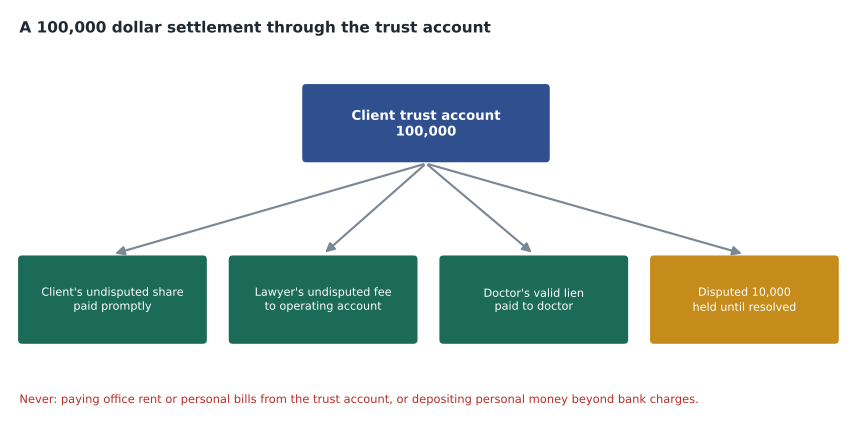
Rule 1.15(d) requires a lawyer, on receiving funds or property in which a client or third person has an interest, to promptly notify the client or third person, promptly deliver to them any funds or property they are entitled to receive, and on request promptly render a full accounting. Third persons can include a doctor holding a valid lien on a personal injury recovery, or a creditor with a judgment against the client. Rule 1.15(e) addresses disputes: when the lawyer and another person both claim an interest in property, the property must be kept separate until the dispute is resolved, but the lawyer must promptly distribute all portions not in dispute.
Worked problem
A disputed fee
A client and lawyer agree on a one-third contingent fee in a signed writing. The case settles for 120,000 dollars, deposited in the trust account. The client now says the lawyer deserves only 20,000 dollars, not 40,000. What should the lawyer do?
Show solution
- The client is entitled to at least 80,000 dollars, and the lawyer to at least 20,000, because neither amount is disputed.
- The disputed 20,000 dollars must stay in the trust account until the dispute is resolved.
Answer: Pay the client 80,000 dollars promptly, withdraw 20,000 dollars as the undisputed fee, and keep 20,000 dollars in trust pending resolution, through fee arbitration if the state offers it. Holding all 120,000 dollars hostage would violate Rule 1.15(e).
Practice problems
Work each problem on paper first, then reveal the answer to check.
May a lawyer take a case in a field new to her?
Show answer
Yes, if she can become competent through study or by associating with an experienced lawyer, without undue delay or expense to the client.
Must a regular hourly fee agreement with a new client be in writing under the Model Rules?
Show answer
No, it should preferably be in writing; contingent fee agreements must be in a writing signed by the client.
May a lawyer charge a contingent fee to defend someone charged with fraud?
Show answer
No. Contingent fees for criminal defense are forbidden.
May a lawyer keep a small amount of her own money in the trust account?
Show answer
Only enough to pay bank service charges on that account.
Common mistakes
MistakeIf the client agreed to the fee, it is reasonable.
InsteadA fee can be unreasonable despite agreement; reasonableness is judged by the 1.5(a) factors.
MistakeBorrowing from the trust account is fine if I pay it back.
InsteadUsing client funds for the lawyer's purposes is misappropriation, a very serious violation.
MistakeWhen a fee is disputed, the lawyer holds the entire amount.
InsteadOnly the disputed portion is held; undisputed amounts must be paid promptly.
Summary and key terms
- Competence requires knowledge, skill, thoroughness and preparation, including understanding relevant technology; diligence forbids neglect.
- Malpractice requires duty, breach, causation and damages; rule violations are evidence, not a claim; some nonclients are owed duties.
- Fees must be reasonable under the 1.5(a) factors; contingent fees need a signed writing and a closing statement and are banned in criminal defense and most domestic relations matters.
- Fee division between firms requires proportional work or joint responsibility, the client's written-confirmed agreement and a reasonable total.
- Client and third-party funds go in a separate trust account; commingling and misappropriation are violations; disputed amounts are held while the rest is paid promptly.
- Commingling
- Mixing a lawyer's own funds with client or third-party funds, beyond money for bank charges.
- Misappropriation
- Using client or third-party funds for any unauthorized purpose, including temporary borrowing.
- IOLTA
- Interest on lawyers' trust accounts; pooled accounts for small or short-term funds whose interest funds legal aid.
- Contingent fee
- A fee that depends on the outcome, usually a percentage of the recovery.
- Joint responsibility
- Financial and ethical responsibility for a matter as if the lawyers were partners, allowing fee division without proportional work.
Lesson quiz · 5 questions
Score 60% or more to complete this lesson.
Create a free account to save your progress, take quizzes and earn a certificate.