
BAR-140 · Lesson 10 of 12 · 22 min
Different roles of the lawyer
▶ Video coming soon A video version of this lesson is on the way.
At the regular Tuesday session on November 10, which Marchetti turns over to ethics for the two candidates sitting that week, Eddie arrives with a question from a practice set. A company's in-house lawyer learns that the sales director is falsifying safety test results. Who is the lawyer's client, he asks: the director who reported to her, the chief executive, or the company? 'The company,' Marchetti says, 'which cannot speak except through people. This lesson is about the roles where the client is not a single human being in front of you, or where you are not acting as anyone's advocate at all.'
The MPRE outline groups these topics as different roles of the lawyer, about 4 to 10 percent of the exam, and duties to the public and the legal system, about 2 to 4 percent. This lesson covers representing organizations, the lawyer as advisor and evaluator, the lawyer as mediator or other neutral, government lawyers, lawyers in nonadjudicative proceedings, law-related services, and the lawyer's public duties: pro bono service, accepting appointments, legal services organizations, law reform, and statements about judges.
The organization as client: Model Rule 1.13
Rule 1.13(a) says a lawyer employed or retained by an organization represents the organization acting through its duly authorized constituents, such as officers, directors, employees and shareholders. The constituents are not the client merely because they direct the lawyer's work. That matters for confidentiality: what an employee tells the company's lawyer belongs to the company, which can choose to disclose it, as the Upjohn discussion in Lesson 4 explained. Rule 1.13(f) requires a lawyer dealing with constituents to explain the identity of the client when the lawyer knows or reasonably should know that the organization's interests are adverse to those of the constituent.
Rule 1.13(b) addresses wrongdoing within the organization. If a lawyer for an organization knows that an officer, employee or other person associated with it is engaged in action, intends to act or refuses to act in a matter related to the representation, in a way that violates a legal obligation to the organization or a violation of law that might reasonably be imputed to the organization, and that is likely to result in substantial injury to the organization, the lawyer shall proceed as is reasonably necessary in the best interest of the organization. Unless the lawyer reasonably believes it is not necessary in the organization's best interest, the lawyer shall refer the matter to higher authority in the organization, including, if warranted, to the highest authority that can act on its behalf, usually the board of directors. This is called reporting up, and it is mandatory when its conditions are met.
Rule 1.13(c) then permits reporting out. If, despite the lawyer's efforts, the highest authority insists on or fails to address in a timely and appropriate manner an action or refusal to act that is clearly a violation of law, and the lawyer reasonably believes the violation is reasonably certain to result in substantial injury to the organization, the lawyer may reveal information relating to the representation, whether or not Rule 1.6 permits it, but only to the extent the lawyer reasonably believes necessary to prevent substantial injury to the organization. Reporting out under 1.13(c) does not apply to information about a lawyer's engagement to investigate an alleged violation of law or to defend the organization or its constituents against a claim arising from an alleged violation. A lawyer discharged or forced to withdraw for reporting up or out must make sure the highest authority is informed of the discharge or withdrawal.
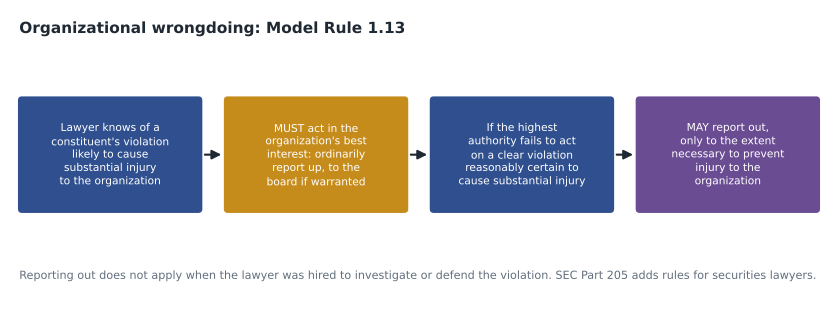
Federal law adds a parallel regime for public companies. Under section 307 of the Sarbanes-Oxley Act of 2002, the Securities and Exchange Commission adopted rules, found in 17 C.F.R. Part 205, requiring lawyers appearing and practicing before the SEC to report evidence of a material violation of securities law up the ladder to the chief legal officer and, if necessary, to the audit committee or the board, and permitting disclosure to the SEC in some circumstances. Rule 1.13's comments note that other law may impose such duties.
Rule 1.13(g) lets a lawyer for an organization also represent any of its directors, officers, employees, members, shareholders or other constituents, subject to Rule 1.7. If the organization's consent is needed for the dual representation, it must be given by an appropriate official other than the individual to be represented, or by the shareholders. In a derivative suit, in which shareholders sue on the corporation's behalf against its officers, the corporation's lawyer usually may defend the corporation, but if the claims involve serious charges of wrongdoing by officers who control the corporation, the conflict may require separate counsel for the officers. ABA Formal Opinion 514 (2025) addresses a related question: a lawyer advising an organization about conduct that may create legal risks for its constituents must remember that the client is the organization and must give advice in its interest, while making clear to constituents whom the lawyer represents.
Worked problem
Reporting up
In-house counsel at a manufacturer learns that the head of quality control has been signing false certificates stating that products passed safety tests. Counsel tells him to stop; he refuses, saying the chief executive approved it to meet shipping deadlines. What must counsel do?
Show solution
- The conduct violates law that may be imputed to the company and is likely to cause it substantial injury, such as recalls, fines and liability.
- Rule 1.13(b) requires counsel to act in the company's best interest and, because the executive is involved, to refer the matter to higher authority, ultimately the board.
- If the board fails to act and the violation is clear and reasonably certain to cause substantial injury, Rule 1.13(c) permits counsel to report outside the company to the extent necessary.
Answer: Counsel must report up to the board. Reporting out is permitted, not required, if the board fails to act.
Advisor and evaluator
Rule 2.1 requires a lawyer representing a client to exercise independent professional judgment and render candid advice. The comments say a lawyer should not be deterred from giving candid advice by the prospect that it will be unpalatable to the client. In rendering advice, a lawyer may refer not only to law but to other considerations such as moral, economic, social and political factors that may be relevant to the client's situation. A lawyer ordinarily need not offer advice the client has not asked for, but may do so when doing so appears to be in the client's interest, such as pointing out that a course of conduct might lead to litigation.
Rule 2.3 permits a lawyer to provide an evaluation of a matter affecting a client for the use of someone other than the client, such as a title opinion for a buyer's lender or an opinion letter in a loan closing, if the lawyer reasonably believes making the evaluation is compatible with other aspects of the lawyer's relationship with the client. When the lawyer knows or reasonably should know that the evaluation is likely to affect the client's interests materially and adversely, the lawyer must not provide it unless the client gives informed consent. Information relating to the evaluation remains protected by Rule 1.6 except as disclosure is authorized in connection with the evaluation. As Lesson 7 noted, the lawyer can be civilly liable to the third party who relies on a negligent evaluation.
The lawyer as neutral: Model Rule 2.4
A lawyer serves as a third-party neutral when the lawyer assists two or more persons who are not clients of the lawyer to reach a resolution of a dispute or other matter, as an arbitrator, mediator or other neutral. Rule 2.4(b) requires a lawyer serving as a neutral to inform unrepresented parties that the lawyer is not representing them, and when the lawyer knows or reasonably should know that a party does not understand the lawyer's role, to explain the difference between a neutral's role and a lawyer's role as one who represents a client. ABA Formal Opinion 518 (2025) adds that a lawyer acting as a mediator must not make misleading statements to the parties, applying Rule 8.4(c) to the mediator's role. Lesson 6 covered the conflict rule that follows when a former neutral wants to represent a party later: all parties must consent, under Rule 1.12.
Government lawyers and nonadjudicative proceedings
Government lawyers are subject to the rules like other lawyers, with special conflict rules in Rule 1.11 and, for prosecutors, Rule 3.8. Identifying the client is harder in government: the comments to Rule 1.13 say that although the client may be a specific agency, it may also be a branch of government or the government as a whole, depending on the context, and that a government lawyer may have authority under law to question the conduct of officials more extensively than a lawyer for a private organization. A government lawyer who learns that an agency official is breaking the law has a duty to the agency, and through it to the public, under the reporting-up structure of Rule 1.13.
Rule 3.9 governs a lawyer representing a client before a legislative body or administrative agency in a nonadjudicative proceeding, such as testifying at a legislative hearing or commenting on a proposed regulation. The lawyer must disclose that the appearance is in a representative capacity and must conform to the candor and fairness rules in Rules 3.3(a) through (c), 3.4(a) through (c) and 3.5. A lobbyist-lawyer who testifies for an industry group must say so and may not knowingly make false statements of fact to the committee.
Law-related services: Model Rule 5.7
Lawyers sometimes provide services that are not legal services but are related to them, such as title insurance, financial planning, accounting or lobbying. Rule 5.7 says a lawyer is subject to the rules of professional conduct in providing law-related services if they are provided in circumstances that are not distinct from the lawyer's provision of legal services to clients, or by a separate entity controlled by the lawyer, unless the lawyer takes reasonable measures to assure that a person obtaining the services knows that they are not legal services and that the protections of the client-lawyer relationship, such as confidentiality and conflict rules, do not exist.
Pro bono and appointments
Rule 6.1 says every lawyer has a professional responsibility to provide legal services to those unable to pay, and a lawyer should aspire to render at least 50 hours of pro bono public legal services per year, with a substantial majority of those hours provided without fee or expectation of fee to persons of limited means or to organizations that address the needs of such persons. The rule uses 'should': it is aspirational, and a lawyer cannot be disciplined for failing to meet it. Some states require lawyers to report their pro bono hours, and New York requires 50 hours of pro bono work for bar admission, but neither is a disciplinary standard under the Model Rules.
Rule 6.2, mentioned in Lesson 3, says a lawyer shall not seek to avoid appointment by a tribunal to represent a person except for good cause, such as that the representation is likely to result in a violation of the rules or other law, is likely to result in an unreasonable financial burden on the lawyer, or involves a client or cause so repugnant to the lawyer as to be likely to impair the client-lawyer relationship or the lawyer's ability to represent the client. Disagreeing with a client's political views is not good cause; being unable to put the views aside enough to represent the client competently can be.
Legal services organizations, law reform and limited services
Rule 6.3 allows a lawyer to serve as a director, officer or member of a legal services organization, apart from the firm where the lawyer practices, even though the organization serves persons with interests adverse to the lawyer's clients. The lawyer must not knowingly participate in a decision or action of the organization if participating would be incompatible with the lawyer's obligations to a client under Rule 1.7, or would have a material adverse effect on the representation of a client of the organization whose interests are adverse to a client of the lawyer. Rule 6.4 similarly lets a lawyer serve in an organization involved in reform of the law, even if the reform may affect a client's interests; when the lawyer knows a client's interests may be materially benefited by a decision in which the lawyer participates, the lawyer must disclose that fact, but need not identify the client.
Rule 6.5 relaxes the conflict rules for short-term limited legal services provided under the auspices of a program sponsored by a nonprofit organization or court, such as a legal advice hotline or a courthouse help desk, when neither the lawyer nor the client expects the lawyer to provide continuing representation. In that setting, Rules 1.7 and 1.9(a) apply only if the lawyer knows that the representation involves a conflict, and Rule 1.10 applies only if the lawyer knows that another lawyer in the firm is disqualified. That lets volunteer lawyers from large firms help people at clinics without running full conflict checks.
| Rule | Topic | Mandatory or aspirational? |
|---|---|---|
| 6.1 | Pro bono service: aspire to 50 hours a year | Aspirational |
| 6.2 | Accepting court appointments: avoid only for good cause | Mandatory |
| 6.3 | Membership in legal services organizations | Permissive, with limits on participation |
| 6.4 | Law reform activities affecting client interests | Permissive, with a disclosure duty |
| 6.5 | Nonprofit and court-annexed limited legal services | Relaxed conflict rules |
Statements about judges and legal officials: Model Rule 8.2
Rule 8.2(a) says a lawyer shall not make a statement that the lawyer knows to be false, or with reckless disregard as to its truth or falsity, concerning the qualifications or integrity of a judge, adjudicatory officer or public legal officer, or of a candidate for election or appointment to judicial or legal office. The standard mirrors the actual malice standard from defamation law. Honest criticism of a judge's rulings, even harsh criticism, is protected and is often a public service; a lawyer who accuses a judge of taking bribes with no factual basis is subject to discipline. Rule 8.2(b) adds that a lawyer who is a candidate for judicial office must comply with the applicable provisions of the Code of Judicial Conduct, which Lesson 11 covers.
Practice problems
Work each problem on paper first, then reveal the answer to check.
Who is the client of a corporation's in-house lawyer?
Show answer
The corporation, acting through its authorized constituents, not the individual officers.
Is reporting up within an organization mandatory?
Show answer
Yes, when the lawyer knows of a violation likely to cause substantial injury to the organization, unless the lawyer reasonably believes it is not in the organization's best interest.
Can a lawyer be disciplined for doing no pro bono work?
Show answer
No. Rule 6.1 is aspirational.
May a lawyer serving as a mediator tell an unrepresented party what the party should accept?
Show answer
No. The mediator must explain that she does not represent the party, and must not mislead the parties.
Common mistakes
MistakeThe CEO is the in-house lawyer's client.
InsteadThe organization is the client; constituents act for it.
MistakeReporting out is required whenever the board ignores a violation.
InsteadReporting out is permitted, not required, and only when its conditions are met.
MistakeCriticizing a judge is misconduct.
InsteadOnly knowingly false or reckless statements about a judge's qualifications or integrity are prohibited.
Summary and key terms
- An organization's lawyer represents the entity; the lawyer must clarify the client's identity to adverse constituents and must report serious violations up, and may report out in narrow cases.
- Lawyers must give candid advice and may consider moral and economic factors; evaluations for third parties need client consent when likely to harm the client.
- A lawyer acting as a neutral must explain the role to unrepresented parties and must not mislead them.
- Government lawyers serve the agency or government; nonadjudicative appearances must disclose the representative capacity; law-related services may carry the rules with them.
- Pro bono is aspirational, appointments may be declined only for good cause, Rules 6.3 to 6.5 enable public service, and Rule 8.2 bars false or reckless attacks on judges.
- Constituent
- An officer, director, employee, shareholder or other person who acts for an organization.
- Reporting up
- Referring an organizational client's wrongdoing to higher authority within the organization, up to the board.
- Reporting out
- Revealing information outside the organization to prevent substantial injury to it, permitted in narrow circumstances.
- Third-party neutral
- A lawyer, such as a mediator or arbitrator, who helps nonclients resolve a matter.
- Law-related services
- Services related to legal services, such as title insurance or financial planning, that nonlawyers may also provide.
Lesson quiz · 5 questions
Score 60% or more to complete this lesson.
Create a free account to save your progress, take quizzes and earn a certificate.