
BAR-140 · Lesson 8 of 12 · 24 min
Litigation and other forms of advocacy
▶ Video coming soon A video version of this lesson is on the way.
Marchetti keeps one image on her screen for the first ten minutes of this workshop: a balance scale with the word 'client' on one side and 'tribunal' on the other. 'Everywhere else in these rules,' she says, 'loyalty and confidentiality to the client win almost every contest. Before a court, they don't. When your client lies under oath, the scale tips toward the tribunal, and the rules make you act even if it means revealing a confidence.' Ngozi says that in Nigerian practice the duty to the court is described the same way, as the lawyer's first duty. Marchetti nods. 'Then you already have the instinct. The MPRE tests the details.'
Litigation and other forms of advocacy make up about 10 to 16 percent of the exam, and the outline's separate block on dealings with persons other than clients adds another 2 to 8 percent. This lesson covers meritorious claims and expediting litigation, candor toward the tribunal, fairness to the opposing party and counsel, impartiality and decorum, trial publicity, the lawyer as witness, the special duties of prosecutors, and the rules on truthfulness and communications with represented and unrepresented persons.
Meritorious claims and expediting litigation
Model Rule 3.1 forbids a lawyer from bringing or defending a proceeding, or asserting or controverting an issue, unless there is a basis in law and fact for doing so that is not frivolous, which includes a good-faith argument for an extension, modification or reversal of existing law. A claim is not frivolous just because the lawyer believes the client will lose, or because the facts have not yet been fully developed and the lawyer expects discovery to support them. A lawyer for a criminal defendant, or a respondent in a proceeding that could result in incarceration, may nevertheless defend the proceeding so as to require that every element of the case be established, because of constitutional protections.
Rule 3.2 requires a lawyer to make reasonable efforts to expedite litigation consistent with the client's interests. The comments say that delay is not reasonable if it is pursued for the purpose of frustrating an opposing party's attempt to obtain rightful redress, and that the question is whether a competent lawyer acting in good faith would regard the course of action as having some substantial purpose other than delay. Filing a motion solely to run up the other side's costs, or seeking continuances for the lawyer's convenience when the client wants the case resolved, violates the rule.
Candor toward the tribunal: Model Rule 3.3
Rule 3.3 is the heart of this topic. A lawyer must not knowingly make a false statement of fact or law to a tribunal, or fail to correct a false statement of material fact or law previously made by the lawyer. A lawyer must disclose to the tribunal legal authority in the controlling jurisdiction known to the lawyer to be directly adverse to the client's position and not disclosed by opposing counsel. The adverse authority duty is limited: it covers legal authority, not adverse facts; only controlling jurisdiction authority; only what is directly adverse; and only what opposing counsel has not already cited. The lawyer may argue that the authority is wrong or distinguishable.
The rule's most tested part concerns false evidence. A lawyer must not offer evidence the lawyer knows is false. If a lawyer, the lawyer's client or a witness called by the lawyer has offered material evidence and the lawyer comes to know of its falsity, the lawyer must take reasonable remedial measures, including, if necessary, disclosure to the tribunal. A lawyer may refuse to offer evidence, other than the testimony of a defendant in a criminal matter, that the lawyer reasonably believes is false. Rule 3.3(b) adds that a lawyer who knows a person intends to engage, is engaging or has engaged in criminal or fraudulent conduct related to the proceeding, such as bribing a juror or destroying evidence, must take reasonable remedial measures, including disclosure if necessary.
Rule 3.3(c) makes these duties override confidentiality: they continue to the conclusion of the proceeding and apply even if compliance requires disclosure of information otherwise protected by Rule 1.6. The conclusion of the proceeding means when a final judgment has been affirmed on appeal or the time for review has passed. This is one of the few places where the Model Rules require, rather than permit, a lawyer to reveal a client's confidences.
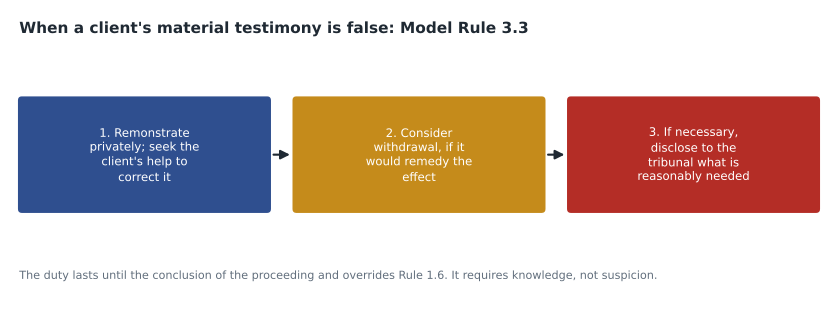
When the client is the one who lied, the comments set out the sequence. The lawyer's first step is to remonstrate with the client confidentially, advising the client of the lawyer's duty of candor and seeking the client's cooperation in withdrawing or correcting the false statements. If that fails, the lawyer must take further remedial action. Withdrawal alone may not undo the effect of the false evidence, and if withdrawal will not remedy it, the lawyer must make such disclosure to the tribunal as is reasonably necessary, even if doing so requires revealing information protected by Rule 1.6.
Criminal defendants raise special problems, because they have a constitutional right to testify. A lawyer who knows, rather than suspects, that a criminal defendant client intends to testify falsely should try to dissuade the client; if that fails, the lawyer may seek to withdraw, and must, if the false testimony is given, take remedial measures. The Supreme Court held in Nix v. Whiteside (1986) that a lawyer who threatened to disclose a client's planned perjury and to withdraw did not violate the client's Sixth Amendment right to effective assistance, because a defendant has no right to the assistance of counsel in presenting false testimony. Some jurisdictions allow a narrative approach, in which the defendant testifies without questions from the lawyer, but the Model Rules' comments reject it as a general solution. The key word throughout is 'knows': a lawyer who merely suspects the client is lying must resolve doubts in the client's favor and may not refuse to let a criminal defendant testify.
Rule 3.3(d) adds a duty in ex parte proceedings, such as an application for a temporary restraining order without notice. Because there is no opposing side to present the other view, the lawyer must inform the tribunal of all material facts known to the lawyer that will enable the tribunal to make an informed decision, whether or not the facts are adverse.
Worked problem
A witness lies
A plaintiff's lawyer calls a neighbor who testifies that the defendant ran a red light. During a recess, the neighbor admits to the lawyer that he did not actually see the light and was told what to say by the plaintiff. The neighbor refuses to correct his testimony. What must the lawyer do?
Show solution
- The testimony was material and was offered by the lawyer, and the lawyer now knows it is false.
- Rule 3.3(a)(3) requires reasonable remedial measures, including disclosure to the tribunal if necessary.
- The client's involvement in coaching the false testimony is also conduct under 3.3(b) requiring remedial measures.
Answer: The lawyer must take reasonable remedial measures. If the witness and client will not correct the testimony, the lawyer must disclose the falsity to the court, even though it reveals confidential information.
Fairness to the opposing party and counsel: Model Rule 3.4
Rule 3.4 forbids a lawyer from unlawfully obstructing another party's access to evidence or unlawfully altering, destroying or concealing a document or other material having potential evidentiary value, or counseling or assisting another person to do so. A lawyer must not falsify evidence, counsel or assist a witness to testify falsely, or offer an inducement to a witness that is prohibited by law. The comments explain that it is not improper to pay a witness's reasonable expenses or to compensate an expert witness on terms permitted by law, but it is improper to pay an occurrence witness for testimony or to pay any witness a fee contingent on the content of the testimony or the outcome of the case.
Rule 3.4 also forbids knowingly disobeying an obligation under the rules of a tribunal, except an open refusal based on an assertion that no valid obligation exists; making frivolous discovery requests or failing to make reasonably diligent efforts to comply with legally proper discovery requests; and at trial, alluding to any matter the lawyer does not reasonably believe is relevant or that will not be supported by admissible evidence, asserting personal knowledge of facts in issue except when testifying as a witness, or stating a personal opinion as to the justness of a cause, the credibility of a witness, the culpability of a civil litigant or the guilt or innocence of an accused. A lawyer may argue, based on the evidence, that a witness should not be believed; what the lawyer may not do is say 'I personally believe he is lying.'
Finally, Rule 3.4(f) forbids requesting a person other than a client to refrain from voluntarily giving relevant information to another party, unless the person is a relative or an employee or other agent of a client, and the lawyer reasonably believes the person's interests will not be adversely affected by refraining. A company's lawyer may ask the company's employees not to speak voluntarily with the plaintiff's lawyer; the lawyer may not ask an unrelated bystander witness to stay silent.
Impartiality and decorum: Model Rule 3.5
Rule 3.5 forbids a lawyer from seeking to influence a judge, juror, prospective juror or other official by means prohibited by law; communicating ex parte with such a person during the proceeding unless authorized by law or court order; communicating with a juror or prospective juror after discharge of the jury if the communication is prohibited by law or court order, the juror has made known a desire not to communicate, or the communication involves misrepresentation, coercion, duress or harassment; and engaging in conduct intended to disrupt a tribunal. Ex parte communication with a judge about the merits of a pending case is a classic violation, even if the lawyer means only to clarify a point.
Trial publicity: Model Rule 3.6
Rule 3.6 balances free expression and fair trials. A lawyer participating or who has participated in the investigation or litigation of a matter must not make an extrajudicial statement that the lawyer knows or reasonably should know will be disseminated by public communication and will have a substantial likelihood of materially prejudicing an adjudicative proceeding in the matter. The Supreme Court upheld the 'substantial likelihood of material prejudice' standard in Gentile v. State Bar of Nevada (1991), while holding Nevada's safe harbor provision void for vagueness as applied in that case.
The rule lists safe statements a lawyer may make regardless: the claim, offense or defense involved and, except where prohibited by law, the identity of the persons involved; information in a public record; that an investigation is in progress; the scheduling or result of any step in litigation; a request for assistance in obtaining evidence; a warning of danger when there is reason to believe a person may cause substantial harm; and in a criminal case, the accused's identity, residence, occupation and family status, whether the accused is at large and information needed to apprehend the accused, the fact, time and place of arrest, and the identity of investigating and arresting officers and the length of the investigation. A lawyer may also make a statement that a reasonable lawyer would believe is required to protect a client from the substantial undue prejudicial effect of recent publicity not initiated by the lawyer or the client, limited to what is necessary to mitigate it.
The lawyer as witness: Model Rule 3.7
Rule 3.7 says a lawyer shall not act as advocate at a trial in which the lawyer is likely to be a necessary witness, unless the testimony relates to an uncontested issue, the testimony relates to the nature and value of legal services rendered in the case, or disqualification of the lawyer would work substantial hardship on the client. The rule applies to trial advocacy; the lawyer may still do pretrial work. And under Rule 3.7(b), other lawyers in the lawyer's firm may act as advocates at the trial unless they are precluded by the conflict rules, Rules 1.7 or 1.9, so the lawyer-witness rule itself is not imputed.
Special responsibilities of a prosecutor: Model Rule 3.8
Prosecutors have duties beyond those of other advocates because they are ministers of justice, not just advocates. Rule 3.8 requires a prosecutor to refrain from prosecuting a charge the prosecutor knows is not supported by probable cause; make reasonable efforts to assure that the accused has been advised of the right to counsel and given a reasonable opportunity to obtain counsel; not seek to obtain from an unrepresented accused a waiver of important pretrial rights; make timely disclosure to the defense of all evidence or information known to the prosecutor that tends to negate the guilt of the accused or mitigates the offense, and in sentencing disclose all unprivileged mitigating information, except when relieved by a protective order; and not subpoena a lawyer to present evidence about a past or present client unless the information is not protected by privilege, is essential, and there is no feasible alternative.
The disclosure duty in Rule 3.8(d) is broader than the constitutional duty under Brady v. Maryland (1963), which applies only to material evidence. ABA Formal Opinion 09-454 said so in 2009, and in August 2026 the ABA amended comment [3] to Rule 3.8 to state it directly: the ethical duty is independent of constitutional and case law requirements and can be more demanding, including as to timing, and has no materiality requirement. Prosecutors also must refrain from extrajudicial comments that heighten public condemnation of the accused, and Rules 3.8(g) and (h) require a prosecutor who learns of new, credible and material evidence creating a reasonable likelihood that a convicted defendant did not commit the offense to disclose it and, in the prosecutor's own jurisdiction, investigate; and to seek to remedy a conviction when the prosecutor knows of clear and convincing evidence that the defendant did not commit the offense.
Truthfulness and communications with others
Rule 4.1 forbids a lawyer, in representing a client, from knowingly making a false statement of material fact or law to a third person, or failing to disclose a material fact when disclosure is necessary to avoid assisting a criminal or fraudulent act by a client, unless disclosure is prohibited by Rule 1.6. The comments recognize the conventions of negotiation: estimates of price or value placed on the subject of a transaction, and a party's intentions as to an acceptable settlement, are ordinarily not taken as statements of material fact. A lawyer may say 'my client won't take a penny less than 500,000 dollars' even if the client would, but may not falsely state that the client has another offer.
Rule 4.2 forbids a lawyer, in representing a client, from communicating about the subject of the representation with a person the lawyer knows to be represented by another lawyer in the matter, unless the other lawyer consents or the communication is authorized by law or court order. The rule protects represented persons even if they start the conversation. The parties themselves may talk to each other directly, and a lawyer may advise a client about what to say, though the lawyer may not script the client to overreach. For organizations, the rule covers constituents who supervise, direct or regularly consult with the organization's lawyer about the matter, have authority to obligate the organization, or whose act or omission may be imputed to the organization; it does not cover former employees. The August 2026 comment amendments added that a lawyer should ask whether an apparently unrepresented person has limited-scope counsel in some situations, and that a lawyer representing himself or herself is representing a client for purposes of the rule.
Rule 4.3 governs dealings with unrepresented persons. A lawyer must not state or imply that the lawyer is disinterested, must make reasonable efforts to correct any misunderstanding about the lawyer's role, and must not give legal advice to an unrepresented person, other than the advice to secure counsel, if the person's interests are or have a reasonable possibility of being in conflict with the client's. Rule 4.4(a) forbids using means that have no substantial purpose other than to embarrass, delay or burden a third person, or using methods of obtaining evidence that violate the legal rights of such a person; Rule 4.4(b), covered in Lesson 4, addresses inadvertently sent documents.
| Situation | Rule | Permitted? |
|---|---|---|
| Talking to the opposing party, who has a lawyer, about the case, with the lawyer's consent | 4.2 | Yes |
| Talking to a represented opposing party who calls you, without the lawyer's consent | 4.2 | No |
| Interviewing the opposing company's former employee | 4.2 | Yes, but do not seek privileged information |
| Telling an unrepresented adverse party what the law requires her to do | 4.3 | No, other than advising her to get a lawyer |
| "My client won't accept less than this" in negotiation | 4.1 | Yes; a negotiating position is not a statement of material fact |
Practice problems
Work each problem on paper first, then reveal the answer to check.
Must a lawyer disclose adverse facts to the court in an ordinary adversary proceeding?
Show answer
No. Rule 3.3 requires disclosure of directly adverse controlling legal authority, not adverse facts, except in ex parte proceedings.
Does a lawyer's duty to remedy a client's perjury override confidentiality?
Show answer
Yes. Rule 3.3(c) applies even if compliance requires disclosure of information protected by Rule 1.6.
May a lawyer pay an expert witness a fee contingent on the outcome?
Show answer
No. Experts may be paid reasonable compensation, but not contingent on the testimony or outcome.
If a lawyer will be a necessary witness at trial, can her partner try the case?
Show answer
Yes, unless the partner has a conflict under Rule 1.7 or 1.9.
Common mistakes
MistakeA lawyer who suspects a client will lie may refuse to let a criminal defendant testify.
InsteadOnly knowledge, not suspicion, triggers the perjury duties; a criminal defendant has a right to testify.
MistakeThe Brady duty and Rule 3.8(d) are identical.
InsteadThe ethical duty is broader: no materiality requirement and earlier timing.
MistakeA represented party who calls the opposing lawyer waives Rule 4.2.
InsteadOnly the party's lawyer can consent to the communication.
Summary and key terms
- Claims must have a nonfrivolous basis in law and fact; criminal defense may require the prosecution to prove every element; delay for its own sake is forbidden.
- Rule 3.3 forbids false statements and false evidence, requires disclosure of directly adverse controlling authority, and requires remedial measures, up to disclosure, until the proceeding concludes.
- Rule 3.4 protects evidence and witnesses; Rule 3.5 bars ex parte contacts; Rule 3.6 bars statements with a substantial likelihood of material prejudice, subject to safe harbors.
- A lawyer likely to be a necessary witness may not try the case, but partners may; prosecutors have extra duties including broad disclosure under Rule 3.8(d).
- Rules 4.1 to 4.4 require truthfulness, bar contact with represented persons without their lawyer's consent, and bar advice to adverse unrepresented persons.
- Remedial measures
- Steps a lawyer must take after false evidence, beginning with remonstrating with the client and ending, if necessary, in disclosure to the tribunal.
- Adverse authority
- Controlling-jurisdiction legal authority directly adverse to the client that opposing counsel has not cited, which must be disclosed.
- Ex parte communication
- A communication with a judge or juror about a matter without the other parties present or notified.
- Extrajudicial statement
- A statement made outside court, such as to the media, about a pending matter.
- Brady material
- Evidence favorable to the accused that the prosecution must disclose under Brady v. Maryland when it is material.
Lesson quiz · 5 questions
Score 60% or more to complete this lesson.
Create a free account to save your progress, take quizzes and earn a certificate.