
BAR-140 · Lesson 2 of 12 · 24 min
Regulation of the profession
▶ Video coming soon A video version of this lesson is on the way.
Hollis Marchetti opens the second Thursday workshop, on October 8, 2026, with a question that sounds simple. 'Who can discipline a lawyer, and for what?' Eddie Boudreaux says the state bar can discipline a lawyer for anything done as a lawyer. Ngozi Adeyemi says the court can discipline a lawyer for anything at all. Marchetti tells them they are each half right, and that the half Ngozi has is the one that surprises people on the MPRE.
This lesson covers the first block of the subject outline, regulation of the legal profession, which NCBE says makes up about 6 to 12 percent of the exam. It includes who regulates lawyers, the grounds for discipline, the duty to report misconduct, unauthorized practice and practice across state lines, the rules on law firm structure and fee sharing with nonlawyers, the responsibilities of partners and supervisors, and restrictions on a lawyer's right to practice. These are rules that apply to every lawyer regardless of practice area, which is why the exam tests them every time.
Who regulates lawyers
Lawyers are regulated mainly by the highest court of each state, acting through bodies it creates: a board of bar examiners for admission, and a disciplinary agency, often called the office of disciplinary counsel, for discipline. The court adopts the rules of professional conduct, usually based on the ABA Model Rules, and has the final say in discipline. Federal courts and many federal agencies also admit and discipline the lawyers who appear before them, so a lawyer can be disbarred from practice before a federal agency or court without losing a state license, and the reverse can happen too. The ABA itself has no power to discipline anyone; it writes model rules and issues advisory ethics opinions.
A lawyer admitted in a state is subject to that state's discipline wherever the conduct occurs. Under Model Rule 8.5(a), a lawyer is also subject to discipline in a state where the lawyer is not admitted if the lawyer provides or offers to provide legal services there. The same conduct can therefore lead to discipline in more than one place, and other states commonly impose reciprocal discipline. For choice of rules, Rule 8.5(b) says that conduct before a tribunal is judged by that tribunal's jurisdiction's rules, and other conduct by the rules of the jurisdiction where the conduct occurred or, if its predominant effect is elsewhere, the rules of that place. A lawyer is not subject to discipline if the conduct conforms to the rules of a jurisdiction where the lawyer reasonably believes the predominant effect will occur.
Grounds for discipline
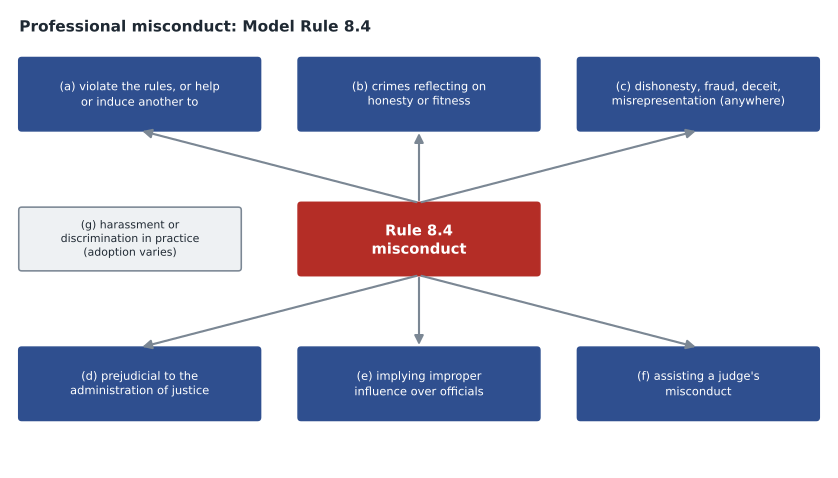
Model Rule 8.4 defines professional misconduct. It is misconduct to violate or attempt to violate the rules, knowingly assist or induce another to do so, or do so through the acts of another. It is misconduct to commit a criminal act that reflects adversely on the lawyer's honesty, trustworthiness or fitness as a lawyer; to engage in conduct involving dishonesty, fraud, deceit or misrepresentation; to engage in conduct prejudicial to the administration of justice; to state or imply an ability to improperly influence a government agency or official; and to knowingly assist a judge in conduct that violates the judicial rules.
This is the part Ngozi had right. Discipline is not limited to conduct while practicing law. A lawyer who lies on a personal loan application, cheats on taxes, or commits a fraud in a private business deal is subject to discipline under Rule 8.4(c), because dishonesty anywhere reflects on fitness to practice. Criminal conduct is different: not every crime is misconduct. Rule 8.4(b) reaches crimes that reflect adversely on honesty, trustworthiness or fitness, such as fraud, theft, violence or a pattern of repeated offenses. A single minor offense unrelated to those traits, such as one speeding ticket, generally is not, though a serious or repeated pattern can be.
Rule 8.4(g), added to the Model Rules in 2016, makes it misconduct to engage in conduct the lawyer knows or reasonably should know is harassment or discrimination on the basis of listed characteristics in conduct related to the practice of law. States have split on it. Vermont adopted it first, in 2017, and others including New Mexico, Connecticut, Colorado and Alaska adopted versions; several states, including South Carolina, Idaho, Arizona and Tennessee, declined. Pennsylvania adopted a narrower version that was challenged on First Amendment grounds, and in 2023 the Third Circuit ordered the challenge dismissed for lack of standing in Greenberg v. Lehocky. For the MPRE, the Model Rule is the standard, but questions on 8.4(g) are uncommon.
Admission and the duty of candor to the bar
Model Rule 8.1 applies to applicants for admission and to lawyers in connection with an application or a disciplinary matter. They must not knowingly make a false statement of material fact, and must not fail to disclose a fact necessary to correct a misapprehension known to have arisen, or knowingly fail to respond to a lawful demand for information from an admissions or disciplinary authority. The rule does not require disclosure of information protected by Rule 1.6, confidentiality. A lawyer who writes a reference for an applicant is also bound: knowingly lying in a letter supporting someone's admission is a violation by the writer.
An applicant who lied on a bar application and was admitted can be disciplined after admission, including disbarment, for the original lie. Marchetti reminds Eddie of the underage drinking citation he disclosed on his Louisiana application. The citation itself was minor. Leaving it off would have been an 8.1 problem, and a far larger one.
Reporting misconduct
Model Rule 8.3(a) requires a lawyer who knows that another lawyer has committed a violation that raises a substantial question as to that lawyer's honesty, trustworthiness or fitness as a lawyer to inform the appropriate professional authority. Rule 8.3(b) imposes the same duty about judges. Three features matter on the exam. First, the standard is knowledge, not suspicion, though knowledge can be inferred from circumstances. Second, only serious violations must be reported; a minor technical violation does not trigger the duty. Third, Rule 8.3(c) says the duty does not require disclosure of information protected by Rule 1.6, or information gained while participating in an approved lawyers' or judges' assistance program.
So when a lawyer learns of another lawyer's theft of client funds from a client who asks that it be kept confidential, the reporting duty yields to confidentiality unless the client consents. Many MPRE questions turn on that interaction. The reporting lawyer must report to the disciplinary authority; telling the other lawyer's firm or the client alone does not satisfy the rule, though it may be wise as well.
Worked problem
Must the lawyer report?
A lawyer learns from a colleague at another firm, in casual conversation, that the colleague backdated a document filed in court to meet a deadline. The information is not confidential client information. Must the lawyer report the colleague?
Show solution
- Is there knowledge? The colleague admitted it directly, so yes.
- Is it a violation raising a substantial question about honesty? Backdating a court filing is deceit toward a tribunal, which goes directly to honesty.
- Is the information protected by Rule 1.6? No; it was not learned in representing a client.
Answer: Yes. The lawyer must inform the appropriate disciplinary authority under Rule 8.3(a).
Unauthorized practice and multijurisdictional practice
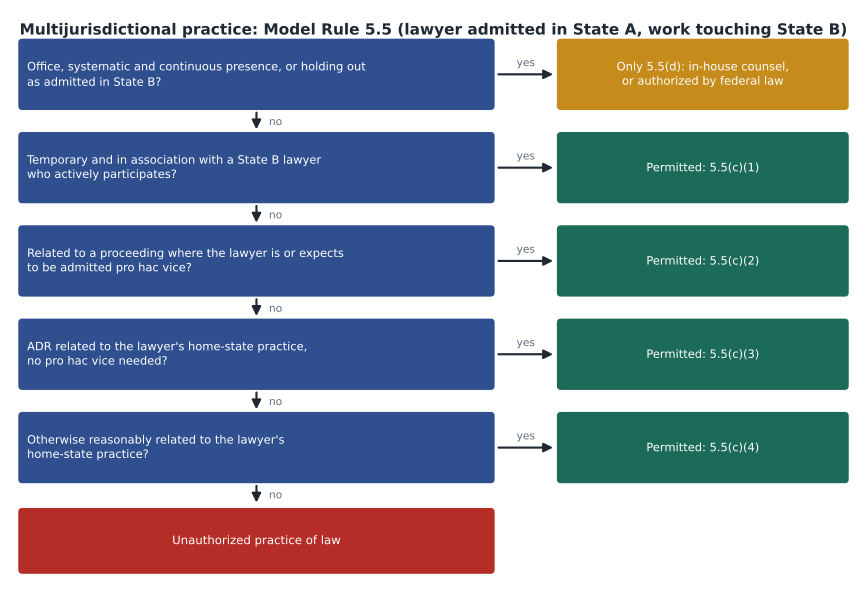
Model Rule 5.5(a) forbids a lawyer from practicing law in a jurisdiction in violation of that jurisdiction's regulation of the profession, or assisting another in doing so. That covers two situations: a lawyer practicing where not admitted, and a lawyer helping a nonlawyer engage in the unauthorized practice of law. Lawyers may hire and supervise paralegals and other nonlawyers to do work under the lawyer's supervision, because the lawyer remains responsible for the work. What they may not do is let a nonlawyer give legal advice independently, appear in court for clients, or set legal fees.
Rule 5.5(b) forbids a lawyer not admitted in a jurisdiction from establishing an office or other systematic and continuous presence there for practicing law, or holding out as admitted there. Rule 5.5(c) then provides safe harbors for temporary practice by a lawyer admitted and in good standing elsewhere: services undertaken in association with a locally admitted lawyer who actively participates; services in or reasonably related to a pending or potential proceeding before a tribunal where the lawyer is authorized or expects to be authorized, such as by pro hac vice admission; services in or reasonably related to arbitration, mediation or other alternative dispute resolution, if they arise out of or are reasonably related to the lawyer's practice in a jurisdiction of admission and do not require pro hac vice admission; and other services that arise out of or are reasonably related to the lawyer's practice where admitted.
Rule 5.5(d) covers more permanent presence: a lawyer admitted elsewhere may provide services through an office in the jurisdiction as in-house counsel to the lawyer's employer or its affiliates (not services requiring pro hac vice admission), or services authorized by federal or other law, such as practice before a federal agency that admits nonresident lawyers. Since remote work became common, ABA Formal Opinion 495 (2020) has said that a lawyer may practice the law of the jurisdiction where admitted while physically located in a jurisdiction where not admitted, if the lawyer does not hold out locally or provide services in local law, unless local law forbids it.
Firm structure and fee sharing with nonlawyers
Model Rule 5.4 protects the lawyer's professional independence. A lawyer or firm must not share legal fees with a nonlawyer, with narrow exceptions: payments to a deceased lawyer's estate over a reasonable period; the purchase price paid to a deceased, disabled or disappeared lawyer's estate for a practice under Rule 1.17; including nonlawyer employees in a compensation or retirement plan even if based on profit sharing; and sharing court-awarded fees with a nonprofit organization that employed, retained or recommended the lawyer. A lawyer must not form a partnership with a nonlawyer if any activity of the partnership is the practice of law, and must not practice in a firm or professional corporation in which a nonlawyer owns an interest, is a director or officer, or has the right to direct the lawyer's professional judgment.
This is the Model Rule. States have begun to depart from it. Arizona eliminated its version of Rule 5.4 in 2021 and licenses alternative business structures with nonlawyer owners, and Utah runs a regulatory sandbox that allows nonlawyer ownership under supervision. The District of Columbia has long allowed a limited form of nonlawyer partners. The MPRE follows the Model Rule, so on the exam a firm with a nonlawyer partner practicing law is a violation, whatever Arizona permits. Rule 5.4(c) adds that a lawyer must not let a person who recommends, employs or pays the lawyer to render services for another direct or regulate the lawyer's professional judgment.
Rule 5.6 forbids agreements that restrict a lawyer's right to practice after the relationship ends, other than retirement benefit agreements, and forbids settlement agreements that restrict a lawyer's right to practice. A partnership agreement that cuts off a departing partner's capital account if she competes with the firm, or a settlement in which a plaintiff's lawyer agrees never to sue the defendant again, are both violations, and a lawyer who proposes such a term violates the rule just as one who accepts it.
Responsibilities of partners, supervisors and subordinates
Model Rule 5.1 requires partners and lawyers with comparable managerial authority to make reasonable efforts to ensure the firm has measures in place giving reasonable assurance that all lawyers conform to the rules, and requires lawyers with direct supervisory authority over another lawyer to make reasonable efforts to ensure that lawyer conforms. A lawyer is responsible for another lawyer's violation if the lawyer orders or, with knowledge of the specific conduct, ratifies it, or if the lawyer is a partner or supervisor who knows of the conduct at a time when its consequences can be avoided or mitigated and fails to take reasonable remedial action. Rule 5.3 applies the same structure to nonlawyer assistants, including outside vendors and, under ABA Formal Opinion 512 (2024), the use of tools such as generative artificial intelligence.
Rule 5.2 addresses the junior lawyer. A subordinate lawyer is bound by the rules even when acting at another person's direction. But a subordinate does not violate the rules by acting in accordance with a supervisor's reasonable resolution of an arguable question of professional duty. If the question is not arguable, for example being told to shred documents under subpoena, following orders is no defense.
| Rule | Who | What it requires |
|---|---|---|
| 5.1(a) | Partners and managers | Reasonable efforts to have firm measures assuring compliance |
| 5.1(b) | Direct supervisors of lawyers | Reasonable efforts to ensure the supervised lawyer complies |
| 5.1(c) | Any lawyer who orders or ratifies, or a manager who fails to remedy | Responsibility for another lawyer's violation |
| 5.2 | Subordinate lawyers | Bound by the rules; protected only when following a reasonable resolution of an arguable question |
| 5.3 | Lawyers supervising nonlawyers, including vendors and technology | Reasonable efforts to make the nonlawyer's conduct compatible with the lawyer's duties |
Worked problem
A subordinate's defense
An associate is told by a partner that the firm need not disclose an adverse controlling decision from another circuit because it is not binding in the forum. The associate believes the partner is wrong but follows the instruction. Later it is determined that disclosure was required. Is the associate subject to discipline?
Show solution
- Rule 3.3(a)(2) requires disclosure of directly adverse authority in the controlling jurisdiction. Whether out-of-circuit authority counts depends on the forum, so the question is arguable.
- Rule 5.2(b) protects a subordinate who acts in accordance with a supervisor's reasonable resolution of an arguable question.
Answer: No, if the partner's resolution was reasonable on an arguable question. The partner may be subject to discipline. If the duty had been clear, the associate would have no defense.
Restrictions on the right to practice and the sale of a practice
Model Rule 1.17 permits a lawyer or firm to sell or buy a law practice, or an area of practice, including goodwill, if the seller ceases to engage in the private practice of law, or in the area sold, in the geographic area or jurisdiction where the practice was conducted; the entire practice or area is sold to one or more lawyers or firms; written notice is given to each client about the proposed sale, the client's right to retain other counsel or take possession of the file, and the fact that consent is presumed if the client does not object within 90 days; and fees charged to clients are not increased by reason of the sale. This rule is one of the exceptions to the ban on sharing fees with nonlawyers, because the seller's estate may receive the purchase price.
Practice problems
Work each problem on paper first, then reveal the answer to check.
Is a lawyer subject to discipline for lying on a personal mortgage application?
Show answer
Yes. Conduct involving dishonesty, fraud, deceit or misrepresentation is misconduct under Rule 8.4(c) even outside practice.
Must a lawyer report another lawyer's serious misconduct learned in confidence from a client?
Show answer
No, unless the client consents. Rule 8.3(c) does not require disclosure of information protected by Rule 1.6.
Can a lawyer admitted only in Ohio open an office in Indiana to advise Indiana clients on Indiana law?
Show answer
No. That is a systematic and continuous presence for practice in a jurisdiction where the lawyer is not admitted.
May a firm agree to pay part of a deceased partner's fees to her estate?
Show answer
Yes. Payment to a deceased lawyer's estate over a reasonable time is an exception to the fee-sharing ban.
Common mistakes
MistakeOnly conduct in practice can lead to discipline.
InsteadDishonesty anywhere, and crimes reflecting on fitness, are misconduct.
MistakeA lawyer must report any rule violation by another lawyer.
InsteadOnly violations raising a substantial question about honesty, trustworthiness or fitness, known to the lawyer and not protected by Rule 1.6.
MistakeFollowing a partner's instruction always protects an associate.
InsteadOnly a reasonable resolution of an arguable question protects the associate.
Summary and key terms
- State high courts regulate lawyers; federal courts and agencies discipline those who appear before them; the ABA disciplines no one.
- Rule 8.4 misconduct includes dishonesty and fitness-related crimes even outside practice; 8.4(g) adoption varies by state.
- Rule 8.3 requires reporting known serious violations to the disciplinary authority, except information protected by Rule 1.6.
- Rule 5.5 bars unauthorized practice but allows temporary practice under four safe harbors and in-house or federally authorized practice.
- Rule 5.4 bans fee sharing and partnerships with nonlawyers, subject to narrow exceptions; Rules 5.1 to 5.3 assign supervisory responsibility.
- Reciprocal discipline
- Discipline imposed by one jurisdiction because another jurisdiction disciplined the same lawyer.
- Unauthorized practice of law
- Practicing law where not admitted, or helping a nonlawyer to practice law.
- Pro hac vice
- Permission from a court for an out-of-state lawyer to appear in a particular case.
- Systematic and continuous presence
- An ongoing practice in a jurisdiction, such as an office, which requires admission there.
- Professional independence
- Freedom of the lawyer's judgment from control by nonlawyers or third-party payers.
Lesson quiz · 5 questions
Score 60% or more to complete this lesson.
Create a free account to save your progress, take quizzes and earn a certificate.