
ARCH-430 · Lesson 7 of 12 · 20 min
Bidding and contract award
At two o'clock on a Thursday in February the bid for the Rail Yard Commons closes. At five past two the city's procurement officer opens the electronic submissions in a public meeting, with Natarajan, Thibodeau, Callum and a dozen bidders' representatives watching on screen, and reads out each bidder's name, its base price and whether bid security is included. Six prices are read. The lowest, from Hiawatha Builders, is 15,720,000 dollars; the highest is 17,140,000. The meeting lasts twelve minutes. The work that follows, deciding whether the low bidder can be awarded the contract, takes three weeks, and this lesson is about those three weeks.
The previous course covered the bid documents: the instructions, the forms, addenda, alternates and unit prices. This lesson starts where that one ended, at the close, and follows the evaluation, the checks of security and capacity, the award and the signing of the contract, up to the moment the contractor is told it may start work.
Opening and first checks
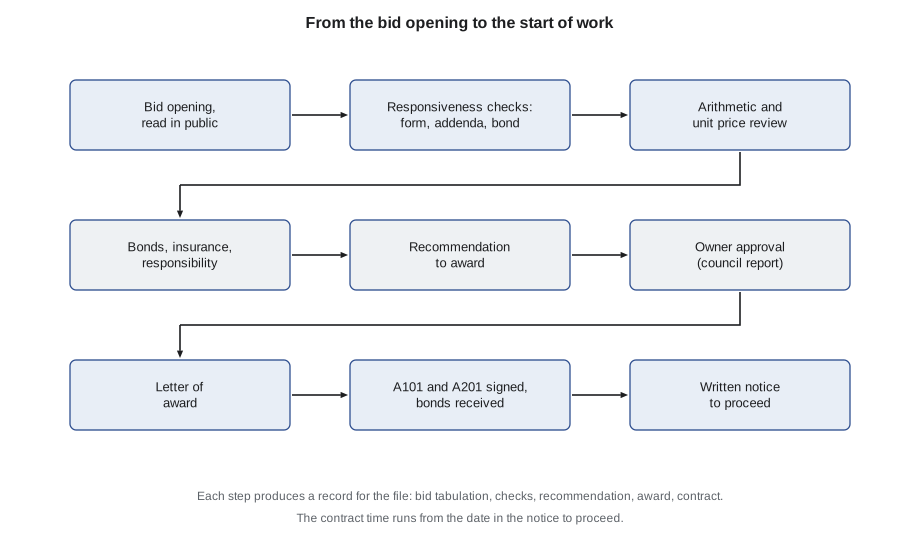
A public bid is usually opened and read aloud in public at the stated time, and the names and base prices are published. The first checks are mechanical: was the bid received before the deadline, on the required form, signed by someone with authority to bind the bidder, with every addendum acknowledged and with the required bid security? Under public bidding law, which the last course introduced, a bid that fails a material requirement is nonresponsive and cannot be accepted, even if it is the lowest; accepting it would be unfair to the responsive bidders and invite a protest. Minor irregularities, such as a missing initial on a page, can usually be waived if the instructions to bidders give the owner that right and if waiving them does not affect the price or give the bidder an advantage over others.
For the Rail Yard Commons one of the six submissions fails at this stage: its bid bond names the wrong project. The other five pass. Thibodeau tells the students that this is the moment when owners are most tempted to bend the rules, because the failed submission is often a good price from a respected firm. 'Do not,' he says. 'The rules are what protect the city from the next bidder's lawyer.'
Arithmetic, unit prices and unbalanced bids
The next check is arithmetic. Forms that ask for unit prices and quantities, or for a breakdown of the price, can contain errors in extension or addition. The instructions to bidders usually say how they will be corrected: commonly, the unit price governs over the extended amount, and the written words govern over the figures. A correction that changes the order of the bidders must be applied exactly as the instructions say, and the bidder is held to the corrected price; a correction the instructions do not provide for cannot be made. Under Canadian tendering law a bidder generally cannot withdraw its tender because it has found its own mistake after the close, unless the mistake is obvious on the face of the tender; American states differ, and some allow a bidder to withdraw without forfeiting its security for a clerical error proved by its worksheets.
The architect also looks for unbalanced prices. A bidder that expects the quantity of some unit-priced work to rise may price that item high and others low, so that its total looks competitive but its final cost will not be. On the rail-yard site the obvious candidate is the unit price for removing unsuitable fill, whose quantity was hard to predict despite the early contract. Comparing each bidder's unit prices with the estimate and with each other reveals any that stand far apart.
# Post-close checks on the five remaining bids for the Rail Yard Commons.
bids = {  # bidder: base price, (unit price for unsuitable fill per cy, assumed quantity), bid bond share
    "Hiawatha Builders": (15_720_000, (52, 2350), 0.05),
    "Riverside Mill Builders": (15_960_000, (49, 2350), 0.05),
    "Nokomis Contracting": (16_180_000, (118, 2350), 0.05),
    "North Star Building Group": (16_420_000, (54, 2350), 0.05),
    "Lake Harriet General": (17_140_000, (50, 2350), 0.02),
}
required_bond = 0.05              # bid security: 5 out of every 100 dollars
estimate_fill_rate = 53           # dollars per cubic yard in the pre-bid estimate
for b, (base, (rate, qty), bond) in bids.items():
    notes = []
    if bond < required_bond:
        notes.append("bid security below the required amount: nonresponsive")
    if rate > 1.6 * estimate_fill_rate:
        notes.append(f"fill rate {rate} is far above the estimate: check for unbalancing")
    # Effect of a larger fill quantity on each bidder's total.
    total_if_3900 = base + rate * (3900 - qty)
    print(f"{b:25s} base {base:,}  with 3,900 cy of fill {total_if_3900:,}  {'; '.join(notes)}")
ok = {b: t for b, t in bids.items() if t[2] >= required_bond}
low = min(ok, key=lambda b: ok[b][0])
print("lowest responsive bid:", low)Hiawatha Builders base 15,720,000 with 3,900 cy of fill 15,800,600 Riverside Mill Builders base 15,960,000 with 3,900 cy of fill 16,035,950 Nokomis Contracting base 16,180,000 with 3,900 cy of fill 16,362,900 fill rate 118 is far above the estimate: check for unbalancing North Star Building Group base 16,420,000 with 3,900 cy of fill 16,503,700 Lake Harriet General base 17,140,000 with 3,900 cy of fill 17,217,500 bid security below the required amount: nonresponsive lowest responsive bid: Hiawatha Builders
The check finds two things. The highest bidder offered bid security below the required amount and is out. The third bidder's unit price for fill is more than double the estimate; if the fill quantity rises to the level the geotechnical engineer called possible, its total would rise by about 185,000 dollars, while the low bidder's would rise by about 80,000. Since the third bidder is not the lowest, the unbalanced price does not affect the award, but Thibodeau asks the students to note it for the file: on a different day, with a different quantity, it could have.
Security, insurance and capacity
Before award the owner confirms that the low bidder can deliver what it promised. The bid bond, usually for five out of every hundred dollars of the bid, guarantees that the bidder will sign the contract and provide the required bonds; if it refuses, the surety pays the owner the difference up to the bond amount. On award the contractor must provide a performance bond and a payment bond, each commonly for the full contract amount, as state law requires for public works; in Minnesota the requirement is set by statute for public contracts above a threshold. The performance bond protects the owner if the contractor defaults; the payment bond protects subcontractors and suppliers, who cannot file liens against public property. The contractor must also provide certificates of the insurance the contract requires, usually general liability, automobile, umbrella and workers' compensation coverage, with builder's risk insurance provided by the owner or the contractor as the contract states.
The owner may also confirm that the bidder is responsible: that it has the experience, staff, equipment and financial capacity to do the work. Some owners prequalify bidders before the competition, which settles the question in advance; others review the low bidder's references and past performance after the close, against criteria stated in the instructions. A low bidder can be passed over as not responsible only on grounds the owner can document and only by the published criteria. For the Rail Yard Commons the city had prequalified six general contractors with mass timber experience, so the review is short: Natarajan calls two of Hiawatha's recent clients, and the city's risk manager checks the bonds and certificates.
Over budget: the owner's options
Sometimes the lowest acceptable price is above the budget. The owner's options are set by its own rules and the instructions to bidders. It can accept alternates that reduce scope, in the published order, if the documents included deductive alternates. It can find more money, if its governance allows. It can negotiate with the low bidder to reduce the price by changing the scope, if the instructions reserved that right and the law of the jurisdiction allows it; many public owners can negotiate only within narrow limits, because a scope reduction negotiated with one bidder is something the others did not have the chance to price. Or it can cancel the competition and call again with a revised design, which costs months and usually some redesign fees.
The architect's role is to give the owner clear information: what each option would cost, save and change, what the documents allow, and what the risks are. It is not the architect's role to negotiate with a bidder on the owner's behalf without the owner's instruction, or to suggest to a bidder how it might adjust its price. For the Rail Yard Commons the question did not arise: the low price was within the budget, with room for the first alternate, the gathering-room terraces.
Award, contract and notice to proceed
The recommendation to award is a short letter from the architect to the owner. It lists the prices received, summarizes the checks, names the lowest compliant bidder and the alternates recommended, and recommends award, or explains why it does not. The owner then approves the award through its own governance, often a report to council or a committee. The letter of award, issued by the owner, accepts the bidder's offer, states the contract price including the accepted alternates, and asks for the bonds, insurance and other documents within the time stated, usually a week or two.
The contract is then prepared and signed. For the Rail Yard Commons it is A101 with A201 and the city's supplementary conditions; the architect assembles the contract documents, including the agreement, the conditions, the specifications and drawings and every addendum, and checks that they match what was bid. Once the contract is signed and the bonds and certificates received, the owner issues a written notice to proceed, which sets the date from which the contract time runs. Work begun before that notice is at the contractor's risk.
Thibodeau's last advice for this stage is to keep a complete file. The opening record, the tabulation, the compliance checks, the correspondence with the bidders, the recommendation, the award approval and the signed contract are the documents any challenge would be judged against. He also suggests offering a debriefing to the unsuccessful bidders, explaining how their prices compared; it costs little and keeps good firms willing to bid on the city's next project.
Worked problem
Writing the recommendation
Draft the key paragraph of the recommendation to award for the Rail Yard Commons.
Show solution
- State the facts: six submissions were received by the closing time; one was set aside because its bid security named the wrong project; one was set aside because its security was below the required amount.
- Summarize the checks: the remaining submissions were reviewed for completeness, arithmetic and unit prices; one unit price was noted as high but did not affect the order.
- Name the result: the lowest compliant price, from Hiawatha Builders, is 15,720,000 dollars, within the budget; with alternate 1 the price is 16,030,000 dollars.
- Recommend award subject to receipt of the performance and payment bonds, insurance and other documents listed in the instructions.
Answer: The paragraph states facts, checks, the result and the conditions of award, and nothing it cannot support.
Exercise 7: from close to contract
- Using the tabulation supplied by the instructor, carry out the compliance, arithmetic and unit price checks and record each decision with its basis in the instructions.
- Draft a letter to one bidder asking it to confirm its scope for an element priced far below the estimate, without inviting a change in price.
- Write the recommendation to award, and a list of the documents the low bidder must provide before the contract is signed.
- Prepare a one-page summary for a debriefing of the unsuccessful bidders.
Self-check
- Have I applied every rule exactly as the instructions state it?
- Have I checked the security, insurance and responsibility of the low bidder?
- Is every step recorded in the project file?
- Have I avoided negotiating or advising any bidder on its price?
Common mistakes
MistakeWaiving a material defect because the price is attractive.
InsteadApply the published rules to every bidder equally.
MistakeCorrecting arithmetic in a way the instructions do not provide for.
InsteadUse only the correction rules stated in the instructions.
MistakeIgnoring unbalanced unit prices.
InsteadCompare unit prices with the estimate and test the effect of larger quantities.
MistakeLetting the contractor start before the notice to proceed.
InsteadStart the contract time only when the contract is signed and security received.
MistakeDiscussing the price with the low bidder without the owner's authority.
InsteadCommunicate only as the owner directs and within its rules.
Summary and key terms
- After the close, submissions are checked for timeliness, form, signature, addenda and security.
- A nonresponsive bid cannot be accepted under public bidding law, even if it is lowest.
- Arithmetic is corrected only by the stated rules, and unbalanced unit prices are identified and tested.
- Bonds, insurance and the bidder's responsibility are confirmed before award.
- The recommendation, award, signed contract and notice to proceed complete the process, and every step is filed.
- Bid bond
- Security guaranteeing that the bidder will sign the contract and provide the required bonds.
- Performance bond
- A surety's guarantee that the contract will be completed if the contractor defaults.
- Payment bond
- A surety's guarantee that subcontractors and suppliers will be paid.
- Unbalanced bid
- A bid that prices some items high and others low to gain from expected changes in quantities.
- Written notice to proceed
- The owner's written instruction to start work, from which the contract time runs.
Practice problems
Work each problem on paper first, then reveal the answer to check.
Why must a submission with security naming the wrong project be set aside?
Show answer
Because it fails a material requirement, and accepting it would be unfair to the compliant bidders.
Which usually governs when a unit price and its extension disagree?
Show answer
The unit price, if the instructions say so.
How can an unbalanced unit price affect the owner?
Show answer
If the quantity rises, the bidder's final cost rises far more than its competitors' would have.
What protects subcontractors on public work where liens are not available or are limited?
Show answer
The payment bond.
When does the contract time start?
Show answer
On the date set by the owner's written notice to proceed.
Lesson quiz · 5 questions
Score 60% or more to complete this lesson.
Create a free account to save your progress, take quizzes and earn a certificate.