
ARCH-430 · Lesson 4 of 12 · 21 min
Construction management and integrated delivery
Before he moved to the construction side, Thibodeau spent most of his career as the architect on projects run by construction managers, and he still remembers the first time a manager's estimator walked into a design meeting with a spreadsheet and a question. The project was a school, the design was at the end of schematic design, and the estimator asked why the gym roof was a long-span steel truss when a glulam arch would cost less, go up faster and suit the client's wish for wood. The design team had assumed steel. The arch was built, and the school opened two months early. 'That is what you buy when you bring the builder in early,' he says. 'Not a cheaper building, necessarily, but a building designed by people who know what it costs to build.'
Two kinds of construction manager
A construction manager is a builder hired early, usually during schematic or design development, to advise on cost, schedule and constructability and then to manage construction. There are two main forms. As an adviser, often called a construction manager as agent, the manager acts for the owner; the owner holds the trade contracts directly, and the manager coordinates them for a fee without taking the risk of the construction cost. As constructor, usually under AIA A133 or a similar form, the manager holds the trade contracts itself and builds the work for the cost of the work plus a fee, with a guaranteed maximum price agreed once the design is far enough along. The second form, construction manager at risk, is widely used by American public owners where state law allows it, often after a qualifications-based selection.
In both forms the manager's early work is called preconstruction services. It includes estimates at each design stage, prepared in the same format as the designers' cost plan so that the two can be reconciled; constructability reviews of the drawings; advice on systems and materials, as in the glulam arch; a construction schedule and a plan for dividing the work into trade packages; and, in many cases, procurement of long-lead items such as structural timber, switchgear or elevators before the design is complete. The owner pays a fee for these services, usually a fixed amount, and can end the arrangement after preconstruction if the price is not acceptable.
The guaranteed maximum price
Under construction management at risk the contract sets a guaranteed maximum price once the design is sufficiently developed, often at the end of design development or partway through construction documents. The price is built up from the estimated cost of the work, the manager's general conditions or site costs, its fee, and contingencies. The manager's contingency covers risks it carries, such as gaps between trade packages or errors in its own estimates; the owner's contingency, usually held separately, covers changes the owner requests and unforeseen conditions. If the actual cost of the work plus the fee comes in below the guaranteed maximum, the savings are shared between the owner and the manager in the proportions the contract states, or returned to the owner entirely; if it comes in above, the manager pays the excess, unless the overrun results from an owner change.
The arrangement is open book. The owner can see the trade prices, the manager's costs and the use of its contingency, and the contract usually gives the owner the right to audit. That openness is the main difference from a stipulated price contract, where the owner never sees how the contractor built up its number. It also creates the main tension: the manager is both the owner's adviser during design and a party with its own commercial interest in the price. A manager who sets a generous guaranteed maximum earns more if the cost comes in low. Owners protect themselves through independent estimates, competitive trade packages, a clear definition of the cost of the work and careful drafting of the savings clause.
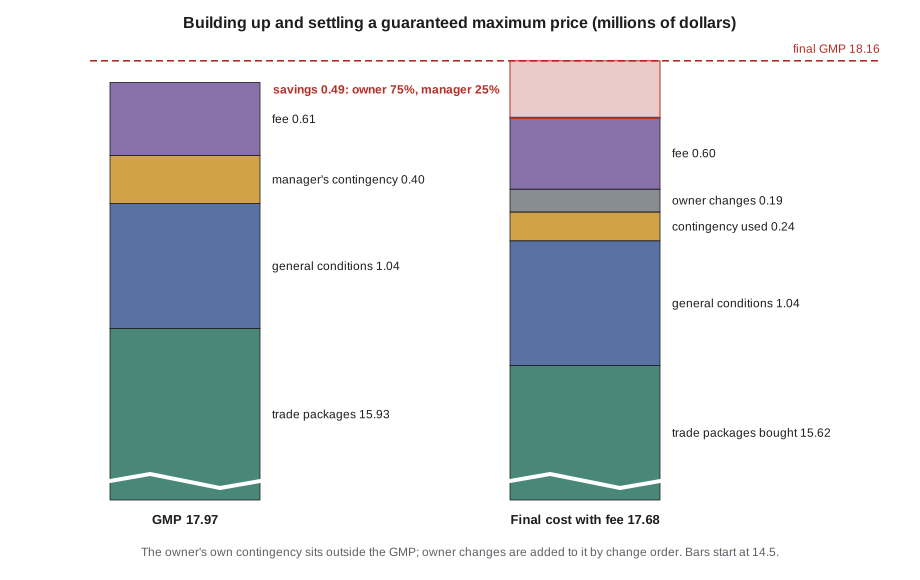
# Build up a guaranteed maximum price (GMP) and settle it at the end.
trades = {"site and piles": 1_650_000, "concrete cores": 1_120_000, "mass timber": 3_480_000,
          "envelope": 2_760_000, "roofing": 820_000, "interiors": 2_140_000,
          "mechanical": 2_390_000, "electrical": 1_310_000, "elevators": 260_000}
cost_of_trades = sum(trades.values())
general_conditions = 0.065 * cost_of_trades      # site staff, trailers, hoisting, cleaning
cm_contingency = 0.025 * cost_of_trades          # the manager's own risks
fee_rate = 0.035                                 # fee on cost of work plus general conditions
cost_of_work = cost_of_trades + general_conditions + cm_contingency
gmp = cost_of_work * (1 + fee_rate)
print(f"cost of trades {cost_of_trades:,.0f}  GMP {gmp:,.0f}")

# At the end: actual trade costs, contingency used, owner changes added to the GMP.
actual_trades = cost_of_trades - 310_000         # trade packages bought below estimate
cont_used = 0.6 * cm_contingency
owner_changes = 185_000                          # added to the GMP by change order
final_gmp = gmp + owner_changes * (1 + fee_rate)
actual = (actual_trades + general_conditions + cont_used + owner_changes) * (1 + fee_rate)
savings = final_gmp - actual
owner_share = 0.75
print(f"final GMP {final_gmp:,.0f}  actual cost with fee {actual:,.0f}")
print(f"savings {savings:,.0f}: owner keeps {owner_share * savings:,.0f}, manager keeps {(1 - owner_share) * savings:,.0f}")
print(f"owner pays {actual + (1 - owner_share) * savings:,.0f}")cost of trades 15,930,000 GMP 17,971,430 final GMP 18,162,904 actual cost with fee 17,677,179 savings 485,726: owner keeps 364,294, manager keeps 121,431 owner pays 17,798,610
The numbers are illustrative but realistic in proportion. Trade packages bought below the estimate and an unused part of the manager's contingency produce savings of about 486,000 dollars, of which the owner keeps three quarters, about 364,000, under this contract. Natarajan notes that the owner's contingency does not appear in the guaranteed maximum at all; the city holds it separately and uses it to pay for its own changes, which are then added to the maximum by change order. Students should be able to trace every dollar in such a settlement, because the architect is often asked to certify the payments that make it up.
The architect's role under a construction manager
Working with a construction manager changes the architect's job in useful and demanding ways. During design the architect receives cost and constructability advice at each stage and must respond to it, accepting some suggestions and explaining why it rejects others. Value engineering proposals deserve particular care: some are genuine improvements, like the glulam arch, while others save money by reducing quality, durability or performance in ways the owner may not understand. The architect's job is to show the owner what each proposal really changes. During construction the manager takes on much of the coordination, scheduling and trade management that a general contractor would do, but the architect still reviews submittals, interprets the documents, observes the work and certifies completion, and the documents may be issued in packages, each of which must be coordinated with the ones already let.
Thibodeau warns the students about the package problem. When foundations are let before the mechanical design is complete, the foundations must allow for whatever the mechanical design later needs: sleeves, pits, housekeeping pads, the route of the underground services. Each early package must be designed and checked against assumptions about the later ones, and the assumptions must be recorded. On the school with the glulam arch, a missed sleeve for a storm drain under the grade beam cost more than the arch had saved on the roof.
Integrated project delivery
Integrated project delivery goes further. The owner, the architect, the main engineers and the builder, and sometimes key trade contractors, sign a single agreement. They agree a target cost early, often during a validation phase in which the team tests whether the owner's goals can be met within its budget. They are paid their actual costs, and their profit is placed in a shared pool that grows if the project comes in under target and shrinks, sometimes to nothing, if it comes in over. Claims between the parties are largely waived, so that problems are solved rather than litigated. Decisions are made by a project management team with members from each party and, above it, an executive team.
In the AIA family the standard form is C191, a single multi-party agreement: the parties are paid their costs, receive goal and incentive payments that all of them lose if a project goal is missed, and run the project through management and executive teams. Several American hospitals and university buildings have been delivered this way, and integrated delivery is also practiced under other forms, including ConsensusDocs 300.
Integrated delivery relies on lean methods borrowed from manufacturing. Target value design sets the cost target first and designs to it, checking the estimate continuously instead of at the end of each phase. Pull planning builds the schedule backward from milestones, with each trade saying what it needs from the one before. The last planner system commits crews to work only when its prerequisites are in place, and measures the share of weekly commitments actually kept. Thibodeau has used these methods on two projects and thinks they work best with owners who can make decisions quickly and teams that have worked together before. With an owner bound by rigid procurement rules or a team assembled for one project, the contract can be signed but the culture cannot be imposed.
Worked problem
Reading a savings clause
A construction management contract says: 'Savings below the guaranteed maximum price shall be shared 75% to the owner and 25% to the construction manager. The construction manager's contingency is part of the guaranteed maximum price.' The manager proposes to use 200,000 dollars of its contingency to pay for a missing trade scope that it should have included in a package. Is that allowed, and what does it cost the owner?
Show solution
- The manager's contingency is meant for risks the manager carries, including gaps between its own trade packages, so the use is allowed unless the contract limits it.
- Because the contingency is inside the maximum, using it reduces the savings at the end.
- If the 200,000 dollars would otherwise have been saved, the owner loses 75% of it, or 150,000 dollars, and the manager 50,000.
- The architect should ask for the contingency log to confirm the gap was the manager's and not an owner change, which would be paid from the owner's contingency instead.
Answer: The use is allowed, but it costs the owner three quarters of the amount through reduced savings.
Exercise 4: an alternative history
- Assume the city had hired a construction manager at risk at the end of schematic design for the Rail Yard Commons. List the preconstruction services you would expect and the decisions they might have changed.
- Divide the work into five or six trade packages and say which could have been let early.
- For each early package, list the assumptions it must make about later packages.
- Run the GMP code with your own trade costs and a 50/50 savings split, and compare what the owner pays.
Self-check
- Can I explain the difference between a manager as adviser and a manager at risk?
- Do I know which contingency belongs to whom?
- Have I shown the owner what each value engineering proposal really changes?
- Have I recorded the assumptions behind every early package?
Choosing and paying the construction manager
Because the construction manager is hired before there is anything to price, it is usually selected mainly on qualifications: its experience with similar buildings, the people it will assign, its preconstruction approach and its record on cost and schedule. Many public owners combine this with price elements that can be compared fairly, such as the fee for preconstruction services, the fee percentage for construction and the rates for general conditions. Thibodeau's advice to owners is to interview the actual project manager and superintendent, not only the firm's executives, because the relationship on site will depend on them. His advice to architects is to take part in the selection if the owner allows it, since the architect will work with the manager every week for two years or more.
The fee percentage looks like the biggest number in the choice, but it rarely decides the final cost. The definition of the cost of the work, the treatment of general conditions, the size and use of the manager's contingency and the savings clause usually matter more. A manager with a low fee and a generous definition of reimbursable costs may cost the owner more than one with a higher fee and a strict definition, which is why the contract terms deserve as much attention as the fee schedule.
Common mistakes
MistakeAccepting value engineering proposals without explaining their effect on quality.
InsteadShow the owner what each saving changes in performance, durability and maintenance.
MistakeConfusing the manager's contingency with the owner's.
InsteadTrack them separately and charge each change to the right one.
MistakeLetting an early package without recording what it assumes about later work.
InsteadWrite down the assumptions and check later packages against them.
MistakeAssuming an integrated contract will create a collaborative team.
InsteadChoose partners who can work that way and invest in the team's culture.
MistakeTreating the guaranteed maximum price as the expected cost.
InsteadIt is a ceiling; the expected cost should be lower, and the savings clause decides who benefits.
Summary and key terms
- A construction manager joins during design to advise on cost, schedule and constructability, then manages construction.
- As agent the manager advises; as constructor under A133 it builds the work at risk for a guaranteed maximum price.
- A guaranteed maximum price combines the cost of the work, general conditions, contingency and fee, with savings shared as the contract states.
- Early packages save time but must be designed against recorded assumptions about later work.
- Integrated delivery under C191 shares risk and reward through one agreement, with cost-based payment, shared incentives and joint management.
- Preconstruction services
- The cost, schedule and constructability advice a construction manager gives during design.
- Guaranteed maximum price
- A ceiling on the cost of the work plus fee, above which the manager pays the excess.
- Open book
- An arrangement in which the owner can see and audit the builder's actual costs.
- Value engineering
- A review of the design to reduce cost while keeping the functions the owner needs.
- Target value design
- Designing to a cost target agreed at the start, with continuous estimating.
Practice problems
Work each problem on paper first, then reveal the answer to check.
What does the owner usually hold under a construction manager acting as adviser?
Show answer
The trade contracts, which the manager coordinates for a fee.
Who pays if the cost of the work and fee exceed the guaranteed maximum?
Show answer
The construction manager, unless the overrun results from an owner change.
Why must early packages record their assumptions?
Show answer
Because later packages must fit them, and an unrecorded assumption becomes a costly gap.
In the GMP example, how much of the savings does the owner keep?
Show answer
Three quarters, about 364,000 dollars of roughly 486,000.
What does the last planner system measure?
Show answer
The share of weekly work commitments that crews actually keep.
Lesson quiz · 5 questions
Score 60% or more to complete this lesson.
Create a free account to save your progress, take quizzes and earn a certificate.