
ARCH-430 · Lesson 2 of 12 · 21 min
Design-bid-build
On a gray morning in early spring the city signs its contract with Hiawatha Builders for the Rail Yard Commons, and two days later the project team gathers in a trailer at the edge of the rail yard for the preconstruction meeting. Thibodeau brings the four students. Around the table are Priya Natarajan for the city; the contractor's project manager, Leona Fairweather, and its superintendent, Arjun Bhatt; the structural, mechanical and electrical engineers; and Callum, whose design this is, sitting for the first time on the other side of the table from the people who will build it. 'From today,' Thibodeau tells the students afterwards, 'the drawings stop being a design and start being a contract. Everything you say on this site has a price and a date attached to it.'
The sequence and its logic
Design-bid-build runs in three steps that do not overlap. The owner hires a design team, which develops the design through schematic design, design development and construction documents. The owner then calls for prices on the complete documents, and the lowest compliant bidder, or the bidder chosen under the published rules, signs a contract to build the work for a fixed price. Only then does construction begin. The logic is simple and its strengths follow from it. The design is complete before anyone prices it, so every bidder prices the same thing; the competition is open and easy to judge; the price is known before the owner commits to building; and the owner's own architect, who owes duties to the owner rather than to the builder, watches over the work.
The weaknesses follow from the same logic. Because the steps do not overlap, the total duration is the sum of the three; nothing can be built while the design is finished and priced. The builder's knowledge of cost, sequence and buildability arrives only after the design is fixed, so opportunities to save money or time are found late, when changing the design costs more. And because the price is a lump sum on documents that can never be perfect, every gap or conflict in the documents becomes a potential claim for extra payment. The low bidder has priced exactly what the documents show and has every incentive to ask for more for anything they do not.
Who does what during construction
Under A201 the owner, the contractor and the architect each have defined roles. The owner provides information about the site, pays the contractor and makes decisions it alone can make, such as approving changes in scope. The contractor supervises and directs the work, is solely responsible for construction means, methods, techniques, sequences and procedures, and is responsible for safety on site. The architect administers the contract as described in A201 and in its own agreement with the owner: it is the owner's representative during construction, interprets the documents, reviews submittals, visits the site at intervals appropriate to the stage of construction to become generally familiar with the progress and quality of the work, certifies the contractor's applications for payment, prepares change orders and construction change directives, and determines the dates of substantial and final completion. The architect is not required to make exhaustive or continuous inspections, is not responsible for the contractor's means and methods or for safety, and does not guarantee the contractor's work.
Thibodeau asks the students to underline one phrase in that description: to the extent stated. The architect's authority during construction comes from the contract, and nothing outside it. An architect who tells a subcontractor how to sequence the roofing, or who approves a change on site without the owner's authority, steps outside that role. The first mistake can bring responsibility for something the architect does not control; the second can bind the owner to a cost it never agreed. Equally, an architect who fails to do what the contract assigns, such as reviewing a shop drawing within the agreed time, can delay the work and owe the cost of the delay.
The chain of communication
The general conditions set a chain of communication, and keeping to it is the basis of everything that follows. The owner and the contractor communicate through the architect on matters of the contract. Subcontractors communicate through the contractor, not directly with the architect or the engineers. The architect's engineers are its own consultants and communicate with the contractor through it. Instructions that change the work, the price or the time are given only in writing, in the forms the contract names. A phone call from the mechanical subcontractor to the mechanical engineer about a duct route may be useful, but any answer that changes the work must come back through the chain, in writing, so that the contractor, the owner and the architect all know about it.
Bhatt, the superintendent, explains why this matters from his side. A subcontractor who takes an instruction directly from an engineer may build something the general contractor has not priced, scheduled or coordinated with the trade working next to it. The general contractor is responsible for the whole of the work and must know about every instruction. 'If you want to talk to my sprinkler fitter, fine,' he says, 'but call me first and copy me on what you send.'
The preconstruction meeting sets these rules out for everyone. Its agenda usually covers the names and authority of each party's representatives; the chain of communication and the forms to be used; the schedule of submittals and the contractor's construction schedule; the procedures for requests for information, changes and payment; site access, security, safety and working hours; the frequency of site meetings and who takes the minutes; and the owner's requirements for occupancy, commissioning and closeout. The minutes become a record that later disputes are judged against.
Requests for information
Even good documents raise questions once a builder starts to price and plan the work in detail. A request for information, or RFI, is the formal way for the contractor to ask one. It identifies the drawing or specification in question, states the problem precisely and often proposes an answer. The architect answers in writing within the time the contract or the preconstruction meeting sets, usually a few working days for routine questions. An answer that clarifies the documents without changing the price or the time is simply an answer. An answer that changes the work must be issued as a change instruction, and the contractor must say promptly if it believes an answer does so.
The RFI log is one of the best measures of how a project is going. A large number of RFIs in the first weeks may mean the documents had gaps, or that the contractor is building a record for later claims; a steady stream of RFIs answered quickly means the team is working well. Thibodeau's office tracked the average time to answer and the share of RFIs that led to changes on every project, and used the figures to improve the next set of documents. The documentation lessons of the last course pay off here: a set with closing dimensions, consistent schedules and complete references produces fewer questions.
# Compare total project durations, in months, for three delivery methods
# on the same building, using the same design and construction times.
design = {"schematic": 3, "design development": 4, "construction documents": 5}
compete = 2         # call for prices, evaluation and award
build = 18          # construction, start to substantial completion
d_total = sum(design.values())

# Design-bid-build: nothing overlaps.
dbb = d_total + compete + build
# CM at risk: the manager is hired during schematic design; early packages
# (site work, piles, foundations) start after design development.
early_start = design["schematic"] + design["design development"] + 1
cmar = max(d_total + 1, early_start + build - 2)   # early works shorten the build by 2 months
# Design-build: one contract after a short requirements phase; design and
# construction overlap from the start of design development.
db = 2 + design["schematic"] + 1 + build - 1
for name, months in [("design-bid-build", dbb), ("CM at risk", cmar), ("design-build", db)]:
print(f"{name:17s} {months:3d} months (saves {dbb - months:2d} months against design-bid-build)")design-bid-build 32 months (saves 0 months against design-bid-build) CM at risk 24 months (saves 8 months against design-bid-build) design-build 23 months (saves 9 months against design-bid-build)
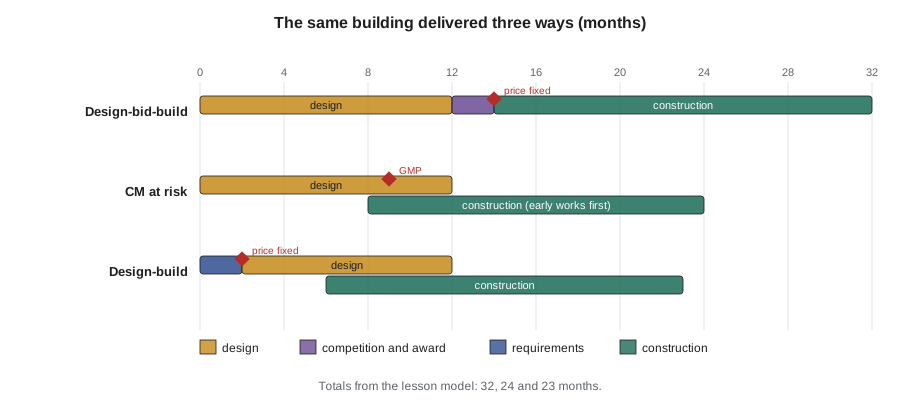
The model is deliberately simple, but it shows the size of the trade. With twelve months of design, two of bidding and eighteen of construction, design-bid-build takes thirty-two months. Starting the foundations early under a construction manager saves eight months; design-build saves nine, because the requirements phase replaces most of the design that would otherwise come before the price. For the Rail Yard Commons the city judged that the gain was not worth giving up the open competition and the firm price on complete documents. Instead it awarded an early, separate contract for removing the contaminated rail-yard fill and building the stormwater outfall, which shortened the main construction period without changing the method.
The architect's standard of care during construction
During construction the architect owes the owner the same standard of care as during design: the skill and judgment of a reasonably prudent architect in similar circumstances. It does not promise perfection, and the documents will contain some errors and omissions that even a careful architect makes. What the architect must do is respond to them promptly and fairly, correct its own errors without hiding them, and keep the owner informed. Courts and insurers look closely at how the architect handled problems once they were found: whether it answered questions in time, recorded its decisions, avoided taking control of the contractor's means and methods, and certified payments and completion on the basis of what it actually observed.
Thibodeau finishes the lesson with the three rules he gave every new member of his contract administration group. Read the contract before you go to site. Write everything down, in the form the contract names, on the day it happens. And never say yes on site to anything that changes the price, the time or the design without the owner's written authority.
Worked problem
Sorting a site conversation
During a site walk the drywall foreman asks Wren whether he can substitute a different steel stud gauge in the corridor walls, the electrical subcontractor asks whether a panel can move 2 ft to clear a beam, and Natarajan says she would like an extra data outlet in each classroom. How should Wren respond to each?
Show solution
- The stud substitution changes a specified product: ask the foreman to submit it through the contractor as a substitution request, with data, for review against the specification.
- The panel move may be a minor change that does not affect price or time: ask the contractor to submit an RFI with the proposed location, and answer it in writing after checking clearances.
- The extra outlets change the scope: tell Natarajan that the architect will request a price from the contractor through a proposed change, and that she will decide once the price is known.
- Record all three in the field report and confirm them in writing through the chain of communication.
Answer: Nothing is approved on site; each request goes into the channel the contract names for it.
Exercise 2: the preconstruction meeting
- Draft the agenda for the Rail Yard Commons preconstruction meeting, with a named owner for each item.
- Prepare a one-page chart of the chain of communication, including the subconsultants and the major subcontractors.
- Set up an RFI log with fields for the question, the documents affected, the dates asked and answered, and whether the answer changed the work.
- Write the paragraph of the minutes that records the rules for site visits, safety and access by the design team.
Self-check
- Do I know the limits of my authority under the contract?
- Will every instruction that changes the work go out in writing, through the chain?
- Have I avoided directing the contractor's means and methods?
- Could I explain to the owner why the method takes longer and what it gives in return?
Common mistakes
MistakeGiving instructions directly to a subcontractor on site.
InsteadCommunicate through the contractor, in writing, so the whole team knows.
MistakeApproving a change of scope because the owner's representative asked for it verbally.
InsteadObtain a price and the owner's written approval through the change procedure.
MistakeTelling the contractor how to sequence or carry out the work.
InsteadLeave means and methods to the contractor and comment only on conformance with the documents.
MistakeLetting RFIs sit unanswered.
InsteadAnswer within the agreed time, or say when the answer will come and why.
MistakeTreating an RFI answer that changes the work as a simple clarification.
InsteadIssue it as a change instruction so price and time are dealt with.
Summary and key terms
- Design-bid-build runs design, competition and construction in sequence, with a fixed price on complete documents.
- Its strengths are a fair competition, a known price and the owner's own architect on site; its weaknesses are time and late builder input.
- Under A201 the architect administers the contract as described in it and is not responsible for means, methods or safety.
- A strict chain of communication and written instructions protect the owner, the contractor and the architect.
- Requests for information are answered in writing, promptly, and any answer that changes the work becomes a change.
- Preconstruction meeting
- The first meeting of the construction team, which sets out roles, procedures and communication.
- Request for information
- A formal written question from the contractor about the documents, answered in writing.
- Chain of communication
- The route the contract sets for instructions and correspondence between the parties.
- Means and methods
- The techniques, sequences and procedures of construction, which are the contractor's responsibility.
- Standard of care
- The skill and judgment of a reasonably prudent architect in similar circumstances.
Practice problems
Work each problem on paper first, then reveal the answer to check.
Why does design-bid-build take longer than the other methods?
Show answer
Because design, the competition and construction run one after another and cannot overlap.
Who is responsible for safety on site under the standard general conditions?
Show answer
The contractor.
Where does the architect's authority during construction come from?
Show answer
From the contract, and only to the extent stated in it.
What should happen to an RFI answer that changes the price?
Show answer
It should be issued as a change instruction under the change procedure.
How did the city shorten construction without changing the method?
Show answer
By awarding an early, separate contract for the contaminated fill removal and the stormwater outfall.
Lesson quiz · 5 questions
Score 60% or more to complete this lesson.
Create a free account to save your progress, take quizzes and earn a certificate.