
ARCH-430 · Lesson 6 of 12 · 21 min
Scheduling
Three weeks after the contract is signed, Fairweather sends the contractor's baseline schedule for review: 214 activities, a start date in late March, a date for substantial completion eighteen months later and a red line through the activities that drive it. Thibodeau asks Ingrid to lead the review. She expects it to be a formality, and finds instead that the schedule shows the roofing finishing in late November, the envelope closed in December, and the interior trades working in an unheated building through January. 'A schedule is a promise and a plan,' Thibodeau says, 'and your job is to read it as both. Is it realistic, and does it tell you when the contractor will need things from you?'
Why schedules matter to the architect
The contractor owns the schedule. The general conditions require it to prepare a construction schedule, keep it up to date and complete the work within the contract time, and they leave the planning of the work to it as part of its means and methods. The architect does not approve the schedule in the sense of accepting responsibility for it. But the architect needs to understand it for three reasons. It shows when the contractor expects submittals to be reviewed, questions to be answered and decisions to be made, which sets the architect's own workload. It is the basis on which claims for extra time will later be judged. And it shows whether the owner's dates, for moving in furniture, training staff or opening to the public, are realistic.
A schedule is reviewed, then, for completeness, logic and realism, and for what it asks of the design team. Ingrid's review of the baseline produces a list: the submittal dates for the glulam and CLT shop drawings allow ten working days for review, while the specification allows fifteen; the curtain wall at the commons has no activity for its mock-up; the commissioning period before substantial completion is two weeks, too short for a building with ground-source heat pumps; and the roof finishing in November in Minneapolis puts the most weather-sensitive work at the worst time of year. She sends the comments to the contractor through the chain, worded as observations rather than instructions, because the sequence is the contractor's to set.
Bar charts and networks
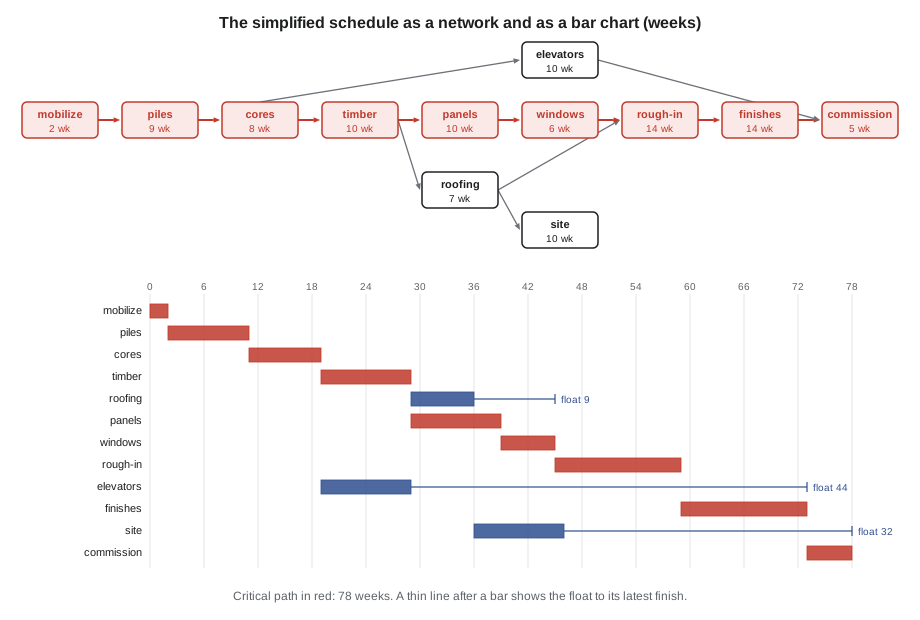
The simplest schedule is a bar chart, sometimes called a Gantt chart after the engineer who popularized it in the early twentieth century. Each activity is a bar along a time scale. Bar charts are easy to read and good for communicating, but they do not show why one activity follows another, so they cannot show what happens when something is late. The critical path method, developed in the late 1950s at the chemical company DuPont and the computer company Remington Rand, adds the logic. Each activity has a duration and a set of predecessors that must finish before it can start. From the logic and the durations, a calculation finds the earliest and latest dates for every activity and the longest chain of dependent activities through the project, the critical path. A delay to any activity on that path delays the whole project.
The calculation runs in two passes. The forward pass starts at the beginning and finds, for each activity, the earliest it can start, which is the latest of the early finishes of its predecessors, and the earliest it can finish. The backward pass starts at the end, from the project finish, and finds the latest each activity can finish and start without delaying the project. The difference between an activity's late start and its early start is its total float, the time it can slip without moving the finish date. Activities with zero float are on the critical path. The code below runs both passes for a simplified version of the contractor's schedule.
# Critical path method for a simplified Rail Yard Commons schedule (weeks).
acts = {  # activity: (duration, predecessors)
    "mobilize":              (2,  []),
    "piles and grade beams": (9,  ["mobilize"]),
    "concrete cores":        (8,  ["piles and grade beams"]),
    "timber erection":       (10, ["concrete cores"]),
    "roofing":               (7,  ["timber erection"]),
    "envelope panels":       (10, ["timber erection"]),
    "windows":               (6,  ["envelope panels"]),
    "services rough-in":     (14, ["roofing", "windows"]),
    "elevators":             (10, ["concrete cores"]),
    "interior finishes":     (14, ["services rough-in"]),
    "site and landscape":    (10, ["roofing"]),
    "commissioning":         (5,  ["interior finishes", "elevators"]),
    "substantial completion": (0, ["commissioning", "site and landscape"]),
}
es, ef = {}, {}
for a in acts:                                   # listed in a valid order
    d, pre = acts[a]
    es[a] = max((ef[p] for p in pre), default=0); ef[a] = es[a] + d
finish = max(ef.values())
lf, ls = {}, {}
for a in reversed(list(acts)):
    succ = [b for b in acts if a in acts[b][1]]
    lf[a] = min((ls[b] for b in succ), default=finish); ls[a] = lf[a] - acts[a][0]
print(f"project duration: {finish} weeks")
for a in acts:
    tf = ls[a] - es[a]
print(f"{a:23s} ES {es[a]:3d} EF {ef[a]:3d} LS {ls[a]:3d} float {tf:3d}{' critical' if tf == 0 else ''}")project duration: 78 weeks mobilize ES 0 EF 2 LS 0 float 0 critical piles and grade beams ES 2 EF 11 LS 2 float 0 critical concrete cores ES 11 EF 19 LS 11 float 0 critical timber erection ES 19 EF 29 LS 19 float 0 critical roofing ES 29 EF 36 LS 38 float 9 envelope panels ES 29 EF 39 LS 29 float 0 critical windows ES 39 EF 45 LS 39 float 0 critical services rough-in ES 45 EF 59 LS 45 float 0 critical elevators ES 19 EF 29 LS 63 float 44 interior finishes ES 59 EF 73 LS 59 float 0 critical site and landscape ES 36 EF 46 LS 68 float 32 commissioning ES 73 EF 78 LS 73 float 0 critical substantial completion ES 78 EF 78 LS 78 float 0 critical
The critical path runs through the piles, the cores, the timber, the envelope panels and windows, the rough-in, the finishes and commissioning: 78 weeks in this simplified version. The roofing has nine weeks of float, because the services rough-in also waits for the windows; the elevators have a large float, because they can be installed while the envelope and interiors proceed. The site and landscape work also has a large float, more than thirty weeks, which tells the owner that it can safely be scheduled for the spring after the building is closed in. A real schedule has many more activities and relationships, including partial overlaps, but the arithmetic is the same.
Weather, seasons and the order of the work
In a northern city the season shapes the schedule more than any other factor. Piles and foundations are best done before the ground freezes or after it thaws; concrete placed in cold weather must be protected and heated to reach its strength, under requirements in ACI 306 and the concrete specification; roofing membranes and sealants have minimum application temperatures; and interior finishing needs a closed, heated building. Mass timber helps, because it can be erected in cold weather and closes in a building quickly, but it must be protected from wetting, and the specification for the Rail Yard Commons limits the moisture content of the CLT before it is covered.
Ingrid's comment about the roof in November is therefore not about the contractor's competence but about risk. If the roofing slips by a month, it falls into December, when the membrane cannot be applied; the interior trades lose a closed building and the critical path moves. The contractor's answer, after a site meeting, is to resequence: the roof teeth at the east end are prefabricated with their membranes applied in the factory, the main roof is dried in with a temporary membrane by late October, and the permanent roofing finishes in spring, off the critical path. The baseline is revised, and the commissioning period is extended to five weeks at the same time.
Delays, extensions and float
Delays are inevitable, and the contract decides who bears them. An excusable delay is one the contractor could not reasonably foresee or avoid, such as an owner change, an act of the owner or the architect, labor disputes beyond the contractor's control, unusually severe weather or a stop-work order not caused by the contractor. The contractor is entitled to an extension of the contract time for an excusable delay that affects the critical path, and to compensation if the owner caused it. A non-excusable delay, such as late delivery of materials the contractor ordered late or a shortage of its own crews, earns no extension; the contractor must recover the time or pay the consequences. Many contracts also provide for liquidated damages, a fixed amount per day of late completion agreed in advance as an estimate of the owner's loss.
Under A201 the contract time is extended by change order for delays caused by the owner or the architect, by changes in the work, labor disputes, fire, unusual delay in deliveries, unavoidable casualties and other causes beyond the contractor's control, and the contractor must make a claim within the time the contract sets. Whether the contractor also recovers costs depends on the cause and on the contract terms. The owner and the contractor waive certain consequential damages, but liquidated damages, where the agreement provides for them, are not affected by that waiver.
Two harder questions arise often enough that the students should recognize them. The first is concurrent delay, when an owner delay and a contractor delay affect the critical path at the same time; the usual result is an extension of time without compensation, though contracts and courts differ. The second is who owns the float. If the owner's late decision uses up the float in a non-critical activity, has the contractor lost something? Many contracts and specifications state that float belongs to the project, available to whoever needs it first; others give it to the contractor. The architect should know which rule applies before the first delay arises.
Updates and look-aheads
The baseline is only the first version. The specification usually requires the contractor to update the schedule monthly, showing actual progress, the remaining durations and any changes to the logic, and to submit a narrative explaining what has changed and why. The architect compares each update with the baseline and the last update. A critical path that changes often, durations that shrink each month without explanation, or float that disappears are signs of trouble worth raising at the site meeting. Most contractors also issue a short-term look-ahead schedule each week or two, which shows the work planned for the next three to six weeks in detail. The look-ahead is where the design team learns which questions need answers next week.
Worked problem
Is the contractor entitled to more time?
In August the city asks for an extra classroom partition and data outlets on the upper floor. The change takes six working days of extra drywall and electrical work in an area whose activities have eight working days of float. In the same month the contractor's window supplier ships two weeks late. Is the contractor entitled to an extension, and for which delay?
Show solution
- The owner's change is an excusable, compensable delay, but it uses six days of an activity with eight days of float, so it does not move the critical path; the contractor is paid for the extra work but receives no extension.
- The late windows are the contractor's responsibility unless the delay was caused by something beyond its control; they sit on the critical path, so they delay the project, but they earn no extension.
- If the window delay was caused by a strike at the supplier's plant, it may be excusable and earn an extension without costs, depending on the contract wording.
- The architect should ask for the contractor's analysis, compare it with the updated schedule and decide in writing.
Answer: Only delays that move the critical path earn extensions, and only excusable ones; the owner's change is paid for but uses float.
Exercise 6: reviewing the baseline
- Review the baseline schedule supplied by the instructor against the specification's submittal review times, mock-ups and commissioning requirements.
- Identify the critical path and the three activities with the least float that are not on it.
- Mark every activity that depends on a design team action, and list the dates by which each must happen.
- Write the review comments as observations, not instructions, and send them through the chain.
Self-check
- Have I left the sequence of the work to the contractor?
- Do I know which delays earn extensions and costs under this contract?
- Have I checked the season of the weather-sensitive work?
- Do I know when the contractor needs each of my answers?
Common mistakes
MistakeApproving the schedule as if it were the architect's plan.
InsteadReview it and comment; the contractor owns it.
MistakeIgnoring the dates the schedule sets for the design team.
InsteadPlan the office's own work around them.
MistakeGranting an extension for any delay.
InsteadExtend only for excusable delays that move the critical path.
MistakeForgetting the season when reviewing a northern schedule.
InsteadCheck when foundations, roofing and sealants fall in the year.
MistakeAssuming float belongs to the contractor.
InsteadCheck the contract: float often belongs to the project.
Summary and key terms
- The contractor owns the schedule; the architect reviews it for logic, realism and what it asks of the design team.
- The critical path method finds the earliest and latest dates of each activity and the chain that drives the finish.
- Total float is the time an activity can slip without moving the finish date.
- Excusable delays that move the critical path earn extensions; owner-caused delays may also earn costs.
- Monthly updates and short look-aheads show whether the project is on track and what decisions are needed next.
- Critical path
- The longest chain of dependent activities, which determines the project duration.
- Total float
- The time an activity can be delayed without delaying the project finish.
- Excusable delay
- A delay the contractor could not reasonably foresee or avoid, which may earn an extension.
- Liquidated damages
- A fixed amount per day of late completion, agreed in advance.
- Look-ahead schedule
- A short-term schedule showing the next few weeks of work in detail.
Practice problems
Work each problem on paper first, then reveal the answer to check.
Why can a bar chart not show the effect of a delay?
Show answer
It does not show the logic linking activities, so it cannot show what moves when one is late.
How is total float found?
Show answer
As the difference between an activity's late start and early start.
In the code, why do the elevators have so much float?
Show answer
They can be installed while the envelope, rough-in and finishes proceed, and are needed only for commissioning.
What did the contractor change after Ingrid's comment on the roof?
Show answer
It prefabricated the roof teeth with factory membranes, dried in the main roof with a temporary membrane by late October and moved the permanent roofing to spring.
What is concurrent delay?
Show answer
An owner delay and a contractor delay affecting the critical path at the same time, usually giving time without compensation.
Lesson quiz · 5 questions
Score 60% or more to complete this lesson.
Create a free account to save your progress, take quizzes and earn a certificate.