
ARCH-430 · Lesson 10 of 12 · 21 min
Change orders
By the end of the summer the Rail Yard Commons has thirty-one open changes. Some came from the city: the extra data outlets in the classrooms, a security film on the commons glazing after a break-in at another branch, and a request to rough in a future kitchen exhaust for the café. Some came from the site: an old concrete footing from a rail-yard building found under the multipurpose wing, and a storm sewer at a different depth from the one on the city's records. A few came from the documents: a missing beam pocket at the stair, and a conflict between the electrical and timber shop drawings at the east core. Natarajan wants to know what they will cost in total and how much of the city's contingency is left. Callum wants to know which of them are his fault. Thibodeau tells the students that both questions deserve honest answers, and that the change procedure is designed to give them.
Why changes happen and who pays
Every building of any size changes during construction. The owner changes its mind or its needs; the site reveals what the investigation did not; the documents contain gaps and conflicts that only building them exposes; codes or authorities impose requirements late; products become unavailable. The contract gives the owner the right to change the work, within the general scope of the contract, and gives the contractor the right to an adjustment of price and time for changes it is instructed to make. Who ultimately pays depends on the cause. Owner-requested changes are paid from the owner's construction contingency. Unforeseen site conditions are usually paid by the owner too, under the concealed conditions clause. Changes caused by errors or omissions in the documents are paid by the owner to the contractor, because the contractor priced what the documents showed; the owner may then look to its architect if the error fell below the standard of care.
That last point is where Callum's question belongs. The missing beam pocket at the stair is a genuine omission: the stair stringer was moved late in the documents and the pocket was not updated. The conflict at the east core is less clear: the electrical engineer's drawings showed a conduit route through a zone the timber shop drawings later used for a connection, and the contractor's coordination of the shop drawings should have caught it. Thibodeau's advice is to separate the questions. First get the work priced and done, so the site does not stop. Then work out the cause, record it fairly, and discuss responsibility with the owner and, if necessary, the office's insurer, who should hear about any possible claim early.
The instruments of change
A201 provides a small set of instruments. The architect can order a minor change in the work, not involving an adjustment of price or time and not inconsistent with the intent of the documents, usually on AIA G710, the architect's supplemental instructions. When the owner is considering a change, the architect issues a proposal request, often on G709, describing the work, and the contractor responds with its price and its effect on the schedule. If the owner, contractor and architect agree, the architect prepares a change order on G701, which they all sign and which changes the contract sum, the contract time or both. If they cannot agree, or if the work must proceed before the price is settled, the owner and architect can issue a construction change directive on G714, which instructs the contractor to proceed and sets out how the price will be determined, such as by unit prices, an agreed lump sum, or cost plus a fee. The contractor must proceed with work under a construction change directive while the price is resolved.
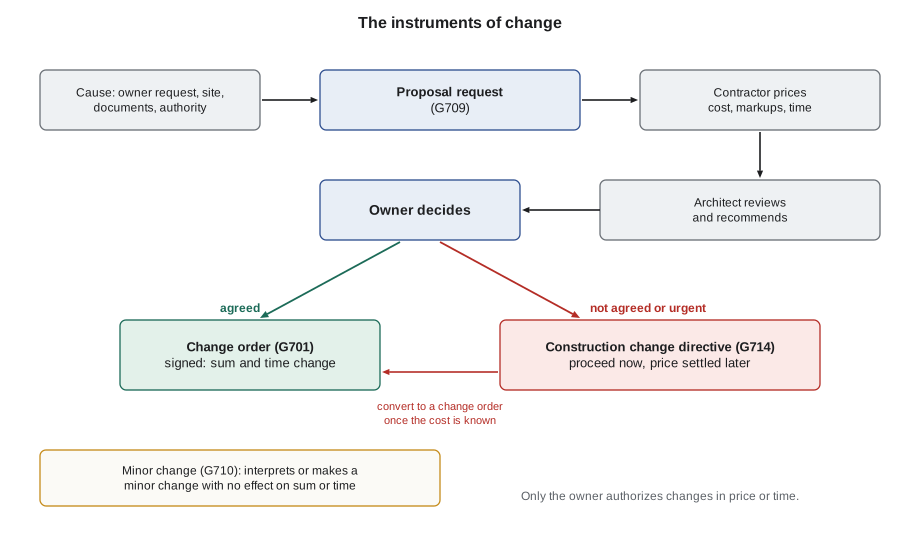
The instruments exist so that every change is authorized by someone with authority and recorded in a form that changes the contract. A change agreed on site by a handshake, or by an email between a superintendent and an engineer, is not a change to the contract; it is a future dispute. Contractors are entitled to refuse to do extra work without a written instruction, and well-run contractors do. The architect prepares and issues the instruments, but it does not authorize changes in price or time on its own: that authority belongs to the owner.
Pricing a change
A contractor's price for a change is built up from the direct cost of the work, which is labor, materials, equipment and subcontract prices, plus allowances for the contractor's overhead and profit, usually as percentages set in the supplementary conditions. The percentages commonly differ for work the contractor does with its own forces and for subcontracted work, on which the contractor adds a smaller markup to the subcontractor's price, which already includes the subcontractor's own markup. Many contracts also say how credits are priced: for a deleted item, the contractor returns the direct cost, and often the subcontractor's markup, but may keep its own. The contractor must also say whether the change affects the schedule, and if it claims an extension, show the effect on the critical path.
The architect reviews the price. It checks the quantities against the drawings, the rates against the cost plan, recent changes and market prices, the markups against the contract, and the time claimed against the schedule. Where the price seems high, it asks for a breakdown and discusses it with the contractor, and if necessary it prepares an independent estimate. It then recommends acceptance, negotiation or a directive to the owner. The review is not an adversarial exercise. A fair price promptly agreed keeps the job moving; a price beaten down unfairly comes back later as a claim.
# Price a change, check it against the contract markups and track the contingency.
markup_own, markup_sub, markup_on_sub_price = 0.10, 0.10, 0.05   # supplementary conditions
change = {  # Proposal request PR-14: remove the old rail-yard footing under the multipurpose wing
    "own forces labor": 18_400, "equipment": 9_600, "materials": 2_300,
    "subcontract: footing revisions": 41_000, "subcontract: concrete disposal": 6_800,
}
own = sum(v for k, v in change.items() if not k.startswith("subcontract"))
sub = sum(v for k, v in change.items() if k.startswith("subcontract"))
# The subcontractors' prices already include their own markup; the contractor adds 5%.
price = own * (1 + markup_own) + sub * (1 + markup_on_sub_price)
print(f"own work {own:,}  subcontracts {sub:,}  price {price:,.0f}")
claimed = 86_500
print(f"contractor claimed {claimed:,}: difference {claimed - price:,.0f}")

contingency = 0.06 * 15_720_000            # the city's construction contingency
approved = [("CO-03 data outlets", 38_200), ("CO-07 security film", 21_900),
            ("CO-09 storm sewer depth", 54_600), ("CO-11 beam pocket at stair", 7_400)]
used = sum(v for _, v in approved) + price
print(f"contingency {contingency:,.0f}  committed {used:,.0f}  remaining {contingency - used:,.0f}"
f" ({used / contingency:.0%} used)")own work 30,300 subcontracts 47,800 price 83,520 contractor claimed 86,500: difference 2,980 contingency 943,200 committed 205,620 remaining 737,580 (22% used)
The contractor's price for removing the old footing is about 3,000 dollars higher than the markups in the contract allow, because it applied its 10% to the subcontract prices instead of the 5% the supplementary conditions set. Fairweather accepts the correction without argument; the error was a spreadsheet formula. The second part of the output answers Natarajan's question. With this change, about 22% of the city's contingency is committed, a little under five months into a construction period of about eighteen. Thibodeau considers that healthy, but he warns that contingency is usually spent faster in the second half, when finishes, owner requests and closeout items arrive.
Directives and disputes
A change directive is a useful tool when the work cannot wait, but it has costs. Work done on actual cost requires records: daily sheets of labor hours and equipment, signed by the contractor and checked by someone on the owner's side, and invoices for materials. The architect or the owner's representative must keep those records current, because reconstructing them months later is difficult and invites disagreement. Directives also remove the contractor's incentive to work efficiently, since it is paid for what it spends. They should therefore be used sparingly and converted to change orders once the cost is known.
When the parties cannot agree on whether something is a change or what it is worth, the contract's claims provisions apply. A201 requires a claim within twenty-one days of the event or of first recognizing it, sends claims first to the initial decision maker, usually the architect, then to mediation, and then to arbitration or litigation as the agreement provides, while the work continues. The architect acting as initial decision maker must act impartially between the owner and the contractor, even though the owner is its client. Good records and a fair, prompt change procedure keep most disagreements from getting that far.
Managing changes as a whole
Individual changes are only half the picture. The architect keeps a change log that records each potential change from the moment it is identified, its cause, its status, its price and its effect on time, and reports the totals to the owner monthly against the contingency. The log reveals patterns: many changes from one discipline's documents, many owner requests from one department, or a run of unforeseen conditions in one part of the site. It also shows pending changes, which are often the largest risk to the budget, because their prices are not yet known. Natarajan asks for a forecast each month of the likely final cost of all changes, including those still pending, and the office provides it with a range.
At the end of the project the change log becomes a lessons-learned document. The causes of the changes, sorted and totaled, show the office where its documents were weakest and the owner where its process allowed late requests. Thibodeau's former office found, over several projects, that roughly a third of its document-related changes came from late design changes not fully carried through the set, which led it to add a 'change propagation' check to its quality control. For the Rail Yard Commons the missing beam pocket was exactly that kind of change.
Worked problem
Valuing a credit
The city decides to delete the exterior blinds at the commons and install them later under a separate contract. The blind subcontractor's price for the deleted work was 64,000 dollars, including its own overhead and profit. The supplementary conditions say that on deleted subcontract work the contractor returns the subcontract price but keeps half of its own markup. The contractor's markup on subcontract work is 5%. What is the credit?
Show solution
- The subcontract price of 64,000 dollars is returned in full.
- The contractor's markup on that price would have been 5%, or 3,200 dollars; it keeps half, 1,600 dollars, and returns the other half.
- The credit is 64,000 plus 1,600, or 65,600 dollars, recorded as a change order that reduces the contract price.
- The architect also confirms that the deletion does not affect other work, such as the blind brackets and their blocking, which must be deleted or kept by the same change.
Answer: The credit is 65,600 dollars, and the change order must also deal with the related work.
Exercise 10: the change log
- Set up a change log for the Rail Yard Commons with the fields described in this lesson and enter the changes listed by the instructor.
- Price two changes from the contractor's breakdowns, check them against the markups and write a recommendation for each.
- Classify every change by cause and calculate the share of the contingency committed and the forecast final total.
- Draft a change directive for work that cannot wait, with the method of pricing and the records required.
Self-check
- Is every change authorized in writing by someone with authority?
- Have I checked quantities, rates, markups and time for each price?
- Do I report pending changes and the forecast, not only approved ones?
- Have I recorded causes fairly, including my own errors?
Unforeseen conditions
The old footing under the multipurpose wing is a classic concealed condition. A201 allows either party to give notice promptly, before the conditions are disturbed and within twenty-one days of first observing them, if conditions differ materially from those indicated in the documents or from those ordinarily found in work of the kind. The architect must investigate promptly and, if the conditions differ materially, recommend an equitable adjustment of the contract sum or time. The investigation should start the same day, with photographs, measurements and a comparison with the geotechnical report and the city's records of the site. The question the architect must answer is not whether the condition was a surprise to the contractor, but whether a reasonable bidder reading the documents and the reports could have expected it.
Here the geotechnical report had warned of old foundations in general terms but showed none at this location, and the city's records placed the old building forty yards to the west. Thibodeau's office concludes that the condition differs materially and recommends the change. Had the report shown the footing and the documents told the contractor to remove it, the cost would have been in the contract price.
Common mistakes
MistakeAgreeing a change on site verbally.
InsteadIssue the proper written instrument, authorized by the owner.
MistakeHolding up work while a price is negotiated.
InsteadUse a directive when the work cannot wait, with records of cost.
MistakeHiding the architect's own errors in the change log.
InsteadRecord causes fairly and tell the insurer early about possible claims.
MistakeReporting only approved changes to the owner.
InsteadReport pending changes and a forecast of the final total.
MistakeAccepting markups that differ from the contract.
InsteadCheck them against the supplementary conditions.
Summary and key terms
- Changes come from the owner, the site, the documents, authorities and the market; the cause decides who ultimately pays.
- A201 uses minor changes, proposal requests, change orders and construction change directives.
- A change price is direct cost plus the markups set in the contract, with any effect on time shown on the schedule.
- Directives let urgent work proceed but need careful cost records and should be converted to change orders.
- A change log tracks causes, status and the contingency, and becomes a lessons-learned record.
- Change order
- A written agreement that changes the contract price, the contract time or both.
- Change directive
- A written instruction to proceed with a change before its price is agreed.
- Supplemental instruction
- An instruction that interprets the documents or makes a minor change without affecting price or time.
- Markup
- The allowance for overhead and profit added to the direct cost of a change.
- Contingency
- The owner's reserve for changes and unforeseen conditions during construction.
Practice problems
Work each problem on paper first, then reveal the answer to check.
Who pays the contractor for a change caused by a gap in the documents?
Show answer
The owner, who may then look to its architect if the gap fell below the standard of care.
Why can the contractor refuse extra work without a written instruction?
Show answer
Because only a written instrument authorized by the owner changes the contract.
What was wrong with the contractor's price in the code example?
Show answer
It applied a 10% markup to subcontract prices instead of the 5% the contract set.
Why should directives be converted to change orders?
Show answer
Because cost-plus work removes the incentive for efficiency and needs ongoing records.
What credit results from deleting the exterior blinds?
Show answer
65,600 dollars: the subcontract price plus half the contractor's markup.
Lesson quiz · 5 questions
Score 60% or more to complete this lesson.
Create a free account to save your progress, take quizzes and earn a certificate.