
ARCH-430 · Lesson 1 of 12 · 22 min
Project delivery methods
The Rail Yard Commons has a design, a set of documents and a budget. What it does not yet have is a builder, and the way the city chooses one will shape everything that follows: who carries which risks, when the price is fixed, how quickly the building can open and what the architect does on site. Professor Marcel Thibodeau has spent twenty-two years on that side of practice. He ran the contract administration group of a large Minneapolis firm for fifteen years and then became project director for a construction manager, so he has sat on both sides of the table. He opens the course with a blank sheet and three boxes, labeled owner, designer and builder. 'Every delivery method,' he says, 'is just a different way of drawing the lines between these three boxes, and a different answer to two questions: when is the price fixed, and who decides how the building is put together?'
This course follows the Rail Yard Commons from the close of the bid to its first year of use. The four students, Wren, Callum, Ingrid and Joon-ho, take turns as the architect's construction administrator on site, and the instructors bring in the people who run construction from the other side: an estimator, a site superintendent, the city's project manager, a building official and the engineers who commission the systems. The first four lessons step back to compare the delivery methods, so that the students understand why the city chose the one it did and what the alternatives would have changed.
Three relationships and two questions
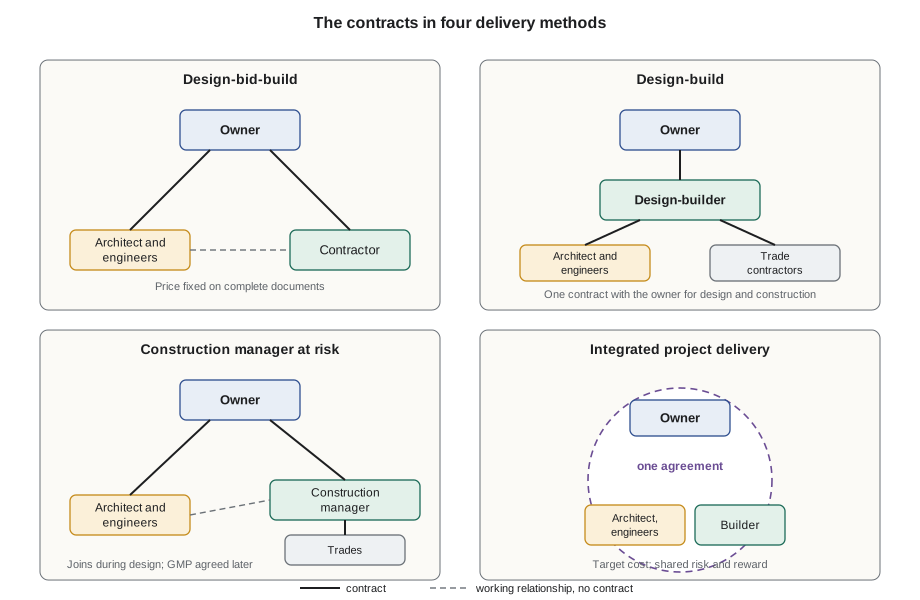
A delivery method is defined by the contracts it creates. In the traditional arrangement the owner holds two contracts, one with the design team and one with the builder, and the design team and builder have no contract with each other. In design-build the owner holds one contract with a single entity that both designs and builds, and the designers work for that entity. In construction management at risk the owner holds a design contract and a separate contract with a construction manager who advises during design and then builds the work for a guaranteed maximum price. In integrated project delivery the owner, the designers and the builder sign one agreement together and share risk and reward.
Thibodeau's two questions sort these methods quickly. The first is when the price becomes fixed. In design-bid-build it is fixed at the close of the bid, on complete documents. In design-build it may be fixed at the start, on a statement of requirements, or later, as the design develops. In construction management at risk it is fixed when the guaranteed maximum price is agreed, usually during design development or construction documents. In integrated delivery a target cost is agreed early and the parties share whatever is saved or overspent. The second question is who decides how the building is put together: the owner's designers, the builder, or both together. The answers decide who carries the risk of a gap in the design, of a rise in market prices and of a slow schedule.
The standard contract families
American owners usually work from the documents of the American Institute of Architects, though many public owners, the federal government and the ConsensusDocs coalition publish their own. In the AIA family, A101 is the agreement for a stipulated sum, A102 a cost plus fee agreement with a guaranteed maximum price, and A201 the general conditions that sit under both. A133 is the agreement with a construction manager as constructor, with a guaranteed maximum price, and A134 the cost plus version without one; the B-series agreements set the architect's services, with B101 the standard. A141 is the agreement between an owner and a design-builder, and A142 the agreement between the design-builder and its contractor. C191 is a single multi-party agreement for integrated project delivery. The architect's own agreement with the owner is usually B101, which the professional practice course covered.
The students should know these families well enough to read a contract and recognize which method it creates, because the architect's duties during construction come from them. In design-bid-build the general conditions give the architect a defined role: interpreting the documents, reviewing submittals, visiting the site, certifying payments and determining substantial completion. In design-build those duties shift, because the design-builder employs the designers, and the owner may hire its own adviser to watch over the work. In construction management the manager takes on scheduling, cost control and coordination that the architect does not do. Reading the contract before the first site meeting is the first habit of good contract administration.
Risk, control and speed
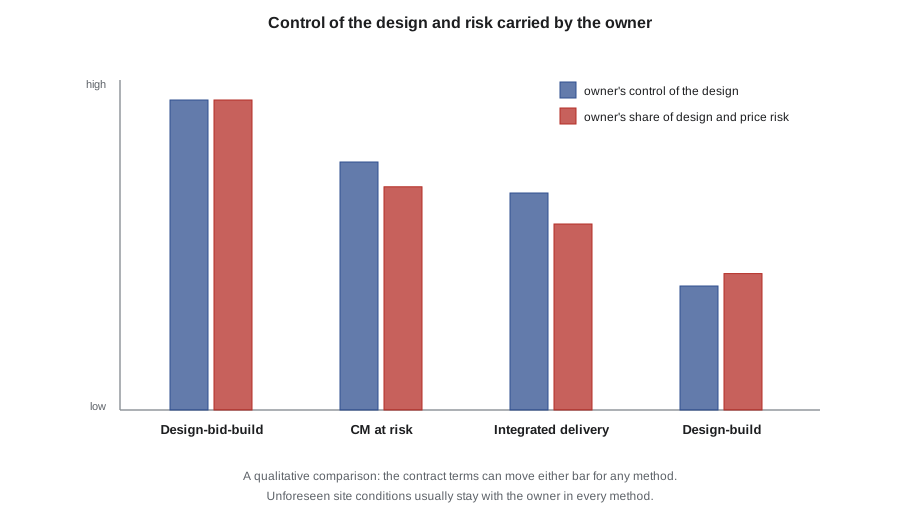
No method is best in every case. Each one trades control of the design against certainty of price and speed. Design-bid-build gives the owner full control of the design through its own architect and a firm price on complete documents, at the cost of time, since construction cannot start until the design is finished and priced, and at the cost of builder knowledge, which arrives only after the design is fixed. Design-build gives the owner a single point of responsibility and can save months by overlapping design and construction, but the owner gives up much of its control of the design once the contract is signed. Construction management at risk brings the builder's knowledge of cost, sequence and constructability into the design, and allows early packages such as excavation and foundations to start before the whole design is finished, but the price is not fixed until later and the owner must manage a more complex relationship. Integrated delivery aligns everyone's interests most closely, at the cost of a demanding contract and a culture that many firms are not yet ready for.
Risk follows control. The owner who controls the design carries the risk that the design is incomplete or wrong, because the builder is entitled to build what the documents show and to be paid for changes. The builder who controls the design carries that risk itself. Market risk, the chance that prices rise between the estimate and the purchase of materials and labor, falls on whoever fixes the price earliest: the design-builder who agrees a lump sum on a statement of requirements carries more of it than the contractor who prices complete documents. Unforeseen site conditions, such as the cinders and old foundations the geotechnical report warned of on the rail yard, are usually kept by the owner in every method, because no bidder can price them sensibly.
Public owners and the rules they work under
A public owner such as the City of Minneapolis chooses its delivery method within rules it does not set alone. State law requires open competition above set values, and for many years it allowed only design-bid-build for most public building work. Minnesota and other states have since authorized design-build and construction manager at risk for public owners under defined conditions, such as qualifications-based selection and published evaluation criteria. Design-bid-build remains common for buildings of this size because it is simple to run fairly and easy to explain to the city council, and the lowest responsible bidder rule is well understood. Public-private partnerships, in which a private consortium designs, builds, finances and often maintains the facility for decades, are used for some infrastructure but rarely for buildings like this one.
Across the industry the balance is shifting. A 2025 study of the American market by the consulting firm FMI put design-build at about 44% of construction spending in the segments it studied between 2019 and 2023, and forecast about 47% by 2028; other alternative methods, including construction management at risk and integrated delivery, accounted for much of the rest. Design-bid-build is no longer the majority method in many sectors, though it remains the default for many smaller public buildings in both countries. Thibodeau warns the students not to read these trends as a verdict: the right method depends on the owner, the project and the market, and a method chosen for fashion rather than fit causes more trouble than it saves.
Choosing a method for the Rail Yard Commons
Priya Natarajan, the city's facilities manager, joins the first class to explain the choice. The city had four goals for the project: a fair, open competition that council would trust; a firm price before construction began; control of the design, because the building had been shaped through months of engagement with the neighborhood; and an opening date tied to the start of a school year, with some flexibility. The design was well advanced when the delivery decision was made, and the city's own staff had long experience of running stipulated price contracts. The scoring below repeats the decision the city made, with weights taken from its own project charter.
# Score four delivery methods against the owner's weighted goals.
# Scores run from 1 (poor fit) to 5 (good fit) for each goal.
weights = {"open competition": 0.30, "firm price early": 0.25,
           "design control": 0.25, "speed": 0.20}
scores = {
    "design-bid-build":    {"open competition": 5, "firm price early": 4, "design control": 5, "speed": 2},
    "design-build":        {"open competition": 3, "firm price early": 4, "design control": 2, "speed": 5},
    "CM at risk":          {"open competition": 3, "firm price early": 3, "design control": 4, "speed": 4},
    "integrated delivery": {"open competition": 2, "firm price early": 2, "design control": 4, "speed": 4},
}
assert abs(sum(weights.values()) - 1) < 1e-9
results = {m: sum(weights[g] * s[g] for g in weights) for m, s in scores.items()}
for m, v in sorted(results.items(), key=lambda x: -x[1]):
    print(f"{m:20s} {v:.2f}")
# How much would the weight on speed have to rise before the answer changes?
for w_speed in [x / 100 for x in range(20, 61, 5)]:
    rest = 1 - w_speed
    w = {g: (weights[g] / 0.80) * rest for g in weights if g != "speed"}
    w["speed"] = w_speed
    best = max(scores, key=lambda m: sum(w[g] * scores[m][g] for g in w))
print(f"weight on speed {w_speed:.2f}: best = {best}")design-bid-build 4.15 CM at risk 3.45 design-build 3.40 integrated delivery 2.90 weight on speed 0.20: best = design-bid-build weight on speed 0.25: best = design-bid-build weight on speed 0.30: best = design-bid-build weight on speed 0.35: best = design-bid-build weight on speed 0.40: best = design-build weight on speed 0.45: best = design-build weight on speed 0.50: best = design-build weight on speed 0.55: best = design-build weight on speed 0.60: best = design-build
Design-bid-build scores highest because the city weighted open competition and design control heavily. The second half of the code asks a more useful question: how sensitive is the answer to the weights? It stays the same until the weight on speed rises past about 0.4, at which point design-build wins. Natarajan says the city did discuss a faster method when the opening date looked tight, and decided instead to start the site preparation as an early, separate contract. The point is not the number itself but the conversation it supports: a written, weighted comparison makes the owner say what it values, and it records why the choice was made.
Worked problem
Matching risks to methods
For each risk, say which party usually carries it under design-bid-build and under design-build: (a) a gap in the drawings, (b) a rise in timber prices after the price is fixed, (c) old foundations found during excavation.
Show solution
- (a) Under design-bid-build the owner carries it, because the contractor is entitled to build what the documents show and is paid for the change; the owner may then look to its architect if the gap falls below the standard of care. Under design-build the design-builder carries it, because the design is its own.
- (b) Under both methods the party that fixed the price carries it, usually the contractor or design-builder, unless the contract has a price adjustment clause for specific materials.
- (c) Under both methods the owner usually carries it through a concealed or unforeseen conditions clause, because the conditions could not reasonably have been known when the price was fixed.
Answer: The method moves design risk; market and site risks depend more on the contract terms than on the method.
Exercise 1: reading the contract
- Obtain the general conditions the city will use and list every duty they give the architect during construction.
- For each duty, note the clause, the time limit if one is stated and the document the duty produces, such as a certificate or a report.
- Draw the contract diagram for the Rail Yard Commons, including the subcontractors, the consultants and the city's own staff.
- Write one paragraph on how the list would change if the city had chosen construction management at risk.
Self-check
- Can I say when the price becomes fixed in each method?
- Do I know which contract gives me each of my duties on site?
- Have I separated design risk, market risk and site risk?
- Could I explain the city's choice to a member of the public in two sentences?
Common mistakes
MistakeAssuming the architect's duties on site are the same in every method.
InsteadRead the contract: the duties come from it, and they change with the method.
MistakeChoosing a method because it is popular.
InsteadChoose it against the owner's written goals, with the weights stated.
MistakeBelieving a lump sum removes all risk from the owner.
InsteadDesign gaps, changes and unforeseen conditions remain with the owner in design-bid-build.
MistakeTreating design-build as a way to save design fees.
InsteadThe design is still paid for; it is simply inside the design-builder's price.
MistakeIgnoring the procurement rules that bind a public owner.
InsteadCheck which methods the owner is allowed to use before recommending one.
Summary and key terms
- A delivery method is defined by the contracts it creates between owner, designers and builder.
- The two key questions are when the price is fixed and who decides how the building is put together.
- A101, A102, A133, A141 and C191, with A201 general conditions, cover the main methods in the AIA family; the architect's agreement is usually B101.
- Each method trades control of the design against certainty of price and speed, and risk follows control.
- Public owners choose within procurement rules, and a weighted comparison records why a method was chosen.
- Delivery method
- The arrangement of contracts and responsibilities by which a building is designed and built.
- Stipulated price
- A fixed price for defined work, called a stipulated sum in A101.
- Construction manager at risk
- A builder who advises during design and then builds the work for a guaranteed maximum price.
- Design-build
- A method in which one entity contracts with the owner to both design and build the project.
- Integrated project delivery
- A method in which owner, designers and builder sign one agreement and share risk and reward.
Practice problems
Work each problem on paper first, then reveal the answer to check.
Name the two questions that sort delivery methods.
Show answer
When is the price fixed, and who decides how the building is put together?
In design-bid-build, who usually carries the risk of a gap in the drawings?
Show answer
The owner, who may then look to its architect if the gap falls below the standard of care.
Why do owners usually keep the risk of unforeseen site conditions?
Show answer
Because no bidder can price conditions that could not reasonably be known, so transferring them would only add a large contingency.
What can construction management at risk do for a schedule that design-bid-build cannot?
Show answer
Start early packages, such as foundations, before the whole design is finished, with the builder's advice.
In the scoring example, what weight on speed changes the answer?
Show answer
A weight above about 0.4, at which point design-build scores highest.
Lesson quiz · 5 questions
Score 60% or more to complete this lesson.
Create a free account to save your progress, take quizzes and earn a certificate.